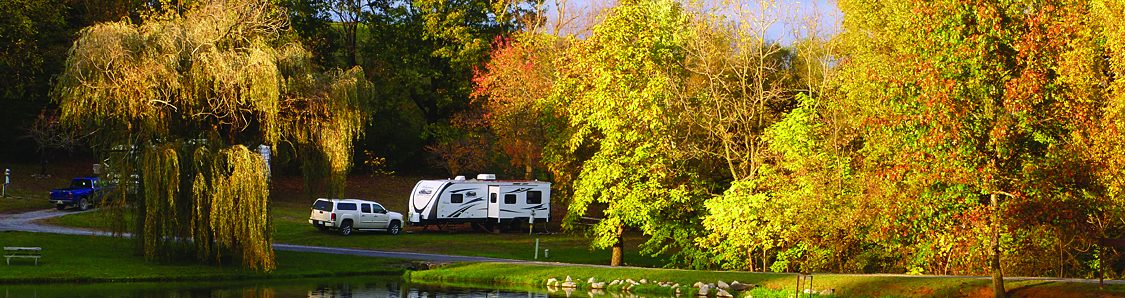
When it comes to attending an evangelical Christian camp in Monterey, Massachusetts, the question naturally arises: what would Jesus do? And the answer, as affirmed this week by the state’s Supreme Judicial Court, is that he’d camp in an RV, even if the town’s zoning bylaws prohibit everyone else from doing so.
This spiritual one-upmanship caps a four-year legal battle that began in 2019 after Hume New England, the East Coast home of Hume Lake Christian Camps, sought planning board approval for 12 RV full hook-up sites despite a town-wide ban on trailer and mobile home parks. The “camping ministry” was seeking to expand its capacity from more than 300 beds to 500, and wanted to supplement its lodging with RV sites; a draft master plan showed that the RV park could eventually grow to 44 sites. When the planning board denied the application, citing the clear language of its zoning regulations, Hume cried foul and filed a lawsuit.
The RV park, Hume argued, is part of its “religious purpose” and would assist the ministry “in furthering our mission of experiencing Jesus in the camp environment,” which apparently is something Jesus would have encouraged.
Monterey, a small town of about a thousand residents in the southwest corner of the state, argued in response that there is nothing inherently religious about an RV park, but that Hume was simply looking for a cheaper alternative for housing volunteers, staff and campers. There was nothing preventing Hume from building additional dormitories, planning board members pointed out—and indeed, one such project had been approved after the RV disagreement flared up. Although religious organizations should be free to practice how they wish, one board member averred, that freedom should not “negate all the zoning laws” that the town’s residents had established to preserve the character of their community.
But that argument did not prevail with the state’s highest court, which concluded that the RV park would be exempt from zoning restrictions under a Massachusetts law known as the Dover Amendment. Designed to prevent religious discrimination, the law limits a municipality’s ability to “regulate or restrict the use of land or structures for religious purposes . . . on land owned or leased by . . . a religious sect or denomination.” The religious purpose exception, the court observed, covers anything designed to “aid a system of faith,” and while the proposed RV park is not intrinsically religious, the court concluded that it would facilitate the camp’s religious purpose.
The irony, of course, is that a law to prevent religious discrimination is being applied in this case to create religious exceptionalism. Thanks to the Supreme Judicial Court’s ruling, the only people in Monterey allowed to operate an RV park will be Christian fundamentalists—unless Monterey says to hell with it and voids that particular zoning regulation altogether, which would amount to giving Hume an outsized policy-making role in the town.
Rubbing salt into the wound, Hume’s religious status already provides it with other benefits not available to local residents. As select board member Susan Cooper pointed out in a newspaper interview in March, Hume neither pays local taxes nor makes payments in lieu of taxes, which some tax-exempt entities make to their host communities. And because the campground will be accessed by a public dirt and gravel road that was not designed for RV traffic, “I think this small town might end up having to pay to do a lot of work on that road,” she said. “They’re basically using our resources and not giving anything back, from my perspective.”
The court decision, meanwhile, seems to open the door for an anything-goes approach to additional developments at Hume New England and any similar, ostensibly religious facility in Massachusetts. As summarized by a National Law Review article Monday, “The court took the broad view that if the land or structure is used for the purpose of carrying out its religious goals and to serve a religious purpose, the use itself can be secular in nature and can be deemed an exemption under the Dover Amendment.” Which, in effect, means it’s open season in Massachusetts for the Jesus crowd, even if that doesn’t sound very Christian.
Most recent posts
- It’s been fun. Now I’m moving on.
- Feds go after reservation algorithms
- Having wheels no guarantee of safety
- Oregon a hellish RV epicenter
- A handful of updates on past posts

 Renting Dirt
OMG !
LikeLike