For RVers, the outdoors is a war zone

Tornado aftermath May 26 at the Lake Ray Roberts Marina RV Park, just north of the Dallas-Fort Worth area.

One of the more insipid refrains the RV park and campground industry is prone to repeating is that it’s in the business of “creating memories.” These days, alas, those memories may start convincing a growing number of RVers that there has to be a better way to spend their vacation time.

The Memorial Day weekend was notable for tornados that essentially wiped out at least two RV parks, in Texas and Oklahoma, but at least three other campgrounds preceded them this year alone: Florida Caverns RV Resort, hammered in January; an RV park east of Madison, Indiana, blasted by an EF2 tornado in mid-March; and a campground at Hanging Rock in southern Ohio in early April that also got thumped. All sustained serious damage, but the violence this past weekend took matters to a whole new level.

At the Will Rogers Downs KOA in Claremore, northeast of Tulsa, an EF2 twister slammed into a campground that had 146 occupied sites, converting an Airstream trailer into a silver bullet that flew the length of a football field, flipping large motorcoaches and tearing apart travel trailers. That same Saturday, 220 miles to the south-southwest, an EF3 tornado made mincemeat out of the Lake Ray Roberts Marina and its 47-site RV park, just five years old, leaving a half-mile-long debris field. That no one was killed at either campground was simply a matter of luck: both twisters hit at night, with campers given no advance warning. And while the Oklahoma park has a storm shelter, not everyone managed to reach it in time.

May tends to be peak tornado season, with such storms declining in frequency through June and into July. But that doesn’t mean the danger they pose is entirely over—and as their threat diminishes, their big cousins are just stepping up to the plate. Hurricane season typically runs from June 1 to Nov. 30, and aside from being themselves a significant threat to coastal areas and as much as 200-300 miles inland as far north as Maine, hurricanes also can spawn tornadoes. Meanwhile, 2024 promises to be one of the most active hurricane seasons on record, with the National Oceanic and Atmospheric Administration forecasting eight to 13 hurricanes, including four to seven “major” hurricanes, with winds of 111 mph or higher.

None of that sounds like picnicking weather, nor does the less dramatic but even more deadly cause of all that turbulence, a rapidly warming atmosphere above and oceans below. Heat-related deaths have been rising steadily since 2014, and the number of extreme heat days in some states is now five times higher than 40 years ago. So the American southwest, while relatively safe from tornados and hurricanes, actually kills far more people than either of those headliners simply by baking them to death. Phoenix last year had 54 days when temps hit 110 or more; Maricopa County, which includes Phoenix, had 645 heat-related deaths in 2023.

(Pity poor Houston, which gets a triple whammy of hurricanes, tornadoes and excessive heat: this past weekend it broke all records by registering a heat index of 115 degrees. In May.)

Given the above extremes, it’s hard to think of a more inappropriate shelter in which to confront the elements than an RV. These boxes on wheels become ovens in a heartbeat if they lose power with which to run their air conditioners, and they’re far more vulnerable than most housing to the baseball-sized hail that’s seemingly ever more common throughout the South and Midwest. Staple-and-glue construction techniques used to assemble cheaper rigs, be they travel trailers or class Cs, guarantee they’ll crumple or fly apart under even a moderately vigorous shaking. And even the most solid fifth-wheels or motorcoaches present sail-like silhouettes to winds strong enough to flatten commercial buildings, never mind dwellings that have only four unanchored points of contact with the ground.

Yet despite these obvious and growing vulnerabilities, the RV industry does nothing to alert the public to the heightened risks it takes when camping in certain areas at certain times. Indeed, it has been positively euphoric when announcing in recent weeks that 45 million Americans “are gearing up for RV adventures this summer,” with an industry chief marketing officer crowing that RVing “offers a unique combination of freedom, adventure and value” and an opportunity to . . . wait for it . . . “create unforgettable memories.” Indeed. Matt and Anna Conners, quoted in numerous news stories, undoubtedly will long remember the night they had to pound on the doors of a storm shelter at the Will Rogers Downs KOA to escape the tornado that flipped their Coachmen Class A.

But it’s not just campers who are being led down the primrose path—so are campground owners, who tend to be blasé about the risks they face, dismissive of climate change warnings and oblivious to how quickly the overall weather outlook is deteriorating. The Lake Ray Roberts Marina RV park, which as mentioned above was opened a mere five years ago, lies just north of Denton, Texas, and right at the base of the area with the highest average number of tornadoes per year, as indicated on the map below. That apparently didn’t dissuade anyone from building the campground, and apparently wasn’t ominous enough to prompt the CYA construction of an underground storm shelter.

Meanwhile, as I wrote earlier this month, a similar indifference to facts on the ground has enabled ongoing planning for a $2 billion-plus amusement park and RV park with more than 1,000 sites and cabins in northwest Oklahoma—just at the edge of that deep maroon blob in the middle of the map. How different is that from building a tourist attraction on the lip of a dormant but not extinct volcano?

The problem is not that people with too much money and not enough sense are indulging in such follies, but that their willingness to do so creates a misleading sense of normalcy for other people who are just looking to have a good time—or even, heaven help us, who are hoping to “create memories.” Some significant portion of them will get more than they bargained for.
Why would any RVer pay Frank Rolfe?

Frank Rolfe, with an assist from his sidekick, Dave Reynolds, is at it again, trying to cash in on the RV park acquisition craze by passing himself off as an expert on something about which he knows squat.

To be clear, Rolfe does have a lot of expertise in the trailer court/mobile home park industry. He’s garnered quite a reputation for buying up trailer parks and then squeezing his captive tenants for every last dollar, while also slashing amenities and maintenance to the bone—then selling his cut-throat tactics as nothing more than good business. That selling comes in the guise of something he unabashedly calls the Mobile Home “University,” which in fact is nothing more than a slew of CDs and printed manuals that explain how you, too, can rationalize predatory practices on the way to personal enrichment.

Okay. Repulsive though that may be, it nonetheless falls squarely within the parameters of modern capitalism, and the devil take the hindmost. But where Rolfe steps over the line is in his blurring of the differences between trailer parks and RV parks, contending that the latter are just a variation on the former and that both can be managed according to the same principles. (I’ve been repeatedly critical of this bait-and-switch in the past, but to be honest, the RV park industry has done itself no favors by increasingly converting transient sites into long-term rentals, not to mention its embrace of cabins, park models and other fixed dwellings.)

While Mobile Home University remains Rolfe’s flagship, he’s again touting its slighter sibling, the equally hubristic RVPark University. This past week he sent out an email-blast promoting an “RV park investing boot camp,” which from all appearances is just an online presentation of material that’s already contained in the “university’s” home study course. There is no boot “camp,” and as it happens, the CDs and printed materials in the home study course can be purchased on RVU’s website for just $497 (or $397 for an electronic copy); watching the boot camp, meanwhile, requires “an investment” of $997. You do the math. Then again, Rolfe claims that the materials in the home study course actually have a total value of $4,688, so any way you slice it you get a heckuva deal!

(You also can count yourself lucky not to be interested in mobile home parks: that online “investing boot camp” will set you back $1,749. Where do all these numbers come from? Apparently, it’s all a matter of what the marks can be convinced to shell out.)

But back to RV parks. Part of Rolfe’s sales pitch is a helpful section headlined “Why Invest in RV Parks?” followed by eight bullet points of varying truthfulness and questionable assertions. Among them, for example, is “low capital expenditure requirements,” explained with the notable phrase, “RV parks are—for the most part—just blocks of land that people park their RVs on.” Oh, sure, “there are other amenities such as clubhouses and pools,” Rolfe concedes, “but what’s lacking are sprawling time bombs of maintenance like roofs and foundations.”

All of which lets me know that Rolfe has never had to fix a broken water main, or snake out a sewer line clogged by RVers insistent on flushing wipes, or repair a pedestal laid low by an errant fifth-wheeler. And with average per-site RV park construction costs approaching $25,000, there clearly are a lot more capital expenditures going into an RV park than Rolfe understands, not to mention all the maintenance issues they will incur.

There are several other howlers of the sort in Rolfe’s pitch, but the one that really illustrates his cluelessness—and that attests to his utterly contemptuous approach to mobile home park management—is the sub-head, “low reliance on personnel.” As Rolfe notes, correctly, “owning a business that relies heavily on employees is becoming a nightmare,” but not to worry! As Rolfe goes on to explain, “The RV Park industry is basically a ‘parking lot’ model in which the customers park their RVs on your land and that’s what you get paid for. It’s not like trying to run a restaurant where just one weak link on your employee base can ruin your business.” Easy-peasy—when it comes to RV parks, no employees required!

Again: clueless. Completely. Because while Rolfe’s description may be apt for a (poorly maintained) trailer court, an RV park that isn’t given over entirely to year-round or seasonal campers is going to need at least some maintenance workers, not to mention desk clerks and housekeepers, plus activities directors, swimming pool attendants and assorted other personnel as those “other amenities” proliferate. But that hasn’t prevented Rolfe from repeatedly representing himself as some sort of authority on RV parks, subbing in his experience as a trailer park mogul to mask his ignorance. In that regard, for example, it’s telling that all of the glowing evaluations and testimonials that litter both “university” websites relate solely to motor home parks.

At a time when mainstream RV park leaders are in a full-throated embrace of their self-assigned role as “the hospitality industry,” with its emphasis on personal connections and personnel training, Rolfe sits at the other extreme. It’s an interesting bifurcation, problematic at both ends. But the Rolfe end of that spectrum, while seeming to offer a cheaper, more streamlined operating model, is a sure-fire guarantee of bad press, bad reviews and bad feelings. Caveat emptor, whether it’s $397, $497 or $997.

You say tomah-to, I say . . . cabbage?

A Class C by any other name is neither a fifth-wheel nor a motorhome—unless you write for Rolling Stone.

It’s the little things.

The RV Industry Association regularly cranks out an email blast, called “News and Insights,” in which it promotes various aspects of the RVing business—upcoming lobbying efforts, various new products or services, RVing research of one kind or another. It also provides summaries and links to other sources that have said or written something to its liking, such as today’s suggestion that readers “take a look” at a recent Rolling Stone article, “From Road trips to Staycations, Here’s Why RVshare Is Our Go-To for Festival Camping.”

Wow. So this is why Rolling Stone has tumbled into obscurity.

It’s pretty clear that Tim Chan, who wrote this puff piece, found himself a nifty way to score a posh free stay while attending the Stagecoach music festival, held in April near the Coachella Lakes RV Resort. But you’d think that he’d at least do a little homework before cranking out such a thinly disguised advertorial. Instead, he liberally stroked RVshare, which presumably arranged and paid for his digs; gave a quick shout-out to “Al,” who not only provided the RV but also delivered it from Temecula, set it up, and then packed it up when Chan was done jamming out to Post Malone and Miranda Lambert; and repeatedly assured his readers how swanky RVs have become.

“That image of a run-down trailer with creaking parts and dusty furniture?” he wrote. “Consider that a relic of the past, and RVshare [stroke, stroke] a leader in the future of travel.”

Well, yeah—if what you’re staying in is “a luxe, 43-foot fifth wheel camper,” with electric fireplace, massage chairs and a master bathroom with his-and-her sinks. Or as Chan also raved, “While RVs often (unfairly) have a reputation of being pedestrian and basic, this was glamping at its finest, and we were spoiled with more space and amenities that [sic] we could have imagined.” Which is like staying at the Palms Casino Resort in Las Vegas and concluding that Motel 6-type accommodations are so ‘Fifties.

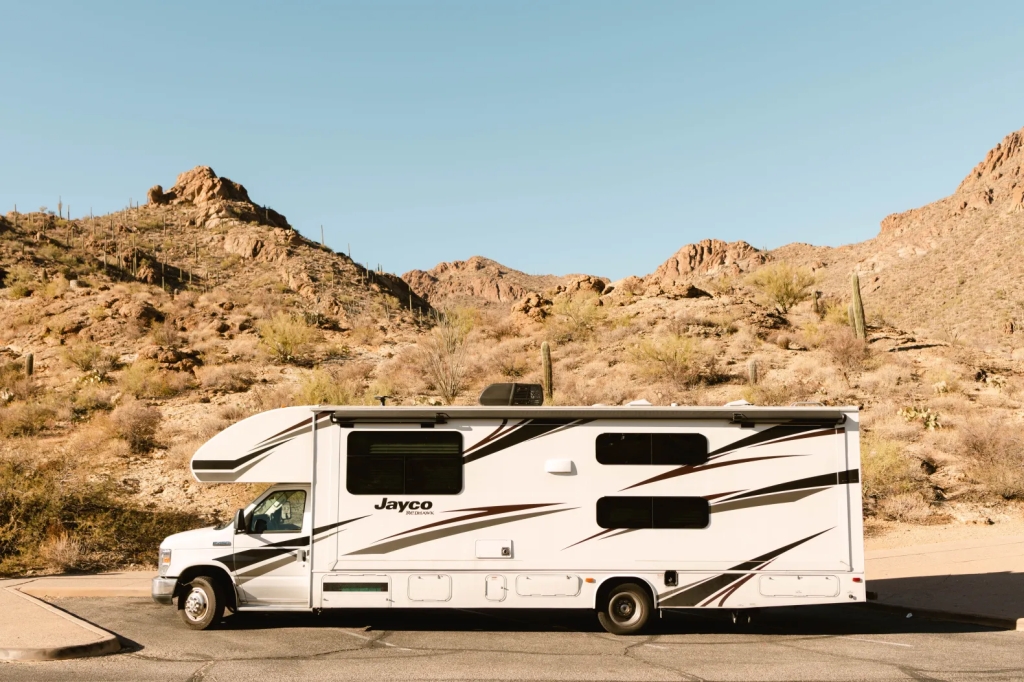
Well, we think Chan stayed in a 43-foot fifth-wheel. His article led off with a photograph of a Jayco Class C (above), which is neither a fifth-wheel nor 43 feet long. He then wrote about having his “motorhome” delivered to the resort, in the next breath describing how Al “was quick to walk us through the trailer settings.” The article wasn’t long enough to throw in truck campers, Class Bs or pop-ups as additional points of confusion, but be forewarned about reading any Chan reviews of automobiles, athletic equipment or electronic gear—it’s all pretty much a blur of undifferentiated products to him.

So why would RVIA highlight this particular piece of froth? Perhaps because Chan’s money graph focused on one of RVIA’s current obsessions, the upcoming travel season and why RVs ostensibly are the most economical way for families to vacation. Indeed, the same RVIA “News and Insights” includes a lengthy nod to the association’s ongoing fiction that “family RV travel to some of the country’s top vacation spots costs an average of 60% less than traditional travel methods.” Although that claim is based on a deeply flawed “study” that I dissected last year, RVIA continues to trumpet its findings as gospel—and is equally ready to repeat even the most sophomoric accounts that seem to bolster its assertion.

In Chan’s money graph, that comes with his observation that “If you’re staying in a hotel, those days and nights can add up, but the average rental price on RVshare.com is only about $150 a night.” Besides the imprecision of that comparison (“add up” to how much?), a “luxe, 43-foot fifth wheel” is going to be on the high end of whatever range produces a $150 average. Apples and oranges. Then there’s the unstated costs of having your RV delivered and set up, as well as site rates that at Coachella Lakes start at $120 a night. That’s not to say it’s not all worth it, but Chan’s lack of transparency about these (and possibly other) costs simply plays into RVIA’s hollow narrative.

RVing can still be a relatively affordable way to travel and vacation, although it’s taking a lot more work than was needed even five years ago. But that’s not going to happen by using 43-foot fifth-wheels (or motorcoaches or whatever) or five-star resorts as points of reference, and any comparisons to other travel options can be highly problematic. RVIA’s readiness to embrace so shallow a piece of reporting as the Rolling Stone story to bolster its claims of affordability, alas, smacks either of carelessness or desperation.

It’s the little things, rubbing you the wrong way, that eventually become a pus-filled blister.

Industry-wide blacklist in the works

Operating an RV park and campground—indeed, running any kind of customer-service business—has never been easy, but in recent years has become a whole lot more unpleasant. Just as our political interactions have become more brutish, so too have our commercial and cultural spheres, increasingly marred by entitled customers with socially oblivious demands and expectations. More and more people want what they want, when they want it and without regard for how that might affect anyone else.

Bad behavior has always been a problem to some extent, of course. When we bought our campground, in 2013, we were shocked to learn how cavalierly some people would treat our property—a campground into which we had sunk every bit of personal wealth and income, not to mention our sweat and dreams. Our customers stole showerheads, fire extinguishers and hanging plants. They would chop down live trees for firewood, drive their RVs across lawns and other sites as a shortcut, dump their trash into our fire rings. Our rental cabins were used to turn tricks and deal drugs, “stealth” campers would show up late and leave early without checking-in or paying, and our efforts to enforce basic rules would prompt scathing, one-sided reviews on social media sites.

Eventually we learned to take it all in stride, recognizing that the bad actors were just a tiny sliver of the camping public, albeit with an outsized impact on our facilities and good humor. But we also realized that we had a right to protect ourselves, and so after our first year we started compiling a blacklist of campers who had abused out staff or property and who under no circumstances were allowed to return. Desk clerks were given a list of prohibited customers, our reservation system was programmed with names that would be refused a reservation, and in most cases I would follow up with a letter advising the offenders that they would spare themselves the embarrassment of being turned away by not returning.

Eventually, our blacklist grew to more than a hundred names. And while it didn’t entirely cure the problem—there’s a never-ending supply of fresh jerks available—it made a significant dent, most notably among repeat offenders from the local population.

Given all of the above, you might think I’d enthusiastically endorse this past week’s introduction of MayiStay, an “RV renter rating app empowering park owners with anonymous ratings, searchable database, and customizable criteria.” And indeed, there’s definitely a need for something of the sort, some way for RV park owners to screen out the vandals, rule-breakers and snowflakes who think the world should cater to their every whim. If campground owners have to grit their teeth when unfairly assaulted on Google Reviews or Trip Advisor, why shouldn’t they have an equal opportunity to assail their malefactors?

As MayiStay points out, bad guests can do more harm than just property damage, hurting a park’s reputation and causing an immeasurable loss of business. Among the top ten complaints it cites that lead to a loss of return business: loud parties and gatherings, dog poop, dogs off-leash, trash, parking on the grass, not checking out on time and camping on the wrong site. “The best way to avoid these problems is by stopping potential troublemakers before they even sign a site agreement,” the MayiStay website observes. “But how can you tell who will be a problem when they seem so nice? That’s where our secret sauce comes in!”

And that’s also where the script gets flipped so completely that it invites a different kind of abuse. Because what MayiStay offers is a new kind of cartel, one that doesn’t fix prices but which comports with the more historical definition of “a coalition or cooperative arrangement intended to promote a mutual interest.” MayiStay’s “secret sauce” is to provide campground owners with a platform to share anonymous evaluations of campers with each other, “ensuring that you can make informed decisions without causing any awkwardness”—that is, without alerting the campers themselves and possibly ticking them off.

Or as this new venture would have it, “With MayiStay, you can provide honest opinions about a guest without fear of retaliation or backlash. The platform ensures that your feedback remains impartial and accurate. . . . MayiStay’s powerful search feature lets you dig into a guest’s history, revealing any red flags that might indicate they’re a potential problem.” The whole process, it concludes, “allows you to use multiple criteria to zero in on potentially troublesome guests, ensuring you can filter out undesirables.”

Well, yeah—that bit about “undesirables” is always Big Brother’s go-to line, excusing all kinds of oppressive behavior. But when it’s done on the QT, with the “undesirables” ignorant of the fact that their behavior is being monitored, recorded in a secret file and then shared anonymously with others, any concept of accountability is out the window. Campground owners are just as capable of personal vendettas or going off the rails as are campers, claims that their feedback “remains impartial and accurate” notwithstanding. And while campers spilling their bile on social media sites do so publicly, MayiStay is a sub rosa operation whose targets may never learn they’re on a potentially industry-wide blacklist and who will never have an opportunity to correct misstatements.

MayiStay’s rationale that campground owners can honestly appraise their guests only in secret, so as to avoid “retaliation or backlash,” speaks to the temper of the times: these are not idle fears when people increasingly are prone to becoming violent when feeling “disrespected.” But it’s also in jarring contrast with all the increased chatter about how campgrounds and RV parks are in “the hospitality industry,” which evokes grace and service rather than a Kafkaesque dystopia.

At the very least, RVers and campers who end up in MayiStay’s data bank should be informed of that fact, as well as be given a chance to review what’s been said about them and to present their version of events. But that’s not going to happen, of course. That would be too “awkward.”

What convertibles tell us about RVing

The Hustle’s curiously disturbing yet apt photo illustration.

Earlier this month The Hustle, a daily online “brief on business & tech news,” published an article by freelance journalist Mark Dent under the headline, “Why Americans stopped buying convertibles.” Turns out, he might have been writing about a lot more than just cars.

The convertible in Dent’s case was a 2004 Ford Mustang he bought in 2010, when U.S. ragtop sales had already swooned by more than half from just a few years earlier, to around 140,000 annually. That slide only continued in the years to follow, to approximately 70,000 in the 12 months through this past February, and convertibles now account for just 0.6% of all vehicle sales. If that strikes you as unsustainable, you’re right: indeed, the sedans and coupes on which convertibles are based are themselves being pushed toward extinction, displaced by SUVs—and SUV makers that tried to sell a convertible model, like Nissan’s crossover Murano or Land Rover’s Evoque, were quickly shown the folly of their ways.

“Americans spoke with their wallets,” Dent observes. “They didn’t want the open air.”

“They didn’t want the open air” says a great deal about more than just cars, although that’s a good place to start. Cars once signified freedom and the opportunity to strike out into an unknown and mysterious landscape, and convertibles cranked up the feeling of unbridled exploration by exposing their drivers to sun and wind and roadside sounds. But no more. Rather than an emotional rush, today’s car owners want technology and a cocooned experience that shields them from the world they’re navigating, with heated seats and GPS navigating systems. Or as Dent also writes, wistfully, “We’re losing the messy, hair-flowing-in-the-wind version of the American Dream to something climate-controlled and closed off to the world.”

So, too, with camping in general and RVing specifically, recreational pursuits with a split personality vacillating between “open air” on one hand and an air-conditioned cocoon on the other. Millions of dollars are spent designing, building and promoting overlanding vehicles to entice would-be campers with the same fantasies that once beguiled American car buyers to hit the open road, preferably in a convertible, but the emphasis remains on how well these technological marvels can duplicate all the comforts of home. You, too, can strike out for the most remote wilderness, but with massive water tanks and solar panels to ensure weeks of comfort and enough juice to power satellite phones so you’re never truly disconnected.

Millions more, meanwhile, are spent defanging and insulating the great outdoors to lure “travelers” who never thought of themselves as campers and who wouldn’t dream of leaving a paved highway, but who fancy themselves as having intrepid personalities. By blurring the distinction between camping and other types of accommodation and promising an authentic encounter with Mother Nature, glamping has become the fastest growing segment of the “outdoor hospitality” industry. Here, as in every other initiative aimed at convincing the public to get out of its comfort zone, the emphasis is on eliminating discomfort.

This week, for example, the RV rental platform Outdoorsy joined booking platforms Reserve America and Campspot in offering “weather guarantees,” a hedge against “undesirable weather” that refunds your money if the sky rains on your outing. Bad sky! The insurance comes “just in time for unpredictable spring and summer weather,” gushes a press release, and is designed to give buyers “peace of mind.” Or as summarized by one of the geniuses behind this innovation, “we recognize the growing desire for outdoor adventure and want to encourage those looking to get out there to enjoy stress-free adventures”—making one wonder, of course, what definition of “adventure” the speaker had in mind.

But as the recently released Camping and Hospitality Report 2024 from KOA makes clear, “While camping has always been a popular activity enjoyed by millions of outdoor enthusiasts, in the past decade, it has emerged as much more than a way to get outside.” Indeed, KOA says it has “seen camping evolve from simply being considered an outdoor activity to becoming a formidable segment of the travel marketplace,” as though it were just one more booth in a bazaar of otherworldly enticements. “Open air” no longer suffices, which is why this is the second year in which KOA’s annual report adds “hospitality” to “camping” in its title. These days it’s all about curated experiences and mediated environments, and that requires expert intervention.

Just as the Outdoorsy spokesman makes pablum out of “adventure” by promoting “peace of mind,” so KOA deftly describes a watering-down of outdoor activities as something that “evolved,” thereby reducing camping to a lower rung on the evolutionary ladder it is building for itself. Or as otherwise explained in the report, KOA “broadened” its outlook because it understood that it needed “to look holistically at outdoor hospitality as more immersive experiences began allowing deeper connections to place and people.”

Oh, so mystical. And oh, such a crock.

The convertible, that ultimate symbol of the freedom of the road, has been driven toward extinction by the competitive appeal of plush-yet-tough digitized, computerized and networked boxes on wheels. Who needs their hair ruffled by the wind? Camping and RVing, mythologized as middle America’s ticket to connecting with the great outdoors, are on the same trajectory, done in by an “evolving travel marketplace” that places little value on “open air.” There is, after all, so much more to camping than just “being outside”—right?

Myth about RVs and flooding lives on

When Jackson County Circuit Court in Mississippi convenes this Thursday, it will hear a novel theory about the federal government’s thoughts on flood-prone property. According to the attorneys for Ocean Springs Islands RV Resort (OSRV), an RV park is precisely the kind of development federal flood officials recommend for flood zones, because those RVs can scoot out of there ahead of any storms—like, say, Hurricane Georges in 1998, which rolled over the site in question with a 10-foot storm surge and dropped up to 30 inches of rain on the state.

That bizarre assertion, attributed in a story in the Biloxi Sun Herald to court documents filed by attorneys Amy St. Pé and Josh Danos, flies directly counter to Federal Emergency Management Agency guidelines that discourage any built-up development in flood-prone areas. The article, alas, does not cite the attorneys’ sources for their claim, so one can only hope Judge Keith Miller insists they do so when they appear before him. That could make for an interesting conversation in Washington, D.C.

At stake, meanwhile, is the most ambitious RV park ever proposed for Mississippi, a 476-site monster development scattered among four clumps of land connected by causeways across a whole lot of swamp. Also in the plans are 20 rentable Airstreams along the waterfront, 16 houses on stilts, a clubhouse, a lazy river, pools and two “bayou houses,” whatever those are. The whole complex would be accessed via Beachview Drive, a narrow two-lane road that connects the two halves of Gulf Park Estates, which are split by an arm of the Davis Bayou Coastal Preserve. All in all, hardly the kind of project or the place for a hasty evacuation ahead of a fast-moving hurricane.

But it’s been a quarter-of-a-century since the last time that happened in a big way, and memories are short. A generation after Hurricane Georges swept ashore as a Level 2 storm and obliterated what had been the Pine Island Golf Course, the 400 acres now being eyed for RV fun in the sun are still vacant, a 2006 plan to build more than a thousand condos, townhouses and villas on the property abandoned for perhaps obvious reasons. None of that deterred Adam Dial from buying the property a year ago March, however, then convincing county officials last December to approve a special use exception to its planned unit development (PUD) zoning.

This week’s court hearing will hear from local opponents, who claim the special use exception violates the PUD provision specifically prohibiting RVs “for living purposes.” St. Pé and Danos, on the other hand, argue that “the entire purpose of the special use exception is to allow the use of property that is otherwise not permitted in a zoning district”—in essence, a get-out-of jail free card that enables the county board of supervisors to ignore its own rules. And as reported in the Sun Herald, it’s precisely because of the site’s flooding potential that the board granted the special-use exception. Local residents, on the other hand, contend that the county has violated its own zoning laws

“In the present case, OSRV bought a piece of land for an RV park that does not allow RV parks,” plaintiffs’ attorney Michael Fondren has argued in court filings. “OSRV caused their own dilemma” of what to do with the property.

Legal zoning arguments aside, the two sides have been throwing out the standard tropes about the impact of such a huge project in the middle of a residential community. On the development side, there are claims about the economic boost the local area will receive, the creation of 25 or more jobs, the increase in the county’s tax base and the creation of “one more unique, authentic option for travelers that want to come check out Mississippi.” On the other side are fears of increased traffic on inadequate roads, a hit to local property values and a steady incursion of strangers—“just people who are nomads,” as one local resident told TV station WLOX. “People who live out of their campers and trailers. Why would you want to have RVs parking out on swamp land?”

Thus far, however, there has been remarkably little discussion about the elephant in the room, perhaps because local residents are just as much on the firing line as any potential RV campers: a 2024 hurricane season that the National Hurricane Center says may exceed even the records set in 2020, and every expectation that subsequent years will get worse. Best not to think about what kind of dent that will make in the local economy, or how hundreds of RVers would contend with an exodus of local residents all jamming the same meager roads as they try to get out of Dodge.

Some ideas are beyond stupid, and this one’s right up there.

Glamping as a Japanese movie villain

Well, that didn’t take long.

It’s been only a handful of years since glamping burst into general public awareness on this side of the Atlantic (it became a thing in Europe about a decade earlier), less time than that since most print references stopped explaining what the term means or how it was derived. Yet its growth has been so explosive that glamping has overshadowed its more staid forebears, which have answered the challenge by falling into an identity crisis.

Camping is old-school and plebian, heavily populated either with geezers trying to recapture a lost sense of youthful freedom or with society’s cast-offs, living in the only housing they can afford. Glamping is money and luxury and a barely concealed sense of decadence, all dressed up in back-to-nature pretensions amid wine bars and hot tubs. Glamping is, most of all, for the young, as vividly graphed at the top of this column.

But the surest sign that glamping has gone mainstream, and in the most hip way possible, is its starring role in a newly released Japanese movie (with English subtitles), “Evil Does Not Exist.” As reviewed by New York Times film critic Manohla Dargis, “Evil” traces what happens when two Tokyo outsiders descend on a pastoral hamlet with plans to build a glamping resort “where tourists can comfortably experience the area’s natural beauty, a wildness that their very patronage will help destroy.” When one of the local residents points out that the resort will obliterate a deer trail, eliciting a suggestion from the developers that the deer will go elsewhere, his response is poignantly brief: “Where would they go?”

But that’s not something that’s high on the list of concerns for the resort’s developers—indeed, it’s entirely incidental to the story they want to tell the hamlet’s residents. Parked behind laptops and seated before a projector screen, they play a video for the locals explaining “glamorous camping” and its rewards, predicting that the area will become “a new tourist hot spot,” as if that alone should dispel all objections. As Dargis writes: “‘Water always flows downhill,’ a village elder says in response. . . . ‘What you do upstream will end up affecting those living downstream,’ stating a law of gravity that’s also a passionate, quietly wrenching argument for how to live in the world.”

For all its timeliness, however, “Evil Does Not Exist” is scarcely more than a rap on the knuckles of the ongoing commodification of Mother Nature or The Great Outdoors or whatever the next trendy tagline may be. The juggernaut is gaining momentum from one year to the next, grossing $791 million in North America last year and growing at an average 12.6% a year through 2030, according to Grand View Research—enough to make glamping a $1.7 billion industry by the end of the decade. All that growth, alas, will come at the expense of a proliferation of domes and cabins with mirrored walls and platformed tents blanketing the landscape, disrupting not just deer trails but entire eco-habitats.

In that regard, it’s instructive to read Grand View Research’s description of what makes glamping tick, at least on this continent. “Travelers interested in glamping want services and amenities similar to that in hotels or resorts,” the analysts write. “They prioritize services and amenities that include social activities, Wi-Fi, a full kitchen, and private restrooms and want them in a family-friendly, laid-back atmosphere that offers a mix of activities and peace.”

Nature? Nary a mention. Maybe evil does exist, after all.

Three Ponies breaks a leg; shoot it?

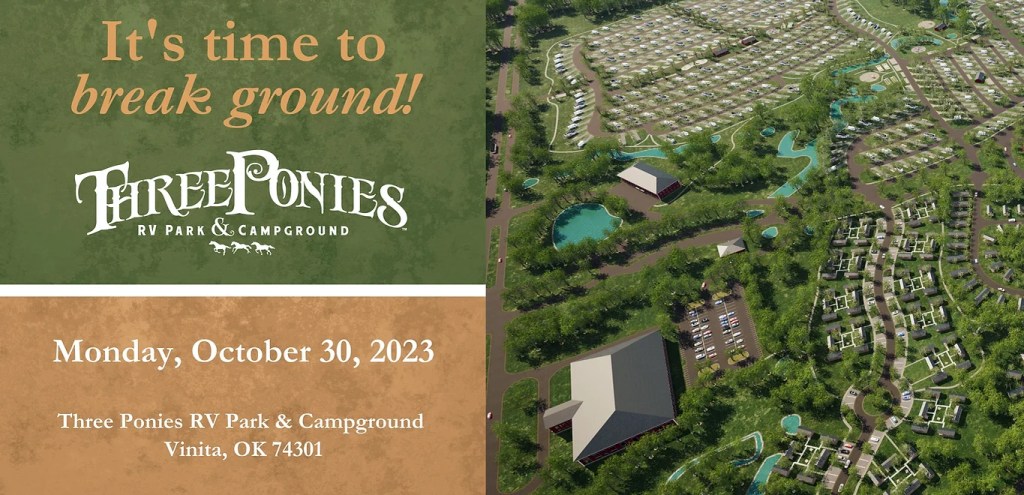
Three Ponies RV Park and Campground, announced with great fanfare last July, officially broke ground the last day of October amid predictions it would open for business spring of 2026. Given that plans call for construction of 750 RV sites and 300 cabins, not to mention a 300- or 400-room hotel (plans keep changing), an indoor waterpark, a restaurant, and other buildings and amenities, an 18-month construction schedule might appear optimistic—but hey, this is Oklahoma, land of sunny optimism and grand ambitions.

And tornadoes . . . but more on that later.

Right now, the problem is much more mundane. As disclosed last week, in response to Vinita city officials who had started wondering why the grand project isn’t moving along more quickly, it turns out a piece of the campground sits in a floodplain. Oops. Apparently this came as a surprise to the developer, Mansion Entertainment Group, who you might think would have known about this before even a shovelful of dirt was turned, but which now is scrambling to deal with the problems it presents. Mansion executive Steve Hedrick acknowledged to the city council that construction is “lagging a little behind,” in part because the government now wants a new survey— and, well, you know how “nothing in government moves quickly.” In other words, it’s not us, it’s the bureaucrats.

But, Hedrick added, somewhat confusingly, the delay “gives us some extra time to work with FEMA and get that flood plain resurfaced.” Meanwhile, it seems there are other problems slowing things down, including a design flaw that made the RV spaces too long. As a result, Hedrick added, the park’s designers have been asked to “compress” the RV park’s 320 acres, presumably to minimize flood plain encroachment.

None of this augurs well for a multi-billion-dollar—yes, billion with a ‘b’—1,000-acre tourist attraction, of which the Three Ponies RV Park is just a small piece. The main draw is supposed to be the American Heartland Theme Park and Resort, the Midwest’s answer to Disneyland and Disney World, featuring six Americana-themed environments with “thrilling rides and heartwarming shows,” including Great Plains, Bayou Bay, Big Timber Falls, Stony Point Harbor, Liberty Village and Electropolis. All this is being plunked down on the Oklahoma prairie just east of Vinita, population 5,100, along the north side of U.S. Highway 60, currently a narrow, two-lane strip of cracked asphalt. Opening day, originally scheduled for early 2026, has been pushed back to the latter part of the year, presumably because of the RV park construction delays.

Oh, and the original $2 billion price tag is slipping, too.

Does this sound a little over the top? Maybe more than a little? Apparently at least some industry observers think so, albeit reservedly so. Robert Niles, editor and analyst with the Theme Park Insider, pointed out last year that the projected $2 billion price tag matched the market cap of the entire Six Flags chain of amusement parks; he was too polite to specifically criticize Mansion Entertainment Group, which owns and operates a successful 3,000-seat theater for the performing arts in Branson, Missouri, for having absolutely no experience with this sort of venture, much less on this scale.

“I always greet new theme park development proposals with skepticism,” he acknowledged last year, adding more broadly: “New parks pitched by companies with extensive theme park development experience don’t always end up getting built. Parks proposed by companies new to the industry even more rarely happen. And the higher the price tag attached to a proposal, the more skeptical I become.”

Then there are the unanswered questions about location and infrastructure—questions that remain unanswered because, it turns out, Vinita’s political leadership signed a series of non-disclosure agreements (NDAs) with Mansion Entertainment Group, which means few details about the project have been made public. As disclosed last November by Samson Tamijani, television reporter for 2 News, Mansion told city leaders that the NDAs were “a standard business practice” and were needed “to safeguard any proprietary information.” Local residents say that as a result they don’t know even the most basic facts about the project’s impact on their livestock, water supplies and overall land use.

“We’ve been told that there will be bumps and humps to go over and that we’re just a small population and that we should be willing to sacrifice for the better good for more people,” local farmer Sara Shelton told Tamijani. Added farmer Cory Poole, “In my opinion, they’ve really put the cart before the horse and kind of sold us a lot of promises on what may or may not happen based on the development of this theme park.”

Indeed, without a theme park there’s really no rationale for building a campground in the middle of a sere stretch of high plains grassland with not much else to see or do. But with or without such a park, you have to wonder why anyone would think it’s a good idea to spend more than $2 billion on a recreational attraction that sits squarely in the middle of a tornado alley that runs up I-44 from Tulsa, just past Vinita and on to Joplin. The National Oceanic and Atmospheric Administration rates this a “very high risk area” for tornadoes, and Vinita itself has a tornado index value of 352.83, or two-and-a-half times the U.S. average—hardly the place you’d want 3,000 people setting up their travel trailers.

Last weekend saw tornadoes and flash flooding swarm Oklahoma southwest of Vinita along that same I-44 corridor, wiping out homes, killing at least four people and devastating the communities of Sulphur and Marietta, among others. That’s an aspect of the American Heartland that no theme park should seek to replicate, but this one may be ideally situated to do so. It should be put out of its misery before that happens.