
Feds go after reservation algorithms

The U.S. Justice Dept. today filed, at long last, an antitrust lawsuit against the real estate software company RealPage. As reported by the New York Times, the lawsuit accuses the company “of facilitating a price-fixing conspiracy that boosted rents beyond market forces for millions of people. It’s the first major civil antitrust lawsuit where the role of an algorithm in pricing manipulation is central to the case.”

Such a lawsuit has been nearly two years in the making, following extensive reporting by ProPublica in the fall of 2022 (as I reported here) that examined how reservation companies that aggregate data from hundreds of clients—in this case apartment buildings—can then “suggest” how rents might be adjusted and what occupancy rates should be targeted. That information, RealPage advertised, could help landlords earn 3% to 7% more than they would otherwise.

It doesn’t take much imagination to see how this sort of wink-wink price-fixing could be applied to any mass market that uses computerized data collection and algorithmically-driven communication with its primary customers. Indeed, the Times noted that in addition to the lawsuit against RealPage, both the Justice Department and the Federal Trade Commission have weighed in on private lawsuits against hotel companies that claim they’ve used similar algorithms to help determine room rates.

The private campground industry, suffering from a country bumpkin self-image within the “hospitality industry” to which it aspires, has uncritically adopted any number of its supposedly more sophisticated counterparts’ practices. So, too, with dynamic pricing, and then with the very sort of algorithmically-derived “guidance” that now has RealPage in the feds’ crosshairs. The most egregious promoter of this sort of invitation to price collusion is CampSpot, if only because of its dominant position within the reservation software marketplace, but it isn’t alone.

RealPage and its imitators argue that their customers are not obliged to act on the information they provide, even as their marketing emphasizes how that information can maximize revenues—and as the cost of renting an apartment has spiraled steadily upward over the past four or five years. Campers and RVers similarly have lived through a near-doubling of rates since the pandemic, and while there are numerous factors accounting for that increase, industry-wide price-fixing undoubtedly is part of the mix.

Congress has been paying attention to the broader problem, and the anti-trust watchdogs are looking more closely as well. The FTC last month, for example, began a study of how financial firms like Mastercard, JPMorgan Chase and Accenture are using data from customers to set prices. Individual states are also starting to weigh in, with North Carolina, California, Colorado, Connecticut, Minnesota, Oregon, Washington and Tennessee—a grab-bag of red and blue—joining the federal suit against RealPage.

Against that backdrop, the campground industry and CampSpot are insignificant economic gnats that may get by for years before someone tries to swat them. Or not. Algorithms do not operate in a law-free zone, a federal lawyer said at today’s news conference announcing the lawsuit. “After all, humans create them. Our laws will always apply to the people behind the machines and the companies behind the algorithms.”
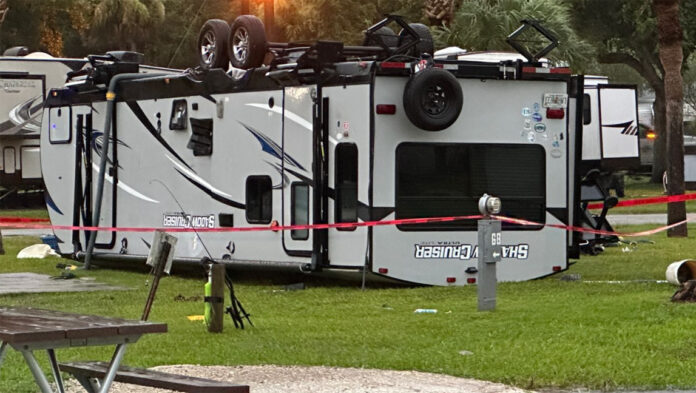
Having wheels no guarantee of safety

Having wheels under your home is no guarantee that you’ll be able to get out of harm’s way—not when those wheels are spinning uselessly in thin air.

One of the prevailing conceits of developers seeking to build RV parks in flood plains or in coastal areas subject to storm surges is that their customer base is mobile. Got a storm coming your way? No problem! Just disconnect the utilities, hook up the hitch and you’re on your way!

That kind of breezy dismissal of perfectly sane objections to putting people in harm’s way is self-serving, of course, but it’s also oblivious to human nature. There’s the problem of narrow roads creating bottlenecks when masses of people suddenly try to evacuate an area with few alternative routes. There’s the human tendency of refusing to believe until the last minute that there’s actually a problem, contributing to the mass rush for the exits just mentioned. And, of course, there’s the inevitable casualty list of those who never do get in motion—until elemental forces take care of that oversight.

The trailer pictured above is one of five that got flipped earlier today by the winds kicked up by a relatively mild Hurricane Debby. What’s noteworthy is that this RV is in Sonrise Palms RV Park, which is in Brevard County—120 miles from where Debby made landfall, across the full width of the Florida peninsula. The owner of this particular trailer wasn’t home at the time, but the occupants of several of the other RVs in his park weren’t as lucky, with one ending up in the hospital.

Debby is plowing northward, its winds diminishing but its rain reaching double digits as it hits the low, flat coastal plains of Georgia and the Carolinas. There will be more devastation in the days ahead, but none as severe—and avoidable—as the destruction wreaked on RV parks and campgrounds. And in all too many cases, having a set of wheels won’t make one bit of difference.

Oregon a hellish RV epicenter

A perfect storm of bad ideas with potentially catastrophic consequences is shaping up in central Oregon, where the already struggling Family Motor Coach Association plans to have a four-day international convention and RV expo. The association, which has been hemorrhaging members for years but still advertises itself as “the world’s largest nonprofit association for recreational vehicle owners,” said it expects more than 700 RVs to converge on the Deschutes County fairgrounds in Redmond on Aug. 14.

Well, maybe.

Such events are planned months and even years ahead of time, so FMCA’s leadership might be excused for not knowing it would be hosting a party in a pizza oven. Then again, this is hardly unexpected. California is getting the most wildfire press at the moment, principally because its Park Fire has grown to more than 400,000 acres and is now the fourth largest in that state’s history. But Oregon is even more of a wildfire hotspot, with twice as many large active fires as its southern neighbor (25 versus 13), and this year already has had more than 973,000 acres scorched. Only two of those wildfires have been contained. The convention’s theme, “Adventure Peaks,” may have more of a dark meaning than originally intended.

You might argue that a million acres is only a small fraction of Oregon’s total land mass of roughly 61 million acres, so what are the odds that your campground will be next to go up in flames? But of course it’s not just a question of whether RVers will have a direct encounter with a fire, but whether they’ll also have to breathe its exhaust. Wildfire smoke has become an annual scourge across all of the western U.S. and Canada, and as it becomes more common, its effects on human health are getting closer scrutiny—with dismaying early findings. One recent study, for example, attributed more than 50,000 premature deaths to wildfire smoke exposure; the risk of cardiac arrests for people who have cardiovascular issues increases 70% during days with heavy smoke.

And here’s a truly sobering warning for the RVing demographic most prone to attend FMCA get-togethers: according to a decade-long study involving more than one million southern California residents, released just a few days ago, exposure to wildfire smoke poses a 21% increase in the risk of being diagnosed with dementia compared with other types of air pollution. The dangers, in other words, aren’t just respiratory or cardiac. Wildfires that tear through manmade structures, vehicles and other non-wild fuel emit smoke that contains a toxic brew of chemical compounds; its aerosolized particles, meanwhile, enable those poisons to infiltrate every part of a human body.

Nor is this sort of hazard something unusual—just the opposite. A much-publicized report this past week from The Dyrt, an online camping reservation platform, disclosed that 18% of campers reported that wildfires or other natural disasters disrupted their camping plans last year, or triple the rate of 2019. Such disruptions are even more common on the West Coast, where fully one-third of campers had their plans interrupted in 2023—as did an even larger 42% in Oregon and Washington. Ironically, The Dyrt is headquartered in Oregon, “so we’ve seen firsthand the toll wildfires have taken on the Pacific Northwest,” The Dyrt’s chief executive, Kevin Long, wrote in releasing the study. “It’s scary and tragic for so many reasons.”

For all that, however, Oregon in general and Deschutes County in particular have been grappling with proposals for several new RV parks as well as rules to allow RVs to be used as permanent rental housing. Those efforts have been given additional impetus by the U.S. Supreme Court’s decision in June upholding an Oregon town’s ban on homeless residents sleeping outdoors, which among its unintended consequences has increased the pressure on elected officials to find housing alternatives—and what’s cheaper (and more flammable) than an RV? The unresolved problem, of course, is finding a home for those RVs that’s not a city street or highway underpass.

None of this is going down well with Deschutes County residents, many of whom turned out this past week for a county commissioners’ meeting to excoriate a proposed 300-site RV campground that the county wants to build just north of Bend, at least in part as a low-cost housing solution. In addition to the standard worries about water, sewage and roads, objections also centered on growing concerns about an influx of the homeless and of an increasingly volatile natural landscape. “We need to start controlling sources of combustion out there, whether it be the homeless, people in campgrounds or fireworks,” one attendee told the board, summing up the powder-keg nature of the RVing phenomenon.

Meanwhile, a luxury RV resort being built on the other side of town, southwest of Bend, was originally scheduled to open this past spring but has been delayed repeatedly. A soft-opening of the 176-site property, the Bend RV Resort, is now projected for later this month, just in time for Labor Day—and well into the fire season. At $120 a night, this clearly is not an RV park that’s targeting the homeless as its customer base. Given current events, however, it’s also an RV park with an uncertain future—as, indeed, is true of summer camping overall.

Most recent posts