When a lot is not a lot

If you’re thinking about getting into the campground business and start looking online for resources, make sure you understand the background and possible motivations of those you encounter. While not necessarily underhanded or sleazy, those you find may have a different but not immediately obvious frame of reference that isn’t compatible with yours–especially if yours is still at an embryonic stage. You’ll save yourself some grief if you understand that before you begin wading in.

What brings this to mind is the latest emailed dispatch from Frank Rolfe, one of two partners (with Dave Reynolds) in the promisingly named RV Park University. “RV Park University” certainly sounds like it should be chockablock with hot tips and good advice for prospective RV park buyers and operators, and indeed its web site offers such resources as a $40 paperback book and a $400 “home study course” for anyone trying to learn the ropes. RV Park University is, in turn, affiliated with RVPark.com, which among other things operates RVParkStore, a bulletin board of campgrounds for sale. Sounds like a good place to start getting educated, isn’t it?

Yet it’s probably wise to understand that despite all the RV references, Rolfe’s and Reynolds’ main line of business is trailer parks and their entire perspective on RV campgrounds is deeply colored by that outlook. For Rolfe and Reynolds, RV trailers and fifth-wheels are just different incarnations of mobile homes, and RV parks are attractive investment opportunities as cheap residential facilities, not as recreational ones.

There’s nothing wrong with that, of course–there are quite a few RV parks filled with long-term residents and only a smattering of short-term sites, if that. But a sea of asphalt or gravel without trees or even the most fundamental amenities is not what most people imagine when they think “RV park,” and an investment philosophy based on a “contrarian bet on a poorer America,” as Rolfe was quoted as saying a few years ago, is not what drives most prospective campground owners. For that majority, it’s prudent to take anything coming out of RV University and its various off-shoots with a large dose of skepticism.

Oh–and about the emailed dispatch that prompted these thoughts? It’s the red flags it was waving, starting with its reference to growing demand for “RV park lots.” They’re not “lots.” They’re sites. Trailer parks have lots, and people stay on them for a lot of time, for which they pay rent. RV parks have sites, and site fees. That may sound like a trivial distinction, but in fact it’s a fundamental difference that tells you volumes about the speaker’s attitude toward his business. As always, caveat emptor.

Lake reflections

It occurred to me that anyone stumbling across this blog might be interested in sampling a bit of Renting Dirt, so from time to time I’ll offer excerpts in the hope that they’ll generate interest in the book itself. Today’s selection is from Chapter 3, in which I describe Mother Nature’s darker side after a flood our first year over-topped the dam of our man-made lake:

That first shocking flood—we had several more in the years that followed, although none quite as severe—was a gut punch that taught me something emotionally I had previously appreciated only in the abstract: that nothing is all one thing, all good or all bad. Everything has a drawback to offset every advantage, a minus to balance each plus. Focus only on the positive and you’re likely to get sucker-punched by the negative; see only the worst, and you’re likely to be blinded to the best.

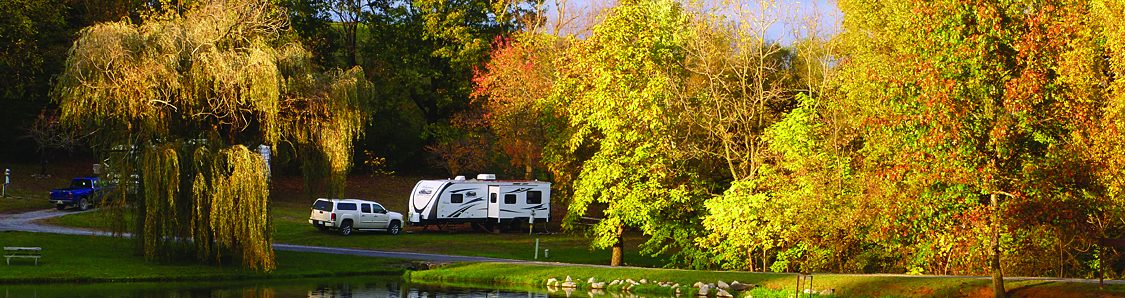
The lake itself was a prime example of this tension, and a constant reminder of the tradeoffs we had to accept. The visual focal point for the entire campground, its adjacent sites are some of the most sought-after in the park and its banks are frequently lined by campers fishing for perch, bluegill or large-mouth bass, the latter running to seven pounds or more. Heron, ospreys, and an occasional bald eagle fish the lake as well, and one year we even had a young beaver mosey through, felling one tree before he decided (thankfully!) to keep moving on. A bulletin board in the office registration area is covered with photos of happy campers proudly showing off their catch, with the biggest fish seemingly caught by the youngest people.

But the lake also is home to snapping turtles that in some cases have grown bigger than a garbage can lid, accounting to some extent for the rise and fall of the resident duck population. And thanks to the liberal use of fertilizer on the surrounding farms, drained by the two creeks that feed the lake, we waged a constant battle against algae that at times covered as much as half of the lake surface.

We also had to combat an annual incursion of Canada geese. Once a protected migratory bird whose flights signaled the changing seasons, the species in recent decades has bifurcated, with one branch continuing to make the long haul from the northernmost reaches of Canada to as far south as Florida and Texas—but with another, apparently lazier cohort deciding no, what’s the point of all that flying if we can just stay year-round in the Goldilocks middle of the continent? In the process, these winged symbols of freedom reveal themselves for what they really are, which is aggressive pooping machines, each producing up to two pounds of particularly slimy excrement every day that fouls waterways and seeds lawns with green land mines. . . .

Lazy, hazy, crazy days indeed

Remember when Nat King Cole would croon about the “lazy, hazy, crazy days of summer”–almost 60 years ago? That refrain was a hymn to a particular experience that no longer exists, and perhaps never will again. These days the “crazy” would refer to an endless procession of hurricanes and tropical storms, while the “hazy” can only mean a sky filled with smoke from millions of acres of burning forest .

You might think such an apocalyptic scenario would be provoking a spirited discussion within an industry whose success is most closely tied to the environment. You’d be wrong. Even as campgrounds and RV parks are bursting at the seams with Covid refugees eager to get out into the world, those organizations most critically positioned to address the issues confronting them are completely silent about climate change, extreme weather and how the campground industry should be responding.

The National Association of RV Parks and Campgrounds, for example, is the only nationwide representative of campground owners, yet the top post on a website largely devoid of anything topical is focused on the hot topic du jour, online reservation systems. Woodall’s Campground Magazine, probably the leading industry publication, dedicates issue after issue to one product line after another: park models in September, wi-fi systems in August, liability insurance in July, pet products in June. Kampgrounds of America, the largest campground franchise system in North America, is so beside itself over the record numbers of campers swarming its campgrounds that it can’t talk about anything else.

Take your pick: maybe that head-in-the-sand outlook is crazy, or maybe it’s just lazy. Either way, it’s ultimately suicidal.

What’s camping without surround-sound?

A major theme in Renting Dirt is the extent to which camping has been neutered, gradually stripped of its basic primal attractions. Instead of being an opportunity to reconnect with nature, “camping” increasingly is all about the “stuff” that makes the experience easier, cushier and less uncomfortable–indeed, more like the home you supposedly left behind.

What brings this most forcefully to mind right now is the subject line of an email I got yesterday from Camper Smarts, a daily RV newsletter of RVLife, which claims 1.4 million members. The subject line of the Sept. 7 post: “Are The Outdoors Too ‘Outdoorsy’?”

Wow. That’s like asking if water is too wet.

The appropriate answer to RVLife’s question is, “If so, just stay home.” But that wouldn’t sell product, which is really what this and most other RV sites are all about–as underscored by the post’s sub-title: “Here’s How to Create The Ultimate RV Entertainment Center!” Because, really, what can be more like camping than a big-screen TV with surround-sound speaker connectivity and video receiver peripherals?