Georgia: the future of RV park taxes?

Florida’s campground owners were jubilant recently over a failed effort in Sumter County to boost annual fire assessment fees. The fees, which pay for firefighters and emergency medical responders, had last been updated in 2006 and had become woefully inadequate in one of the state’s fastest growing areas. The failed proposal would have nearly tripled the existing rate, to $323.24 per household from the current rate of $124.

But here’s what really galled the RV park industry: the annual fee would have been levied against each individual RV site. Rather than one fee for an entire campground—the way a single fee would be levied against a hotel, whose assessment would be based on square footage rather than number of rooms—each site would have been treated like a separate structure. Have a campground with 200 sites? Be prepared to see your annual tax bill jump $65,000 a year.

No wonder they’re breathing easier in Florida—even though the question of how to pay for adequate fire protection and emergency medical services remains unresolved. But as a small county in nearby Georgia illustrates, the idea that RV sites rather than RV parks should be taxed for basic support services is still very much alive. And as more private campgrounds embrace long-term RVers and add park models, cabins and other quasi-residential facilities, the more local counties and municipalities will begin to view them as substantially like subdivisions, and therefore suitable for taxing like subdivisions.

Don’t see the parallel? Then consider this: what message does a campground convey when its gates become a regular school bus stop?

That was just one of the many considerations tossed around at a fascinating Oct. 17 meeting of the Monroe County board of commissioners, viewable on its Facebook page here (the relevant portion begins around the 57-minute mark). Unlike Sumter County in Florida, Monroe County is not big on RV parks—but that doesn’t mean it doesn’t have a lot of RVs. Like a growing number of rural areas with more people than housing and less money than land, its 400 square miles are dotted with RVs, singly and in clumps of two or three, as alternative housing. Monroe County also is working hard to attract new businesses and industry, and all those proliferating RV homes could be seen as detracting from its charms. Something had to be done.

The first step Monroe County took was to adopt on Sept. 5 a Unified Development Ordinance (UDO), a 312-page document two years in the making that was presented as a much-needed effort to get a handle on the RV problem—a problem that commissioners said had grown markedly worse even as the UDO was being developed. No surprise, then, that the new rules prohibit permanent resident use of an RV outside of an RV park unless it is on agriculturally zoned land of at least three acres, is occupied by the property owner or a family member, and has full utility hook-ups. Moreover, more than one RV per property is prohibited except in RV parks, for which additional requirements were to be adopted in October.

The kicker? Each RV on private property will be assessed $1,000 a year in lieu of property taxes ($750 for senior citizens), starting Jan. 1, to offset the cost of county services.

Having thus all but guaranteed that the county’s RV parks will get a surge in demand next year, Monroe’s commissioners took up campground regulations at their Oct. 17 meeting—and discovered that regulating RV parks is quite a bit more complicated than regulating individual properties. Although the board readily agreed that such campgrounds should have a minimum of 10 RV sites, in order to generate enough income to provide minimal services—“otherwise, it’s just an RV in a field,” one commissioner observed—and that such campgrounds should have a minimum size of 25 acres, the question of how full-time RVers should pay for county services proved much thornier.

Permanent RV dwellers in a campground, board members ventured, should pay an annual fee just like RV dwellers on private property. But in a campground, who’s “permanent” and how is that determined? As Keith Morey, the owner of L&D RV Park—one of only three parks in Monroe that county officials held up as meeting the new standards—pointed out, one of his customers leaves an RV parked at the campground for three months each year, but uses it only on the weekends when Mercer University has a home baseball game. Should he be charged the same fee as someone who lives at the park 12 months a year?

And what, exactly, distinguishes a permanent stay from a transitory one? Is it 90 days? Thirty days? Fourteen? Whatever the cut-off, what happens if an RVer stays that length of time, then moves to another site at the same campground? Does that reset the clock? Moreover, who determines how many RVers are permanent and how many transitory when a campground census is changing all the time? Is a single annual snapshot adequate? Once a month? Weekly? And who decides? The campground owner, or an already overworked county code enforcement officer?

The deeper into these weeds the commissioners waded, the more it became evident that a site-by-site approach was impractical—“a logistical nightmare,” in one commissioner’s words— and that the only workable solution is to have a flat fee per site without regard for how long the site is occupied, or if it’s occupied at all. As a result, the originally proposed $1,000 fee—matching the amount charged to individual property RVs—dropped to $500, then to $250. And so it was approved, by a unanimous 5-0 vote.

Whether Monroe County’s new RV regs will accomplish their intended purpose remains to be seen, of course—it’s already obvious that at least some tweaks will be needed, either by granting variances or through outright code changes. The 19-site Red Oaks RV Park, for example, despite being cited as one of the three campgrounds meeting the new standards, is less than a quarter the size of the newly mandated minimum 25 acres. On the other hand, county officials said there are a dozen or more sketchy facilities that need “a lot” of upgrades to meet the new code—too many, in most cases, to be worthwhile—suggesting the county may be well on its way to shutting down the worst RV eyesores.

Of wider relevance, meanwhile, is the county’s willingness to tackle an issue that has bedeviled many larger or more sophisticated jurisdictions. In California, for example, the president of the state’s RV association recently lamented that the trend toward permanent “campers” has created “the appearance of residential affordable housing”—an appearance “that will bury us in the legislature in the very near future.”

“If it walks like a duck and floats like a duck, then it must be a duck,” she added.  “If we look like and act like low-income housing, then that is how we will be perceived and regulated.  As an industry, we must operate our parks as though they are 100% transient even though we may have long term guests, but how do we do that?”

Good question. The answer in Monroe County, just to mix up animal metaphors, is that the horse is already out of the barn.

Cornwell crows about a sham victory

It’s only natural that Bobby Cornwell, president of the Florida RV Park & Campground Association, would preen about a legislative “major victory” in which he played—at best!— only a minor role; he is, after all, a politician of sorts, dependent on the association’s dues-paying members for his livelihood. Stretching the truth—and then some!—comes with the territory. But you can’t say as much for Woodall’s Campground Magazine, which at least pretends to be a journalistic product. Would that it were so, in which case its Florida readers would have some insights into what’s going on in their backyards.

I gave passing mention to Woodall’s continuing slide toward industry sycophancy a couple of posts ago, reporting on its superficial coverage of a Citrus County glampground, so there’s not much purpose in rehashing that issue here. But that was only one of the two “victories” recounted in a page 6 Woodall’s article under the assertive headline, “Florida Association Scores Major Property Tax, Development Wins,” in which Cornwell boasted of the association’s “necessary show of force” to prevent officials in two counties from “making a big mistake.”

That second averted mistake supposedly occurred in Sumter County on Aug. 22, when the county’s board of commissioners considered a proposal to increase its fire assessment fee from $124 to $323.64 a year for residents and businesses. The increase was needed, proponents said, to avoid $26 million in budget cuts for fire and ambulance services in the county as well as in The Villages, possibly the country’s largest retirement community, with which it shares emergency responders. Retirees don’t look on tax increases favorably, and they have a lot of time on their hands, so there’s no surprise that the Aug. 22 hearing was packed, passionate and ran for five hours. Cornwell’s contribution was a mere sliver of the whole. The commissioners, dutifully cowed, ended up defeating the entire proposal by a wobbly vote of 3-2.

Which, of course, didn’t resolve the underlying problem, so the cutting has already started. Sumter County’s fire chief says he’ll be laying off 30 firefighters and deep-sixing plans that had been made to hire an additional 27 employees next year. The chief of the public safety department at The Villages said he will lose 57 new positions that had been planned for next year, and has already lost three of the seven staffed ambulances the community had been leasing from American Medical Response. County officials said they’re trying to “come up with solutions.”

None of this was mentioned in Woodall’s coverage, nor in Cornwell’s public pronouncements, which would have us believe that the Florida RV Park & Campground Association had successfully repelled an attack specifically targeting RV campgrounds and not tens of thousands of homes and other businesses. Defeating the fire assessment fee “was a great night for Florida’s RV park industry,” Cornwell crowed, quite likely forestalling “similar proposals in other counties.” Yadda-yadda.

The point that Cornwell failed to explore—aside from, you know, that whole context thing—is the curiously specific number assigned to the proposed new fee: $323.64 a year according to press reports, $323.40 per RV site, according to Cornwell. Without getting into the complexities of how either number was derived, suffice to say that numerous variables were factored into the proposed fee, including ten years of actual responder histories, and the result was to be charged per single dwelling unit—which is to say, under the proposed fee schedule each site at an RV park was to be treated as a separate residence. And that, all by itself, deserves attention for at least two reasons.

Number one, it suggests that public officials are starting to view RV parks less as providing transient lodging akin to hotels and more as wheeled subdivisions, which means campground owners are seen as having a multiplicity of taxable units rather than owning just one large business entity. And number two, this shifting perspective means that RV parks are becoming recognized as an agglomeration of discrete cost centers, with separate and distinct demands on fire and rescue services, demand for road and school access and claims on other county amenities, such as libraries, community centers and landfills. Those costs have to be underwritten, and how to do that equitably without charging for each site?

Campground owners, of course, are aghast at such an idea. As Cornwell pointed out, a 200-site RV campground in Sumter County, had the proposed fee schedule passed, would have been on the hook for an annual (and additional) tax bill of $64,680. Others, pointing to a different aspect of the defeated fee that included square-foot calculations, said they would have been been hit with six-figure assessments—indeed, one unnamed campground owner with two properties told a local reporter her annual assessment would rise to $490,000.

Alarmist, perhaps—but also willfully determined not to recognize the perceptual shift that’s underway, much less how to respond in a meaningful way. It should be evident that much of this change is of the industry’s own doing, as campgrounds increasingly rent long-term sites to people who are not passing through but are, in fact, living in their RVs. And as recent events in Georgia have demonstrated, rolling back the tide in one state, however temporarily, doesn’t mean it won’t rise elsewhere—and, eventually, become an industry standard.


Next post: Monroe County, Georgia, approves a $250-a-year surcharge per RV site in its campgrounds for basic services, as it also clamps down on residents living in RVs on private land—potentially forcing some to move to those pricier RV parks, further enhancing their long-term housing attributes.

When RVs are for travel, not housing

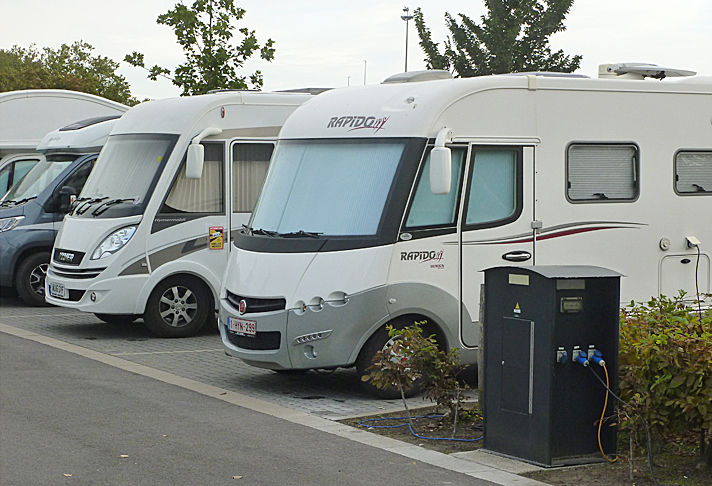
No, that’s not a parking lot. It’s an RV park in Bruges, Belgium, which charges 30 euros a night in season (currently around $32) for an electric-only site. Room for your awning? Not so much.

My six-week hiatus from this blog was intended as a break from all things usual, resulting (among other things) in several hundred photos of European canals, cobble-stoned streets, cathedrals, castles, mountain peaks and refugios, from which I will spare you. But old habits are hard to break. Scattered among the mix are a few shots of RV parks continental-style that are worth sharing in this space, and most American RVers, I’ll venture, would not be pleased.

For starters, it appears that European RVs are built with an entirely different mindset than their U.S. counterparts. Smaller and sleeker, they’re clearly designed as transportation first and lodging second, whereas in the U.S. it’s typically the reverse. These are not houses on wheels. Not a fifth-wheel to be seen—or, for that matter, few trailers of any kind. The overwhelming majority are class Bs and modest class As (with scant evidence of slide-outs), an occasional class C (as visible in the picture above) thrown in for good measure.

Although some European RV parks have a limited number of full hook-ups, most seem to offer only electricity, and then to a centralized pedestal that has multiple outlets requiring lots of electric cord.

Nor are many RV “parks” the least bit park-like, more closely resembling parking lots than a campground—and not a tent in sight, either. Any grass tends to be in a centralized strip and is more landscaping than lawn. (Perhaps explaining why many European RVs don’t appear to have awnings.) Water and sewer dumps typically are available at a centralized location, and electricity can be tapped from a common pedestal that can have as many as half-a-dozen outlets. Because Europe transmits electricity at 220 volts, rather than the 110 common in the U.S., the correspondingly lower amperage allows RVers to run their connecting (and thinner) wire over longer distances, resulting in RV cabling running across roads and around other RVs for considerable distances.

(As a side note: perhaps because of this greater hook-up flexibility, there seems to be no standardization among European-made RVs for utility hook-up placement. American RVs have all their hook-ups on the left side, preferably near the rear on large units; in Europe, anything goes. Driver side, passenger side, back, middle . . . Just one thing to assess by Americans thinking of buying a European model for use in the States.)

All of this makes for a more Spartan “camping” experience than most Americans expect when they go RVing, with little to suggest that European RVers are looking to embrace the Great Outdoors. While I did see campers sitting on folding chairs outside their units for a morning cup of coffee, the sighting was rare and looked like a tightly hemmed-in experience—although these are people who also eat a lot of meals at sidewalk cafes, so who’s to say they felt the least bit discomfited? On the plus side, on the other hand, their RVs are suitably sized for narrow European streets, undoubtedly slurp less (expensive!) gas than American road hogs, and the RV parks they occupy charge rates that the U.S. hasn’t seen since the last decade.

A Walmart parking lot it ain’t—nor a Margaritaville resort.

Greed and fear: the twin motivators

On returning to the U.S. after more than a month of hiking and cycling in western Europe, I’m struck by how little has changed in the domestic RV and campground industry—and how much has changed in the world it occupies, and how little it seems to care.

RVing trends that were already evident in mid-summer continued as before: softening midweek campground reservations, ongoing declines in RV production and sales, relentlessly upbeat industry assurances that any downswing was bottoming out and that 2024 will see a rebound. The natural environment within which the industry operates, on the other hand, continued to grow increasingly inhospitable (as of Oct. 10, the daily average Northern Hemisphere temperature had been at a record high for 100 consecutive days and at least 65 countries recorded their warmest Septembers on record)—and was just as resolutely ignored by RVing promoters, who much prefer to rhapsodize about the exploding growth of glamping and the latest gee-whiz innovations in RV design than to wrestle with issues of climate change and global warming.

The industry’s determination not to acknowledge the existential threat on its doorstep has been enabled by a lack of internal critics, but outside business pressures may finally crack its insularity. In recent weeks, for example, First Street Foundation issued its ninth national climate risk assessment, this time focusing on property insurance—or, more precisely, on the skyrocketing cost or outright unavailability of such insurance because of increased wildfire, flooding and windstorm risks. (I’ve written about some of First Street’s earlier assessments, here and here.) It’s a sobering read. Campground owners will feel the squeeze twice over, first through the increased expense of insurance premiums and then—if they try to sell their property—through the devaluation of their capital investment, as higher expenses mean lower net operating income and a higher cap rate.

This dynamic was further explored in a Grist article published this past Tuesday under the headline, “As climate risks mount, the insurance safety net is collapsing.” Reporting that natural disasters now cost the U.S. insurance industry $100 billion a year, the article rhetorically asks, “What happens when no one wants to pick up the tab?”

The First Street report and Grist’s article both pay particular attention to Florida because of its hurricane vulnerability, so it’s ironic that there is no more extreme example of a state’s businesses and politicians remaining stubbornly oblivious to climate change. A prime example was provided in August by Citrus County commissioners, who voted unanimously to reverse their planning commission and approve creation of the Fishcreek Glampground, despite the coastal property sitting a mere two to three feet above sea level. Bobby Cornwell, president of the Florida RV Park and Campground Association, had lobbied on behalf of the applicants and was only too happy to describe the approval as a major industry victory.

“For well over a year the owners of Fishcreek, Jen and Dimitri Magradze, have meticulously planned the project to co-exist with the beautiful natural setting and to provide outdoor enthusiasts and nature lovers with needed accommodations and access to the waterway without harming the environment,” Cornwell gushed to Woodall’s Campground Magazine. “But even though they had everything perfectly planned for their land and had many local supporters and studies showing how the project would benefit the area and not harm the environment, there was a large, organized effort against their proposal.”

Imagine that. A “large, organized effort” that Woodall’s couldn’t be bothered to describe or Cornwell to rebut, but which was rooted in the same environmental considerations that had prompted the county’s planning commission to reject the proposal not once, but twice, by votes of 5-2 and 6-1. Mere weeks later, Hurricane Idalia struck. The putative glampground’s Facebook page advised followers Sept. 3 that “there is a trailer full of logs submerged in the water along Fishcreek. Please use extreme caution when navigating out here.” So it goes.

Meanwhile, a few hundred miles north, along the coast of North Carolina in the Cape Fear region, the Leland planning board unanimously reversed its own unanimous May decision and voted to allow RV parks in flood hazard areas. The decision was urged by developer Evolve Acquisitions, which contended that it was seeking to “correct a mistake”—that the town had not really intended for flood zones to be off-limits to RV parks. As further evidence of the reasonableness of its request, Evolve’s spokesperson averred that RV parks are often located in flood-prone areas. The case for putting people in harm’s way having been put forth so cogently, the Leland town council unanimously approved the change Sept. 14.

Back when I reported on capital markets, one of my mentors stressed that market movements can be attributed to just two basic impulses: greed and fear. So it is with most things in life. Greed initially has the upper hand when developers start trotting out their honeyed visions, but as the real costs of such laissez faire policies start accumulating, fear will start coming on strong—and then watch out. You’ll be amazed how rapidly things can unravel.


Oct. 14 addendum: Inside Climate News reports that the U.S. Fish and Wildlife Service will consider tightening protections on the West Indian manatee because of substantial scientific evidence that it faces renewed threats to its survival. Citrus County supports the state’s largest concentration of manatees in a natural spring area; the Crystal River National Wildlife Refuge, relatively near Fishcreek Point, was established specifically to protect manatees.

Idalia, disabled vets and glamp hustle

The bad news this past week was that Idalia exceeded even the most pessimistic early forecasts, slamming into the Florida coast as a Category 3 hurricane. The good news is that she tore through the state with hardly a hiccup, dumping a lot less rain than some had feared. Nonetheless, the storm surge was almost as as bad as predicted, cresting at seven feet or more above sea level—more than enough to roll right over the site of the proposed Fishcreek Glampground, about which I wrote last weekend.

How much damage was sustained at the westernmost end of the West Ozello Trail, where it nears Fishcreek Point, might not be known for some time— but with Citrus County one of just seven Florida counties declared national disaster areas as a result of the storm, the prognosis is not good. Nor is there any way to forecast whether Idalia and the damage she wreaked will force any rethinking of the idiocy of putting an RV park and glampground in such a perilous location, although I wouldn’t want to bet on it. All that will shake out in the weeks ahead, but it’s already clear that some lessons are learned the hard way.

When local residents objected that hurricane winds and storm surge would vastly hinder an evacuation of Fishcreek Point, their concerns were brushed aside by glampground promoter Jen Magradze with the claim that there would be ample time for people to get out before a storm hit. Last week’s events, as law enforcement officials cruised the flooded streets in airboats, suggest otherwise. As Chris Evan, director of Citrus County Emergency Management, told a local reporter, Idalia’s storm surge was comparable to that of Hurricane Hermine in 2016, which area residents “took seriously.” Yet just seven years later, he added, “the thing that concerns me is, people didn’t heed the warnings.”

People have an inclination to say whatever they think will get them what they want, even when a cursory look at the facts suggests otherwise, which certainly has been the case with Fishcreek Point. But people also have an immense capacity for simply rejecting what they don’t want to hear and moving ahead with whatever they’re after, often justifying their actions by appealing to a higher purpose or calling.

Such is the case at Lake Vermilion in Minnesota, where Christine Wyrobek, the owner of approximately 45 acres zoned for residential use, sought to open a 47-site glampground oxymoronically called Rough-N-It. Her rezoning request was denied in May on a 7-1 vote by the county planning commission, following a public hearing at which local residents spoke 42-3 in opposition to Wyrobek’s proposal and the local town board weighed in with a unanimously approved resolution, also in opposition. Among their concerns—as at Fishcreek Point in Florida—was the access road to the property, described as the most dangerous in the area; and with the campground itself accessible only by boat, first-responders would face serious obstacles in an emergency

No matter. An undeterred Wyrobek plowed ahead anyway, announcing in mid-August that Rough-N-It was open for business. Her hook, and presumably the sympathy-evoking ploy she hoped would convince her defiance to be overlooked? Rough-N-It would be serving disabled veterans, who would get a 90% discount from the $100-a-night fee charged to “regular campers.” In essence, Wyrobek was saying, shutting her down would be tantamount to spitting on the American flag.

Jen Magradze and Christine Wyrobek, for all their apparent differences, are sisters under the skin. Each acquired a piece of land that was legally incompatible with their ideas of what they wanted to do with it; each faced stiff opposition from local residents who believe existing zoning and land use regulations should apply; each had their proposed glampgrounds overwhelmingly vetoed by the local planning commission. And each pushed ahead nonetheless, one by artful politicking and appealing to local avarice, the other by simply ignoring local officials and hoping to embarrass them with a red herring of a cause.

County officials in Minnesota are now investigating a complaint they received about Rough-N-It operating improperly, but are being tight-lipped about when and how the matter may be resolved. Fishcreek Glampground received the rezoning it needed, but still must clear state environmental review—which, after Idalia, may be more problematic. Neither proposal, however, has done anything in its area to burnish the faded promise of “glamorous camping,” which too often is more glitz than substance, gold leaf rather than gold plate.


This will be my last post for the next six weeks, during which time I’ll be hiking and cycling in mercifully internet-free locales. I expect that little will change in the interim among the many RV- and campground-related developments I’ve been following, but just as assuredly there will be several new off-the-wall proposals tossed into the mix. I’ll look forward to several days of intense catching up, but could use some help: if you know of something you want me to pursue, or if you have an update you think I should know about, please send an email and any appropriate links or background material to: azipser@renting-dirt.com. All subject-matter donations cheerfully accepted!

Happy travels.

Most recent posts

Careful what you wish for in Florida

A developing tropical system in the Caribbean is moving north, among predictions that give it an 80% chance of becoming a tropical storm before it reaches the Gulf Coast—because, you know, Florida. Even though the tentatively named Idalia probably won’t hit before mid-week, by which time there’s some chance it will have strengthened into a hurricane, Governor Ron DeSantis already has declared a state of emergency for 33 of the state’s 67 counties—because, you know, DeSantis.

And right in the middle of the potential impact zone is Citrus County, where the county commissioners this past week gave a thumbs-up to building a coastal RV park and glampground on a site that averages two to three feet above sea level—because, you know.

Florida.

Remember when you first learned about the supposed suicidal behavior of lemmings chasing each other off a cliff, making you wonder how any animal could be so dumb? Uh-huh.

Sunshine RV-Fishcreek Glampground & Boat Ramp is the brainchild of Jennefer and Dimitri Magradze, who less than three years ago bought a 16-acre parcel at the end of a narrow, key-hopping two-lane road that snakes through the bayou about 60 miles north of Tampa. As I’ve previously reported, the site is bounded by the St. Martins Marsh Aquatic Preserve and the Crystal River National Wildlife Refuge, a rich off-shore area of marshes, mud flats, oyster bars, mangrove islands and seagrass beds, as well as the only wildlife refuge dedicated to the protection of the West Indian manatee—just the place, the Magradzes decided, to put in a campground for 32 RV sites, 16 glamping cabins and 20 “primitive” sites.

But because the parcel is zoned as a coastal and lakes residential district, which doesn’t allow for RV parks, the Magradzes had to get the approval of the county’s planning development commission—which it declined to give. Twice. Nonetheless, unfazed by the commission’s 5-2 and 6-1 denials or by the gathering storm of local opposition its plans were whipping up, the Magradzes persevered, culminating Aug. 22 in a unanimous vote by the county commissioners to reverse the planning commission. The 5-0 vote came after a five-and-a-half hour meeting attended by hundreds of local residents, which judging from census figures, may have accounted for virtually everyone living within a mile of the contested site.

To be fair, it must be acknowledged that the Magradzes have their supporters, a combination of those with a thin hope they’ll provide an economic boost to the area and those who resent any government attempt to control land use. But the local turnout—so great, according to the Citrus Chronicle, that it overflowed the the hearing room and forced many to watch the proceedings on closed circuit TV—attested to widespread concerns about septic tank contamination from flooding during the inevitable storms, as well as the potential for life-threatening bottlenecks on the narrow roads in an evacuation emergency. As quoted in the Chronicle, one of the planning commissioners said he’d had trouble navigating the access roads in an SUV, “let alone an RV,” adding, “The infrastructure is not there to support this project.”

No matter. The county commissioners overrode their own advisory board for largely inarticulate reasons, such as the commissioner who expressed her “confidence” that the Magradzes would address the various issues that had been raised, or the one who confessed that she still had “concerns” about the effect of flooding and septic tanks on the environment—but had decided to side with her colleagues anyway. But as made clear by county commissioner Jeff Kinnard, who made the winning motion, the whole process was simply a buck-passing exercise. The Magradze proposal still must be approved by several state agencies, including the Florida Department of Environmental Protection, Kinnard observed, before paternally counseling those in attendance to “take time to heal and get to know your neighbors again.”

The wider RV community seemingly greeted this reversal with glee, if a fawning report from Modern Campground can be believed. In an Aug. 25 post bearing the unmistakable imprint of chatbot assistance, the online news service claimed the Florida RV Park and Campground Association had “celebrated” the decision as a “landmark victory.” The association’s support “was instrumental” in securing approval for a glampground that “had faced significant opposition,” according to Modern Campground. “However,” it added, “the meticulous planning by owners Jen and Dimitri Magradze, emphasizing harmony with the natural environment and catering to outdoor enthusiasts, swayed the county commissioners.”

No mention, of course, of why the Magradzes had faced “significant opposition,” nor of the planning development commission’s double-barreled rejection. Nor was there any description of the couple’s “meticulous planning”—which, forgive my cynical heart, may have amounted to no more than lobbying the Florida RV Park and Campground Association—nor how that planning is going to cope with a storm surge that will handily roll right over the little bit of heaven they’re proposing to build.

The next week may demonstrate just what awaits, even before the first glamping cabin makes an appearance or an RV tries to flee the floods.


On a related note: It’s been hard to miss the drumbeat of reports about Florida’s growing insurance crisis, much of it driven by, yes, soaring hurricane coverage premiums. At least six insurers went insolvent in the state last year, despite average annual property insurance premiums that rose at the end of last year by triple the national average. Commercial rates are rising even more sharply and are expected to go up 45%-50% this year—and a doubling of premiums won’t be out of the question, according to a report from Yardi Matrix, a commercial real estate data and research firm.

Premium levels are determined by risk, and with each new risky development—such as the Fishcreek Glampground—the industry’s overall risk factor goes up. That suggests the Florida RV Park and Campground Association should hold off on celebrating developments in Citrus County, which in the long run will mean higher insurance costs for all of its members.

Most recent posts

PMRVs: the tail that wags the RV dog

PMRV, for the uninitiated, means “park model recreational vehicles,” which is a nonsensical word salad. Consider, for example, that the La Plata County, Col. building code defines park model RVs as “a special subset of recreational vehicles that are constructed for the purpose of permanent placement in a park or a residential site.” (Why cite a Colorado county code to make a point? More on that in a moment.) The point here is that “vehicles,” defined as “things that transport goods or people,” ipso facto become non-vehicles as soon as they are in “permanent placement.”

Still, the obvious fiction that park models really are just RVs persists, thanks to vociferous industry lobbying. An interview in the current issue of Woodall’s Campground Magazine with Dick Grymonprez, who’s retiring as the longtime director of park model sales for Skyline Champion, has him triumphantly acknowledging that the RV Industry Association—on whose board he served for a decade—was in the forefront of rebuffing federal efforts to regulate park model designs and construction. “A few years ago, the Department of Housing and Urban Development was trying to say that park model RV manufacturers were advertising and selling the units as housing,” he recalled dismissively, without disputing the claim.

Park models were a cash-cow not easily relinquished, so it’s not surprising that the industry pushed back vigorously. But after defeating HUD’s efforts, it also did nothing to dispel the notion that park models are so much more than an RV. “I think a lot of people that buy park models are buying them for a second home or vacation home”—or more, Grymonprez added, with a “what are ya’ gonna do?” shrug of his metaphorical shoulders. “If you think about it, a person’s going to live wherever they want to live. The RV business doesn’t want to admit this, but there are people that live in RVs year-round, full-time. There are people that live in park models year-round.”

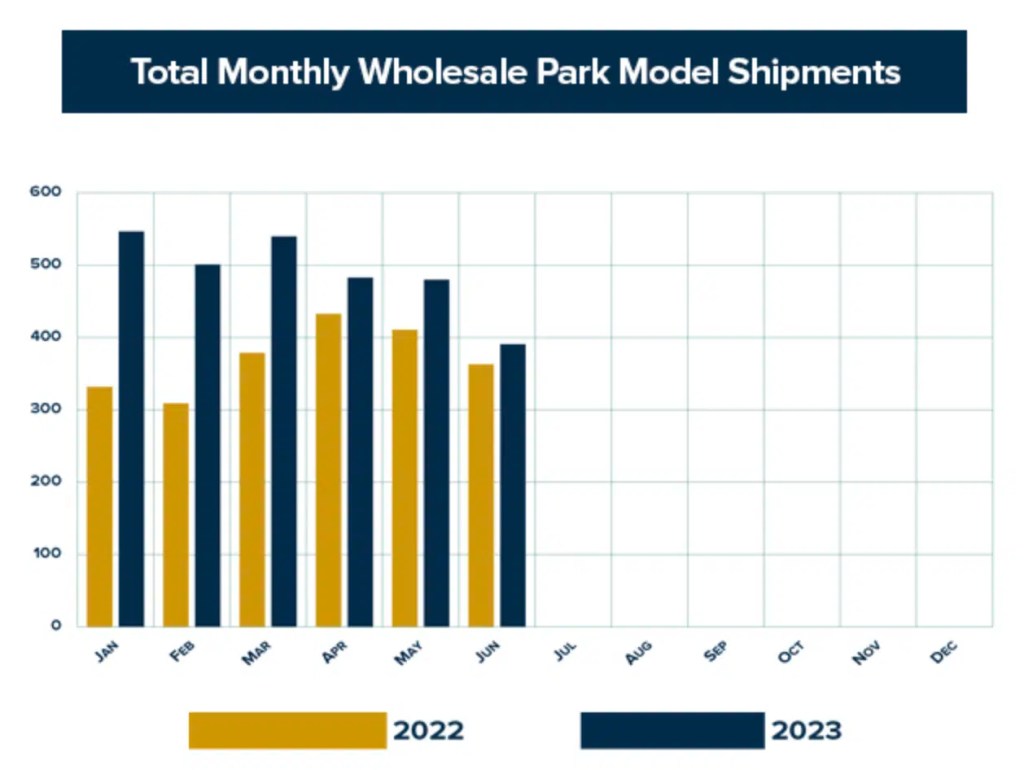
In some ways, this is old news; what’s more recent is the blasé attitude by industry leaders toward the possibility of serious challenges to the housing hybrid they’ve created. And why not? At a time when RV shipments across the board are plunging by 40% to 50% over year-earlier numbers, RV park models—as seen in the bar chart above—are the stunning exception. Month after month, park model shipments have strengthened over last year and are up 32.1% for the year through the end of June. And while total park model numbers are a fraction of overall RV shipments, they’re also significantly pricier pound-for-pound than their rolling counterparts and have seen the greatest price appreciation over the past few years.

(They’re also increasingly boxier. While limited to no more than 400 square feet [500 in Florida] by HUD standards, all but a handful of this year’s shipments have been more than 8.5 feet wide—the maximum width permitted for real RVs and tiny homes on wheeled chassis. Of the 2,942 park models shipped the first six months of this year, 2,921 were too wide to be wheeled down a highway without a special permit.)

Just how costly these putative “RVs” can become is suggested by an email I received last week from a reader who wants to build his own winter ski chalet at a resort in Colorado. In 2017 he purchased a 20′ by 102′ lot in a private gated campground for $19,000, with the thought of eventually putting a park model on the site. After grading and leveling, installing retaining walls, upgrading to 100-amp electrical service and installing a heated hydrant 12 feet deep, he figures his property value is now $135,000. But in the interim, park model prices increased so much that “what was 50k for a custom model is now in excess of 100k for a cookie-cutter standard model,” making him wonder whether it’s all worth it.

Spending upwards of $200,000 for 400 square feet on a sliver of land no wider than can fit a standard automobile cross-wise isn’t how I would spend that kind of money, assuming I had it to spend. Then again, I’m not a skier. On the other hand, this kind of housing development, disguised as a resort community, is becoming ever more common, and it makes its inroads by maintaining the fiction that 12- and 14-foot-wide park models are just RVs and therefore should be admitted wherever the rolling variety is allowed.

In La Plata County, as referenced at the top of this post and as I’ve written before, Scott Roberts, an Arizona-based developer, has advanced his plans to build the so-called Durango Village Camp on the banks of the Animas River. When first presented to local residents and planners last December, the proposal foresaw creation of a 306-site RV park that would include an initial 42 or maybe 49 park models, with more to be added in some indefinite future. According to Roberts’s business model, the park models would eventually be sold—perhaps for as much as $450,000, as they currently are at some of his other properties. Still, regardless of how much that may look like a housing development, Roberts argues that Durango Village Camp “most closely resembles an RV park,” and that’s one of the allowed uses on the property as currently zoned.

But that was then, and this is now. Earlier this month, the final Village Camp paperwork was filed with La Plata County—and in the intervening eight months the proposal’s make-up has changed considerably. Instead of the 306 sites Roberts initially proposed, Village Camp would have only 277—but of those, fewer than half would be RV sites. The balance would include 54 undefined “RV cabin sites” as well as 86 park models, or roughly double the initial number. The narrative laying all this out helpfully observes that the park models “are technically RVs, but their fit and finish is similar to an upscale hotel room with beds, a kitchenette, a bathroom and living room.”

Whether this would be an appropriate use for the property in question is best resolved by the people of Durango. But their job would be much simpler if the whole process were more honest and the evidence of our senses was accepted over industry word-play and obfuscation: a park model is no more a recreational vehicle than a mobile home is mobile. They’re both fixed dwellings, separated by an arbitrary dividing line based on square footage. Nor does it help that zoning regulations all over the country—not just in La Plata County—are years behind the times in recognizing changes in the definitions of camping, campgrounds, RV parks and, now, glamping.

Most recent posts

Without sugar, lemonade is still sour

That old adage about turning lemons into lemonade overlooks a key ingredient, without which you’ll still be puckering up. But where’s the sugar in the RV industry’s latest attempt to sweeten an increasingly sour outlook for its members?

Amid a steady decline in RV sales, higher campsite booking costs and increased camping volatility—KOA’s August report finds that extreme weather has prompted two-thirds of campers to change their travel plans—the RV Industry Association is pinning its hopes on the kids. Well, near-kids. The latest monthly report from its Go RVing marketing arm, released a couple of days ago under the headline “Gen Z means business: young entrepreneurship is on the rise,” makes the tenuous case that the RV industry is well positioned to benefit from . . . hustle culture. Otherwise known as burnout culture.

“More and more young people are starting businesses and side hustles with the aim of creating a more fulfilling life,” the report states. “It’s all part of a larger movement among young people to seek more control over their time and income through nontraditional means. . . . As a result, the concept of ‘hustle culture’ is evolving to include more flexible work schedules, working vacations, and personal time,” creating an opportunity for the RV industry to demonstrate “how working from an RV offers flexibility, inspiration, excitement, and relaxation without compromising on productivity.”

If some of that sounds awfully familiar, that’s because it echoes the lofty praise once lobbed at the “gig economy,” a supposed evolution in labor economics that applied “just-in-time” manufacturing principles to the labor force itself. Creating a new class of rootless workers characterized as freelancers and “independent contractors,” the gig economy sold itself as conferring flexibility and independence to people who otherwise would have to labor as “employees” with all the burdens that entails, including steady paychecks, health care and other benefits and the protections of labor laws, such as overtime pay. Yes, there was a segment of the labor force that took the concept and ran with it to enormous personal benefit, notably among tech workers. But for most of the new employment gypsies, “flexibility and independence” meant gnawing uncertainty, less income, longer hours and erratic schedules subject to the whims of the hiring class.

The manufacturing sector learned about the vulnerabilities of just-in-time scheduling when the Covid pandemic struck, but some employers still view workers from the same transactional perspective, albeit with a rebranding change. “Hustle culture” sounds so much better than a gig economy, as witness Go RVing’s unblinking endorsement of the concept. Hustling sounds like energy and ambition, of going places. Never mind that “side hustles” are promoted as a way for people who are insufficiently paid to make enough money to make ends meet.

It’s noteworthy, therefore, that while the Go RVing report cites sources for its observations about the rising incidence of Gen Z side hustles, its conclusions about motives apparently were invented from thin air. If anyone talked to the Gen Zers themselves, they’re keeping it a secret, leaving the field wide open for whatever fairy tales Go Rving wants to concoct. Are Gen Zers hustling “with the aim of creating a more fulfilling life”? Some, for sure—but some undoubtedly because they have no other options. With Gen Zers “more likely to pursue multiple side hustles,” as the Go RVing report observes, is that because they’re seeking “to maximize the value of their time and experiences”—or because, like the Haitians in those old Saturday Night Live skits, they have to work multiple jobs just to keep their heads above water? How much is all this about opportunity—and how much about desperation?

Here’s a clue that tips the balance in an unwelcome direction: total U.S. credit card indebtedness increased by $45 billion in the second quarter, sending aggregate balances over $1 trillion for the first time ever. With that increase also came an increase in the delinquency rate, with 7.2% of credit card payments late by at least 30 days. Any guesses who’s getting hit the hardest? Yup: according to a June study by Quicken Inc., more than half (53%) of millennials and 41% of Gen Z respondents said they were more reliant than ever on credit cards, and Gen Zers had the highest credit card delinquency rates of all.

As reported earlier this week by Yahoo Finance, almost half (49%) of millennials and 55% of those earning under $50,000 a year said they “didn’t see an end in sight” as they live paycheck to paycheck. “Credit card rates are currently in double digits, and not uncommonly 20% or more, which is causing many young people to face a rising debt load,” Quicken’s CEO, Eric Dunn, told Yahoo Finance. “I’m troubled by the compounding problems facing this group.”

Meanwhile, a separate study from TransUnion found that Gen Z credit card balances grew to $55 billion in the second quarter, up from $36 billion a year earlier—an astounding 51.9% increase year-over-year. Half of Gen Z borrowers plan to apply for new credit or to refinance existing credit within the next year, compared to 32% of the general population. At the same time, U.S. News & World Report reported that 46% of student loan borrowers—typically Gen Z and millennials—say they aren’t financially prepared to resume federal loan payments when the pandemic-era forbearance program ends this fall.

If these are the lemons from which Go RVing is hoping to squeeze some industry-reviving lemonade, it better find a whole lot of sugar to add to the mix. What it has now is a bitter, bitter brew.

Most recent posts

Maui fire has burnt away the pretense

As cadaver dogs and forensics teams continue their grisly search of charred Lahaina, state officials investigate why the island’s warning sirens weren’t activated and the Hawai’ian Electric Company girds for lawsuits over its failure to deenergize power lines that may have sparked last week’s fires, any number of “lessons” will be drawn from the tragedy. Most will be somewhat predictable; most will be viewed from afar as being of little broader relevance. How much, after all, can one of the world’s most remote archipelagoes teach the rest of us?

Yet to the extent that Hawai’i is emblematic of other tourist-driven economies on the mainland, the dispiriting answer is: quite a lot.

As the BBC News reported today, the fires have exacerbated an already festering divide between the haves and the have-nots, between the entitled and self-absorbed visitors from elsewhere and the impoverished locals whose economic survival depends on satisfying their guests’ whims. With roughly 80% of the state’s economy fueled by a so-called “visitor industry” that’s served by a largely captive workforce—there’s no hopping into a pick-up here to drive to the next state in search of a better job—Hawai’ian islanders have little choice but to suck it up and repress their frustrations and resentment. So even as Maui officials asked visitors to leave the island, and the Hawai’i Tourism Authority urged outsiders to steer clear for the next few weeks because “our collective resources and attention must be focused on the recovery of residents and communities that were forced to evacuate,” the tourists kept coming.

And the anger kept growing.

In that respect, the fires illuminated much more than a surprisingly flammable landscape: they also highlighted the disparities that exist throughout the U.S. wherever a lot of money has moved in to create affluent playgrounds. Maui’s acute housing crisis, which in its case means cramming multiple families into modest ranch-style homes with curtains or thin plywood walls for partitions, is replicated in other ways in Vail, the Berkshires, Jackson Hole or any other scenic area where housing gets snatched up for vacation homes and short-term rentals. And it’s not just housing costs that get boosted by a tourist-based economy—it’s everything, from groceries to hard goods to entertainment. Hawai’i is an even more extreme case because it’s an island, but the same dynamic is experienced in every community dependent on the “visitor industry.”

What’s the relevance in all this to the RV park and campground industry? Only this: as investor money has poured into the sector, an inordinate number of outsized projects involving hundreds of new RV and glamping sites have been proposed over the past couple of years, from KOA’s two-fer just outside Yosemite National Park, to the Kentucky Bluegrass Experience Resort, to a Roman-themed “resort” next to a brand new Caesars casino in southern Virginia, to name just a few. Virtually all have targeted areas that are down on their heels, holding out the allure of plentiful new jobs, fresh tax revenue and a shot in the arm to local businesses. Virtually all provoke local opposition, in some cases more spirited and better organized than in others, amid predictions of the increased traffic, noise and potential crime that such a tidal wave of visitors may be expected to bring. Some get blocked. Some don’t.

Of those that prevail, few become the economic salvation their supporters anticipated, even as many of the problems their detractors had foreseen come to pass. Yet that’s not the worst of it. While increased traffic, noise and disruption of rural tranquility are nothing to sneeze at, even the most ardent opponents of such megaprojects fail to understand the massive warping effect they have on an area’s social fabric, beside which everything else is mere inconvenience. It’s as though a black hole were to slip into nearby orbit, its gravitational pull distorting every preexisting relationship: of people to people, people to the environment, people to their political and economic institutions.

Hawai’i is an extreme example because of its isolation and the longevity of its subservience to the visitor industry, but the past week has ripped away the veil that screened the island built for visitors from the harsher version left to the Hawai’ians themselves. In the words of a 21-year-old Maui native interviewed by the BBC, “It’s all butterflies and rainbows when it comes to the tourism industry, but what’s really under it is kind of scary.” It is, and that should be an object lesson to the next planning board, zoning commission or county board of supervisors listening to the siren song of a mega-campground developer.


Aug. 17 postscript: An encouraging sign that people can stand up to an exploitative “visitor industry” has come out of Lamoine, Maine, where an Arizona-based corporation was proposing to build a subdivision of so-called “glamping domes.” Despite receiving planning board approval, the project was so out of whack with a fragile coastal environment and local sensibilities that grass-roots opposition quickly flourished, then grew irresistible.

Two nights ago, that groundswell manifested in an overwhelming 397-2 vote to impose a six-month moratorium on any new hotels, motels, resorts or glampgrounds while town planners address issues of overdevelopment “and protect the community’s rural character.” The town meeting turnout was the largest in anyone’s recollection, according to local residents.

Most recent posts

RV cost-analysis devil’s in the details

In recent months, as RV sales fell off a cliff and the industry scrambled for any suggestion that things aren’t quite as bad as they appear, an especially tenuous claim has been advanced that RVing is actually cheaper than other forms of vacation travel. Yes, RVs may be gas guzzlers, and yes, RV parks are charging more than ever for even basic sites. But given that RVs also provide shelter and cooking facilities, they emerge as clear winners when compared with flying and renting a car at a vacation destination, renting a hotel room, eating all meals in a restaurant, yada, yada.

All of which may be true as far as it goes, and even more so the more people you can load into an RV. But it doesn’t go far enough. As I wrote on Memorial Day weekend, in response to a report making such claims from the RV Industry Association, “the  argument that RVing is an economical way to vacation works only if such a vehicle gets deposited in your driveway for free and it never suffers any mechanical issues.”

One immediately obvious problem with the RVIA’s study, conducted by an outfit called CBRE Hotels Advisory, was that the operating costs it cited for various RV classes were seriously out of step with those reported by Go RV Rentals, which issued a contemporaneous study attempting to show the cost advantage of renting an RV vs. owning one. But the big unknown in both reports was the $64,000 question (almost literally) of what it actually costs to own an RV. How much overhead is there to owning an RV that the airline-flying, hotel-booking vacationer doesn’t have to shoulder?

A second potential problem with the RVIA study was how it had calculated RV purchase costs—or, more specifically, what it would cost to finance an RV at a time of high interest rates. As I wrote on the July 4 weekend,  the RV Dealers Association had reported that the average RV sold in May went for $51,896, with most of that amount financed over 16 years at a 9.61% interest rate. Those are huge numbers. What were the chances that CBRE Hotels Advisory was using anything close to being comparable?

As it turns out, none at all.

Now that I’ve seen the entire 125-page analysis, it’s clear that the old saw about the devil being in the details was coined with this study in mind. To start with the second point first, although the study is titled “The 2023 Vacation Cost Comparison,” the financing figures it uses are several years out of date and therefore applicable only to RVs bought before the pandemic. For example, the study assumes that a new travel trailer was financed over 10 years at a 5.49% interest rate, that a new Class B was financed over 12 years at a 4.69% interest rate and that a new Class A motorhome was financed over 20 years at a 4.49% rate. Nice numbers—if you already have them, but not anything you got this year, last year or in 2021.

But financing is only a piece of the overall cost of ownership, to which has to be added the initial cost of the RV and from which—as CBRE notes—can be subtracted the tax-deductible cost of interest, just as with second-home mortgages. For reasons it never explains, however, CBRE completely ignores the costs of maintenance and upkeep, which are not insignificant and arguably much higher for a vehicle than for a second home. Moreover, the study computes a hinky “weighted average” for what it misleadingly calls the “total cost of ownership,” by separately calculating costs for new RVs and for used ones, then combining the two, with 36.2% of the total based on new ownership and 63.8% on used ownership. In other words, your results not only may but definitely will vary, unless you somehow land one of those mythical part new, part used RVs.

Yet here’s the real curve ball CBRE throws into the mix: even before getting to the bottom line, the study assumes that every RV will be sold after seven years—and therefore that the true cost of ownership can be reduced by the anticipated “residual value” of the RV at time of sale. So, for example, a new Class B that was purchased for $93,000 will have an expected residual value in seven years of $55,800, which means its cost to you (before accounting for interest) is just $37,200. Mix in the fantastical financing costs and the weighted-average methodology and assume 25 days of use a year, and before you know it you’ve reduced your per-day cost of Class B ownership to just $197 (or of Class C ownership to $233, to cite another example).

It’s entirely understandable why RVIA would try to buck up the troops with claims of a supposed RV cost advantage, what with RV shipments continuing their relentless slide—down 49.2% through the end of June compared to last year. But it’s a bogus, or at least meaningless, juxtaposition. As the numbers above illustrate, the comparison is between hard and fast numbers on the non-RV side—the price of a plane ticket, hotel room and car rental that you can reserve today—and the assumptions and weighted averages applied to a hypothetical family that owns a hybrid new-used RV that never needs repairs. And while it may make some abstract accounting sense to discount today’s costs by future residual value, that kind of math is meaningful only for businesses, not for a family of four trying to figure out how to budget a trip to the Grand Canyon.

RVIA, alas, has waded into the weeds on this one.

Most recent posts