It’s been fun. Now I’m moving on.

How to put this most simply? The thrill is gone. It’s not you—it’s me.

I started this blog just a tad more than three years ago, with a post under the headline, “What’s camping without surround-sound?” That somewhat snarky question set the tone, I think, for much of what followed: 206,000 words across 253 posts, flaying and filleting the increasingly aloof, pompous business of commercial campgrounds, RV parks and the RV industry writ large.

Certainly, there’s been no lack of targets, from the clueless investors pouring into this hot new commercial real estate sector to the relentless Disney-fication of the “outdoor experience” to the heedless insistence on ignoring Mother Nature’s cries of “Enough!” I’ve written about it all: the empty promise of glamping, the shoddy construction of new RVs, the pretense that cabins on wheels are recreational “vehicles.” And yes, the rise of RVs as housing of last resort , the de-staffing of a business sector that nonetheless aspires to being part of the “hospitality industry,” the unremitting jacking-up of prices.

Camping and RVing, not so very long ago, were the equivalent of minor-league baseball, an opportunity for working class families to have a good time on a lazy summer weekend without breaking the bank. That’s still possible, of course, but the possibility is quickly slipping away. The new campgrounds that are being rolled out in communities across the country are the horizontal equivalent of multi-story cruise ships, a sprawling exurbia of hundreds of RV sites, cabins, glamping tents and a child’s fantasy of amusements and distractions all plunked down in the middle of an overwhelmed rural community.

I’ve had some fun poking and prodding at all this pretense, and in at least a couple of cases was rewarded by having my critiques wielded by others, typically in opposition to yet another over-the-top RV park proposal. But I can write solely for my own amusement for only so long, and to the extent that I want my writing to make a difference—well, it’s pretty clear that’s been a losing battle. The economic incentives are too big, and most people’s critical thinking skills too undeveloped, to check the overall momentum of this particular pendulum.

It’s now been several weeks since my last post, and indeed, I wrote only twice in August, and I can say I don’t miss it at all. In fact, it’s a relief; in recent months it felt too much like homework. I feel like I don’t have a lot to say that’s new, which means it’s probably a good time to stop saying it. At the same time, it’s equally clear that reader interest in what I write also has been diminishing, my view numbers soaring from 12,874 in 2022 to 26,458 in 2023, but declining to less than 9,000 thus far this year. Either I’ve grown stale—always possible!—or an already niche readership has grown even more so, perhaps because the bloom is off the RV rose more widely.

Whatever the case, I find myself spending more time and giving more attention to the lack of affordable housing and growing homelessness in my hometown of Staunton, VA. There’s a lot to write about there, and in many ways it seems more important than what I’ve been doing. And time, for all of us, is ever shorter.

—30—

Feds go after reservation algorithms

The U.S. Justice Dept. today filed, at long last, an antitrust lawsuit against the real estate software company RealPage. As reported by the New York Times, the lawsuit accuses the company “of facilitating a price-fixing conspiracy that boosted rents beyond market forces for millions of people. It’s the first major civil antitrust lawsuit where the role of an algorithm in pricing manipulation is central to the case.”

Such a lawsuit has been nearly two years in the making, following extensive reporting by ProPublica in the fall of 2022 (as I reported here) that examined how reservation companies that aggregate data from hundreds of clients—in this case apartment buildings—can then “suggest” how rents might be adjusted and what occupancy rates should be targeted. That information, RealPage advertised, could help landlords earn 3% to 7% more than they would otherwise.

It doesn’t take much imagination to see how this sort of wink-wink price-fixing could be applied to any mass market that uses computerized data collection and algorithmically-driven communication with its primary customers. Indeed, the Times noted that in addition to the lawsuit against RealPage, both the Justice Department and the Federal Trade Commission have weighed in on private lawsuits against hotel companies that claim they’ve used similar algorithms to help determine room rates.

The private campground industry, suffering from a country bumpkin self-image within the “hospitality industry” to which it aspires, has uncritically adopted any number of its supposedly more sophisticated counterparts’ practices. So, too, with dynamic pricing, and then with the very sort of algorithmically-derived “guidance” that now has RealPage in the feds’ crosshairs. The most egregious promoter of this sort of invitation to price collusion is CampSpot, if only because of its dominant position within the reservation software marketplace, but it isn’t alone.

RealPage and its imitators argue that their customers are not obliged to act on the information they provide, even as their marketing emphasizes how that information can maximize revenues—and as the cost of renting an apartment has spiraled steadily upward over the past four or five years. Campers and RVers similarly have lived through a near-doubling of rates since the pandemic, and while there are numerous factors accounting for that increase, industry-wide price-fixing undoubtedly is part of the mix.

Congress has been paying attention to the broader problem, and the anti-trust watchdogs are looking more closely as well. The FTC last month, for example, began a study of how financial firms like Mastercard, JPMorgan Chase and Accenture are using data from customers to set prices. Individual states are also starting to weigh in, with North Carolina, California, Colorado, Connecticut, Minnesota, Oregon, Washington and Tennessee—a grab-bag of red and blue—joining the federal suit against RealPage.

Against that backdrop, the campground industry and CampSpot are insignificant economic gnats that may get by for years before someone tries to swat them. Or not. Algorithms do not operate in a law-free zone, a federal lawyer said at today’s news conference announcing the lawsuit. “After all, humans create them. Our laws will always apply to the people behind the machines and the companies behind the algorithms.”

Having wheels no guarantee of safety

Having wheels under your home is no guarantee that you’ll be able to get out of harm’s way—not when those wheels are spinning uselessly in thin air.

One of the prevailing conceits of developers seeking to build RV parks in flood plains or in coastal areas subject to storm surges is that their customer base is mobile. Got a storm coming your way? No problem! Just disconnect the utilities, hook up the hitch and you’re on your way!

That kind of breezy dismissal of perfectly sane objections to putting people in harm’s way is self-serving, of course, but it’s also oblivious to human nature. There’s the problem of narrow roads creating bottlenecks when masses of people suddenly try to evacuate an area with few alternative routes. There’s the human tendency of refusing to believe until the last minute that there’s actually a problem, contributing to the mass rush for the exits just mentioned. And, of course, there’s the inevitable casualty list of those who never do get in motion—until elemental forces take care of that oversight.

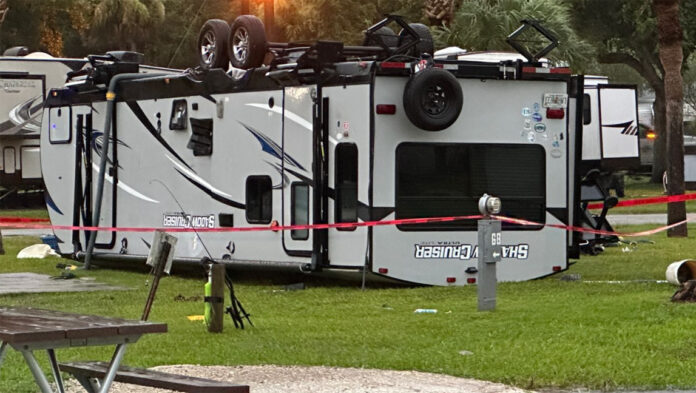
The trailer pictured above is one of five that got flipped earlier today by the winds kicked up by a relatively mild Hurricane Debby. What’s noteworthy is that this RV is in Sonrise Palms RV Park, which is in Brevard County—120 miles from where Debby made landfall, across the full width of the Florida peninsula. The owner of this particular trailer wasn’t home at the time, but the occupants of several of the other RVs in his park weren’t as lucky, with one ending up in the hospital.

Debby is plowing northward, its winds diminishing but its rain reaching double digits as it hits the low, flat coastal plains of Georgia and the Carolinas. There will be more devastation in the days ahead, but none as severe—and avoidable—as the destruction wreaked on RV parks and campgrounds. And in all too many cases, having a set of wheels won’t make one bit of difference.

Oregon a hellish RV epicenter

A perfect storm of bad ideas with potentially catastrophic consequences is shaping up in central Oregon, where the already struggling Family Motor Coach Association plans to have a four-day international convention and RV expo. The association, which has been hemorrhaging members for years but still advertises itself as “the world’s largest nonprofit association for recreational vehicle owners,” said it expects more than 700 RVs to converge on the Deschutes County fairgrounds in Redmond on Aug. 14.

Well, maybe.

Such events are planned months and even years ahead of time, so FMCA’s leadership might be excused for not knowing it would be hosting a party in a pizza oven. Then again, this is hardly unexpected. California is getting the most wildfire press at the moment, principally because its Park Fire has grown to more than 400,000 acres and is now the fourth largest in that state’s history. But Oregon is even more of a wildfire hotspot, with twice as many large active fires as its southern neighbor (25 versus 13), and this year already has had more than 973,000 acres scorched. Only two of those wildfires have been contained. The convention’s theme, “Adventure Peaks,” may have more of a dark meaning than originally intended.

You might argue that a million acres is only a small fraction of Oregon’s total land mass of roughly 61 million acres, so what are the odds that your campground will be next to go up in flames? But of course it’s not just a question of whether RVers will have a direct encounter with a fire, but whether they’ll also have to breathe its exhaust. Wildfire smoke has become an annual scourge across all of the western U.S. and Canada, and as it becomes more common, its effects on human health are getting closer scrutiny—with dismaying early findings. One recent study, for example, attributed more than 50,000 premature deaths to wildfire smoke exposure; the risk of cardiac arrests for people who have cardiovascular issues increases 70% during days with heavy smoke.

And here’s a truly sobering warning for the RVing demographic most prone to attend FMCA get-togethers: according to a decade-long study involving more than one million southern California residents, released just a few days ago, exposure to wildfire smoke poses a 21% increase in the risk of being diagnosed with dementia compared with other types of air pollution. The dangers, in other words, aren’t just respiratory or cardiac. Wildfires that tear through manmade structures, vehicles and other non-wild fuel emit smoke that contains a toxic brew of chemical compounds; its aerosolized particles, meanwhile, enable those poisons to infiltrate every part of a human body.

Nor is this sort of hazard something unusual—just the opposite. A much-publicized report this past week from The Dyrt, an online camping reservation platform, disclosed that 18% of campers reported that wildfires or other natural disasters disrupted their camping plans last year, or triple the rate of 2019. Such disruptions are even more common on the West Coast, where fully one-third of campers had their plans interrupted in 2023—as did an even larger 42% in Oregon and Washington. Ironically, The Dyrt is headquartered in Oregon, “so we’ve seen firsthand the toll wildfires have taken on the Pacific Northwest,” The Dyrt’s chief executive, Kevin Long, wrote in releasing the study. “It’s scary and tragic for so many reasons.”

For all that, however, Oregon in general and Deschutes County in particular have been grappling with proposals for several new RV parks as well as rules to allow RVs to be used as permanent rental housing. Those efforts have been given additional impetus by the U.S. Supreme Court’s decision in June upholding an Oregon town’s ban on homeless residents sleeping outdoors, which among its unintended consequences has increased the pressure on elected officials to find housing alternatives—and what’s cheaper (and more flammable) than an RV? The unresolved problem, of course, is finding a home for those RVs that’s not a city street or highway underpass.

None of this is going down well with Deschutes County residents, many of whom turned out this past week for a county commissioners’ meeting to excoriate a proposed 300-site RV campground that the county wants to build just north of Bend, at least in part as a low-cost housing solution. In addition to the standard worries about water, sewage and roads, objections also centered on growing concerns about an influx of the homeless and of an increasingly volatile natural landscape. “We need to start controlling sources of combustion out there, whether it be the homeless, people in campgrounds or fireworks,” one attendee told the board, summing up the powder-keg nature of the RVing phenomenon.

Meanwhile, a luxury RV resort being built on the other side of town, southwest of Bend, was originally scheduled to open this past spring but has been delayed repeatedly. A soft-opening of the 176-site property, the Bend RV Resort, is now projected for later this month, just in time for Labor Day—and well into the fire season. At $120 a night, this clearly is not an RV park that’s targeting the homeless as its customer base. Given current events, however, it’s also an RV park with an uncertain future—as, indeed, is true of summer camping overall.

Most recent posts

A handful of updates on past posts

The end of July marks the mid-point of the traditional camping season, although that term has become increasingly elastic and even meaningless due to the distorting effects of climate change. Nevertheless, this seems like an apt moment to hit “pause,” check back on what I’ve written in the past and provide updates where appropriate. Some stories actually do reach a resolution, but many more have a way of continuing with no clear end in sight.

Ghost Town in the Sky just won’t die

One such ongoing drama has to do with Ghost Town in the Sky, a now defunct amusement park in Maggie Valley, NC about which I last wrote nearly two years ago. The property’s greatest champion, Alaska Presley, had entered into a business partnership with a Myrtle Beach-based hustler, Frankie Wood, who sweet-talked her into naming him the managing partner of their joint venture despite his shady past. In addition to contributing the property itself, Presley apparently covered all of the venture’s operating costs; Wood’s end of the deal amounted to little more than half-baked ideas drizzled with snake oil.

Then Presley died, age 98.

Inheriting Presley’s 50% stake in the partnership was her niece, Jill McClure, who cast a notably more business-like eye on its affairs. It didn’t take her long to conclude she was holding one end of a snake—and not the business end of it, either. The upshot was a lawsuit seeking to dissolve the partnership, filed in North Carolina’s Superior Court, alleging that Wood had breached his fiduciary responsibilities and thus was putting McClure’s interests at risk. Given Wood’s history to date, that would have seemed like a slam dunk.

But no. Ruling more than 18 months after the case was filed—in part because of numerous filing extensions requested by Wood, earning a judicial rebuke for “litigation by ambush” that nevertheless had no effect on the final decision—Special Superior Court Judge for Complex Business Cases Adam M. Conrad concluded in mid-May that McClure didn’t have a case. The legal arrangement to which Presley had agreed, and which McClure had inherited, clearly specified that Wood “is the sole managing member of Ghost Town in the Sky and that it has unilateral authority under the operating agreement to manage the company’s day-to-day affairs without McClure’s consent.”

That “management,” as the decision also observes, includes four years in which the venture “did not secure financing, earn income or hire employees.” Since Presley’s death, it also includes non-payment of 2022 and 2023 property taxes. No matter. As Judge Conrad sees it, there is nothing extreme enough to merit an involuntary dissolution of the partnership—which leaves Wood still at the helm, Ghost Town in the Sky even more of a moldering heap than it was four years ago, and McClure gamely telling a local reporter, “I’m moving forward with a positive attitude.”

Stay tuned.

Cacapon locals knock out two RV parks

While Maggie Valley refuses to give up the ghost, a two-fisted attempt to put an RV park in or next to Cacapon State Park, West Virginia, finally appears to have been defeated.

The first such effort, as I wrote a year ago, featured an overly cozy relationship between state officials and Blue Water Development and their efforts to build an RV campground with more than 300 sites in the state park. The proposal quickly generated fierce local opposition from park advocates and local residents, who objected to its size and the amount of traffic it would generate in a rugged area notable for its narrow roads and rustic vibe. As more details emerged of Blue Water’s backdoor maneuvering, the whole idea became politically untenable and ended up getting axed.

But that only made way for a competing proposal that had already been floated as an alternative to the state facility: a 50-acre private development adjacent to Cacapon State Park, with up to 241 sites for RVs, cabins, yurts and tents, as well as such mega-park amenities as a swimming pool, bathhouse, mini golf course, sports courts, dog parks, several pavilions and food truck areas. Ironically, as local opponents worried that the “oversized RV campground” would scar a panoramic viewshed rated by National Geographic Magazine as “one of the top 5 scenic views in the East,” the developer of the proposed campground was . . . Scenic LLC.

Despite boisterous public hearings that divided the Morgan County Planning Commission, all needed permits were approved and Scenic LLC seemed set to proceed. But then the months rolled by and nothing seemed to be happening, encouraging the opposition to renew its battle. In late June, more than two dozen local residents showed up at a planning commission meeting to demand a reconsideration, with some accusing commissioners of “selling out” the community and the commissioners responding that the project had met all county guidelines for commercial development, so what else could they do.

And then, just like that, it was over. Two weeks ago, Aaron Bills, Scenic’s principal owner, announced that he is stepping away from the project. The plan had been to seek a KOA franchise for the property, but apparently the price tag was too steep. This is “shockingly bad timing for finances,” Bills told county officials, according to the Morgan Messenger. “As a family, we’ve decided we can’t deliver on a KOA-branded campground”–indeed, he added, would the county be interested in buying the property for itself?

Danville’s casino-related RV park craps out

A 333-site Roman-themed RV park in Danville, VA, proposed last year by  J. Cubas Holdings of Coral Gables, Florida—which, not incidentally, has absolutely no experience in operating an RV park of any size, much less an avowed “high end” operation—is no more.

After the neighbors rose up in arms for any number of obvious reasons, Cubas switched gears and said early this year he’d build a bunch of new homes, priced between $300,000 and $350,000. Ironically, he’d held that out as a threat against the city if it refused to permit his RV park—only to have the city elders say that more housing is exactly what Danville needs. “Folks moving here, they need somewhere to live and there’s only so many places you can build new developments, so we’re happy to have this moving forward,” explained city councilman Lee Vogler.

Plus here’s another bonus: putting the kibbosh on Cubas’ “Palace Resort” also deep-sixed his plans for an annual biker rally that he promised would rival those of Sturgis, SD and Orlando, FL.

Reservation software getting regulatory stink-eye

As public officials learn about the price-fixing potential of algorithms used by centralized reservation software systems, first extensively detailed by ProPublica two years ago, they’ve started erecting legislative constraints at the national level. Now that’s filtered down to the local precincts: yesterday, the San Francisco board of supervisors adopted the country’s first local ordinance banning landlords from using certain software to set rents.

According to CBS News, the measure bans the sale and use of software “which combines non-public competitors’ data to set, recommend or advise on rents and occupancy levels.” Doing so, said the ordinance’s sponsor, amounts to “automated price-fixing.”

Yes, that’s only one city, and a decidedly liberal one at that. And yes, the ordinance applies to rental apartments only. But it’s not much of a leap to see how the same concerns can apply to widely shared campground reservation systems, like CampSpot, which aggregate user data and enable “individual campground owners to compare their metrics, such as average daily rates, occupancy rates and revenue per available site, with what everyone else is doing—and to make adjustments as desired.”

Sooner or later, the anti-trust police may take notice.

Frank Rolfe is at it again—but badly

Finally, scarcely more than two months after an email blast soliciting customers for his misleadingly titled RV Park University, Frank Rolfe is at it again, still hyping his “RV Park Investor’s Boot Camp.” This broadside, like the previous one, touts his 30 years of experience “building one of the largest portfolios in the U.S.”—experience that can be yours for only $997. “That’s for roughly 20 hours of video,” he writes. “And that’s a true bargain investment in your education on this sector.”

Okay. Pretty standard Frank Rolfe fare thus far. But embedded in the email is a link to a video that’s supposed to seal the deal, “Unlock RV Park Investment Success,” under the equally problematic headline, “The RV Park Boot Camp Is The Gold-Standard.” The first half of the two-minute video is Frank giving his sales pitch. The second half, without anything resembling an introduction, apparently is supposed to highlight one of Frank’s investment successes: the Mission Bell-Trade Winds RV and Mobile Home Resort, deep in the heart of Texas.

This is, as you might glean from the name, not an RV park but a long-term residential mixed-use development catering to retirees (“Homeownership Made Affordable”) and snowbirds. The residents, by all accounts, are a cheerful and welcoming bunch. The place itself is a dump, showing its age and in a generally run-down condition. Its website, where the only items under “news” urges readers to check out “the exciting events of the 2022-2023 season,” is just as outdated.

Judging by this example, Frank’s boot camp deserves the boot.

RV bluegrass is seriously out of tune

This is what the Kentucky Bluegrass Experience Resort will look like—or maybe not. NadiGroup’s site plan, as well as all of its other photos and documentation, seems to have vanished from public view.

Bluegrass: now there’s a multi-layered word. It can refer to a musical style popularized by Kentuckian Bill Monroe, not unlike country music but consisting entirely of stringed instruments. It can refer to the lush grass covering much of Kentucky’s rolling hills, giving that state its nickname. But these days it also can mean a battleground pitting real estate developers against that other Kentucky icon, its thoroughbreds.

A proposed mega RV park calling itself the Kentucky Bluegrass Experience Resort (KBER) is now entering its fifth year of laying siege to the town of Midway (midway between Frankfort and Lexington) and the surrounding county of Woodford. First floated to Midway officials in June of 2020, the massive $40 million project thereafter slid rapidly from ready acceptance to growing horror at its scope and environmental impact, to permit denials and a lawsuit, and now to greater secrecy by the developers about just what it is they’re contemplating. Adding to the intrigue: while KBER’s access road and a chunk of its acreage are in Woodford County, an even larger piece of the property is on the other side of a creek, in adjacent Scott County—and the two jurisdictions could scarcely be more dissimilar in their views on economic development.

Now things are coming to a head, as KBER’s developers look to surmount a final regulatory barrier by seeking a zoning change in Scott County that would allowing recreational development of 96.9 acres currently reserved for agriculture. The county planning commission originally scheduled a July 11 vote on the application, but that’s been moved to August 8. And in the interim, local resistance has steadily mounted, this time spearheaded by the area’s thoroughbred farm owners, some of whom have property adjoining to KBER’s parcel but who despite that proximity only now are recognizing they face an existential threat.

“Horses need a place that’s quiet. There’s just no way we can survive if that RV park goes in,” Foxbrook Farm owner Jason Tackitt told T.D. Thornton, of the Thoroughbred Daily News. “Anybody who raises thoroughbreds knows that you can’t have noise and disruptions. Noise changes horses’ sleeping patterns and it affects pregnant mares. We can’t have that.” Should the KBER project actually go through, he added, he won’t have any recourse but to move his 20 thoroughbreds, probably to Florida—as will many of his neighbors, a prospect he simply can’t fathom. “If something like this happens to you, it’s like a slap in the face. It’s like people saying, ‘We don’t value horse-raising in this area.'”

That KBER would have a major game-changing impact on the area is undeniable. As originally proposed, it would have placed 818 RV sites, 155 cottages, 15 spots for employee accommodations and 37 rustic tent sites across 240 acres split by the ox-bowed Elkhorn Creek, creating one of the ten largest RV parks in the eastern U.S. But that’s not all. In addition to the usual campground amenities, like an aquatic park, sports courts and game room, KBER’s developers planned to lean into its “resort” aspirations with a business center, a fitness and yoga center, spa services, food services with seating for 400, a 525-person capacity amphitheater and an educational center with a 100-person capacity. The “bluegrass experience” theme was to be served with a farmer’s market of local produce, equestrian trails and a bourbon-tasting room. There would be golf car rentals, mini-golf and mini-bowling, kayaking, perhaps a lazy river . . . .

That was the original plan. What it is now is anyone’s guess, although some permutations can be traced. When Midway’s town elders finally understood the immensity of what was being proposed, they threw up the only roadblock available to them by denying the project’s application to hook into the town’s sewage treatment plant. KBER responded by applying for a state permit to build its own treatment plant, assuring county officials that it had severely reduced the project’s footprint—“in response to criticism that that proposal was ‘too big'”—by withdrawing plans for developing its 142 acres in Scott County. The downsized, more modest KBER would have only 390 RV sites and 82 cottages, all on Woodford County’s side of Elkhorn Creek.

But KBER’s application for the Scott County portion of the property was only “postponed,” according to that county’s planning commission. So, bogus claim. And when Woodford County wouldn’t relent, KBER simply shifted the site for its proposed sewage treatment plant across the creek, to Scott County—a jurisdiction that’s home to the world’s largest Toyota Motors’ manufacturing plant, and one with clearly more receptive views of large economic projects than its agriculturally-fixated neighbor. And while Elkhorn Creek had been severely polluted decades earlier by raw sewage from a trailer park treatment plant, resulting in a Scott County ban on private treatment plants in the area—well, times change. Memories fade. Economic imperatives demand the benefit of the doubt.

“There are RV parks all across the United States that are generating opportunities, and I have concerns about cutting that opportunity out because of negative issues in the past,” asserted a Scott County regulator last fall in a lead-up to that county’s eventual approval of KBER’s application, summarizing the new attitude.

That would have seemed to be that, had not that pesky rezoning matter started edging into local awareness. And as it did, KBER’s neighbors who had been oblivious to what was going on belatedly woke up, and nowhere more so than in the thoroughbred farming community—which, yes, recognizes that it’s been asleep at the switch. As Thornton wrote in his extensive article in Thoroughbred Daily News: “Although Tackitt said opposition to the RV park is now at a can’t-miss level within the community because of roadside signage, mass mailings, and online social media groups devoted to stopping the development, he acknowledged that some abutters [those whose property abuts the KBER parcel]—including himself—didn’t immediately pick up on the threat.”

Now, as Tackitt and the other breeders interviewed by Thornton scramble to defend their way of life, KBER’s promoters have gone dark. In sharp contrast to early days, when project owner Andrew Hopewell and local real estate broker Joey Svec were glad-handing local officials and mounting a full-court publicity blitz about the economic benefits of their idea, these days . . . nothing. Hopewell ghosted Thornton’s efforts to get a response to community concerns. A wealth of online information about the project has disappeared. The number of proposed RV and other sites now varies from one public account to another, and an initial project cost estimate of $40 million—after a four-year delay—almost certainly is too low, raising questions of how the bottom line will pencil out.

But perhaps the most disturbing void in all the publicly available information is the disappearance of the Kentucky Bluegrass Experience Resort from the NadiGroup website. The Nadi-designed site plan at the top of this column was just one of the many documents once available from the Canadian design firm, as it unabashedly showed off the most ambitious of its many RV park projects—gone. Nowhere to be found. And with no public explanation of such a disappearing act, leaving open to conjecture just what changes KBER’s plans are undergoing, and what further effect those plans will have on Kentucky’s horse country.

The Aug. 8 meeting in Scott County promises to be one helluva bluegrass experience, all right (cue the strings)!

Scrambling to insure Florida parks

In the aftermath of Hurricane Ian, 2022

Back in April, when Beryl wasn’t even a glimmer on the horizon and as national campground leaders continued to pretend they can do business as usual, I wrote about the especially dire situation in Florida. This is a state, after all, that has a front-row seat for the some of the most devastating hurricanes to afflict the northern hemisphere, a state that with an average elevation of just 100 feet above sea level poses no more than a speed bump for the increasingly savage maelstroms periodically pounding the peninsula. How do RV park owners cope with such a growing threat? Where do they turn for some measure of relief?

Piquing my interest was a half-page ad in an industry publication placed by K&K Insurance, advising readers that it “protects campgrounds with coverage designed for your unique needs”—mostly. Because even though the ad specifically stated that K&K is a licensed insurance producer in all states, the ad just as specifically stated that its campground coverage “is not available in Florida.” Only Florida. California and its wildfires, the entire Midwest and its tornadoes—hell, even Texas and its comparable hurricane and tornado exposure were not singled out for exclusion. Isn’t that special?

Nor is K&K an outlier. Indeed, property insurance has become so prohibitively expensive in the Sunshine State, when it’s available at all, that even the most resolute climate-change deniers have been forced to confront the one thing everyone understands. Think what you want about internal combustion engines and carbon dioxide and the greenhouse effect, but airy-fairy opinions don’t stand up well against the remorseless logic of cold, hard cash. When your business is on the line and every hurricane season means a fresh roll of the dice as to whether you’ll make it to December—well, what’s that saying about atheists and foxholes?

It therefore isn’t entirely surprising, although still to its credit, that the Florida-Alabama RV & Campground Association has taken a tentative first step toward dealing with a seemingly intractable problem. As recapped on its website, the association has started exploring the possibility of creating a captive insurance company—an insurer, as the name implies, that is owned and controlled by its customers. In one sense, this amounts to self-insurance on a grand scale, dispersing risk over a wider base than would be possible if each campground set aside only its own reserves. In another sense, a captive insurance company would be an attempt to insulate its members from wider market forces, such as “changing investor appetites,” which the association blames in part for its plight.

To make its case, the association recently hosted a “virtual Q&A” with Austin Gaines, a partner in Alabama-based insurer Starke Agency, and is currently seeking expressions of interest from its members. But while the session detailed the benefits of a captive insurer, including more control over insurance costs, profit retention and customizable coverage, it provided only a sketchy description of the downsides, diplomatically labeled “challenges and considerations.” Most notably that includes substantial up-front capital contributions, which Gaines apparently did not enumerate—although, to be fair, how much those might be will depend on how many campground owners sign up. “Economies of scale are crucial,” he said, noting that “the more members and premium dollars a captive has, the lower the fixed costs per member.”

Radical though such a concept might seem to some, it’s actually just an example of history repeating itself. Evergreen USA was the insurance company for campgrounds and RV parks for more than 20 years, created in 1989 with investments from privately owned campgrounds because conventional insurers didn’t know how to assess the risks of a relatively exotic business they didn’t understand. That’s a lot like the concept being examined in Florida, although Evergreen was set up as a risk retention group, which is similar to a captive insurance company but with several key differences that the Florida association might also consider exploring.

Evergreen, meanwhile, is no more: it shuttered its doors a decade ago, a victim of those same “changing investor appetites” that prompted the stuffy insurers who had turned up their noses at an upstart industry to suddenly decide this was a hot new product line, after all. Now the pendulum has swung the other way, and Florida won’t be the end of it. Other states, as alluded to above, have at least as perilous a risk profile as Florida’s, with their RV parks having just as many problems obtaining affordable insurance. At least California and Texas have the advantage, as in Florida, of having their own independent, active and well-subscribed state associations through which to raise the issue and explore solutions with their members.

The same can’t be said of the great swath of the country’s interior that gets pummeled by tornadoes, flooding and hail the size of softballs. Many of those states, like Iowa, Oklahoma and Arkansas, don’t even have state associations. Those that do, like Missouri, Kansas, South Dakota and Illinois, are too small to shoulder the burdens imposed by self-insuring, and the umbrella organization that should be filling the void, OHI (formerly the National Association of RV Parks and Campgrounds, or ARVC), is too busy rebranding itself as a marketing and lobbying group for the “Outdoor Hospitality Industry” to notice what’s happening at the grassroots level. Crippling weather events? Unaffordable insurance rates? OHI doesn’t recognize these as problems in any sort of public way, other than to periodically issue requests for contributions for campgrounds that have been pummeled by the latest weather outrage.

The route Florida has chosen is a tough slog, starting with having to convince individual campground owners to cough up a whole lot of paperwork and financial records going back at least five years so that valuations and risk can be properly assessed. But clearly something has to change, and the notoriously self-reliant campground industry just may be up to the challenge. Or as the Florida association’s recap concludes, the “captive insurance solution holds promise of stabilizing and potentially reducing costs for its members.” It’s been done before. Could be, it’ll be done again.

Full-timers add to election denialism

It’s depressing to realize, in this age of political extremism and escalating threats to democratic governance, that among the most blithe contributors to this sorry state of affairs are full-timing RVers. Not all full-timers, I hasten to add. Just those who think that their chosen lifestyles as so-called “travelers” should exempt them from fundamental civic obligations while leaving their civic rights intact—even as that attitude further chips away at voter confidence in the integrity of our elections.

I’m talking, of course, about the arrogance reflected in stories such as this one, “South Dakota county moves to restrict voting rights for full-time RVers,” which was published by RVtravel a couple of days ago. Written by Nanci Dixon, reprising her laments of last year about being called for jury duty by a state in which she doesn’t live, the piece continues her tendency to assume nefarious motives where none have been proven and to insist that full-time RVers are being disenfranchised simply because they are rootless—or as she prefers to think of herself, “full-time travelers.”

Let’s start with the latter fiction. Dixon winters in Arizona and spends her summers work-camping, which is to say, for most of each year she’s putting her roots down in one place or another. That’s not to say that she doesn’t travel, but it is to say that the travel is largely incidental to her getting from one semi-permanent campground site to another. Dixon is not a “full-time traveler” as much as she is a full-time RV-dweller, and while there’s nothing wrong with that, it should be noted that South Dakota apparently is not one of those semi-permanent dwelling places.

South Dakota is, however, the state Dixon and thousands of other full-timers have claimed as their official domiciles for unabashedly self-serving reasons, chief among them the absence of a state income tax or a personal property tax on vehicles. You, too, can have such perks. All you need is a couple of hundred bucks to rent a mailbox at one of a handful of the state’s mail-forwarding services, spend a night in town to nail down your status as an “official resident,” and just like that you’ll have everything you need to get a South Dakota driver’s license—and until last summer, the voter registration that came with it.

But the problems with that loosey-goosey arrangement, as I detailed a year ago, should be readily apparent, and especially in an age when ensuring voting integrity is all the rage (and I do mean rage). Concerned about the potential for abuse (one fanciful scenario contemplated thousands of liberal Minnesotans driving into the Republican state for a 24-hour stay and the opportunity to sway an election), the South Dakota legislature last year adopted new rules requiring voters to attest they’d actually lived in the state f0r 30 days or more in the year prior to voting.

Such a requirement isn’t unique—Alaska, Illinois and Nevada, among others, have similar residency rules—but it does pose several problems. The most obvious is that while South Dakota has an understandable interest in restricting voting on state and local issues to state and local residents, the residency requirement puts arguably unconstitutional limitations on voting in national elections. A more pragmatic problem is simply one of enforceability: how can election officials determine whether the residency requirement has been met? For that reason alone, a similar law was enacted and then repealed after just a year more than two decades ago.

Yet there’s also little question that South Dakota—and presumably other states that offer mailbox residency, notably Texas and Florida— has a problem. Approximately 60,000 out-of-state vehicles were registered in South Dakota five years ago, and that number undoubtedly has since increased. More than 6,3000 people are registered to vote at the address of mail-forwarding company Americas Mailbox in Box Elder, while as many as 1,400 registered South Dakota voters “live” in the mailboxes of My Home Address in the town of Emery—or roughly three times the town’s actual population. That’s a whole lot of imaginary residents capable of creating very real election havoc.

Now that problem has erupted, following a June 4 primary in which two candidates lost by a small margin—a loss quite possibly affected by election officials, citing the new residency requirement, declining to count 132 ballots that had been cast by people registered with a mailbox address. The ACLU of South Dakota has jumped in, challenging that decision but also demanding that no “improper challenges will be entertained” during the Nov. 5 general election, paving the way for even more election denialism in the months ahead. “South Dakota has been heralded as the freest state in the nation,” the ACLU thundered with questionable assurance in a June 21 press release, “but restricting access to one of the most fundamental rights we have as Americans—participating in our democracy through voting—strips residents of the freedom to take part in our elections.”

Residents? Really?

To be sure, this is a problem of South Dakota’s own making. But it remains a problem because of public pressure from libertarian RVers and screeds like Dixon’s. Contrary to the headline, South Dakota is not moving to restrict the voting rights of full-time RVers, but of people who don’t live in their state while pretending they do. Dixon could always register to vote in Arizona, and perhaps should, since that’s where she spends a big chunk of her time—but that would mean shouldering the civic responsibilities that come with it, such as paying Arizona taxes and serving Arizona jury duty.

Far more lucrative to go venue shopping for states that allow a disconnect between rights and responsibilities, loading up on the former, disregarding the latter and taking offense when asked how it became socially acceptable to be a freeloader.

Fiddling while California burns

California is burning once again, after a two-year hiatus, with something like 200,000 acres already turned to charcoal—and here it is only mid-July, with three to four months of fire season still ahead of us. The state’s property insurance premiums are getting hiked by 30% or more a year. Wildfire smoke, according to a National Bureau of Economic Research (NBER) analysis released in April, is contributing to nearly 16,000 deaths annually across the U.S. as a consequence of large wildfires in the western U.S. and Canada.

Alarming, right? The kind of apocalyptic onslaught that would have any thoughtful outdoor industry leadership publicly fretting about a proper response—but hey, this is California, long renowned for living in an alternative reality. So when Dyana Kelly, president and chief executive of the California Outdoor Hospitality Association, recently took figurative pen to paper to address the burning (sorry) issue of the day, it was to go after . . . the organization formerly known as the National Association of RV Parks and Campgrounds (ARVC). And not for anything having to do with weather, wildfires, insurance rates or other existential threats to the RVing lifestyle, either.

No, what ruffled Kelly’s feathers was ARVC’s temerity in rebranding itself as OHI, or Outdoor Industry Hospitality, which aside from being an awkward three-legged stool of a name is strikingly similar to CalOHA, which is how Kelly’s organization usually styles itself. The rebranding is not news—it happened early this year—but Kelly greeted it as though it were, sarcastically congratulating ARVC for moving “away from the standard membership of RV parks and campgrounds by partnering with Hipcamp and allowing non-permitted parks, dispersed campgrounds and possibly even backpacking locations (as indicated by their release video) into membership.” Ouch.

This kind of frontal assault in an industry of glad-handers and back-slappers was notable enough for RV Business to seek Kelly’s permission to reprint her broadside, originally written for CalOHA’s members. But to be fair, Kelly was only playing tit for tat: it wasn’t all that long ago that ARVC took legal action against the California association after it dropped its affiliation with the national group but retained the CalARVC name. The similarity, ARVC contended, was causing “confusion” for park members. So rather than get embroiled in a trademark tussle, the Californians switched to CalOHA—only to now find their roles reversed.

“Is there confusion,” Kelly wrote, reprising ARVC’s earlier complaint. “YES. A number of parks have called to inquire about an invoice they received recently from ‘CalOHA’ when it was actually a well-disguised invoice from OHI.”

Yes, of course this is a problem—but not, I’ll submit, as big as the problem that both CalOHA and OHI are resolutely ignoring. Bookkeeping confusion pales beside the fundamental climate threat to RVing’s business model, which if nothing changes will make the current contretemps seem more than just a bit precious. And quite irrelevant. But both organizations are carrying on as though it’s business as usual—nothing to see here!

If Kelly wanted a truly righteous fight to pick on a national stage, she’d take ARVC/OHI to task for its history of climate change denial. This is an organization whose official policy maintains that there is still “considerable uncertainty surrounding the theories on climate change,” so much so that the only responsible thing to do is “more research, data collection and scientific analysis” before changing emission standards—or, indeed, doing anything at all that might have an economic impact on the industry. Of course, that economic impact is felt more severely with each passing year precisely because of such a don’t-rock-the-boat approach.

Yes, that would be a righteous rumble, but also a hard slog. And not nearly as satisfying as a quick and dirty couple of jabs over something as relatively meaningless as what we choose to call ourselves.

When big RV parks face Big Weather

Extreme weather season, exemplified by forest fires, hurricanes and tornadoes, is upon us, and in its crosshairs are three of the biggest RV park proposals ever conceived. Yet one of those projects has given no indication that it’ll be deterred by something so banal, a second is officially still on track but threatened by non-weather related developments, and the third has gone AWOL.

The AWOL project is KOA’s proposal for two camping resorts on more than 900 acres straddling State Highway 140, a major access road to Yosemite National Park. The two resorts were to have more than 400 RV pads, 25 to 50 tent sites, 80 to 90 “conditioned glamping units” under KOA’s Terramor label, abundant amenities and a workforce of approximately 100, also housed at the site. In other words, KOA’s plans called for constructing the equivalent of a small town with a peak population comparable to that of the nearby existing town of Mariposa.

Or at least that’s what KOA was proposing, well more than two years ago (more context here, here and here). A preapplication it filed in early 2022 was followed that June by a “coffee and conversation” meeting with local residents that was supposed to assuage their apprehensions but raised more questions then it answered. Mere weeks after that, in late July, the Oak Fire sprang up almost literally next door and swept through 19,000 acres—less than a mile west of the even larger Ferguson Fire of 2018, which had ravaged 97,000 acres. KOA thereupon fell silent on the whole grand scheme, neither following up on its preapplication nor announcing it was dropping its plans.

This week the fire came roaring in from the other side, and while at this writing the French Fire is still considerably smaller than its nearby predecessors, it’s fierce enough to put the entire town of Mariposa under a mandatory evacuation order. A video on Facebook showed “the entire mountain above the high school” on fire, State Highway 140 was closed on Thursday and approximately 3,500 customers had lost electric power as of yesterday. This afternoon the blaze was nearing 1,000 acres but also was 25% contained, raising hopes that further damage could be limited.

Still, this will hardly be the end of it. Yesterday’s heat in California was so extreme that Palm Springs hit a record 124 degrees, a Death Valley extreme—or was, once upon a time. Fourteen wildfires have ignited in California in the first five days of July; 145,000 acres have burned in the state this year, which is more than four times the five-year average for this date. One can only hope that KOA’s brain trust, reluctant though it might be to overcome institutional inertia, is looking at the same statistics and trend lines and concluding that no, maybe this wasn’t such a good idea, after all. And maybe at some point they’ll let everybody else know the same thing.

Elsewhere, as Hurricane Beryl plowed across the Yucatan Peninsula and seemed poised to hit Texas tomorrow night, coastal residents could console themselves with the thought that at least it no longer was the Category 4 and 5 storm it had been when it thrashed Jamaica, Barbados and other Caribbean islands. Yet Beryl already has made history as the earliest Category 5 ever to form in the Atlantic, and its early emergence portends an especially active and severe hurricane season that should put all Gulf Coast communities on high alert.

But that seems to be of no concern to the developers of a 400-acre RV park in Jackson County, Mississippi, who early last month defeated a court challenge to their plans filed by nearby property owners concerned that the development would “destroy the residential nature” of their community. Those neighbors aren’t necessarily wrong: Ocean Springs Islands RV Resort is projected to include 476 RV sites, 20 rental Airstreams, 16 elevated “tree houses,” a lazy river and a whole lot more, and all accessed by a single two-lane road that connects the two halves of that larger community, Gulf Park Estates. That means there’s going to be a lot of new people in town, and a lot of new traffic running through that narrow bottleneck.

Yet even as the court hearing was in progress, workers at the resort site were still cleaning up debris from Hurricane Katrina—from 2005. Seven years prior to that, Hurricane Georges had rolled over the property with a 10-foot storm surge (more context here). Nothing surprising in any of that, given that the site sits on a flood zone on Davis and Simmons bayous and the Mississippi Sound. But local residents, presumably because they face the same dangers and therefore are as willfully unable to confront them, couched their objections entirely in terms of zoning regulations. Of the increasingly high possibility of devastating winds and floods, not a word. Of the mayhem that will result when all those new neighbors try to evacuate along the same narrow road as the old neighbors, also not a word.

Finally, the hubristic $2.5 billion American Heartland Theme Park and Resort—to include the 320-acre, 750-site Three Ponies RV Park and Campground—dodged several weather bullets the past couple of months despite being sited smack in the middle of a busy tornado thoroughfare in northeastern Oklahoma (more context here). The bullet it didn’t miss? A $5.5 million lien filed by a Canadian firm the developers had hired to design the mammoth project, for allegedly unpaid invoices for work it had done through January. The filing came as the Oklahoma legislature was considering a $35 million request from the city of Vinita to upgrade its utilities to accommodate the project, so not a good look.

The allegedly unpaid work, coupled with a 25% increase in projected costs, lagging construction and unspecified delays in the completion date, have only increased skepticism that the developers—who have no previous amusement park experience—are in over their heads. “I hate to see the governments and the local communities and people spend a lot of money and get behind this because it’s just not realistic,” Dennis Spiegel, chief executive of International Theme Park Services, told a local news outlet. “It just won’t work there, OK? I’ve done this all my life. . . . And we do feasibility studies all the time, and we know the market. It just isn’t there.”

All of which may well be true, but which again avoids acknowledging the even more sobering facts on the ground: that Vinita has a tornado index value of 352.83, or two-and-a-half times the U.S. average, and just might not be the place you’d want 3,000 people setting up their travel trailers. It is, however, entirely consistent with an industry that despite being built around the idea of getting people into the Great Outdoors, pays little to no heed to what the Great Outdoors may do to them. Moreover, it’s also an industry that keeps thinking bigger is better, or at least more profitable, and so those efforts include piling up more people in a more concentrated area, with predictably greater carnage when the inevitable happens.

At some point, maybe we’ll recognize that something fundamentally different is going on—something that requires us to think and make decisions in a fundamentally different way.