
For some RVs, the sky’s the limit

Yes, there really is a Winnebago logo on that helicopter.

Given that many, many RV owners still think an electricity-powered RV is the stuff of science fiction, it’s perhaps surprising that a decidedly more outlandish concept was dropped into a panel on the subject last week without any comment.

The speaker was Ashis Bhattacharya, Winnebago Industries’ senior vice president for business development, strategy and advanced technology, so no slouch about technological development in the RVing world—even if he was off by a couple of decades. Speaking at an RV Industry Association webinar on the development of EV-RVs, Bhattacharya asserted Winnebago’s innovation chops by mentioning that the company had introduced a helicopter RV perhaps 25 years ago.

The comment apparently flew over everyone’s head. But if a first-tier manufacturer could add wings (okay, rotors) to the RVing concept, surely switching from a gas-driven technology to an electrified one can’t be too much of a stretch?

Not that Winnebago actually built its “Heli-Campers”—later changed to “Heli-Homes”— from the ground up, any more than it builds RVs from scratch today. But it did partner with Orlando Helicopter Airways, which in the early to mid 1970s was buying surplus military Sikorsky S-55s and S-58s for various civilian purposes. Half-a-dozen or so were furnished by Winnebago with a full galley with stove and refrigerator, twin water heaters, air conditioning and a furnace, a bathroom with holding tanks and shower, and sleeping arrangements (in the larger of two models) for six. Also included were a color TV and an eight-track tape deck (because, remember, the mid-’70s), a mini-bar, full carpeting and sound-proofing, a generator, an awning and, for a few extra dollars, pontoons for landing on water.

Heli-Camper performance numbers were more than competitive with today’s rolling homes: with a dry weight of 9,200 pounds, the flying Winnebagos could carry up to 3,000 pounds, had a cruising speed of 110 mph and a range of more than 300 miles. Plus, of course, the whirlybirds could access the most remote and trackless wilderness, outdoing even the gnarliest four-wheel drive RVs in search of boondocking heaven.

Only two stumbling blocks prevented the Heli-Camper from becoming a ubiquitous overhead annoyance in the backcountry. One was the price tag, which ranged from $185,000 for the base model up to $300,000—or between $1 million and $1.65 million in 2022 dollars. Even in a world of luxury Class As starting at more than half-a-million, that’s a lot of dollars.

Then there’s the little matter of knowing how to, you know—actually fly a helicopter. Winnebago tried to finesse that issue by creating a rental option for campers who wanted to hire a pilot, but even that was a pricey alternative, at $10,000 a week plus the pilot’s fees and cost of fuel. And then, of course, there was the whole sticky issue of what to do with that pilot once you reached your week-long retreat far from civilization. Perhaps it’s not surprising that neither sales nor rentals really took off, so to speak.

Still, if Winnebago was willing to take a shot at flying RVs, perhaps it’s only to be expected that today it would be at the forefront of the EV-RV ramp-up. At least with EVs the customer base is considerably larger, the cost per unit is a lot more within the public’s means, and there’s every reason to think that the technology will see constant improvement even as costs get driven down.

And then there’s this: those quiet and exhaust-less RVs will be a whole lot easier on the landscape than fleets of transport helicopters would have been, descending on whatever paradise you’d found. There’s good innovation, and then there’s the other kind.

Most recent posts
More electrifying news for RVers

A pair of webinars this past week, one hosted by the RV Industry Association and one by the National Association of RV Parks and Campgrounds, underscored how seriously the campground world views the oncoming onslaught of electric vehicles. While campground and RV owners remain mostly skeptical, questioning the costs, range, recharging availability and environmental impact of a lithium-based technology, industry leaders are unwavering in their belief that the EV-RV revolution is already here and that the problems others see are either overblown or will be resolved in timely fashion.

“We are really at an inflection point which is amazing,” Ashis Bhattacharya, senior vice president for development and advanced technology at Winnebago Industries, told his RVIA audience. A “wave of electric adoption” is already washing over rental car agencies, delivery services such as Prime, UPS and FedEx, as well as school buses and other municipal vehicle fleets, all of which is normalizing the technology. The paradigmatic shift already underway, Bhattacharya added, is as significant as any ever experienced in the transportation sector.

Meanwhile, said Jay Landers, RVIA’s vice president of government affairs, state initiatives to outlaw internal combustion engines are giving the entire EV sector a kick in the pants. Five states, including California, already have voted to ban sales of new internal combustion vehicles by 2035, and others are looking to possibly follow suit. The state of Washington, which had the country’s sixth highest rate of RV shipments this year, is even more aggressive, adopting a 2030 cutoff deadline. Furthermore, expansion of the EV charging network nationwide is being super-charged by $5 billion in federal funding approved earlier this year.

None of which, all speakers agreed, is to minimize the problems confronting EV in general, and EV-RVs in particular. “The (EV) technology is still more expensive than what it’s replacing,” conceded MacKay Featherstone, Thor Industries’ senior vice president of global innovation. Moreover, he added, “the charging experience is utterly critical” and still inadequate for RVers in particular, both because most RVs need pull-through charging stations to be practical and because they have larger power needs than EV cars.

To their credit, RV manufacturers, frequently criticized for shoveling out hundreds of thousands of RVs without giving a thought to where their buyers might use them, are at least trying to get out in front of this development. And there is little reason to doubt that a society-wide change is coming, and coming hard. EV-RV costs inevitably will come down as sales take off, as they do with any emerging technology. Alternatives to lithium batteries, using less exotic minerals, are being developed, and advances in recycling technologies will further ease environmental concerns. Similarly, ongoing improvements in battery density will continue to expand vehicle range, relieving one of the biggest consumer anxieties about EVs.

The weak link, however, appears to be the RV park and campground end of the product chain. The RVIA webinar inadvertently made that point when its campground representative on the panel—Toby O’Rourke, president and CEO of KOA—was so unintelligible that she had to be dropped from the screen, apparently because she was trying to link in from an airport. (And why O’Rourke, again? Is there no other campground industry representative who can speak to the industry’s issues? Maybe someone from the Yogi franchise, or ARVC, or one of the other large state RV park associations, like Texas or California?)

Subbing in for O’Rourke was Brandi Simpson, her chief of staff, whose faltering contribution was to assert that campground owners are dealing with “a ton of misinformation” about EVs and need a lot of education and guidance. Which, presumably, KOA is scrambling to provide. . .

. . . as is ARVC, which lustily beat the drum on behalf of EV-RVs at its national conference in early November, and again at an hour-long webinar a couple of days after RVIA’s face-to-face. Pitched as “a recap of the best” of the conference for those who might have been unable to attend, the session inexplicably ignored the most contentious convention issue—a proposal to adopt industry-wide “standards”—while devoting the majority of its time to further promoting the idea that campgrounds need to get on the EV bandwagon, starting with the installation of EV chargers.

All of which is undeniably true, but far more nuanced and with many more questions than have been answered to date. For example: both webinars referenced possible tax breaks and federal grants to defray campground costs for installing chargers, while glossing over the reality that such inducements will require making the chargers accessible to the general public, and not just campground guests. Getting equally short shrift were any explanations of the occasionally mentioned “partnerships” that campgrounds might have to accept, whether with public utilities or third-party providers, to deal with licensing and infrastructure issues, since electric sales are typically a utility monopoly and EV chargers require robust additional power supplies.

(On a related note: one of the biggest frustrations for many KOA franchisees has been the parent company’s insistence on taking a 10% cut of all site fees—including any electric charges, even though campgrounds are legally prohibited from making a profit from reselling electricity. To the extent that EVs will increase electricity consumption at RV sites, that means even more unearned money transferred from franchisees to corporate headquarters.)

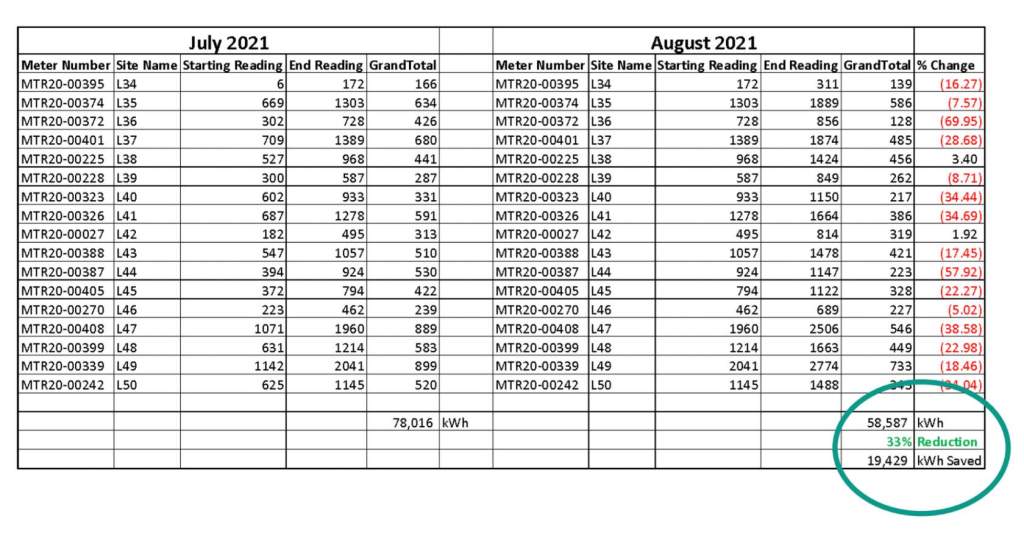
By ARVC’s calculations, electric metering of RV sites can reduce energy consumption by a third.

Indeed, the whole issue of who is going to pay for the extra electricity consumed by EV-RVs, and how, is still being sidestepped at the national level, quite possibly because there is no one answer. That, by itself, may become the biggest impediment to mom-and-pop campgrounds rushing into this brave new world. It’s notable, for example, that while ARVC now has an online “EV Toolkit” to help its members understand how to accommodate the new technology, the only guidance it provides for covering their costs is the vague advice to “consider billing for shorter stays, especially [campers] with unique equipment (large class As, EVs, electric golf carts, etc.), automatically billing those campers for the electricity they use. “

Presumably these and other issues will get resolved, sooner or later—once the industry stops talking around them. The RVing public, meanwhile, should brace itself for still higher costs, as a new electric sensibility starts percolating through the camping universe. Just as computerized reservation systems have introduced demand pricing and all kinds of add-on fees, the electrification push ultimately will result in all RV sites getting electric meters. Or as ARVC’s EV Toolkit asks, in a prominently displayed screen, “You don’t give away ice, candy bars or firewood, why give away electric?”

Most recent posts

In Colorado, camping on private land

As the American landscape gets overrun by a tidal wave of RVs, governing bodies ranging from the Bureau of Land Management to cities as large as Los Angeles to rural towns and counties are scrambling to manage the onslaught. Improper disposal of human waste always looms large as the biggest problem, but other concerns include illegal tapping of power lines, fire hazards posed by open fires, and slum-like conditions caused by garbage, trash and broken appliances.

But forcing RVers on city streets and public lands to disperse, in addition to courting legal and constitutional challenges, can be an exercise in whack-a-mole because of the lack of alternatives. Commercial campgrounds frequently are too expensive and too full, cheaper public campgrounds often are booked months in advance, and boondocking sites are either rare (east of the Mississippi) or have become so heavily impacted by over-use that they periodically get shut down for remediation. Pushing RVs out of one location simply shifts the problem to another, in a merry-go-round of 21st century urban blight.

What’s to be done? One possible solution is being worked out in Chaffee County, Colorado, some 70 miles due west of Colorado Springs. A rural county of some 20,000 residents, long on recreational opportunities and light on industry, Chaffee County’s board of supervisors recently adopted an agritourism-friendly ordinance allowing primitive commercial camping on private land—the kind of camping that many localities around the country explicitly prohibit, while others try to ignore altogether. A second ordinance, scheduled for a vote Jan. 10, would establish similar allowances for workforce camping on private land.

Chaffee’s new rules are part of an attempt to provide its farmers and ranchers, many of whom are struggling economically, with an additional income stream. “It’s never been harder to make a living off the land,” county commissioner Keith Baker said in a news release announcing the ordinance. “Expanding economic opportunities for rural landowners in Chaffee by allowing for well-regulated, small-scale private land camping is a huge win for our community” and will “reduce pressure on public lands.”

To its credit, the new ordinance does impose some regulations in a largely unregulated arena. Landowners who wish to accommodate campers in RVs, tents or vans must get an annual permit for a commercial campsite of at least 900 square feet (600 square feet for tents-only sites) on a minimum of five acres. Additional sites, to a maximum of ten sites on a minimum of 100 acres, are allowed, provided there are “no permanent improvements, facilities or lodging material outside of water, sanitation facilities, and/or fire mitigation elements.”

Yup—that means no electric hookups. And “sanitation facilities” may mean no more than disposing of sewage “off-site by way of personal waste facilities, such as wag bags [basically doggie bags for humans, designed primarily for backcountry hiking], RV holding tanks, or portable toilets.”

There are a few other requirements, notably that the property owner (or “assigned caretaker”) must be available within a 60-minute radius of all occupied campsites at all times, as well as a limit of 10 such sites per property owner, regardless of how many properties are owned or how big they may be. All such sites must have quiet hours of 10 p.m. to 7 a.m. And the sites must have signs “to educate guests on current fire ban status, campfire safety, Leave No Trace principles, and quiet hours.”

But Chaffee’s regulation pales next to the regulatory, licensing, taxing and inspection regimen that commercial RV parks and campgrounds face, with all their associated costs and time demands. For many commercial campground owners, the kind of licensing Chaffee County has authorized is unfair competition at best, an existential threat at worst. Moreover, it won’t help their disposition one bit that the new ordinance was championed by Hipcamp, which along with Harvest Hosts has internet listings of thousands of camping possibilities on private land, from farms to vineyards to ranches and breweries.

One acknowledgment of this sensitivity can be read in the December issue of Woodall’s Magazine, in which editor Ben Quiggle speculates that the Chaffee County measure “could lead to even more municipalities looking at similar ordinances,” even as he notes that Hipcamp “for years has drawn the ire of many park owners” for precisely this kind of camping. Although he concludes that “it may be time” for park owners “to think about how more individuals opening up their spaces for a small number of campers may impact their businesses,” most park owners won’t think about it at all—their response will be an immediate and reflexive “No way!”

It doesn’t help that approval of the ordinance flew under the radar of the National Association of RV Parks and Campgrounds, which is headquartered just outside Denver—almost next door to Chaffee, by Western standards—and which held its national convention just a month after the vote. If ever there were an opportune time to examine a potentially pace-setting development affecting the entire industry, that would have been it, a chance for ARVC to lead a measured discussion on an issue affecting its entire membership.

That didn’t happen, and meanwhile, the pressure on other counties and municipalities to adopt a similar approach will only increase. And as tens of thousands of low income, disabled or seasonal workers turn to RVs as their housing of last resort, recreational RVers will encounter ever more competition for a limited inventory of places to park their wheels.

Most recent posts

Reader responses as a Rorschach test

I’ve been writing for an unseen public for a great many years, yet I still get bewildered by the astonishing range of responses my words can elicit. Some of the feedback I receive is warm and gratifying, reassuring me that I’ve connected with a reader—but sometimes it’s so angry, even vituperative, that it makes me wonder how I could have misfired so badly. Just in the past week, for example, I received the following (excerpted) emails, the first from someone explaining why he was ordering both my books, the second from someone who has been reading Renting Dirt:

We read a few of your articles & blog posts and appreciated what you had to say. We are new owners of a resort & campground in Minnesota and are finding [the] balance between charging enough to keep the lights on and adding amenities, yet keeping the experience approachable for local families from the entire socioeconomic spectrum.

That was a greatly appreciated pat on the back—but then there was this:

I’ve never in my life tried to read a book about real estate, general investing or any other information topic that was so clearly dripping with one-sided political propaganda than yours. If you want to be a liberal pussy, that’s your business—but my family purchased an RV park and I bought your book trying to become better educated on RV PARKS. Take your own advice in the book and understand that nobody wants to hear about your political beliefs. If you’re taking people’s money, maybe try to educate them without pissing them off with your snide left-wing sissy nonsense.

Wow. That’s the sort of diatribe that can take the wind out of your sails—and even more so were it not for the counterbalance provided by other readers. But still: you have to wonder why anyone would think he has a right to impose his vision of a book on someone else’s writing.

On reflecting about this at some length, there are two observations I can report. The first, and less original, is that there’s a chunk of the population for whom certain words or phrases trigger a visceral response that shuts down critical thinking. It’s Pavlovian and possibly beyond conscious control, and in its unthinking fury ends all discussion or nuance. Worse yet, it dehumanizes those who unwittingly pulled the trigger, making them unworthy of respect, consideration or compassion.

And the list of triggers keeps growing: pandemic masking, abortion rights, LGBTQ+, critical race theory. In the case of my angry correspondent they included “Trump” and “extreme weather,” the first used in a description of objectionable flags and banners displayed by many RVers, to the dismay and sometimes fear of other campers; the second as part of a lengthier discussion about the campground industry being oblivious to growing climate threats. Mind you, this was all in the context of a book clearly described as a “first-hand narrative” of our ownership of a campground, with all the many problems and challenges we faced.

But instead of responding with an argument about why these aren’t problems, or why they’re overblown, or why the reality is more complicated than I allowed, my correspondent simply resorted to firing back with what I presume he thought were other triggers, i.e. “liberal pussy” and “snide left-wing sissy nonsense.”

That’s taking the intellectual high ground, eh? En garde!

Fortunately, I’m too old to have my feathers ruffled if someone calls me a sissy, and I probably am at least a liberal pussy—if not a radical one—so that swing is a whiff. But this sort of ad hominem riposte does make me wonder what the writer hoped to accomplish with his rant, and if he realized how much more he revealed about himself than he may have intended. Such a small-minded, rigid personality must feel under assault every day.

But the other observation I’ll make is that my raving correspondent is not all that unusual in this industry—and that my Minnesota fans may find themselves, with their commendable effort at “finding balance,” very much in the minority among their peers. Not that the majority are quite as wild-eyed, but as a tribe, mom-and-pop campground owners overall are fiercely individualistic, resentful of taxes and government regulation and certain that they know better than anyone else how to run their business. And if you don’t agree, shut up.

Quite aside from whether they’re right or wrong, there’s a case to be made that hardened attitudes are essential for success at running an enormously demanding enterprise. Doubt yourself, be wishy-washy about your rules, allow your campers to run your business—that way lies ruin. But over-the-top certitude may not be the best fit for dealing with people, either, and mom-and-pop campgrounds are all about the people. There’s more than one kind of balance that has to be struck in this business.

Given a choice of staying at a campground operated by the first of my correspondents vs. one run by the second, I wouldn’t hesitate for a moment to pick the first. I’m guessing that would be true for most other campers as well, not for political reasons but because of a wish to avoid unpleasant personal encounters, but unfortunately that’s a lesson the second writer may be incapable of learning.

Most recent posts

Campground sale offers ray of hope

Score one for the good guys.

At a time when RV parks everywhere are being snatched up by developers who covet their real estate, or by investment groups looking to cash in on the latest vacation fad, the Cape Cod town of Wellfleet is pursuing a different approach that promises to decrease pressure on local campgrounds to serve as low-income housing—even as it reduces the overall number of local RV sites.

The lack of affordable housing on Cape Cod, emblematic of a problem afflicting high-dollar resort areas all over the country, has been felt most acutely in Wellfleet, which has the lowest percentage of affordable housing on the Cape. Seasonal ownership, short-term rentals and skyrocketing prices have decimated the year-round rental supply, just as they have in Vail and Aspen, the Berkshires, the Smoky Mountains, Jackson Hole and other playgrounds of the well-to-do. Waiters, cooks, sales clerks—even teachers, firefighters and cops–are left scrambling for a place to sleep, much less for a family life of any kind, given that the median price of Wellfleet houses sold in the first part of this year was over $800,000.

So when Wellfleet’s town fathers learned that the three Gauthier brothers were looking to sell the 21.3-acre Maurice’s Campground, they realized they were looking at “a once in a lifetime opportunity,” as reported by the Cape Cod Times. Unfortunately, private developers and other campground operators had reached the same conclusion—albeit for different reasons—and with readier access to financing and fewer bureaucratic hurdles to clear, were quick to start lining up with their offers.

But the Gauthiers, aged 68 and up and whose family has owned the property since 1950, weren’t all that enchanted with their suitors. “So many of these people come in and the first thing they do is double the rates, or they’re going to build trophy homes,” the youngest brother, John, told the Provincetown Independent, explaining that such a possibility didn’t meet the family’s “vision.” The town’s purchase, on the other hand, “is a win-win.”

Still, there were those hurdles. Although the town agreed in mid-April to buy the entire operation for $6.5 million, the purchase would have to be approved at a special town meeting Sept. 10. So would a deed restriction requiring the land be used for affordable housing, and so would $225,000 in additional funding to operate the campground through the end of the fiscal year. And then it would all require a second vote Sept. 20, even before the town figured out how it was going to pay off a loan underwriting the purchase.

Oh, and then there was the little problem of 35 failed cesspools at the campground. . . .

For all that, Wellfleet’s voters approved the purchase more than two-to-one, by a vote of 583 to 247, as well as giving a thumbs-up to the rest of the package. Just don’t look for any quick changes. The purchase agreement stipulates that the property will continue as a campground for six years, partly in order to give its residents time to find alternative housing, partly because the town says it will take several years to get permitting, design and approvals for housing and wastewater treatment projects to be built.

Although Maurice’s has more than 180 RV sites, as well as 12 cabins and 16 tent sites, roughly two-thirds of the sites are occupied by seasonal campers, including vacationing families and approximately 60 seasonal workers. And while Wellfleet’s planners have not yet indicated how many housing units they want to build on the 21 acres, even a moderately dense development would be big enough accommodate both the seasonal workers at Maurice’s as well as those now living at the five other area campgrounds that permit long-term stays. That, in turn, should result in an overall increase in available RV camping for tourists and transient campers.

Or so one can hope. With promised affordable housing at Maurice’s not available until late this decade, and given an ongoing housing squeeze that long ago entered the crisis stage, it’s fair to wonder if it’s all too little too late. “We get a bunch of inquiries from people looking for long-term,” Katie Nussdorfer, owner of a campground in nearby Eastham, told the Independent, attesting to the unbalanced demand for affordability. “We have gotten into situations with people who are homeless, and that has been difficult.”

One thing’s for sure, though. Had the Gauthiers decided differently, even a flicker of hope wouldn’t exist.

Most recent posts

Maybe Terramor should be Terrless?

When KOA decided it wanted to get into the luxury end of the campground business—goosed along, no doubt, by its survey findings that there are a lot of campers out there with too much money and not enough ways to spend it at a conventional RV park—the brand-happy brain trust in Billings, Montana, opted to spin off yet another name plate. Even “KOA Resort” must have seemed too plebian for something as grand as was being envisioned for this new venture. Something more lofty and cultured was needed.

So it was that KOA gave birth to the pseudo-Latinate “Terramor,” a designer mashup connoting “love of the earth.” And thus began a protracted exercise in unintended irony.

The first Terramor glampground was created a couple of years ago in Bar Harbor, Maine, on the grounds of the former Woodlands KOA. Problems ensued. Although highly rated overall in Google reviews, a surprisingly large number of negative reviews identified the same basic problems: too much road noise, a lack of parking at the luxury tents, gravel trails that made it hard to haul luggage from car to tent, tents crowded too close together, inadequate outdoor lighting—problems, in other words, that had to do with location and infrastructure limitations. Problems that might put a serious dent in any return business, given Terramor’s site rates of $350 to $500 a night.

So when KOA went shopping for a second Terramor location, it wanted a blank canvas, a raw piece of property in an upscale neighborhood that it could shape more to its liking. That upscale neighborhood turned out to be near the Catskills towns of Woodstock and Saugerties, an area gaining some renown as the new Hamptons for New York’s monied crowd. The property it settled on is a 77-acre expanse of mature forest, providing relatively more space for site dispersal and sound buffering than it had in Bar Harbor, on which KOA is proposing to build 75 luxury platform tents with ensuite bathrooms and showers, each with its own firepit and parking space. Oh, and there also are plans for a 4,000-square-foot restaurant and event center, an outfitter’s shop, a swimming pool and wellness center, and a small cluster of housing units for 28 employees.

But—can this be?—KOA’s prospective neighbors are not happy. Up to 15 of the 77 acres are wetlands, which KOA proposes to bridge with a berm that will disrupt water flow. Talk of evening concerts has raised concerns about noise pollution, with some residential properties only 100 feet from the glamping sites. Increased traffic, wood smoke from dozens of fire pits, loss of wildlife habitat—no, the neighbors are not happy. They’ve formed a group called Citizens Against Terramor, started a Change.org petition and a GoFundMe account, and raised nearly $30,000 locally to hire a hydrologist, an environmental engineer, a geologist—and, of course, a lawyer.

Protesters at planning board meetings have been hoisting signs that read “Terra LESS” and “Terramor Means ‘Love the Earth’: What About ‘Love Thy Neighbor?'”

Here’s the promised irony: not four miles up the road is the former Saugerties/Woodstock KOA, a typically modest mom-and-pop KOA franchise that puttered along for years to middling reviews. But that all ended two years ago, and earlier this year the property reopened as—wait for it—AutoCamp Catskills. That’s right: one of KOA’s major national competitors in the glamping sector has set up shop at a former KOA that’s a five-minute drive away. And did it without any of the sturm und drang that is battering the Terramor proposal, basically because it was not changing area dynamics.

Indeed, while KOA is still hoping its contested Terramor project can be opened in 2024, AutoCamp already has generated a slug of fawning press coverage for its first season. The 37-acre site houses 65 converted Airstream trailers, 10 tiny-home cabins and 10 “basecamps,” which comprise an Airstream plus a luxury tent; a central wood-beamed clubhouse with vaulted ceilings provides room for games, craft cocktails and morning breakfast and coffee service. (The discerning reader may note that this is a significantly higher development density than is being proposed for Terramor, making the lack of local opposition all the more notable.)

And, of course, everything is quite expensive, with weekend nights in October (two-night minimum required) priced upwards of $500 a night—not to mention firewood selling for $20 a bundle, barbecue kits for $69 and s’more kits for $15. “I’ve been in this industry for 15 years and I’ve never seen prices like this,” a local travel agent told a skeptical New York Post reporter. It’s also, of course, why KOA continues to flog this particular horse, despite all the ill-will it’s generating locally. There’s money to be made, dammit, and getting it the old-fashioned way—you know, by catering to middle-class families with travel trailers and troops of snotty-nosed kids—is just so dreary. And slow.

Glamping. Yeah—that’s the ticket.

Jan. 25 author’s note: This post has been lightly edited to make some corrections, but because this is an evolving story, the reader is encouraged to look at the subsequent post for updates.

Most recent posts

Mom and pop: pretty much out of it

Some myths die hard. Case in point: the declaration by Jayne Cohen to 30 or so industry newbies that RV parks and campgrounds “are a mom-and-pop industry.”

That warm comment was made at a morning session of the “Prospective Owners Workshop,” hosted by the National Association of RV Parks and Campgrounds as an add-on to its national convention a couple of weeks ago. Cohen is a long-time industry veteran who retired from the hands-on business of running campgrounds a decade ago to become an industry consultant. Her assertion was intended as encouragement, an assurance that unlike most other business ventures, campgrounds are run by friendly, people-oriented types who will bend over backwards to help each other, offer advice and share their knowledge. You won’t be alone, she was telling those newbies.

Maybe not so much.

A lot has happened in the past decade. There still are a lot of mom-and-pop operators around the country, but they’re quickly being elbowed aside by investors more concerned with debt leverage and financing their next acquisition than in helping out some greenhorn. And as the money becomes more important than the myth, that quasi-frontier mentality of “we’re all in this together” is being stripped out.

Two sets of numbers help put this in focus. One is the attendance figures ARVC trumpeted for its convention, including 1,127 attendees “representing” over 1,500 member parks. Think what that means. First, the number of campground owners was significantly less than 1,127, because the attendees list included several hundred vendors and exhibitors, as well as multiple attendees—spouses, adult children, employees— from individual properties. Second, that widening of the gap between owners and parks implies that as many as two-thirds of the 1,500-plus “represented parks” didn’t have someone who actually works the property attending the convention. Put another way, most of those “represented campgrounds” were links in a group or chain, not family businesses run by scrappy entrepreneurs.

The other number worth noting came from the ARVC Foundation, a charitable arm of the association that raises money from its members for disaster relief and education. “It’s in our nature to help,” assured a foundation spokeswoman on the convention floor, as she ticked off the natural disasters that had battered RV parks and campgrounds in the past year—culminating, just weeks earlier, in a devastating romp through Florida by Hurricane Ian. The amount in disaster grants doled out by the foundation in the year to date? A grand total of slightly more than $20,000—less than $15 per “represented” campground in the audience. How embarrassing is that?

It’s not that the traditional campground stalwarts have become suddenly cold-hearted. It’s that they’re dying off, like consummate industry promoter David Berg did last year, or they’re throwing in the towel and selling, or they’re simply being outnumbered by the more bottom-line oriented newcomers.

Even as veterans like Jayne Cohen maintain the myth of a warm and fuzzy campground culture, ARVC itself is growing ever more distant from its meat-and-potatoes members. This year’s convention registration initially was priced at $495—but only if convention-goers also booked their stay at the Rosen Center, at a cost of more than $1,000 a room. Otherwise, registration was going to get bumped up another $200—this for a crowd that includes campground owners who travel to conventions in their own RVs and stay at local RV parks. (It appears that this $200 penalty was eventually dropped, although it’s unclear how many attendees got clipped first.) Filet mignon and lobster, anyone?

As tone-deaf as that was, ARVC found another way to squeeze those least able to afford it: it touted “buyer workshops,” an offer to rebate convention registration fees to attendees who agreed to schedule individual meetings with five different vendors. These captive-audience sessions, more appropriately termed “seller workshops,” resembled nothing so much as an offer of free restaurant meals to lure the unwary to a time-share sales pitch. Investor-owners could readily pass on such a deal, but mom-and-pop owners? To those already bludgeoned by a four-figure hotel bill, a $500 savings could be just too much to resist.

As with its simultaneous push to create campground “standards,” ARVC clearly is following the money. It can be argued—and there are those who do— that this is an inevitable evolution of the industry and that it’s futile to resist the trend. Perhaps—although it’s worth noting that the country’s four most populous states, California, New York, Texas and Florida, all have their own campground associations that are not part of ARVC, suggesting that there’s a price to pay for becoming too distant from the grassroots.

Yet inevitable or not, the times have changed. A purely mom-and-pop industry this no longer is, and Jayne Cohen probably knows that, her assurances otherwise notwithstanding. Prospective campground owners should know that, too.

Most recent posts

FEMA didn’t get ARVC’s admonition

The split personality afflicting the RV industry, in which it can’t quite decide whether the wheeled homes it produces are recreational or residential in nature, has been on display again the past couple of weeks. The confusion is all but certain to result in calamity some day.

On the record, at least, the RV Industry Association (RVIA), the RV Dealers Association (RVDA) and the National Association of of RV Parks and Campgrounds(ARVC) all agree that the fifth-wheels and travel trailers that serve as vacation homes for millions of Americans are not meant for permanent, or even long-term, residency. Ditto for RV park models, which look every bit as sturdy and livable as their close cousins, the single-wide mobile homes beside which they are sometimes parked.

The distinction isn’t merely semantic. As I’ve written before, RVs are legally viewed as vehicles and are built to different codes than house trailers, which are defined as housing and therefore subject to more rigorous construction standards. The only notable distinction between the two is that as long as a house on wheels has less than 400 square feet under its roof—excluding lofts and outside porches—it only has to conform to the voluntary consensus standards set by the American National Standards Institute; more than 400 square feet and it has to meet more stringent Housing and Urban Development regulations.

The RV industry likes things this way because it means lower costs and less meddlesome interference from government regulators, which is understandable from a libertarian perspective—even if it does result in correspondingly shoddier and even life-threatening construction. As reported by the Indianapolis Star a month ago, in a devastating series that the RV industry has resolutely ignored, RV assembly workers don’t even need a license or certification to do electrical work, a level of lax oversight that HUD would never tolerate.

What brings this to mind is a general session at last week’s ARVC convention under the self-congratulatory title, “How National ARVC’s Advocacy Works for You.” Among the panelists was Wade Elliott, who has worked tirelessly over the years to raise electrical standards for campgrounds that in many cases were a do-it-yourselfer’s nightmare of undersized wiring, reversed grounds and shoddy work-arounds. Yet even Elliott demonstrated that he’s bought the myth that there’s a bright line between recreational vehicles and residential ones. Asked by an audience member why RVs shouldn’t be required to meet housing electrical standards, since there are so many people living in RVs, his answer was a short, “Well, they shouldn’t be living in them!”

Maybe not—there are a lot of “shouldn’ts,” including the necessary observation that people shouldn’t be living on sidewalks, either. But that’s the world we live in, and it’s naive at best and immeasurably cruel at worst to pretend otherwise.

Meanwhile, it’s clear that the federal government is no less fuzzy on the question of whether RVs are suitable as living quarters. Without any apparent recognition of the irony involved, RVIA issued a press release yesterday under the headline, “FEMA to Release Accessible Emergency Housing Proposal Request to RV Manufacturers.” As further detailed in the release, the Federal Emergency Management Agency wants to ensure access to a supply of RVs that are ADA compliant, with counter-top heights, thermostat placements and bathrooms suitable for wheelchair use.

The release stressed that “manufacturers will be able to use their existing processes, suppliers and materials,” and that FEMA will “do a significant run of units to create a stock of accessible travel trailers.” No mention, of course, of building the RVs to stricter HUD requirements—ANSI regs will suffice. And no acknowledgment of Elliott’s view that people “shouldn’t be living in them” because, of course, we all know they do. Even people in wheelchairs. In disaster areas.

What could possibly go wrong?

Most recent posts

Increasingly, it’s about da Benjamins

For all the high-fives and back-patting on display at the National Association of RV Parks and Campgrounds convention last week, an undercurrent of anxiety rippled just beneath the surface. Yes, the 2022 camping season was one of the best ever. Yes, there’s a wave of new campers invigorating the industry. And yes, a lot of the new-timers are more affluent than the fuddy-duddy boomers who dominated the landscape for so long. And yet. . . .

And yet, as strong as business was this year, for the most part it barely improved on 2021. As observed at an afternoon cracker barrel session led by Larry Brownfield, assistant vice president for franchise development at KOA, franchise revenues were up about 3% for the year even as camper nights were flat—in other words, any growth came from squeezing money out of a static customer base, not from increased business. Meanwhile, as summarized by economist Bob Kaplan in a breakout session on the economic outlook for 2023, industry headwinds are still gathering strength, including higher operating costs, higher fuel prices and inflationary pressures on family budgets.

Indeed, if there was one recurring theme to all the dollars-and-cents discussions, it was the observation that camping is becoming a pricey pastime. Propelled by a high savings rate during the many months of pandemic shut-downs, households were “flush with cash to spend on leisure activities,” Kaplan observed, to which the industry responded with opportunistic enthusiasm. As the number of camping households with annual incomes of more than $100,000 doubled from 2019 to 2021, the average cost of new RVs jumped 20% in three years, site rates kept going up, and the campground industry’s compound annual growth rate soared by half, to 12.7%, “an awesome number” that transformed the staid sector into a growth industry almost overnight.

But as seasoned investors are fond of saying, nothing grows to the sky. A strong dollar has made overseas tourism increasingly competitive with domestic travel—and as camping gets more expensive, hotels and other resorts also are competing for the same now shrinking pool of pent-up savings. Indeed, said Kaplan, demand for quality hotel rooms is already outstripping supply. Higher interest rates and rising fuel prices are deflating the RV sales balloon. And campground buyers are taking note and pulling back, as evidenced by a gradual rise in capitalization rates of newly sold properties, a marker of higher investment risk.

More cautious campground owners also are paying attention. Judy Brown, owner of a Florida RV park, said her campground now is almost completely occupied by full-timers, a hedge against softening transient demand and a transition enabled by the state’s flood of hurricane refugees. And Eric Rasmussen, president and director of acquisitions for Spacious Skies, an aggressively expanding chain of RV parks in the eastern U.S., said the company has started evaluating whether some of its properties should start accepting more long-term campers to ensure steadier cash flow.

While KOA and Spacious Skies both claim not to be changing their acquisition strategies—yet—Brownfield forecast that 2023 would be flat or even slightly down from this year. The “prudent” thing to do in an inflationary environment, he said, would be to reduce debt—the implication being that KOA’s pace of acquisitions may in fact start slowing down. Rasmussen, meanwhile, suggested that campground owners should “fire” their lower-end customers to make room for those who can absorb higher rates, another hint of growing financial stress.

Yet if the RV park industry indeed is heading into a significant slowdown, that may—somewhat paradoxically—result in a renewed acquisition spree. There’s more than $365 billion in cash sitting on the sidelines of the private real estate sector, Kaplan noted, just waiting for good opportunities, and real estate traditionally has been a safe haven in inflationary times.

Most recent posts

The new ‘campers’ really aren’t

If there’s one trend that has many veteran campground and RV park owners shaking their heads, it’s the largely pandemic-driven phenomenon of “the new camper.” Considerably younger, more diverse and more urban than their predecessors, the newcomers have changed not just the quantity of campers, but their overall quality—and not always in a good way. At least not from a traditionalist perspective.

Perhaps no one statistic sums up this new reality more succinctly than the answers to a Campspot survey, taken this past August, that among other things asked campers why they camp. A less than overwhelming 10% of 1,556 respondents answered “to spend time in nature.” The three larger responses could as readily have applied to an ocean cruise, a hotel stay or a ski resort: 23% for vacation family time, 19% for relaxation and 17% for proximity to outdoor activities. In other words, the one characteristic that traditionally set camping apart from all other vacation options has become the least important reason for doing it.

A summary of the Campspot survey was distributed at a breakout session at the National Association of RV Parks and Campgrounds annual convention last week, which was only fitting. Campspot, a cloud-based campground reservation management system, has been a principal driver behind both the swelling tide of new campers—who are most comfortable in the online universe—and of the increasingly transactional nature of “the camping experience.” With more than 2,000 campgrounds in its customer base, for which it processed more than $1 billion in gross bookings within a recent 12-month period, Campspot has been a leader in pushing “revenue optimization” in all its various incarnations, including demand pricing, site-lock fees and increasingly onerous cancellation fees.

But other industry representatives at the ARVC convention sang the same tune, usually to lay the groundwork for urging campground owners to accommodate the changing demographics. Typical in that regard was the observation by Jon Gray of RVshare, a peer-to-peer RV rental company, that the new campers are “looking for hotel-type amenities,” which he contended is a “great opportunity” for campground operators. In real-world terms, “great opportunity” means the opportunity to spend more money on various upgrades, increased amenities and all the marketing bells and whistles that go along with that. More spending, in turn, will necessitate higher rates, but the new campers, everyone seems to agree, not only can afford to foot the bill but won’t even notice the difference. “They’re conditioned for it—nobody says anything,” piped up an audience member at the Campspot presentation.

Indeed, KOA’s North American Camping Report 2022, released in late April, found that nearly 40% of the new campers have annual household incomes exceeding $100,000. Moreover, nearly half went glamping in 2021 and the rest planned to glamp this year, which is to say, planned on the least outdoorsy—and most expensive— way to “camp.” That high level of glamping interest contributed to KOA’s broader finding that 36% of all campers went on a glamping trip for the first time in 2021, with 50% saying they would seek a glamping trip this year.

While industry purists may shake their heads at such trends, others are all too willing to jump aboard what they see as a gravy train. As one such campground owner observed at a cracker barrel discussion about managing RV parks in a softening economy, “When we first started we welcomed everyone, but then we started upgrading our clientele.” Added another campground manager, who runs a large Florida park, ” People will pay to have fun. That will never go away.”

Just how pervasive the change has become was evidenced by ARVC’s choice of campgrounds for its prospective owners’ workshop, a pre-convention one-day session attended by approximately 30 people learning the business as they prepare to build or buy an RV park of their own. Following a morning of quick-and-dirty workshops, the prospective owners piled into a bus to drive an hour to . . . Camp Margaritaville RV Resort, the only example of what an RV park looks like that they would be shown.

Nice place, Margaritaville. Two restaurants, 401 sites that include 75 RV park models, 650 imported palm trees, artificial turf throughout, its own call center, a cashless economy—everything that’s needed, said one of its amiable owners, “to propel old-style RV parks into the present day.”

[Next post: Whistling past the graveyard? Despite all the upbeat emphasis on “the new camper,” a softening economy has some campground owners scrambling.]

Most recent posts