Stetler a victim, hustler—or both?

One of the many calamities that Stetler has endured: a fire, allegedly caused by an electrical fault, that ripped through her Planet RV dealership in the early morning of March 22, 2021.

RV dealer and relentless self-promoter Gigi Stetler, 62, was arrested this past week by Florida state officials and charged with theft of state funds. According to charging documents, Stetler’s parent company, RV Sales of Broward, had “collected and failed to pay a minimum of $471,447.35 in sales tax” from RV sales at her dealership, Planet RV in Pompano Beach. The charges carry a maximum penalty of 30 years’ imprisonment.

Two things about this incident stand out. The first is that the allegedly unpaid taxes were collected from May 2019 to June 2023, a four-year span that raises the obvious question: is anyone staffing the Florida Department of Revenue? Did no one notice a sudden change in tax payments from an RV dealership that has been around for decades? Why is a state government fixated on drag queens, Mickey Mouse and blastocysts apparently incapable of performing one of the most rudimentary governmental functions, that of ensuring timely tax collections? (Oh, right.)

The second is: WTF?

Stetler’s mug shot this past week.

How is it that Gigi Stetler, one of the most storied—some might say notorious—RV dealers in the country, is once again in the headlines, and once again for reasons that as easily provoke condemnation as sympathy? Reviewing her history, one is struck by the near-biblical scale of her tribulations, as if to give Job a reason for good cheer. Yet it’s also safe to say that Stetler will milk her latest setback to the hilt, further burnishing her image as an indomitable survivor. That’s just how she rolls. And while some might view her as merely another hustler, others will see only a gutsy warrior standing up against malignant forces trying to tear her down because she’s a woman, she’s mouthy and she’s been beating the boys at their own game.

Stetler in a 15-year-old glamor shot she still uses to promote herself.

If there’s one thing about which most everyone can agree, it’s that Gigi Stetler holds herself in high regard. The blurb for her 2009 book, “Unstoppable: Surviving Is Just the Beginning,” says it all: “Gigi Stetler is a complex and inspirational woman— a single mother that didn’t finish the tenth grade who became a queen of the male-dominated RV industry, presiding over the $18 million a year RV Sales of Broward as the first female founder or owner of an RV dealership in the country; she has redefined the climate of the RV industry. A Motivational Speaker, Author, Entrepreneur, Business-woman, Accomplished Equestrian, Designer and Life Coach, Gigi has become an inspiration to women everywhere.”

The book itself hardly matches the hype—of the scant handful of readers’ reviews on Amazon, several include the suggestion that she should have hired herself an editor, or at least a proofreader—but it does set the tone for the persona she’s cultivated ever since, starting with her oft-repeated claim of being the stabbing victim of a homeless man she’d tried to help. Yet despite 21 wounds, 200 stitches and doctors warning her she’d lose the use of her left arm, Stetler went on to battle a sexist industry, repeatedly tangled with the industry’s 800-pound gorilla, Marcus Lemonis, and took down General Electric in a successful breach-of-settlement lawsuit that a jury decided in just four hours.

“I showed up with my stilettos and my pony tail and my big brilliant ideas,” Stetler recalled for the Miami Herald in 2017, describing her first RV dealer association meeting, in the mid-1980s. Those ideas included catering to young families, not just retirees, and opening her dealership 9 a.m. to 9 p.m. seven days a week instead of keeping bankers’ hours. Her all-male peers responded with, “Little girl, you need to go home and bake cookies.”

Fast-forward a couple of decades and Stetler was riding high, claiming $20 million in annual sales, when she tangled with Lemonis in a complex dispute involving an RV campground and dealership that she was operating at the Winter Equestrian Festival in Wellington. When the property owner refused to renew her lease after 16 years and instead gave it to Lemonis’s company, Camping World, she opened a small competing campground nearby and rented RVs at half of Camping World’s rates. And after she was banned from the festival grounds, allegedly in retaliation, Stetler also filed a protest with the U.S. Equestrian Federation—the festival’s governing body—which found in her favor, fined the the property owner and ordered that Stetler be allowed back on the festival grounds.

Playing into that decision were emails that Camping World officials had sent to the property owner, complaining that Stetler was undercutting their prices and upsetting their business. One of those emails declared that “stopping her would go a long way,” presumably toward making Lemonis happy.

That was in 2009, and Stetler and Lemonis have been at each other ever since. She sued him for allegedly ruining her business, he sued her for trademark infringement. Other lawsuits began piling up, typically over financial disputes. And as her woes mounted Stetler began reinventing herself, leaning in to her “unstoppable” image to become not just a plucky woman in a man’s world, but a champion of the little guy. Or girl.

“I’m a warrior. I was stabbed 21 times and left for dead. There’s nothing that hasn’t happened to me in my life,” she told RVBusiness.com in 2019, shortly after she created a new business, The RV Advisor. “So many times, people have tried to kill me physically, mentally, emotionally, and everything. But I don’t play the victim card. . . . I’m the underdog, and I feel that consumers are underdogs. Somebody has to speak for them. Somebody has to speak up—like Erin Brockovich spoke up for the people with bad water.”

The RV Advisor, a membership-based organization supposedly modeled on Angie’s List, was advertised as a certification service that would vet RV dealers for the buying public. “I know everything they could be up to. I know everything about everything in this business. They can’t hide anything from me,” she told RVBusiness. “So, I want them to be afraid of me. I want a dealer to be able to tell a consumer, ‘Oh, you’re an RV Advisor member? Here, let me take care of you.'”

The concept proved an instant winner—with some. Football legend Dan Marino, reportedly a long-time acquaintance of Stetler’s, quickly aligned himself with the brand, appearing in its promotional material with the explanation that “RVs have always been present in my life.” RVtravel, an independent online RVing magazine, announced it had joined forces with Stetler “to promote her messages/services,” which by then included the sale of extended warranties, RV insurance and emergency road service. “This woman will fight for you, I strongly believe,” publisher Chuck Woodbury assured his readers. Memberships, at $25 apiece, began rolling in.

Who wasn’t wowed by Stetler’s crusade were the dealers Stetler was supposed to evaluate—not when she wanted to charge them $350 for an on-site inspection of their premises, and certainly not at a time when RV sales had shot through the roof and would-be buyers were lining up in unprecedented numbers. “I’ve been calling them and sending them emails to get them certified, but they don’t want to be certified because business is too good,” Stetler conceded to RVBusiness. “They don’t want to be accountable.” But if she could get a million members, Stetler added, that would turn the tide—“Do you know how much power we would have in the industry?” Not to mention, of course, the $25 million war chest that would create.

Just a couple of months later, Stetler’s RV-related career may have hit an all-time high, as she and her company won an eight-day court battle with General Electric Commercial Distribution Finance. The case dated back to 2008, when GE erroneously repossessed her entire RV inventory and almost put her out of business. Now, more than a decade later, Stetler was quick to proclaim her triumph in various media, including a lengthy article on her website headlined, “The Day Gigi Beat Goliath,” but in none of the accounts was there a mention of what she actually got out of the ordeal. Still, it made for good press.

And then things started unraveling.

First came the pandemic, which must have stressed Stetler’s finances. A year after that, in March of 2021, her RV dealership building and its contents—including several RVs—was declared a total loss following a blaze so intense firefighters could mount only an exterior attack. That disaster came just four days after Lemonis had filed his trademark infringement suit, and apparently other lawsuits already were swirling around her: one, filed earlier this year over allegations of financial misdealing, cited a 2023 Broward court determination that Stetler had been “employing such [fraudulent] schemes for years” and had been sued “numerous times for identical” misconduct, including swindling customers.

Meanwhile, RV Advisor’s claim to represent the underdog became increasingly tenuous. A cost comparison earlier this year of six RV roadside assistance plans by Fulltime Families, an Amazon-related service, ranked RV Advisor’s as the most expensive, starting at $289 a year—ironically, more than four times as much as Good Sam’s basic plan. RV Advisor’s annual membership fee, now $29, has been decried as “sizzle with little beef,” with little to show for it beyond an opportunity for RV Advisor to sell other products—including “Gigi’s Personal Services,” featuring the same outdated headshot as shown above and a $350 price tag.

(That’s actually a bargain compared to the deal offered on Stetler’s side hustle, a life-coaching website, under the screaming headline, “Today is the day you become unstoppable.” There you can buy a gold package, which includes a customized coaching seminar of two two-hour sessions “with Gigi Stetler and a small group of people” (?), which she values at $3,895 but can be yours for just $2,500. The sessions are designed “to make you and your group UNSTOPPABLE.”)

Then there’s Planet RV itself, which rates a middling 3.7 stars on Google reviews and basically has only two kinds of ratings: five stars and rave reviews of Stetler’s service, and one-star complaints about broken promises, misappropriated funds and months-long waits for transfer of ownership papers. Her customers love her or hate her, and there’s little middle ground. Stetler, meanwhile, has said that the negative reviews have been planted by her competitors and that she’s never heard of or met some of the supposed “customers.”

Like a Rorschach inkblot test, Gigi Stetler’s life and relentless self-promotion provide ample room for differing interpretations of her character. This latest chapter, as we see how she responds to the sales-tax theft charges, only adds to the inkblot’s complexity.

When con artists become predators

This is Eddie Sides in a recent mug shot. Would you buy a used RV from this man—much less invest in an RV park with him?

The best hustlers, as described in my last post, are the smooth-talkers—the enormously sincere and effusive spinners of all the marvels that can be yours if you would but set aside your critical faculties and nagging suspicions and buy The Dream. The very best hustlers even believe their own stories, and are as shocked and dismayed as anyone when The Dream crashes on the reefs of financial or political reality. How could that be? We’re all victims here, the smooth talkers will tell you, of small minds or insufficiently committed investors or an ignorant public that simply doesn’t get it.

But then there’s the other kind. The predators for whom there is no pretense of fair-dealing, the con men whose only purpose is to separate you from your bank account as quickly and ruthlessly as possible. And it’s unfortunately true that the RV park and campground industry, by becoming such a hot sector of the commercial real estate market over the past three or four years, has attracted both dream-weavers and pickpockets at an unprecedented rate. A key difference? The dream-weavers spin their magic around an entire community, which at least distributes the inevitable pain. The pickpockets’ victims are fleeced individually.

Take Duane and Stephanie Smith, of the Twin Lakes area in Arkansas. According to Duane Smith, a school teacher in Mountain Home, Brian “Eddie” Sides approached him two years ago with a proposal that he invest in a new RV park. At that point he had known Sides a couple of years, Smith told a local reporter, with Sides and his wife coming off “as a respectable Christian family that lived their lives with Christian values and that had done reasonably well for themselves,” owning an upper middle-class home and several expensive boats and vehicles.

Sides initially emphasized that the Smiths would not need to put down any money, but that he needed their good credit scores and financial credibility to obtain the financing he needed. That right there should have rung an alarm bell and convinced Smith to back the hell away, but Smith didn’t hear it. Perhaps he was reassured by Sides’ share of the deal, which was to kick in an initial $200,000 in proceeds from the sale of his home, which he had put up for sale.

Although that wasn’t quite what it seemed.

First, because he needed bridge funding until his house was sold, Sides prevailed on the Smiths to put up an initial $25,000 to get the ball rolling. Then it turned out that the home didn’t actually belong to Sides personally, and when it was sold, the proceeds made it into anything other than the RV park account for which they had been promised. Meanwhile, with Sides having blown through the $25,000 start-up fund, a resulting deficit in the RV park account was jeopardizing the bank loan that had been obtained through the Smiths’ good credit . . . and you can see where this is going.

Long story short—and it is a very long story indeed, meticulously documented by the online Mountain Home Observer—the Smiths got cleaned out to the tune of $334,384. That’s how much they recently won in a civil suit against Sides, but Sides already had a string of judgments and court orders against him dating back more than a decade, for various grifts and scams that netted him tens of thousands more—none of which, it seems, he has coughed up. And despite a nearly year-long effort by the Smiths to convince the Baxter County prosecuting attorney to bring criminal charges, no charges have been brought and Sides continues to skate. The Smiths, meanwhile, are teetering on the financial brink.

“The prosecutor keeps making excuses and keeps making a point to say that if he decides to file charges it’s not going to help people get their money back,” Smith recently told the Observer. “Yes, but what about holding people accountable for alleged crimes they commit—especially when it involves numerous victims and large sums of money? . . . I talk and communicate frequently with many of Mr. Sides’ alleged victims, and most simply want him to be held accountable for his actions at this point, and for closure.”

You could argue that even the skimpiest due diligence should have discouraged anyone from getting into a business relationship with Sides, so maybe Smith is undeserving of your sympathy. Putting that aside, however, there’s also unmistakable evidence that Smith didn’t have the slightest understanding of the business itself—of what it takes to build and run an RV park, much less one that was promoting itself as a “luxury” campground. As I wrote more than a year ago, the new venture was flashing warning signals right out of the gate, proclaiming that a $500 deposit would be sufficient to reserve a site—or “lock in the full year for the low price of $3100.”

“Low,” indeed.

There were lots of other disturbing clues that this was a doomed project, from Sides’ willingness to forego getting required construction permits, to the incredible amount of rancor he provoked among the project’s neighbors, to the absence of any of the numerous amenities the luxury RV park would supposedly provide. In the end, all that Sides had to show for his efforts was a dead-ended gravel road bulldozed the length of a small peninsula, flanked by a series of gravel RV pads. By the end of last summer, the whole venture was shut down. As the Observer reported, “Today, the park sits abandoned, with trash strewn about and equipment sitting out in the elements to rust. Felled trees mark the landscape alongside empty travel lots. The park is silent.”

RV hustlers circle closer to the flame

Maybe it’s the heat, or maybe it’s just that these things run in cycles. Whatever the cause, it seems that the grifters who think RV parks are an easy con are suddenly circling closer to the flame. With any luck, they’ll self-immolate before causing too much damage.

One of my favorite flimflam artists, if only because of the scale on which he operates, is Ricky Trinidad, who for nearly two years has been casting his spell over the destitute town of New Castle, PA. After making a hash of things in Florida, where to lose your shirt in real estate suggests you might be dumber than a manatee, Trinidad apparently decided he would have an easier time of it in an area where hustlers aren’t tripping all over each other. And New Castle, desperate for any investment that might lift its moribund economy, was only too eager to roll over and have its belly scratched.

Thus began the age-old dance between seducer and seduced, a string of extravagant promises made easier to swallow because of Trinidad’s evangelical fervor—indeed, as he explained to the local press, he’d moved to New Castle after learning that it’s the home of Jubilee Ministries International. Tellingly, Jubilee asserts that its vision “is to come together as a militant, spiritual army that is arising and keeping rank so that we may take dominion and possess the land,” an aspiration that Trinidad apparently took to heart. Jubilee’s various enterprises are named “Royal” this and “Kingdom” that, and that too is a practice that Trinidad quickly emulated.

First on his list: “Royalty Camping,” touted last year as a luxury RV park that would draw tourists from all across the country, thereby turbocharging the local economy. Indeed, Royalty Camping was envisioned as merely the first in a series of campgrounds in half-a-dozen states, all offering “white-glove service” that would “change the RV industry.” Best of all, Royalty Camping would operate year-round because the 30-acre property would include a massive air dome spanning its RV sites, accessed through air locks and soaring so high that campers could have fires and outdoor barbecues and all that other camping stuff even in the dead of winter.

Apparently, no one blinked.

Thus unchallenged, Trinidad went on to extol two housing developments he was planning, “Kingdom Place” and “Royalty Place,” which would add more than 200 new homes to the area—most of which, he said last summer, would be built and sold by December 2023, thanks to an innovative modular construction technology he would be using. And then, at the end of this past February, even as he clearly had blown past his subdivision projections and was still just scraping roadways, Trinidad unveiled the crown jewel of his ambitions: “Preeminence,” a $52 million, five-story, mixed-use cluster of buildings in the heart of downtown New Castle, with retail, commercial and office space on the ground floors, topped by four floors of 200 “deluxe” apartments, a gym and a rooftop garden.

There was just one teeny problem: Trinidad doesn’t actually own the land where he wants to build Preeminence—the city does. And rather than attempt to buy the land, Trinidad wants New Castle to go into business with him in a so-called public-private collaboration that he insists is the next big thing in urban development. The result will be “transformational,” he has gushed, providing a housing magnet for middle-class families to move into the heart of the city, reversing an 80-year exodus that has more than halved the city’s population and catalyzing a resurgence in downtown property values. As to where all those new residents will find middle-income jobs in an area afflicted with a 26% poverty rate and average household income of just above $50,000, that’s something Trinidad has yet to explain.

But boy, does he talk up a storm otherwise.

After initially welcoming the effusive Trinidad as a possible economic savior, at least some local residents and politicians are starting to have their doubts—not least because of that whole public-private collaboration thing. If past is prologue, Trinidad’s history in Florida is hardly reassuring: by the time he ended up in Chapter 7 liquidation in 2022, Trinidad was at least $87 million in debt and juggling more than a dozen projects in the Miami-Dade area, plus a couple more in Illinois—a track record of lots of starts, few finishes and a host of stiffed creditors. Where would that leave New Castle if history repeated itself?

Indeed, Kingdom Place and Royalty Place, which Trinidad had projected would be completely finished by this summer, still have little to show other than a lot of raw dirt. Royalty Camping, meanwhile, has ditched the whole dome concept, erased any mention of a nationwide chain of RV parks, and so completely butchered its web site that it confuses project managers Gary Johnson and Gary Cox. The luxury campground’s latest design, meanwhile, is dominated by a new proposal for a 40,000-square-foot marketplace, while an announced signature “two-mile heated lazy river” is, if the site’s architectural drawings can be believed, just a figure-eight swimming pool no more than 35 yards long.

As a sure sign that the masterminds behind this campground “design” have no idea what they’re doing, not a single back-in or pull-through site is angled to the road. Nor, according to the local planning commission, is there an adequate number of parking spaces to serve the vaguely defined “marketplace”—but not to worry. “This campground should not be looked at like a KOA,” Trinidad assured a reporter from the local New Castle News. “This is a regional tourism attraction.”

Actually, it’s nothing of the sort. Really—there’s nothing there. Other than a lot of bluster, that is, as with so much of what Trinidad touches. But that seems only to have convinced him that he needs to double down, as he also told the News last month that he’s “tired” of county residents bringing up his past financial history and the Florida bankruptcy. “I’m done trying to defend myself. I’m fine with people trashing me,” he magnanimously declared. “Anybody who does something great gets criticized. They can keep criticizing me. I don’t care about that,” he added, as he reeled off the company of criticized greats among whom he finds himself: Jesus Christ, Christopher Columbus, Elon Musk, Donald Trump.

Yes, Ricky Trinidad operates at a scale most other hustlers can only dream about. But his sights are set even higher.

Next post: while an affable Ricky Trinidad is busy selling snake oil, his far cruder counterpart in Arkansas and Missouri stands accused of wire fraud, theft and document forgery.

Maybe it’s time to rethink s’mores

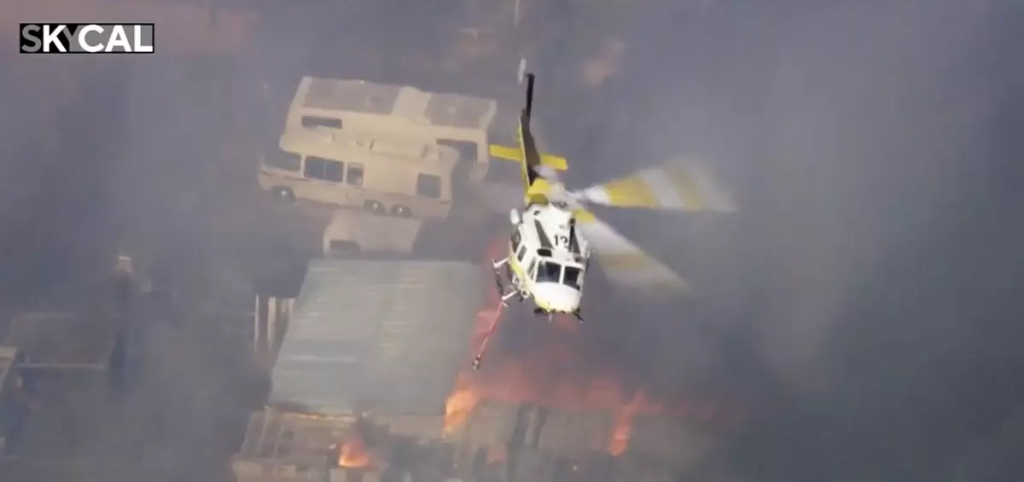
The original Los Angeles Times caption under this photo identified the scene as “a fast-moving brush fire [that] damaged some buildings” this past weekend. But those “buildings” sure do look like RVs, which despite nearby flames are not going anywhere.

If there is any one iconic image of what it means to go camping, it has to be that of a family or group of friends clustered around a campfire under a starry canopy, sparks swirling toward the sky to join their celestial counterparts. Whereas such fires were once the means by which hunters, cowboys and pioneer families cooked their meals, these days it’s rare that anything more than marshmallows on a stick gets thrust into the flames. This is fire as an aesthetic—even mystical—experience, not as a tool for meal prep.

The Dyrt, a mobile app for campers looking for sites, recently underscored that point in its annual survey, in which it quoted several campers on the central importance of campfires. For Adam R. of Colorado, a list of the things that thrill him about camping starts most notably with “campfires and stargazing at night, sunrises and hearty breakfasts in the morning.” Miccal M. of Vermont went deeper, contending that “there is nothing like sitting next to a fire in the woods to help look inwards and see if you need to adjust paths.”

They’re not wrong. I’ve had my share of pensive moments of staring into the embers of a well-banked campfire, watching intense blue flames dance along a charred log cosseted by orange coals. There’s primitive pleasure in feeling a skin-tightening warmth on your face while your back tingles with evening’s chill, of hearing the occasional pop and hiss of damp or sappy wood echoing through the otherwise still air, of letting your thoughts drift upwards with the sparks and wispy smoke. I get it.

Here’s what I also get. According to the National Academy of Sciences, seven of every eight wildfires are caused by humans, and of those, 29% are attributed to unattended or abandoned campfires. Such wildfires are becoming increasingly common and increasingly large and widespread, especially in the West. Indeed, The Dyrt’s annual report also relates—without any acknowledgement of irony—that 33.1% of West Coast campers had their plans last year interrupted by wildfires and natural disasters, more than twice the rate of campers not on the West Coast (13.1%).

As I write this, a series of wildfires is again burning up and down California, with the largest—along I-5 between Los Angeles and Bakersfield—having consumed nearly 16,000 acres and as of early this morning being only 31% contained. More than 61,000 acres have burned in the state this year, making this the fourth biggest fire season to date since 1996—and this is after two years of resumed rain and snow that ended a years-long drought.

In southern New Mexico, meanwhile, where the drought still persists, a pair of forest fires is advancing on the village of Ruidoso “like a pair of pincers,” according to local officials. Residents were urged to flee immediately, without pausing to pack valuables, as the South Fork Fire grew to nearly 14,000 acres with zero containment and the Salt Fire neared 5,000 acres, also with zero containment. Much of the American southwest is under “red flag warnings” because of the increased risk of wildfires, due to very dry air and winds and parched ground cover.

All this is happening in the closing days of spring, which is to say, with the hottest days of summer still ahead of us. No surprise, then, that the Colorado Sun published an opinion piece Monday under the headline, “Six reasons why campfires should be banned year-round in Colorado.” Written by science writer and lecturer Trish Zornio, the piece argues that increased wildfire risks and increased health risks from rising smoke pollution suggest “it’s time for Coloradans to ditch the campfire ring.”

While the causes of the California and New Mexico fires remain under investigation, that’s not the case with Zornio’s leading example, the Interlaken fire near Twin Lakes in Lake County, Colorado. Now more than a week old, the Interlaken fire is being blamed on an improperly extinguished campfire that smoldered for several days before being reported. To date it has burned more than 700 acres, and while it’s reportedly 86% contained, that doesn’t mean it’s almost out; expectations are that it will continue burning within its circumscribed perimeter for weeks to come.

As Zornio points out, there are no fire restrictions in Lake County—no one thought they were needed this early in the season. But growing climate instability “makes predicting weather conditions more difficult,” she writes, which in turn means “our ability to predict and manage wildlife conditions is also impacted.” Meanwhile, a growing population with more of a taste for outdoor activities is further stressing the environment. “Once spacious campgrounds are now packed to the gills, dramatically increasing the concentration of campfires,” Zornio writes, thereby increasing “the chances of human-caused wildfires.”

There will be other Interlaken fires in the weeks ahead, but that won’t deter traditionalists who cling to the idea that a campfire is the very essence of camping. It isn’t, unless you need some way to cook that rabbit you just bagged while living off the land. But until there is a widespread understanding that open fires have become much more of a threat to the environment—not to mention to human health and property—than was true even a decade ago, most campers will stubbornly continue building fires in a flammable landscape because that’s what “camping” is all about. And, no surprise, more of that landscape will burn.

Looking for a mystical experience? Try yoga, or deep breathing and meditation, or even ‘shrooms. Consign campfires to the same historical closet in which we store fur leggings and brush lean-tos.

The bloom is off the RV camping rose

One person’s blessing can be another person’s curse. Take gas prices, for example: according to AAA, Gas Buddy and the Energy Information Administration, gas demand is declining and so are gas prices, down more than 19 cents a gallon from a month ago and more than 14 cents below last year’s June prices. For the RVing public, that’s good news. For RV parks and campgrounds grown accustomed to a brisk amount of business, maybe not so much.

Although lower gas prices mean more people may decide to hit the road, one reason for those lower prices is . . . fewer people are hitting the road. “Demand is just kind of shallow,” according to AAA spokesperson Andrew Gross, as quoted in an Associated Press story earlier this week. “Traditionally—pre-pandemic—after Memorial Day, demand would start to pick up in the summertime. And we just don’t see it anymore.”

Of course, less demand is just one factor in the gas equation, and it will take months to sort through accumulating data to determine what’s really going on at the pump. Crude oil prices are one obvious variable. So is refinery capacity. But it’s not just prices that are down, as overall gas consumption is off by 10% from pre-pandemic levels. More fuel-efficient cars may account for some of that, as may growing sales of EVs. However you parse it, though, the bottom line seems to be that fewer people are driving this summer than in years past, and they’re not driving as far.

How much of that will translate into less traffic at RV parks and campgrounds? That, too, remains to be seen, but it certainly suggests the possibility that business overall will continue softening, as became noticeable early last year. One indicator the bloom is off the RVing rose: RV sales continue declining, even as RV manufacturers keep shoveling out new product on the thin hope that business will turn around any month now. Retail registrations in April, released Monday and the most recent available, marked a 9.8% drop compared to April of 2023. Nor was that a statistical blip: year-to-date sales are down 10.4% from the same four-month period last year.

The downturn has become pronounced enough that The Wall Street Journal took note last week in an article headlined, “It’s a Buyer’s Market for Boats, RVs and Other Pandemic Toys.” Extra cash, low interest rates and a desire for buffered recreation during the pandemic years resulted in a buying surge that pushed RV sales and campground visitation to record highs, but when all that turned around, a lot of new RV and boat owners were left with lightly-used playthings for which the bills keep coming. “The whole business is based on a monthly payment,” Marcus Lemonis, chief executive of Camping World Holdings, told the Journal.

Camping World’s stock price has been on a steady decline since the end of March, when it closed at $27.95 ahead of an expected seasonal upsurge in RV sales that still hasn’t arrived, and now sits at $18.68 amid a bearish short interest outlook. Lazydays Holding, an RV dealership that describes itself as the world’s largest, saw its shares tank more than 64% over the past year and lost $1.63 a share in the first quarter, as reported mid-May; it’s now on the verge of being delisted. Thor Industries, the world’s largest RV manufacturer, reported last week that sales for its fiscal third quarter were down 40% and earnings per share were down by two-thirds from the same period a year earlier.

To be sure, none of that automatically translates into slower business for RV parks and campgrounds, which may yet hope that a continued decline in gas prices will tease out more traffic. But it does suggest a shift in the recreational zeitgeist, a turning away from a pandemic-induced “it” thing to something that’s less physically demanding and with less of a long-term financial overhang. That might mean glamping—which puts the onus of capital investment on campground owners, rather than on campers. It might mean flying off to places an RV just can’t go. Or maybe it just means a return to staycations, now that most people feel comfortable hosting friends and family on familiar turf.

Then there’s the whole pesky weather problem that no one in the campground industry likes to talk about. RV park owners and RV retailers and manufacturers may resolutely turn a blind eye to the issue, but campers aren’t, and they’re making plans—or not making plans—accordingly. There are only so many crushing tornadoes or fire-ravaged hillsides or biblical floods (hello, Florida!) that most people can absorb before they begin to question the wisdom of parking out in the open in a relatively small box on wheels. Next week’s forecast calls for the season’s first truly massive heat wave in much of the country. Any doubts about how that will affect year-over-year camping statistics?

Unlike the manufacturing and much of the retailing ends of the RVing industry, campgrounds and RV parks are still privately held and too fragmented to produce much in the way of reliable metrics. Nor are its trade associations able to keep a finger on the business pulse, forcing observers to rely mostly on anecdotal accounts of what’s going on. Thus far those accounts aren’t bullish, but more illumination on that score may be provided the next time KOA chooses to publicize its reservation numbers: if it follows recent practice, those numbers will be all about the dollars, not about camper nights—which last fall it reluctantly acknowledged have been down.

Perhaps RVers can hope site rates, like gas prices, will start responding to softened demand? Isn’t that, after all, the carrot that KOA and other adopters of “dynamic pricing” have dangled in front of their customers to ease the sting of demand-driven price increases?

How efficient can RV parks become?

Homestead RV Community in Alabama, which by design minimizes the number of employees needed to keep it humming.

One of my most faithful readers, Ed O. Bridgman, had quite a bit to say in response to my last post, in which I lamented the post-pandemic recovery of the RV park and campground industry. Drawing on U.S. Bureau of Labor Statistics surveys, I had concluded that while the number of campground sites had increased, the number of employees servicing them has declined; and that payrolls had increased more slowly than overall revenues. In short, campers today are paying more for less, with a growing share of that revenue going to profit margins rather than to paying workers.

Ed’s response, which can be read in its entirety at the end of that post, took me to task for failing to recognize how much more efficient the overall industry has become, efficiency defined as needing fewer employees to do the same amount of work. In relevant part, he wrote: “As the RV industry matures it evolves to a more efficient model. A few years ago most of the ‘owned by sole proprietors – private owners’ campgrounds made reservations on a pad of paper. Today nearly all campgrounds employ reservation software and many use sophisticated pedestals that meter electricity and water. Security cameras have taken the place of security people. Many campgrounds are not operated the way you did yours 10 years ago and they don’t require the workforce.”

But only some of that is true. Computerization indeed has tempted many campgrounds to severely cut back on desk staff, allowing—or forcing, depending on your point of view—campers to make reservations on-line rather than on a phone. More limited desk staff, in a large and growing number of instances, also has led to shorter office hours, more telephone calls going to voice mail and campers encouraged to find their own sites and to check themselves out. That all can be defined as an increase in “efficiency,” but it’s worth asking whether greater efficiency is compatible with “hospitality,” which requires at least some modicum of personal interaction.

Meanwhile, although security cameras enable a smaller staff to keep eyes on an RV park, and indeed may provide some deterrence against unwanted behavior, they can’t entirely replace security people. Not unless observed misbehavior is to go unchallenged, which requires a human response.

But the real flaw in Ed’s response lies in his statement that “many campgrounds are not operated the way” mine was, “10 years ago” and, presumably, three years ago when we sold the place. Three years also happens to be how long it’s been since Ed opened his own RV park, Homestead RV Community in Mobile, Alabama—which, just to be clear, by all accounts truly is a gem. Boasting a knock-your-socks-off Google rating of 4.9 stars (out of five) based on 325 reviews, Homestead appears to be a meticulously built property that boasts large and perfectly level concrete RV pads, high-speed fiber optic connections to every site, impeccably clean bathrooms and other facilities, and a growing roster of amenities that include a stocked fishing pond, playground, large shaded dog park, pavilion with 82-inch LED stadium TV, and a community fire pit. A swimming pool and fitness center are under construction and slated for completion this August. And for a $100 set-up fee and modest daily charge, guests can have a portable Jacuzzi delivered to their site and filled with cool or hot water, as they prefer.

All of which is to say that Ed sits on an enviably rarefied perch that is no more representative of most campgrounds than a showroom model at the local dealership is of most cars on the road. Most obviously, Homestead is brand-spanking new—unlike the great majority of RV parks, especially in the East and Midwest, which are many decades old and therefore have decades-old infrastructures. An old Victorian on an overgrown lot is going to have many more plumbing, electrical, structural and landscaping problems and challenges than a new suburban ranch on a freshly sodded patch of dirt, and that means more staff is going to be needed to keep it all trimmed and properly functioning.

Homestead also, at this time, is still on the small side, with only 75 sites and no cabins or other lodging to maintain or keep clean. The terrain is flat, the RV sites concentrated in a featureless area–no trees, shrubbery, fences or other impediments to mowers— and the roads are all asphalt: no need to worry about scraping gravel roads or filling potholes! And unlike the vast majority of RV parks, Homestead is now transitioning to a camper-owned facility, with as many as 59 of its sites for sale. The more sites sold, the fewer available for transients and the less turnover—further cutting back on demand for labor.

None of this is a criticism of Ed, who clearly has a well-thought out, well-executed business plan and who takes enormously justifiable pride in what he’s accomplishing. But his opinion about how many employees it can take to run an RV park is shaped by his unique circumstances, whereas mine was forged by a 60-year-old campground with twice as many sites, plus 13 cabins and gravel roads widely dispersed across a hilly 43 acres, not to mention a constantly changing camping population. Computerization can take you only so far in a business that rises or falls on personal interaction, and automation won’t pick up trash, scrub toilets or clean fire pits—which Homestead, aside from the communal firepit, notably does not have.

Where we differ, then, is in how representative we each think our own experiences are of the industry overall. But whereas Ed thinks “many” campgrounds are being operated more efficiently than they were a decade ago, the only increased efficiency most of those campgrounds can claim is in how they take reservations: the rest of their labor requirements are a function of age, size, topography and design, most of which is immutable.

Which leads me back to my original observation: campgrounds are charging you significantly more to spend the night, even though their depleted workforces are less able to keep up with routine maintenance and cleaning. But don’t take it from me: you can determine that for yourself, as you travel from one campground to another, and as you compare today’s experience with that of a decade ago.

Pay more, get less—by the numbers

This Saturday marks the third annual attempt to gin up public excitement for National Go RVing Day, a marketing campaign from the RV Industry Association. As helpfully noted by the association, the celebratory event takes place during both National Camping Month and Great Outdoors Month and is “intended to motivate customers to embrace the RVing experience by reserving a campsite, visiting their local dealer, upgrading with a new aftermarket feature, or researching new road trip adventures.”

A sourpuss might also note that National Go RVing Day comes just a week after the start of hurricane season, not to mention an unofficial start to fire season in California and an especially brutal volley of tornadoes throughout the Midwest. Perhaps that—as well as an uneven economy that most penalizes the lower end of the economic spectrum—accounts for the season’s ragged start, as RV dealers and campground owners alike have been eyeing the coming months with some trepidation. No one really expects a disastrous season, but nor is anyone forecasting a really bitchin’ summer. Against that backdrop of anxious uncertainty, surely any marketing push can only help.

Then again, National Go RVing Day may be the most appropriate time to survey the RV park and campground industry overall to see how it’s been doing since the pandemic broke its back, in early 2020. And that exercise, for all the qualifications and caveats that must precede it and as detailed below, leads to two observations: number one, commercial camping and RVing has become significantly more expensive over the past four years, as RV parks keep jacking up their rates and larding on all kinds of new fees. And number two, industry wage growth has failed to keep pace with those revenue increases, resulting in workforce numbers that have yet to match pre-pandemic levels, even as the number of campgrounds and RV parks has grown.

Or to put it in a nutshell: if you go RVing this weekend, expect to pay a lot more than you did four years ago for dirtier accommodations and notably less personal service.

More on that in a moment, but first the caveats. Despite the fact that there are approximately 12,000 private RV parks and campgrounds in the U.S., they still constitute a niche market about which it is almost impossible to get good statistical data. That difficulty is compounded, recent acquisition fever notwithstanding, by the industry’s extreme fragmentation: for all of the growing roster of investor-driven roll-ups, the overwhelming majority of campgrounds are still owned by sole proprietors—private owners, it should be noted, who typically ignore industry surveys and tend to think it’s no one else’s business how they run their properties.

As a result, virtually all industry- and consultant-driven surveys are highly suspect, marred by flawed sampling techniques and low response rates. Even the nation’s 500-pound surveying gorilla, the U.S. Bureau of Labor Statistics, doesn’t attempt to drill down to such a granular level. Instead, it subsumes RV parks and campgrounds under a much broader “accommodation subsector,” which is defined as industries that “provide lodging or short-term accommodation for travelers, vacationers and others.” All told, that subsector included approximately 78,000 private establishments at the end of 2023, with campgrounds and RV parks therefore comprising roughly 15% of a total dominated by hotels, motels, resorts and other kinds of lodging.

Trying to understand what is happening within the campground/RV park universe using BLS data therefore means extrapolating from this broader aggregate, but despite those limitations it’s still the most extensive and reliable data set available. Moreover, it also requires factoring in the reality that campgrounds and RV parks are very much on the low end of wage scales within the accommodations sector, which means that however dismal such numbers are sector-wide, they’re even worse for the “outdoor hospitality” segment.

That noted, here are some relevant numbers:

  • The overall number of private lodging establishments barely took a hit from the pandemic, dropping from 73,792 at the beginning of 2020 to 72,756 three months later. Otherwise, that number has been on a steady upward climb ever since, growing by 7.3% over the four-year period ending in December, 2023.
  • The total workforce within the accommodations sector, meanwhile, plunged by more than half, from a record high of 2,119,700 at the start of 2020 to 1,056,700 in May of that year. It has yet to fully recover. Indeed, the growth in workforce size shows signs of leveling off since late last year and now stands at a preliminary estimate of 1,923,900—a 9.2% drop from its pre-pandemic high.
  • The accommodations sector’s producer price index, on the other hand, has been booming. Defined by the BLS as an index that “measures the percentage change in prices that domestic producers receive for goods and services”—briefly, what you get charged for the night—the PPI went from a high of 177.5 in the summer of 2019 to a low of 148.7 in November of 2020. Ever since it’s been on a sharp, albeit zigzagging upward march, dipping each winter before surging the following summer and hitting an all-time high of 201.875 last July. It currently sits at a preliminary estimate of 195.651, with nothing to suggest it won’t resume its upward trajectory to new highs over the coming months.
  • Finally, average hourly earnings of production and nonsupervisory employees in the accommodations sector have climbed pretty steadily since the end of 2019, from $15.90 an hour to a preliminary estimate of $20.78 this past March—which, as it turns out, is actually a slight dip from the $20.84 recorded in January.

What’s it all mean? Just this: over the past four years or so, the number of lodging establishments has gone up more than 7% while the number of people serving those establishments—greeting and booking guests, cleaning up after them, fixing the inevitable maintenance issues—has gone down 9.2%. That decline in employee headcount has come despite a 30.7% increase in wages over the same period, even as lodging prices have gone up 35.8%. In other words, campers (and other lodgers) are paying more for less service, and a disproportionate amount of that increased outlay is going to non-labor costs and margins and not to attract more and better-quality employees.

There’s every reason to believe, meanwhile, that these disparities are even greater on the campground and RV park end of things. A perusal of any campground job listings will quickly disclose that almost all are advertising wages between $12 and $15 an hour, which is scarcely above minimum wage in many states, and the accommodations sector’s “average” wage of $20-$21 is essentially unheard of among campground employees. RV park pricing, meanwhile, has readily exceeded the 35.8% increase in overall lodging prices over the past four years, and in many cases approaches or exceeds a 100% increase, creating even more of a disconnect between revenue and payroll.

Potential employees looking for a way to fill their gas tanks and stock their pantries don’t need a whole lot of number-crunching to figure out that working in the hospitality industry generally, and at campgrounds and RV parks in particular, isn’t going to cut it. And a camping public looking for an affordable way to spend a weekend or a week on a family vacation doesn’t need a spreadsheet to know that this RVing business is getting hopelessly out of hand—nor does it need a white-glove examination to understand it’s paying quite a bit more for quite a bit less in return.

The problems facing the industry, in other words, are far larger than National Go Rving Day can overcome.

For RVers, the outdoors is a war zone

Tornado aftermath May 26 at the Lake Ray Roberts Marina RV Park, just north of the Dallas-Fort Worth area.

One of the more insipid refrains the RV park and campground industry is prone to repeating is that it’s in the business of “creating memories.” These days, alas, those memories may start convincing a growing number of RVers that there has to be a better way to spend their vacation time.

The Memorial Day weekend was notable for tornados that essentially wiped out at least two RV parks, in Texas and Oklahoma, but at least three other campgrounds preceded them this year alone: Florida Caverns RV Resort, hammered in January; an RV park east of Madison, Indiana, blasted by an EF2 tornado in mid-March; and a campground at Hanging Rock in southern Ohio in early April that also got thumped. All sustained serious damage, but the violence this past weekend took matters to a whole new level.

At the Will Rogers Downs KOA in Claremore, northeast of Tulsa, an EF2 twister slammed into a campground that had 146 occupied sites, converting an Airstream trailer into a silver bullet that flew the length of a football field, flipping large motorcoaches and tearing apart travel trailers. That same Saturday, 220 miles to the south-southwest, an EF3 tornado made mincemeat out of the Lake Ray Roberts Marina and its 47-site RV park, just five years old, leaving a half-mile-long debris field. That no one was killed at either campground was simply a matter of luck: both twisters hit at night, with campers given no advance warning. And while the Oklahoma park has a storm shelter, not everyone managed to reach it in time.

May tends to be peak tornado season, with such storms declining in frequency through June and into July. But that doesn’t mean the danger they pose is entirely over—and as their threat diminishes, their big cousins are just stepping up to the plate. Hurricane season typically runs from June 1 to Nov. 30, and aside from being themselves a significant threat to coastal areas and as much as 200-300 miles inland as far north as Maine, hurricanes also can spawn tornadoes. Meanwhile, 2024 promises to be one of the most active hurricane seasons on record, with the National Oceanic and Atmospheric Administration forecasting eight to 13 hurricanes, including four to seven “major” hurricanes, with winds of 111 mph or higher.

None of that sounds like picnicking weather, nor does the less dramatic but even more deadly cause of all that turbulence, a rapidly warming atmosphere above and oceans below. Heat-related deaths have been rising steadily since 2014, and the number of extreme heat days in some states is now five times higher than 40 years ago. So the American southwest, while relatively safe from tornados and hurricanes, actually kills far more people than either of those headliners simply by baking them to death. Phoenix last year had 54 days when temps hit 110 or more; Maricopa County, which includes Phoenix, had 645 heat-related deaths in 2023.

(Pity poor Houston, which gets a triple whammy of hurricanes, tornadoes and excessive heat: this past weekend it broke all records by registering a heat index of 115 degrees. In May.)

Given the above extremes, it’s hard to think of a more inappropriate shelter in which to confront the elements than an RV. These boxes on wheels become ovens in a heartbeat if they lose power with which to run their air conditioners, and they’re far more vulnerable than most housing to the baseball-sized hail that’s seemingly ever more common throughout the South and Midwest. Staple-and-glue construction techniques used to assemble cheaper rigs, be they travel trailers or class Cs, guarantee they’ll crumple or fly apart under even a moderately vigorous shaking. And even the most solid fifth-wheels or motorcoaches present sail-like silhouettes to winds strong enough to flatten commercial buildings, never mind dwellings that have only four unanchored points of contact with the ground.

Yet despite these obvious and growing vulnerabilities, the RV industry does nothing to alert the public to the heightened risks it takes when camping in certain areas at certain times. Indeed, it has been positively euphoric when announcing in recent weeks that 45 million Americans “are gearing up for RV adventures this summer,” with an industry chief marketing officer crowing that RVing “offers a unique combination of freedom, adventure and value” and an opportunity to . . . wait for it . . . “create unforgettable memories.” Indeed. Matt and Anna Conners, quoted in numerous news stories, undoubtedly will long remember the night they had to pound on the doors of a storm shelter at the Will Rogers Downs KOA to escape the tornado that flipped their Coachmen Class A.

But it’s not just campers who are being led down the primrose path—so are campground owners, who tend to be blasé about the risks they face, dismissive of climate change warnings and oblivious to how quickly the overall weather outlook is deteriorating. The Lake Ray Roberts Marina RV park, which as mentioned above was opened a mere five years ago, lies just north of Denton, Texas, and right at the base of the area with the highest average number of tornadoes per year, as indicated on the map below. That apparently didn’t dissuade anyone from building the campground, and apparently wasn’t ominous enough to prompt the CYA construction of an underground storm shelter.

Meanwhile, as I wrote earlier this month, a similar indifference to facts on the ground has enabled ongoing planning for a $2 billion-plus amusement park and RV park with more than 1,000 sites and cabins in northwest Oklahoma—just at the edge of that deep maroon blob in the middle of the map. How different is that from building a tourist attraction on the lip of a dormant but not extinct volcano?

The problem is not that people with too much money and not enough sense are indulging in such follies, but that their willingness to do so creates a misleading sense of normalcy for other people who are just looking to have a good time—or even, heaven help us, who are hoping to “create memories.” Some significant portion of them will get more than they bargained for.

Why would any RVer pay Frank Rolfe?

Frank Rolfe, with an assist from his sidekick, Dave Reynolds, is at it again, trying to cash in on the RV park acquisition craze by passing himself off as an expert on something about which he knows squat.

To be clear, Rolfe does have a lot of expertise in the trailer court/mobile home park industry. He’s garnered quite a reputation for buying up trailer parks and then squeezing his captive tenants for every last dollar, while also slashing amenities and maintenance to the bone—then selling his cut-throat tactics as nothing more than good business. That selling comes in the guise of something he unabashedly calls the Mobile Home “University,” which in fact is nothing more than a slew of CDs and printed manuals that explain how you, too, can rationalize predatory practices on the way to personal enrichment.

Okay. Repulsive though that may be, it nonetheless falls squarely within the parameters of modern capitalism, and the devil take the hindmost. But where Rolfe steps over the line is in his blurring of the differences between trailer parks and RV parks, contending that the latter are just a variation on the former and that both can be managed according to the same principles. (I’ve been repeatedly critical of this bait-and-switch in the past, but to be honest, the RV park industry has done itself no favors by increasingly converting transient sites into long-term rentals, not to mention its embrace of cabins, park models and other fixed dwellings.)

While Mobile Home University remains Rolfe’s flagship, he’s again touting its slighter sibling, the equally hubristic RVPark University. This past week he sent out an email-blast promoting an “RV park investing boot camp,” which from all appearances is just an online presentation of material that’s already contained in the “university’s” home study course. There is no boot “camp,” and as it happens, the CDs and printed materials in the home study course can be purchased on RVU’s website for just $497 (or $397 for an electronic copy); watching the boot camp, meanwhile, requires “an investment” of $997. You do the math. Then again, Rolfe claims that the materials in the home study course actually have a total value of $4,688, so any way you slice it you get a heckuva deal!

(You also can count yourself lucky not to be interested in mobile home parks: that online “investing boot camp” will set you back $1,749. Where do all these numbers come from? Apparently, it’s all a matter of what the marks can be convinced to shell out.)

But back to RV parks. Part of Rolfe’s sales pitch is a helpful section headlined “Why Invest in RV Parks?” followed by eight bullet points of varying truthfulness and questionable assertions. Among them, for example, is “low capital expenditure requirements,” explained with the notable phrase, “RV parks are—for the most part—just blocks of land that people park their RVs on.” Oh, sure, “there are other amenities such as clubhouses and pools,” Rolfe concedes, “but what’s lacking are sprawling time bombs of maintenance like roofs and foundations.”

All of which lets me know that Rolfe has never had to fix a broken water main, or snake out a sewer line clogged by RVers insistent on flushing wipes, or repair a pedestal laid low by an errant fifth-wheeler. And with average per-site RV park construction costs approaching $25,000, there clearly are a lot more capital expenditures going into an RV park than Rolfe understands, not to mention all the maintenance issues they will incur.

There are several other howlers of the sort in Rolfe’s pitch, but the one that really illustrates his cluelessness—and that attests to his utterly contemptuous approach to mobile home park management—is the sub-head, “low reliance on personnel.” As Rolfe notes, correctly, “owning a business that relies heavily on employees is becoming a nightmare,” but not to worry! As Rolfe goes on to explain, “The RV Park industry is basically a ‘parking lot’ model in which the customers park their RVs on your land and that’s what you get paid for. It’s not like trying to run a restaurant where just one weak link on your employee base can ruin your business.” Easy-peasy—when it comes to RV parks, no employees required!

Again: clueless. Completely. Because while Rolfe’s description may be apt for a (poorly maintained) trailer court, an RV park that isn’t given over entirely to year-round or seasonal campers is going to need at least some maintenance workers, not to mention desk clerks and housekeepers, plus activities directors, swimming pool attendants and assorted other personnel as those “other amenities” proliferate. But that hasn’t prevented Rolfe from repeatedly representing himself as some sort of authority on RV parks, subbing in his experience as a trailer park mogul to mask his ignorance. In that regard, for example, it’s telling that all of the glowing evaluations and testimonials that litter both “university” websites relate solely to motor home parks.

At a time when mainstream RV park leaders are in a full-throated embrace of their self-assigned role as “the hospitality industry,” with its emphasis on personal connections and personnel training, Rolfe sits at the other extreme. It’s an interesting bifurcation, problematic at both ends. But the Rolfe end of that spectrum, while seeming to offer a cheaper, more streamlined operating model, is a sure-fire guarantee of bad press, bad reviews and bad feelings. Caveat emptor, whether it’s $397, $497 or $997.

You say tomah-to, I say . . . cabbage?

A Class C by any other name is neither a fifth-wheel nor a motorhome—unless you write for Rolling Stone.

It’s the little things.

The RV Industry Association regularly cranks out an email blast, called “News and Insights,” in which it promotes various aspects of the RVing business—upcoming lobbying efforts, various new products or services, RVing research of one kind or another. It also provides summaries and links to other sources that have said or written something to its liking, such as today’s suggestion that readers “take a look” at a recent Rolling Stone article, “From Road trips to Staycations, Here’s Why RVshare Is Our Go-To for Festival Camping.”

Wow. So this is why Rolling Stone has tumbled into obscurity.

It’s pretty clear that Tim Chan, who wrote this puff piece, found himself a nifty way to score a posh free stay while attending the Stagecoach music festival, held in April near the Coachella Lakes RV Resort. But you’d think that he’d at least do a little homework before cranking out such a thinly disguised advertorial. Instead, he liberally stroked RVshare, which presumably arranged and paid for his digs; gave a quick shout-out to “Al,” who not only provided the RV but also delivered it from Temecula, set it up, and then packed it up when Chan was done jamming out to Post Malone and Miranda Lambert; and repeatedly assured his readers how swanky RVs have become.

“That image of a run-down trailer with creaking parts and dusty furniture?” he wrote. “Consider that a relic of the past, and RVshare [stroke, stroke] a leader in the future of travel.”

Well, yeah—if what you’re staying in is “a luxe, 43-foot fifth wheel camper,” with electric fireplace, massage chairs and a master bathroom with his-and-her sinks. Or as Chan also raved, “While RVs often (unfairly) have a reputation of being pedestrian and basic, this was glamping at its finest, and we were spoiled with more space and amenities that [sic] we could have imagined.” Which is like staying at the Palms Casino Resort in Las Vegas and concluding that Motel 6-type accommodations are so ‘Fifties.

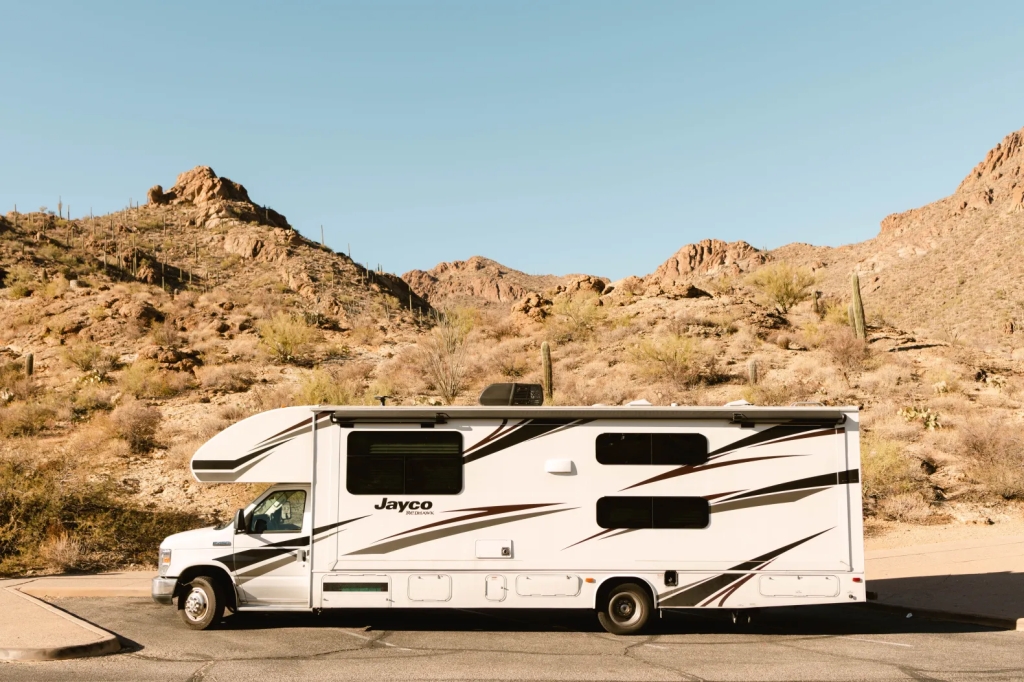
Well, we think Chan stayed in a 43-foot fifth-wheel. His article led off with a photograph of a Jayco Class C (above), which is neither a fifth-wheel nor 43 feet long. He then wrote about having his “motorhome” delivered to the resort, in the next breath describing how Al “was quick to walk us through the trailer settings.” The article wasn’t long enough to throw in truck campers, Class Bs or pop-ups as additional points of confusion, but be forewarned about reading any Chan reviews of automobiles, athletic equipment or electronic gear—it’s all pretty much a blur of undifferentiated products to him.

So why would RVIA highlight this particular piece of froth? Perhaps because Chan’s money graph focused on one of RVIA’s current obsessions, the upcoming travel season and why RVs ostensibly are the most economical way for families to vacation. Indeed, the same RVIA “News and Insights” includes a lengthy nod to the association’s ongoing fiction that “family RV travel to some of the country’s top vacation spots costs an average of 60% less than traditional travel methods.” Although that claim is based on a deeply flawed “study” that I dissected last year, RVIA continues to trumpet its findings as gospel—and is equally ready to repeat even the most sophomoric accounts that seem to bolster its assertion.

In Chan’s money graph, that comes with his observation that “If you’re staying in a hotel, those days and nights can add up, but the average rental price on RVshare.com is only about $150 a night.” Besides the imprecision of that comparison (“add up” to how much?), a “luxe, 43-foot fifth wheel” is going to be on the high end of whatever range produces a $150 average. Apples and oranges. Then there’s the unstated costs of having your RV delivered and set up, as well as site rates that at Coachella Lakes start at $120 a night. That’s not to say it’s not all worth it, but Chan’s lack of transparency about these (and possibly other) costs simply plays into RVIA’s hollow narrative.

RVing can still be a relatively affordable way to travel and vacation, although it’s taking a lot more work than was needed even five years ago. But that’s not going to happen by using 43-foot fifth-wheels (or motorcoaches or whatever) or five-star resorts as points of reference, and any comparisons to other travel options can be highly problematic. RVIA’s readiness to embrace so shallow a piece of reporting as the Rolling Stone story to bolster its claims of affordability, alas, smacks either of carelessness or desperation.

It’s the little things, rubbing you the wrong way, that eventually become a pus-filled blister.