Extreme weather season, exemplified by forest fires, hurricanes and tornadoes, is upon us, and in its crosshairs are three of the biggest RV park proposals ever conceived. Yet one of those projects has given no indication that it’ll be deterred by something so banal, a second is officially still on track but threatened by non-weather related developments, and the third has gone AWOL.
The AWOL project is KOA’s proposal for two camping resorts on more than 900 acres straddling State Highway 140, a major access road to Yosemite National Park. The two resorts were to have more than 400 RV pads, 25 to 50 tent sites, 80 to 90 “conditioned glamping units” under KOA’s Terramor label, abundant amenities and a workforce of approximately 100, also housed at the site. In other words, KOA’s plans called for constructing the equivalent of a small town with a peak population comparable to that of the nearby existing town of Mariposa.
Or at least that’s what KOA was proposing, well more than two years ago (more context here, here and here). A preapplication it filed in early 2022 was followed that June by a “coffee and conversation” meeting with local residents that was supposed to assuage their apprehensions but raised more questions then it answered. Mere weeks after that, in late July, the Oak Fire sprang up almost literally next door and swept through 19,000 acres—less than a mile west of the even larger Ferguson Fire of 2018, which had ravaged 97,000 acres. KOA thereupon fell silent on the whole grand scheme, neither following up on its preapplication nor announcing it was dropping its plans.
This week the fire came roaring in from the other side, and while at this writing the French Fire is still considerably smaller than its nearby predecessors, it’s fierce enough to put the entire town of Mariposa under a mandatory evacuation order. A video on Facebook showed “the entire mountain above the high school” on fire, State Highway 140 was closed on Thursday and approximately 3,500 customers had lost electric power as of yesterday. This afternoon the blaze was nearing 1,000 acres but also was 25% contained, raising hopes that further damage could be limited.
Still, this will hardly be the end of it. Yesterday’s heat in California was so extreme that Palm Springs hit a record 124 degrees, a Death Valley extreme—or was, once upon a time. Fourteen wildfires have ignited in California in the first five days of July; 145,000 acres have burned in the state this year, which is more than four times the five-year average for this date. One can only hope that KOA’s brain trust, reluctant though it might be to overcome institutional inertia, is looking at the same statistics and trend lines and concluding that no, maybe this wasn’t such a good idea, after all. And maybe at some point they’ll let everybody else know the same thing.
Elsewhere, as Hurricane Beryl plowed across the Yucatan Peninsula and seemed poised to hit Texas tomorrow night, coastal residents could console themselves with the thought that at least it no longer was the Category 4 and 5 storm it had been when it thrashed Jamaica, Barbados and other Caribbean islands. Yet Beryl already has made history as the earliest Category 5 ever to form in the Atlantic, and its early emergence portends an especially active and severe hurricane season that should put all Gulf Coast communities on high alert.
But that seems to be of no concern to the developers of a 400-acre RV park in Jackson County, Mississippi, who early last month defeated a court challenge to their plans filed by nearby property owners concerned that the development would “destroy the residential nature” of their community. Those neighbors aren’t necessarily wrong: Ocean Springs Islands RV Resort is projected to include 476 RV sites, 20 rental Airstreams, 16 elevated “tree houses,” a lazy river and a whole lot more, and all accessed by a single two-lane road that connects the two halves of that larger community, Gulf Park Estates. That means there’s going to be a lot of new people in town, and a lot of new traffic running through that narrow bottleneck.
Yet even as the court hearing was in progress, workers at the resort site were still cleaning up debris from Hurricane Katrina—from 2005. Seven years prior to that, Hurricane Georges had rolled over the property with a 10-foot storm surge (more context here). Nothing surprising in any of that, given that the site sits on a flood zone on Davis and Simmons bayous and the Mississippi Sound. But local residents, presumably because they face the same dangers and therefore are as willfully unable to confront them, couched their objections entirely in terms of zoning regulations. Of the increasingly high possibility of devastating winds and floods, not a word. Of the mayhem that will result when all those new neighbors try to evacuate along the same narrow road as the old neighbors, also not a word.
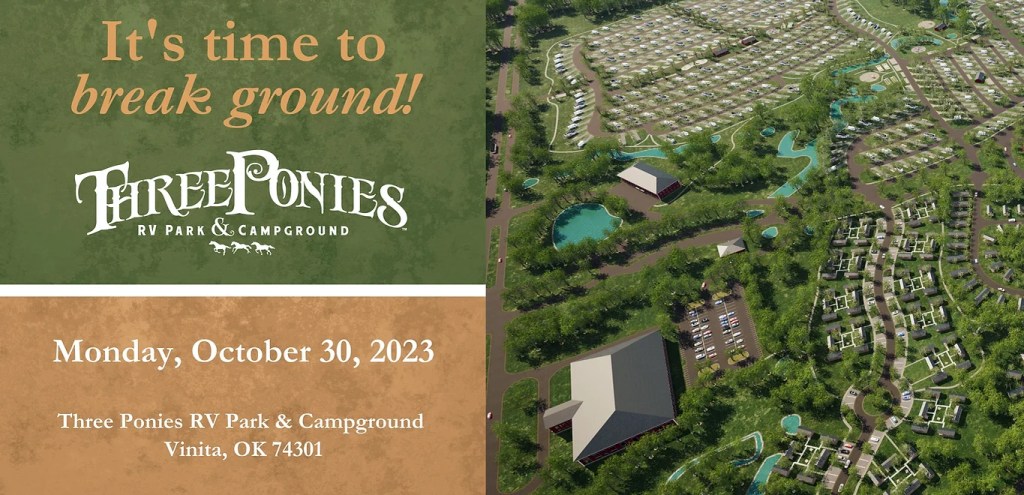
Finally, the hubristic $2.5 billion American Heartland Theme Park and Resort—to include the 320-acre, 750-site Three Ponies RV Park and Campground—dodged several weather bullets the past couple of months despite being sited smack in the middle of a busy tornado thoroughfare in northeastern Oklahoma (more context here). The bullet it didn’t miss? A $5.5 million lien filed by a Canadian firm the developers had hired to design the mammoth project, for allegedly unpaid invoices for work it had done through January. The filing came as the Oklahoma legislature was considering a $35 million request from the city of Vinita to upgrade its utilities to accommodate the project, so not a good look.
The allegedly unpaid work, coupled with a 25% increase in projected costs, lagging construction and unspecified delays in the completion date, have only increased skepticism that the developers—who have no previous amusement park experience—are in over their heads. “I hate to see the governments and the local communities and people spend a lot of money and get behind this because it’s just not realistic,” Dennis Spiegel, chief executive of International Theme Park Services, told a local news outlet. “It just won’t work there, OK? I’ve done this all my life. . . . And we do feasibility studies all the time, and we know the market. It just isn’t there.”
All of which may well be true, but which again avoids acknowledging the even more sobering facts on the ground: that Vinita has a tornado index value of 352.83, or two-and-a-half times the U.S. average, and just might not be the place you’d want 3,000 people setting up their travel trailers. It is, however, entirely consistent with an industry that despite being built around the idea of getting people into the Great Outdoors, pays little to no heed to what the Great Outdoors may do to them. Moreover, it’s also an industry that keeps thinking bigger is better, or at least more profitable, and so those efforts include piling up more people in a more concentrated area, with predictably greater carnage when the inevitable happens.
At some point, maybe we’ll recognize that something fundamentally different is going on—something that requires us to think and make decisions in a fundamentally different way.
 Renting Dirt