
More electrifying news for RVers

A pair of webinars this past week, one hosted by the RV Industry Association and one by the National Association of RV Parks and Campgrounds, underscored how seriously the campground world views the oncoming onslaught of electric vehicles. While campground and RV owners remain mostly skeptical, questioning the costs, range, recharging availability and environmental impact of a lithium-based technology, industry leaders are unwavering in their belief that the EV-RV revolution is already here and that the problems others see are either overblown or will be resolved in timely fashion.

“We are really at an inflection point which is amazing,” Ashis Bhattacharya, senior vice president for development and advanced technology at Winnebago Industries, told his RVIA audience. A “wave of electric adoption” is already washing over rental car agencies, delivery services such as Prime, UPS and FedEx, as well as school buses and other municipal vehicle fleets, all of which is normalizing the technology. The paradigmatic shift already underway, Bhattacharya added, is as significant as any ever experienced in the transportation sector.

Meanwhile, said Jay Landers, RVIA’s vice president of government affairs, state initiatives to outlaw internal combustion engines are giving the entire EV sector a kick in the pants. Five states, including California, already have voted to ban sales of new internal combustion vehicles by 2035, and others are looking to possibly follow suit. The state of Washington, which had the country’s sixth highest rate of RV shipments this year, is even more aggressive, adopting a 2030 cutoff deadline. Furthermore, expansion of the EV charging network nationwide is being super-charged by $5 billion in federal funding approved earlier this year.

None of which, all speakers agreed, is to minimize the problems confronting EV in general, and EV-RVs in particular. “The (EV) technology is still more expensive than what it’s replacing,” conceded MacKay Featherstone, Thor Industries’ senior vice president of global innovation. Moreover, he added, “the charging experience is utterly critical” and still inadequate for RVers in particular, both because most RVs need pull-through charging stations to be practical and because they have larger power needs than EV cars.

To their credit, RV manufacturers, frequently criticized for shoveling out hundreds of thousands of RVs without giving a thought to where their buyers might use them, are at least trying to get out in front of this development. And there is little reason to doubt that a society-wide change is coming, and coming hard. EV-RV costs inevitably will come down as sales take off, as they do with any emerging technology. Alternatives to lithium batteries, using less exotic minerals, are being developed, and advances in recycling technologies will further ease environmental concerns. Similarly, ongoing improvements in battery density will continue to expand vehicle range, relieving one of the biggest consumer anxieties about EVs.

The weak link, however, appears to be the RV park and campground end of the product chain. The RVIA webinar inadvertently made that point when its campground representative on the panel—Toby O’Rourke, president and CEO of KOA—was so unintelligible that she had to be dropped from the screen, apparently because she was trying to link in from an airport. (And why O’Rourke, again? Is there no other campground industry representative who can speak to the industry’s issues? Maybe someone from the Yogi franchise, or ARVC, or one of the other large state RV park associations, like Texas or California?)

Subbing in for O’Rourke was Brandi Simpson, her chief of staff, whose faltering contribution was to assert that campground owners are dealing with “a ton of misinformation” about EVs and need a lot of education and guidance. Which, presumably, KOA is scrambling to provide. . .

. . . as is ARVC, which lustily beat the drum on behalf of EV-RVs at its national conference in early November, and again at an hour-long webinar a couple of days after RVIA’s face-to-face. Pitched as “a recap of the best” of the conference for those who might have been unable to attend, the session inexplicably ignored the most contentious convention issue—a proposal to adopt industry-wide “standards”—while devoting the majority of its time to further promoting the idea that campgrounds need to get on the EV bandwagon, starting with the installation of EV chargers.

All of which is undeniably true, but far more nuanced and with many more questions than have been answered to date. For example: both webinars referenced possible tax breaks and federal grants to defray campground costs for installing chargers, while glossing over the reality that such inducements will require making the chargers accessible to the general public, and not just campground guests. Getting equally short shrift were any explanations of the occasionally mentioned “partnerships” that campgrounds might have to accept, whether with public utilities or third-party providers, to deal with licensing and infrastructure issues, since electric sales are typically a utility monopoly and EV chargers require robust additional power supplies.

(On a related note: one of the biggest frustrations for many KOA franchisees has been the parent company’s insistence on taking a 10% cut of all site fees—including any electric charges, even though campgrounds are legally prohibited from making a profit from reselling electricity. To the extent that EVs will increase electricity consumption at RV sites, that means even more unearned money transferred from franchisees to corporate headquarters.)
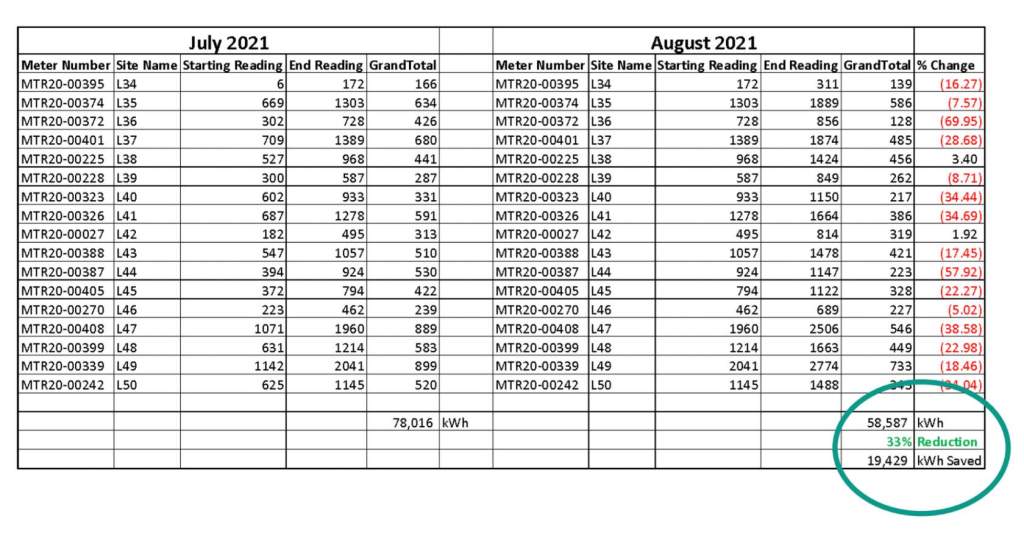
By ARVC’s calculations, electric metering of RV sites can reduce energy consumption by a third.

Indeed, the whole issue of who is going to pay for the extra electricity consumed by EV-RVs, and how, is still being sidestepped at the national level, quite possibly because there is no one answer. That, by itself, may become the biggest impediment to mom-and-pop campgrounds rushing into this brave new world. It’s notable, for example, that while ARVC now has an online “EV Toolkit” to help its members understand how to accommodate the new technology, the only guidance it provides for covering their costs is the vague advice to “consider billing for shorter stays, especially [campers] with unique equipment (large class As, EVs, electric golf carts, etc.), automatically billing those campers for the electricity they use. “

Presumably these and other issues will get resolved, sooner or later—once the industry stops talking around them. The RVing public, meanwhile, should brace itself for still higher costs, as a new electric sensibility starts percolating through the camping universe. Just as computerized reservation systems have introduced demand pricing and all kinds of add-on fees, the electrification push ultimately will result in all RV sites getting electric meters. Or as ARVC’s EV Toolkit asks, in a prominently displayed screen, “You don’t give away ice, candy bars or firewood, why give away electric?”

Most recent posts

Party like there’s no tomorrow

If you’d been in Raleigh, N.C. this past week, looking on as the National Association of RV Parks and Campgrounds (ARVC) held its annual convention, you’d have thought the Covid-19 coronavirus had been vanquished months ago.

Most extreme was Monday’s reception at the Sheraton Hotel, a boisterous affair of hundreds of people from all corners of the country jostling each other over pizzas and beer, shouting to be heard over the din. There was a time not long ago when this would have been called a super-spreader, but then again, this demonstrably is not a group that puts a lot of stock in science.

The rest of the confab showed similar if more restrained disdain for public health and welfare. Notwithstanding “mask up” signs posted throughout the convention center, virtually the only people paying heed were the masked convention center employees patiently attending to their unmasked guests. The double standard was so blatant that all attendees were sent an email Tuesday requesting that they observe the masking protocol, but as with the masks themselves, the email was almost universally ignored.

By Wednesday, security guards had been stationed at the doors to hand out masks to anyone entering the facilities who wasn’t already wearing one. Campground owners would take the masks, often grudgingly, then walk off without putting them on.

This sort of clueless behavior often starts at the top, so it was no surprise to see ARVC executive director Paul Bambei walking the halls and in the ballrooms with a naked face. Bambei’s offices, it should be noted, are in Centennial, Colorado, a state that for the past several weeks has seen such a sharp spike in Covid-19 infections that a local television station reported yesterday its contact tracers have been overwhelmed and can no longer keep up with the spread.

The U.S. overall is now reporting 23 new cases daily per 100,000 population. The rate is twice that in Arapahoe County, where Centennial is located. Viruses, like gases in a closed container, diffuse from areas of higher concentration to those with less. That’s why the U.S. overall is looking at a fourth wave this coming winter–as is already occurring in Europe, which has seen a 50% surge in just the past month–and why ARVC and its leadership did no one any favors this week.

Cognitive dissonance, part 2

The article in Woodall’s Campground Management that I mentioned in my previous post, regarding efforts by California campgrounds to “stay on top of” the wildfire situation, includes an interesting aside that underscores why we seem incapable of making any headway against extreme weather-driven calamities.

Interviewing Dyana Kelly, president of the CampCalNOW RV Park and Campground Alliance, the article notes that a “recent win” for the trade group was an exemption from a state rule that would have required Class A diesel pushers to participate in an annual emissions inspection and maintenance program. First unveiled this past March, the rule drew an instant and sharp response not only from CampCalNOW, but also from ARVC and RVIA, two national trade groups that declared their mission was to “protect the public” from “overly burdensome” regulations on motorhomes.

The new regs, which remain applicable to commercial truckers, create a smog-check program to ensure that diesel engines in the state have properly functioning emissions controls. Improper control systems, it should go without saying, add to the atmosphere’s greenhouse gases, which further increase global warming and thus exacerbate California’s drought and the wildfires it promotes. In other words, a campground industry that idealizes the environment for recreation is simultaneously doing its damnedest to block efforts to protect that environment from its own depredations.

There’s no question that California’s motorhome owners would have been somewhat inconvenienced by having to trundle off to an emissions inspection station once a year. And there’s also no question that some of those owners would have been hit with the financial costs of repairing or upgrading equipment that failed the smog test. But keeping any equipment in working order is the cost of ownership, and that cost should be borne by the actual owner, not by the broader public–which is what unchecked polluters are imposing. “Protecting the public” should mean all of the public, not just the motorhome-owning portion of it.

Instead of knee-jerk opposition to any regulatory attempt to control the external costs of private actions, the campground industry’s lobbyists and trade groups would do everyone a service by acknowledging reality and working toward alternatives. In Europe, for instance, which is hard at work on eliminating all diesel engines, the RV industry is years ahead of the U.S. in moving to alternative power sources. German-based Erwin Hymer Group, as one example, is developing not just electric motorhomes, but travel trailers–powered in part by roof-top solar panels–with electrified axles that reduce the amount of power needed by tow vehicles. How cool is that? And how not American. . . .

Ironically, Erwin Hymer was acquired by Thor Industries a couple of years ago, which might lead one to think such cutting-edge technology would quickly show up on this side of the Atlantic. Guess again. Apparently, it’s easier simply to lobby for the status quo, regardless of the greater social cost that entails, and celebrate successful obstruction of change as a “win.”

Lazy, hazy, crazy days indeed

Remember when Nat King Cole would croon about the “lazy, hazy, crazy days of summer”–almost 60 years ago? That refrain was a hymn to a particular experience that no longer exists, and perhaps never will again. These days the “crazy” would refer to an endless procession of hurricanes and tropical storms, while the “hazy” can only mean a sky filled with smoke from millions of acres of burning forest .

You might think such an apocalyptic scenario would be provoking a spirited discussion within an industry whose success is most closely tied to the environment. You’d be wrong. Even as campgrounds and RV parks are bursting at the seams with Covid refugees eager to get out into the world, those organizations most critically positioned to address the issues confronting them are completely silent about climate change, extreme weather and how the campground industry should be responding.

The National Association of RV Parks and Campgrounds, for example, is the only nationwide representative of campground owners, yet the top post on a website largely devoid of anything topical is focused on the hot topic du jour, online reservation systems. Woodall’s Campground Magazine, probably the leading industry publication, dedicates issue after issue to one product line after another: park models in September, wi-fi systems in August, liability insurance in July, pet products in June. Kampgrounds of America, the largest campground franchise system in North America, is so beside itself over the record numbers of campers swarming its campgrounds that it can’t talk about anything else.

Take your pick: maybe that head-in-the-sand outlook is crazy, or maybe it’s just lazy. Either way, it’s ultimately suicidal.