

For some RVs, the sky’s the limit

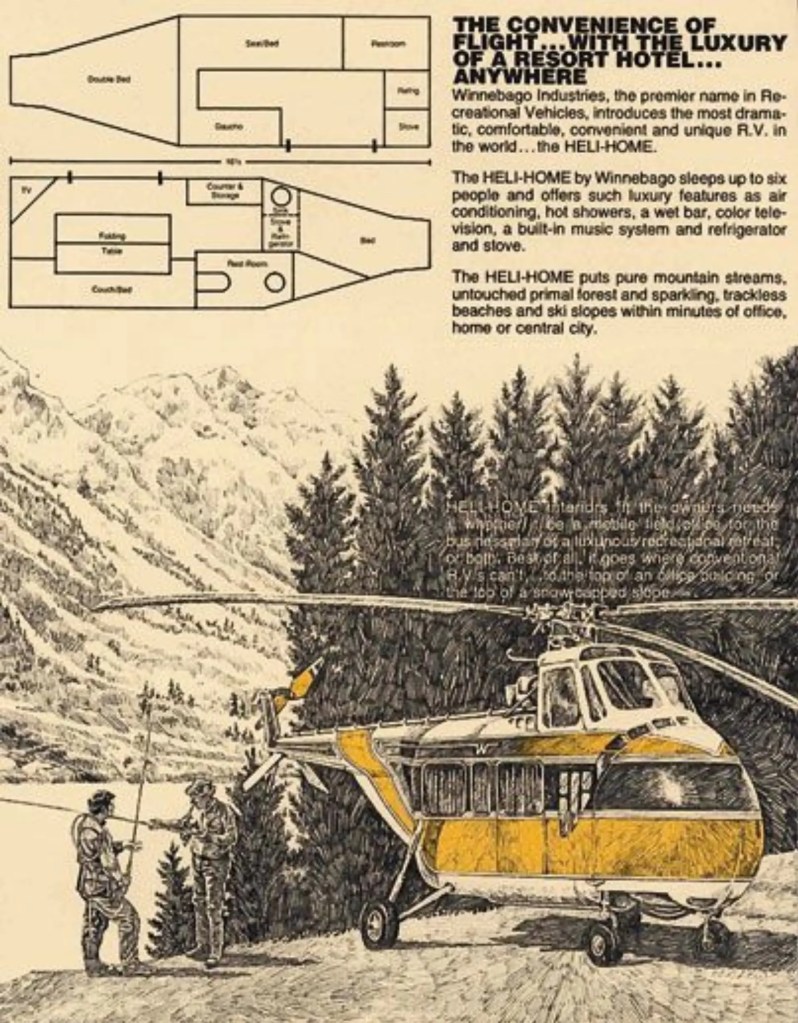
Yes, there really is a Winnebago logo on that helicopter.

Given that many, many RV owners still think an electricity-powered RV is the stuff of science fiction, it’s perhaps surprising that a decidedly more outlandish concept was dropped into a panel on the subject last week without any comment.

The speaker was Ashis Bhattacharya, Winnebago Industries’ senior vice president for business development, strategy and advanced technology, so no slouch about technological development in the RVing world—even if he was off by a couple of decades. Speaking at an RV Industry Association webinar on the development of EV-RVs, Bhattacharya asserted Winnebago’s innovation chops by mentioning that the company had introduced a helicopter RV perhaps 25 years ago.

The comment apparently flew over everyone’s head. But if a first-tier manufacturer could add wings (okay, rotors) to the RVing concept, surely switching from a gas-driven technology to an electrified one can’t be too much of a stretch?

Not that Winnebago actually built its “Heli-Campers”—later changed to “Heli-Homes”— from the ground up, any more than it builds RVs from scratch today. But it did partner with Orlando Helicopter Airways, which in the early to mid 1970s was buying surplus military Sikorsky S-55s and S-58s for various civilian purposes. Half-a-dozen or so were furnished by Winnebago with a full galley with stove and refrigerator, twin water heaters, air conditioning and a furnace, a bathroom with holding tanks and shower, and sleeping arrangements (in the larger of two models) for six. Also included were a color TV and an eight-track tape deck (because, remember, the mid-’70s), a mini-bar, full carpeting and sound-proofing, a generator, an awning and, for a few extra dollars, pontoons for landing on water.

Heli-Camper performance numbers were more than competitive with today’s rolling homes: with a dry weight of 9,200 pounds, the flying Winnebagos could carry up to 3,000 pounds, had a cruising speed of 110 mph and a range of more than 300 miles. Plus, of course, the whirlybirds could access the most remote and trackless wilderness, outdoing even the gnarliest four-wheel drive RVs in search of boondocking heaven.

Only two stumbling blocks prevented the Heli-Camper from becoming a ubiquitous overhead annoyance in the backcountry. One was the price tag, which ranged from $185,000 for the base model up to $300,000—or between $1 million and $1.65 million in 2022 dollars. Even in a world of luxury Class As starting at more than half-a-million, that’s a lot of dollars.

Then there’s the little matter of knowing how to, you know—actually fly a helicopter. Winnebago tried to finesse that issue by creating a rental option for campers who wanted to hire a pilot, but even that was a pricey alternative, at $10,000 a week plus the pilot’s fees and cost of fuel. And then, of course, there was the whole sticky issue of what to do with that pilot once you reached your week-long retreat far from civilization. Perhaps it’s not surprising that neither sales nor rentals really took off, so to speak.

Still, if Winnebago was willing to take a shot at flying RVs, perhaps it’s only to be expected that today it would be at the forefront of the EV-RV ramp-up. At least with EVs the customer base is considerably larger, the cost per unit is a lot more within the public’s means, and there’s every reason to think that the technology will see constant improvement even as costs get driven down.

And then there’s this: those quiet and exhaust-less RVs will be a whole lot easier on the landscape than fleets of transport helicopters would have been, descending on whatever paradise you’d found. There’s good innovation, and then there’s the other kind.
Most recent posts
More electrifying news for RVers

A pair of webinars this past week, one hosted by the RV Industry Association and one by the National Association of RV Parks and Campgrounds, underscored how seriously the campground world views the oncoming onslaught of electric vehicles. While campground and RV owners remain mostly skeptical, questioning the costs, range, recharging availability and environmental impact of a lithium-based technology, industry leaders are unwavering in their belief that the EV-RV revolution is already here and that the problems others see are either overblown or will be resolved in timely fashion.

“We are really at an inflection point which is amazing,” Ashis Bhattacharya, senior vice president for development and advanced technology at Winnebago Industries, told his RVIA audience. A “wave of electric adoption” is already washing over rental car agencies, delivery services such as Prime, UPS and FedEx, as well as school buses and other municipal vehicle fleets, all of which is normalizing the technology. The paradigmatic shift already underway, Bhattacharya added, is as significant as any ever experienced in the transportation sector.

Meanwhile, said Jay Landers, RVIA’s vice president of government affairs, state initiatives to outlaw internal combustion engines are giving the entire EV sector a kick in the pants. Five states, including California, already have voted to ban sales of new internal combustion vehicles by 2035, and others are looking to possibly follow suit. The state of Washington, which had the country’s sixth highest rate of RV shipments this year, is even more aggressive, adopting a 2030 cutoff deadline. Furthermore, expansion of the EV charging network nationwide is being super-charged by $5 billion in federal funding approved earlier this year.

None of which, all speakers agreed, is to minimize the problems confronting EV in general, and EV-RVs in particular. “The (EV) technology is still more expensive than what it’s replacing,” conceded MacKay Featherstone, Thor Industries’ senior vice president of global innovation. Moreover, he added, “the charging experience is utterly critical” and still inadequate for RVers in particular, both because most RVs need pull-through charging stations to be practical and because they have larger power needs than EV cars.

To their credit, RV manufacturers, frequently criticized for shoveling out hundreds of thousands of RVs without giving a thought to where their buyers might use them, are at least trying to get out in front of this development. And there is little reason to doubt that a society-wide change is coming, and coming hard. EV-RV costs inevitably will come down as sales take off, as they do with any emerging technology. Alternatives to lithium batteries, using less exotic minerals, are being developed, and advances in recycling technologies will further ease environmental concerns. Similarly, ongoing improvements in battery density will continue to expand vehicle range, relieving one of the biggest consumer anxieties about EVs.

The weak link, however, appears to be the RV park and campground end of the product chain. The RVIA webinar inadvertently made that point when its campground representative on the panel—Toby O’Rourke, president and CEO of KOA—was so unintelligible that she had to be dropped from the screen, apparently because she was trying to link in from an airport. (And why O’Rourke, again? Is there no other campground industry representative who can speak to the industry’s issues? Maybe someone from the Yogi franchise, or ARVC, or one of the other large state RV park associations, like Texas or California?)

Subbing in for O’Rourke was Brandi Simpson, her chief of staff, whose faltering contribution was to assert that campground owners are dealing with “a ton of misinformation” about EVs and need a lot of education and guidance. Which, presumably, KOA is scrambling to provide. . .

. . . as is ARVC, which lustily beat the drum on behalf of EV-RVs at its national conference in early November, and again at an hour-long webinar a couple of days after RVIA’s face-to-face. Pitched as “a recap of the best” of the conference for those who might have been unable to attend, the session inexplicably ignored the most contentious convention issue—a proposal to adopt industry-wide “standards”—while devoting the majority of its time to further promoting the idea that campgrounds need to get on the EV bandwagon, starting with the installation of EV chargers.

All of which is undeniably true, but far more nuanced and with many more questions than have been answered to date. For example: both webinars referenced possible tax breaks and federal grants to defray campground costs for installing chargers, while glossing over the reality that such inducements will require making the chargers accessible to the general public, and not just campground guests. Getting equally short shrift were any explanations of the occasionally mentioned “partnerships” that campgrounds might have to accept, whether with public utilities or third-party providers, to deal with licensing and infrastructure issues, since electric sales are typically a utility monopoly and EV chargers require robust additional power supplies.

(On a related note: one of the biggest frustrations for many KOA franchisees has been the parent company’s insistence on taking a 10% cut of all site fees—including any electric charges, even though campgrounds are legally prohibited from making a profit from reselling electricity. To the extent that EVs will increase electricity consumption at RV sites, that means even more unearned money transferred from franchisees to corporate headquarters.)

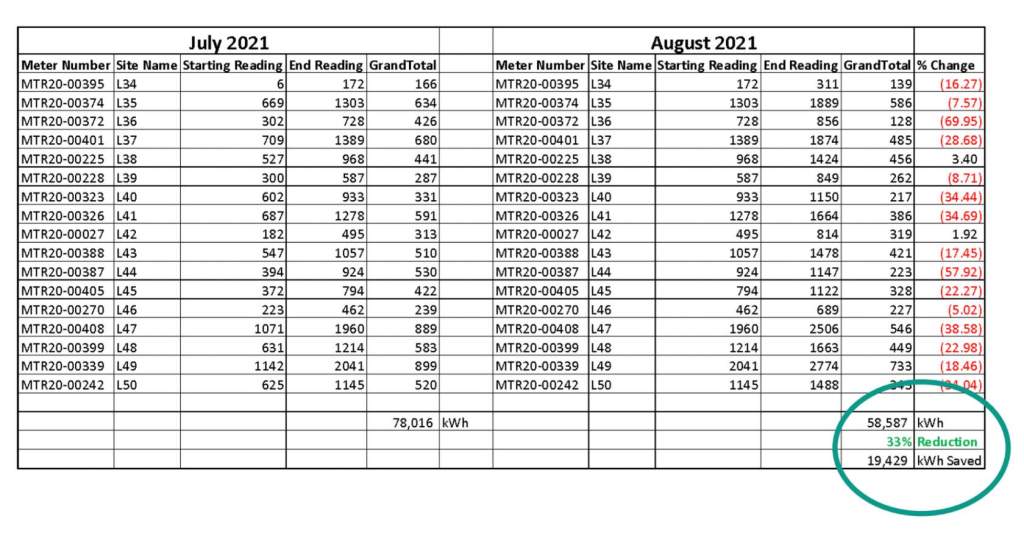
By ARVC’s calculations, electric metering of RV sites can reduce energy consumption by a third.

Indeed, the whole issue of who is going to pay for the extra electricity consumed by EV-RVs, and how, is still being sidestepped at the national level, quite possibly because there is no one answer. That, by itself, may become the biggest impediment to mom-and-pop campgrounds rushing into this brave new world. It’s notable, for example, that while ARVC now has an online “EV Toolkit” to help its members understand how to accommodate the new technology, the only guidance it provides for covering their costs is the vague advice to “consider billing for shorter stays, especially [campers] with unique equipment (large class As, EVs, electric golf carts, etc.), automatically billing those campers for the electricity they use. “

Presumably these and other issues will get resolved, sooner or later—once the industry stops talking around them. The RVing public, meanwhile, should brace itself for still higher costs, as a new electric sensibility starts percolating through the camping universe. Just as computerized reservation systems have introduced demand pricing and all kinds of add-on fees, the electrification push ultimately will result in all RV sites getting electric meters. Or as ARVC’s EV Toolkit asks, in a prominently displayed screen, “You don’t give away ice, candy bars or firewood, why give away electric?”

Most recent posts