If there is any one iconic image of what it means to go camping, it has to be that of a family or group of friends clustered around a campfire under a starry canopy, sparks swirling toward the sky to join their celestial counterparts. Whereas such fires were once the means by which hunters, cowboys and pioneer families cooked their meals, these days it’s rare that anything more than marshmallows on a stick gets thrust into the flames. This is fire as an aesthetic—even mystical—experience, not as a tool for meal prep.
The Dyrt, a mobile app for campers looking for sites, recently underscored that point in its annual survey, in which it quoted several campers on the central importance of campfires. For Adam R. of Colorado, a list of the things that thrill him about camping starts most notably with “campfires and stargazing at night, sunrises and hearty breakfasts in the morning.” Miccal M. of Vermont went deeper, contending that “there is nothing like sitting next to a fire in the woods to help look inwards and see if you need to adjust paths.”
They’re not wrong. I’ve had my share of pensive moments of staring into the embers of a well-banked campfire, watching intense blue flames dance along a charred log cosseted by orange coals. There’s primitive pleasure in feeling a skin-tightening warmth on your face while your back tingles with evening’s chill, of hearing the occasional pop and hiss of damp or sappy wood echoing through the otherwise still air, of letting your thoughts drift upwards with the sparks and wispy smoke. I get it.
Here’s what I also get. According to the National Academy of Sciences, seven of every eight wildfires are caused by humans, and of those, 29% are attributed to unattended or abandoned campfires. Such wildfires are becoming increasingly common and increasingly large and widespread, especially in the West. Indeed, The Dyrt’s annual report also relates—without any acknowledgement of irony—that 33.1% of West Coast campers had their plans last year interrupted by wildfires and natural disasters, more than twice the rate of campers not on the West Coast (13.1%).
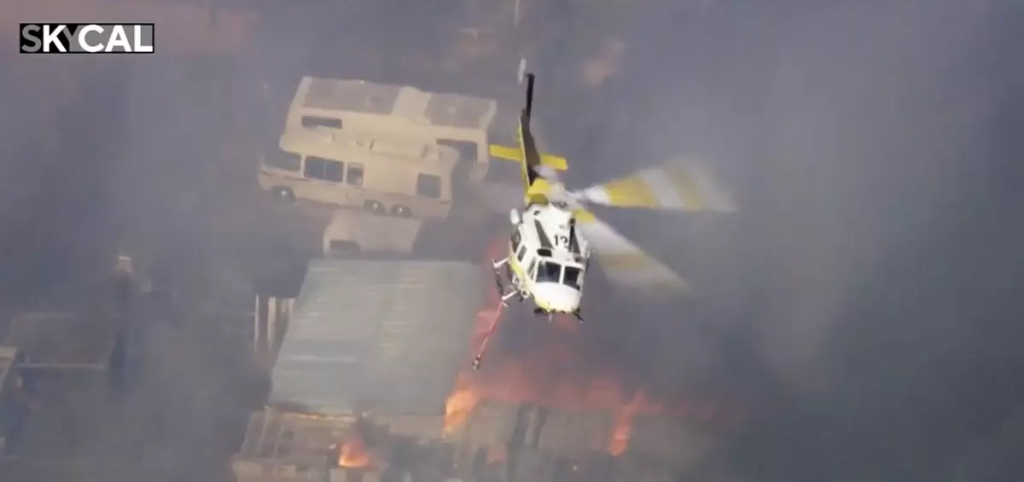
As I write this, a series of wildfires is again burning up and down California, with the largest—along I-5 between Los Angeles and Bakersfield—having consumed nearly 16,000 acres and as of early this morning being only 31% contained. More than 61,000 acres have burned in the state this year, making this the fourth biggest fire season to date since 1996—and this is after two years of resumed rain and snow that ended a years-long drought.
In southern New Mexico, meanwhile, where the drought still persists, a pair of forest fires is advancing on the village of Ruidoso “like a pair of pincers,” according to local officials. Residents were urged to flee immediately, without pausing to pack valuables, as the South Fork Fire grew to nearly 14,000 acres with zero containment and the Salt Fire neared 5,000 acres, also with zero containment. Much of the American southwest is under “red flag warnings” because of the increased risk of wildfires, due to very dry air and winds and parched ground cover.
All this is happening in the closing days of spring, which is to say, with the hottest days of summer still ahead of us. No surprise, then, that the Colorado Sun published an opinion piece Monday under the headline, “Six reasons why campfires should be banned year-round in Colorado.” Written by science writer and lecturer Trish Zornio, the piece argues that increased wildfire risks and increased health risks from rising smoke pollution suggest “it’s time for Coloradans to ditch the campfire ring.”
While the causes of the California and New Mexico fires remain under investigation, that’s not the case with Zornio’s leading example, the Interlaken fire near Twin Lakes in Lake County, Colorado. Now more than a week old, the Interlaken fire is being blamed on an improperly extinguished campfire that smoldered for several days before being reported. To date it has burned more than 700 acres, and while it’s reportedly 86% contained, that doesn’t mean it’s almost out; expectations are that it will continue burning within its circumscribed perimeter for weeks to come.
As Zornio points out, there are no fire restrictions in Lake County—no one thought they were needed this early in the season. But growing climate instability “makes predicting weather conditions more difficult,” she writes, which in turn means “our ability to predict and manage wildlife conditions is also impacted.” Meanwhile, a growing population with more of a taste for outdoor activities is further stressing the environment. “Once spacious campgrounds are now packed to the gills, dramatically increasing the concentration of campfires,” Zornio writes, thereby increasing “the chances of human-caused wildfires.”
There will be other Interlaken fires in the weeks ahead, but that won’t deter traditionalists who cling to the idea that a campfire is the very essence of camping. It isn’t, unless you need some way to cook that rabbit you just bagged while living off the land. But until there is a widespread understanding that open fires have become much more of a threat to the environment—not to mention to human health and property—than was true even a decade ago, most campers will stubbornly continue building fires in a flammable landscape because that’s what “camping” is all about. And, no surprise, more of that landscape will burn.
Looking for a mystical experience? Try yoga, or deep breathing and meditation, or even ‘shrooms. Consign campfires to the same historical closet in which we store fur leggings and brush lean-tos.
 Renting Dirt