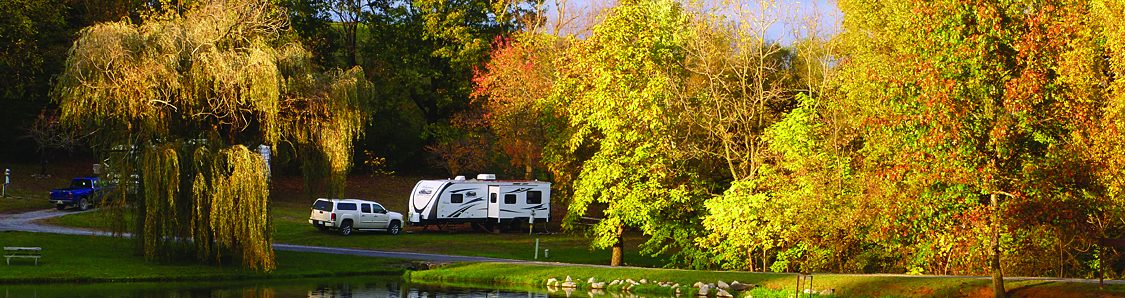
As the American landscape gets overrun by a tidal wave of RVs, governing bodies ranging from the Bureau of Land Management to cities as large as Los Angeles to rural towns and counties are scrambling to manage the onslaught. Improper disposal of human waste always looms large as the biggest problem, but other concerns include illegal tapping of power lines, fire hazards posed by open fires, and slum-like conditions caused by garbage, trash and broken appliances.
But forcing RVers on city streets and public lands to disperse, in addition to courting legal and constitutional challenges, can be an exercise in whack-a-mole because of the lack of alternatives. Commercial campgrounds frequently are too expensive and too full, cheaper public campgrounds often are booked months in advance, and boondocking sites are either rare (east of the Mississippi) or have become so heavily impacted by over-use that they periodically get shut down for remediation. Pushing RVs out of one location simply shifts the problem to another, in a merry-go-round of 21st century urban blight.
What’s to be done? One possible solution is being worked out in Chaffee County, Colorado, some 70 miles due west of Colorado Springs. A rural county of some 20,000 residents, long on recreational opportunities and light on industry, Chaffee County’s board of supervisors recently adopted an agritourism-friendly ordinance allowing primitive commercial camping on private land—the kind of camping that many localities around the country explicitly prohibit, while others try to ignore altogether. A second ordinance, scheduled for a vote Jan. 10, would establish similar allowances for workforce camping on private land.
Chaffee’s new rules are part of an attempt to provide its farmers and ranchers, many of whom are struggling economically, with an additional income stream. “It’s never been harder to make a living off the land,” county commissioner Keith Baker said in a news release announcing the ordinance. “Expanding economic opportunities for rural landowners in Chaffee by allowing for well-regulated, small-scale private land camping is a huge win for our community” and will “reduce pressure on public lands.”
To its credit, the new ordinance does impose some regulations in a largely unregulated arena. Landowners who wish to accommodate campers in RVs, tents or vans must get an annual permit for a commercial campsite of at least 900 square feet (600 square feet for tents-only sites) on a minimum of five acres. Additional sites, to a maximum of ten sites on a minimum of 100 acres, are allowed, provided there are “no permanent improvements, facilities or lodging material outside of water, sanitation facilities, and/or fire mitigation elements.”
Yup—that means no electric hookups. And “sanitation facilities” may mean no more than disposing of sewage “off-site by way of personal waste facilities, such as wag bags [basically doggie bags for humans, designed primarily for backcountry hiking], RV holding tanks, or portable toilets.”
There are a few other requirements, notably that the property owner (or “assigned caretaker”) must be available within a 60-minute radius of all occupied campsites at all times, as well as a limit of 10 such sites per property owner, regardless of how many properties are owned or how big they may be. All such sites must have quiet hours of 10 p.m. to 7 a.m. And the sites must have signs “to educate guests on current fire ban status, campfire safety, Leave No Trace principles, and quiet hours.”
But Chaffee’s regulation pales next to the regulatory, licensing, taxing and inspection regimen that commercial RV parks and campgrounds face, with all their associated costs and time demands. For many commercial campground owners, the kind of licensing Chaffee County has authorized is unfair competition at best, an existential threat at worst. Moreover, it won’t help their disposition one bit that the new ordinance was championed by Hipcamp, which along with Harvest Hosts has internet listings of thousands of camping possibilities on private land, from farms to vineyards to ranches and breweries.
One acknowledgment of this sensitivity can be read in the December issue of Woodall’s Magazine, in which editor Ben Quiggle speculates that the Chaffee County measure “could lead to even more municipalities looking at similar ordinances,” even as he notes that Hipcamp “for years has drawn the ire of many park owners” for precisely this kind of camping. Although he concludes that “it may be time” for park owners “to think about how more individuals opening up their spaces for a small number of campers may impact their businesses,” most park owners won’t think about it at all—their response will be an immediate and reflexive “No way!”
It doesn’t help that approval of the ordinance flew under the radar of the National Association of RV Parks and Campgrounds, which is headquartered just outside Denver—almost next door to Chaffee, by Western standards—and which held its national convention just a month after the vote. If ever there were an opportune time to examine a potentially pace-setting development affecting the entire industry, that would have been it, a chance for ARVC to lead a measured discussion on an issue affecting its entire membership.
That didn’t happen, and meanwhile, the pressure on other counties and municipalities to adopt a similar approach will only increase. And as tens of thousands of low income, disabled or seasonal workers turn to RVs as their housing of last resort, recreational RVers will encounter ever more competition for a limited inventory of places to park their wheels.
Most recent posts
 Renting Dirt