Oregon a hellish RV epicenter

A perfect storm of bad ideas with potentially catastrophic consequences is shaping up in central Oregon, where the already struggling Family Motor Coach Association plans to have a four-day international convention and RV expo. The association, which has been hemorrhaging members for years but still advertises itself as “the world’s largest nonprofit association for recreational vehicle owners,” said it expects more than 700 RVs to converge on the Deschutes County fairgrounds in Redmond on Aug. 14.

Well, maybe.

Such events are planned months and even years ahead of time, so FMCA’s leadership might be excused for not knowing it would be hosting a party in a pizza oven. Then again, this is hardly unexpected. California is getting the most wildfire press at the moment, principally because its Park Fire has grown to more than 400,000 acres and is now the fourth largest in that state’s history. But Oregon is even more of a wildfire hotspot, with twice as many large active fires as its southern neighbor (25 versus 13), and this year already has had more than 973,000 acres scorched. Only two of those wildfires have been contained. The convention’s theme, “Adventure Peaks,” may have more of a dark meaning than originally intended.

You might argue that a million acres is only a small fraction of Oregon’s total land mass of roughly 61 million acres, so what are the odds that your campground will be next to go up in flames? But of course it’s not just a question of whether RVers will have a direct encounter with a fire, but whether they’ll also have to breathe its exhaust. Wildfire smoke has become an annual scourge across all of the western U.S. and Canada, and as it becomes more common, its effects on human health are getting closer scrutiny—with dismaying early findings. One recent study, for example, attributed more than 50,000 premature deaths to wildfire smoke exposure; the risk of cardiac arrests for people who have cardiovascular issues increases 70% during days with heavy smoke.

And here’s a truly sobering warning for the RVing demographic most prone to attend FMCA get-togethers: according to a decade-long study involving more than one million southern California residents, released just a few days ago, exposure to wildfire smoke poses a 21% increase in the risk of being diagnosed with dementia compared with other types of air pollution. The dangers, in other words, aren’t just respiratory or cardiac. Wildfires that tear through manmade structures, vehicles and other non-wild fuel emit smoke that contains a toxic brew of chemical compounds; its aerosolized particles, meanwhile, enable those poisons to infiltrate every part of a human body.

Nor is this sort of hazard something unusual—just the opposite. A much-publicized report this past week from The Dyrt, an online camping reservation platform, disclosed that 18% of campers reported that wildfires or other natural disasters disrupted their camping plans last year, or triple the rate of 2019. Such disruptions are even more common on the West Coast, where fully one-third of campers had their plans interrupted in 2023—as did an even larger 42% in Oregon and Washington. Ironically, The Dyrt is headquartered in Oregon, “so we’ve seen firsthand the toll wildfires have taken on the Pacific Northwest,” The Dyrt’s chief executive, Kevin Long, wrote in releasing the study. “It’s scary and tragic for so many reasons.”

For all that, however, Oregon in general and Deschutes County in particular have been grappling with proposals for several new RV parks as well as rules to allow RVs to be used as permanent rental housing. Those efforts have been given additional impetus by the U.S. Supreme Court’s decision in June upholding an Oregon town’s ban on homeless residents sleeping outdoors, which among its unintended consequences has increased the pressure on elected officials to find housing alternatives—and what’s cheaper (and more flammable) than an RV? The unresolved problem, of course, is finding a home for those RVs that’s not a city street or highway underpass.

None of this is going down well with Deschutes County residents, many of whom turned out this past week for a county commissioners’ meeting to excoriate a proposed 300-site RV campground that the county wants to build just north of Bend, at least in part as a low-cost housing solution. In addition to the standard worries about water, sewage and roads, objections also centered on growing concerns about an influx of the homeless and of an increasingly volatile natural landscape. “We need to start controlling sources of combustion out there, whether it be the homeless, people in campgrounds or fireworks,” one attendee told the board, summing up the powder-keg nature of the RVing phenomenon.

Meanwhile, a luxury RV resort being built on the other side of town, southwest of Bend, was originally scheduled to open this past spring but has been delayed repeatedly. A soft-opening of the 176-site property, the Bend RV Resort, is now projected for later this month, just in time for Labor Day—and well into the fire season. At $120 a night, this clearly is not an RV park that’s targeting the homeless as its customer base. Given current events, however, it’s also an RV park with an uncertain future—as, indeed, is true of summer camping overall.

Most recent posts

Deschutes dithering about RV homes

There’s a lot of dithering these days in Deschutes County, Oregon, about whether it’s a good idea to give a government stamp of approval to people living in RVs as permanent residences. No other county in Oregon has yet taken that step. And as county commissioner Phil Chang noted in today’s commission meeting, there’s a difference between “the bleeding edge” and “the leading edge” of innovation, with no telling what the consequences may be for those leading the charge.

Or as plaintively asked by commissioner Patti Adair, “For once, do we need to be first?”

Occasioning such angst has been a will-they-won’t-they struggle by the three-member board to decide whether to include RVs as permissible dwellings under an Oregon law that allows accessory dwelling units on single-family rural lots. Although two public hearings last fall elicited strongly negative comments about the whole idea, the Deschutes planning commission only narrowly shot it down, on a 4-3 vote—close enough for the county’s board of commissioners, after discussing the planning board’s decision at a Feb. 28 meeting, to decide it should keep talking. Because, as Adair also noted, “it could have gone either way.”

Today’s upshot? A vague decision—no date has been set yet—to hold another public hearing on the matter. Maybe before Memorial Day—or maybe in the fall, with a thinly expressed hope that some other county (Tillamook and Clackamas were prominently mentioned) will bite the bullet first, “allowing for an assessment of those programs and the lessons learned therein.” After you, my dear Gaston. No, no—after you, Alphonse.

To be fair, today’s meeting was called in part to get answers to questions that were raised at the Feb. 28 meeting, principally having to do with wastewater management. But those answers weren’t encouraging: RV wastewater characteristics are significantly different from a regular household’s, according to Todd Cleveland, onsite wastewater manager. It’s more concentrated, and the chemicals that RV owners add to reduce odors are not septic-system friendly, regardless of what the label may say. Among the most frequent complaints fielded by county enforcement officers about RV tenants are surface wastewater discharges, presumably because their septic systems are over-burdened. And soil quality in Deschutes County is such that adding an RV to a single-home site will require at least a one-acre lot for adequate percolation—and even that’s a guess because “we haven’t evaluated RVs for permanent use.”

No matter. Despite all the uncertainties, not to mention abundant other reasons why legitimizing RVs as suitable year-round housing is an enormously woeful idea, the pressure is on to provide some kind of alternatives in a state—like much of the U.S.—desperately in need of affordable homes. The Source, a county weekly newspaper, pressed the issue late last month in an editorial headlined, “With Affordable Housing, Why Are Deschutes County And The City Of Bend Ignoring The Low-Hanging Fruit?” as though the only difference between an RV and a bungalow is its placement on a tree of housing options.

In that respect, however, Deschutes County and the concessions it seems prepared to make are far from unique. Earlier this week, for example, RVtravel reported on “good news for RVers in the U.S. Navy!” Navy families may now “choose to live in an RV park for up to a year as they await availability of base housing when reporting to a new duty station.” The new policy, “an initiative of the U.S. Navy Morale, Welfare and Recreation Program,” is “aimed at reducing the stressors that come with a military lifestyle.”

The best way to reduce such stress, it should go without saying, would be to provide military families with something other than an aluminum or fiberglass band-aid. Living full-time in an RV—especially for more than a couple of adults—is its own significant stressor. But as the U.S. Navy has demonstrated, and as Deschutes County—and its Oregon peers—are sure to emulate, the normalization of RVs as an acceptable housing “solution” is well underway. Codify it, regulate it, inspect it—but not too closely—and hope for the best, because at least it gets people off the streets and out of those damn tents.

Meanwhile, it’s noteworthy that the RV industry, despite years of adamant public statements about how its products are specifically not designed for full-time occupancy, has remained completely mum on this issue. Not a word has emanated from the Washington, D.C. suburbs headquarters of the RV Industry Association to deplore this misuse of its recreational vehicles. Recreational, residential—what’s the diff? The important thing is to keep those production lines moving, especially after the post-pandemic slump, and leave it up to someone else to do the policing.

That may work in the short-term. What the RVIA has yet to understand is that the long-term consequences of such a laissez-faire attitude is a growing public disdain for RVs in general. It happened with “manufactured homes,” aka house trailers, which increasingly came under attack from their better-heeled neighbors. And it’s already happening with RV parks, which likewise are being seen as a blight on the community, to the long-term detriment of the entire industry.

Next post: A look at some of the pushback against proposed new RV parks.

New homes are now smaller than RVs

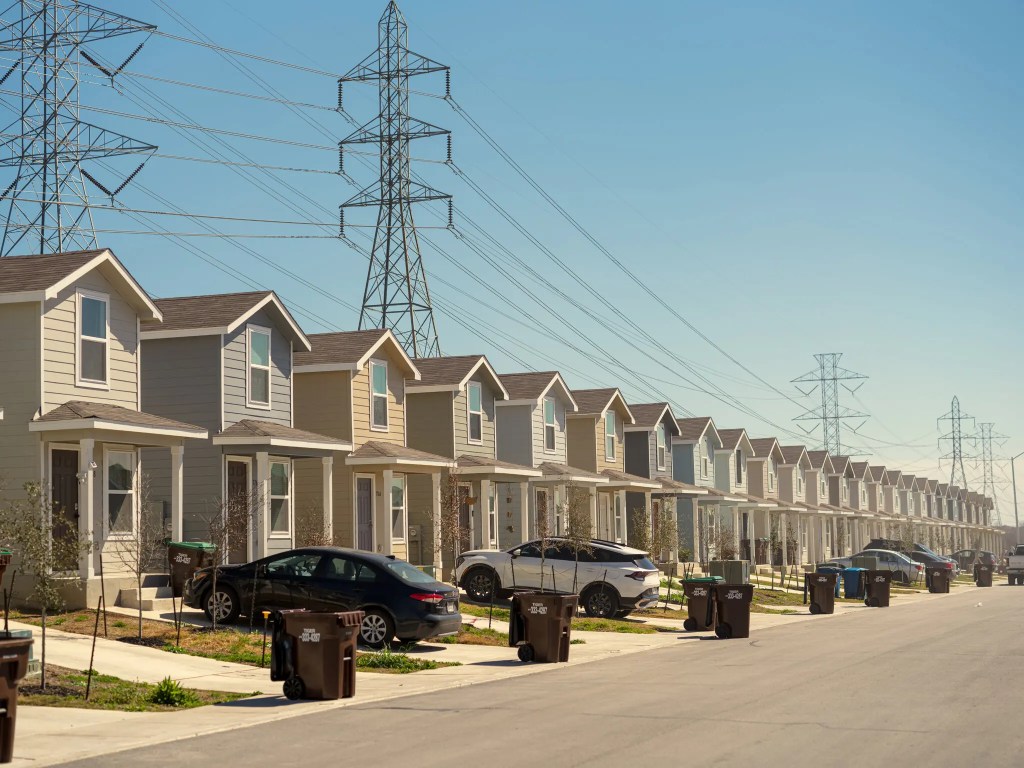
Built by Lennar Homes in San Antonio, TX, each of these houses at Elm Trails is just 8.5 feet wide—exactly the same width as the Prevost RV owned by Clarence Thomas, although not as long.

Sometimes the unexpected intersection of unrelated trends and events can be . . . illuminating. Whether we’ll be comfortable with the resulting insights is another story.

Sunday was a such a day. That’s when the New York Times business section ran a lengthy lead story headlined “The Great Compression,” an obvious play on “the great recession” and “the great resignation,” both recent developments that are still working their way through the economy. “Thanks to soaring housing prices, the era of the 400-square-foot subdivision house is upon us,” the subhead explained, with the story then relating how even so limited a home size can be preferable for some people when compared to the financial uncertainty of ever-increasing rents.

Sunday evening, TV host John Oliver made headlines of his own. Oliver offered Supreme Court Justice Clarence Thomas—who has complained that he doesn’t get paid enough, apparently as a justification for accepting lavish gifts from the billionaire class—an annual stipend of $1 million if he would step down from the bench. As a deal sweetener, Oliver said he would throw in a brand-new Prevost Marathon motorcoach to replace Thomas’ current model, which he purchased for $267,230 in 1999 with the help of a “loan” from one of his benefactors.

Forget the annual stipend: that Prevost all by itself might be enough to sway Thomas, who makes little effort at hiding his upper-crust pretensions even as he dons the mantle of common-man humility. Driving a motorcoach that cost more than most people’s homes was important to him, he has said, because it enabled him to escape the “meanness” of Washington, D.C. and to connect with regular people and the American heartland. He has a preference for seeing the regular parts of the United States and spending time with the people he meets along the way in RV parks and Walmart parking lots, Thomas has said, as it feels normal to him and he comes from regular stock. Thomas likes the word “regular” quite a bit.

Then again, Thomas also corrected an interviewer who referred to his Prevost as an RV by maintaining that it is, in fact, not an RV but “a motorcoach”—a “condo on wheels.” Which, of course, is exactly what “regular” folks expect to see in a Walmart parking lot. (And not to nit-pick, but despite Thomas’ claim to the contrary, motorcoaches are indeed RVs, which simply means “recreational vehicles.” But “RV” sounds so, um, déclassé, don’t you think?)

Still, it must chafe Thomas that his condo on wheels is now well into its third decade. As wheeled conveyances go, that’s so old—just one more year, and in Virginia that Prevost will qualify for a special antique license plate. Which is why Oliver’s offer must be tempting: the 2024 Prevost MarathonH3-45 model retails for upwards of $2.4 million, depending on the upgrade package. And at 45 feet in length with two slide-outs, it offers 430 square feet of floor space—enough for a king-size bed, 1.5 bathrooms, a home-size refrigerator and four large TV sets on which to watch John Oliver on Last Week Tonight.

It’s also a stunning contrast with the teensy tract houses that are now popping up around the country, apparently targeting the very kind of “regular” people that patronize Walmart stores, where they can ogle Clarence Thomas’ wheeled condos. This new iteration of the American dream, typically ranging between 350 and 800 square feet, is not to be confused with the trendy embrace of “tiny homes,” which typically—but not always—are mounted on a chassis and can claim at least some amount of mobility. The compressed homes are stick-built on permanent foundations, just like their more conventional brethren, and conform to federal housing construction regulations. They exist simply because too many people can no longer afford a “regular” home.

Let me not overstate the size of this phenomenon. As the Times article notes, homes under 500 square feet still comprise less than 1% of the new homes being built in the U.S.—but they’re the start of something that might have been unimaginable a decade ago. And at the same time, it’s hard not to see this development as a diminishment of what it means to be middle-class—a diminishment thrown into sharp relief by the contrast with Thomas’ aspirations. While some folks can drive condos on wheels, others will just have to settle for a similarly sized—and much less luxuriously appointed—house that isn’t going anywhere. As, all too often, may be true of them as well.

One other intersection bears noting. The New York Times article opened with a vignette featuring Robert Lanter, a 63-year-old retired nurse who searched in vain for a “regular” home he could afford in Deschutes County, Oregon, after moving back to the area from a condo in Portland. He ended up in 600 square feet, in a house “that can be traversed in five seconds and vacuumed from a single outlet,” in a neighborhood of homes as small as 20-by-20 feet.

Coincidentally, the previous day I had posted about Deschutes County toying with the idea of permitting RVs to be used as year-round homes because of the lack of affordable housing. I called out the idea—slated for a possible public hearing, following a Feb. 28 meeting of county commissioners and planning staff—as a sure-fire recipe for creating dispersed slums. The Times article demonstrates that even in Deschutes there are sounder—if no larger—alternatives becoming available, and so prudence might suggest holding off on the RV idea for a while.

But if, for some reason, the county commissioners want to stick with the RV concept anyway, maybe they should contact Clarence Thomas. He just might be looking to unload a 24-year-old condo on wheels.

RVs as ‘housing’ a recipe for slums

Squeezed by a housing crisis that is approaching Great Depression dimensions, state and local governments have started turning their backs on “decent, safe and sanitary” standards that long guided the home-building and mortgage-lending industries. The scale of the problem they face is daunting: half of all renters nationwide were “rent burdened” in 2022, spending more than 30% of their income for housing; a record 635,000 Americans were homeless last year. But faced with such overwhelming need, elected officials are grasping at a most primitive “solution”—RVs as permanent housing—and in doing so are laying the groundwork for even bigger problems a few years hence.

A case history of such declining standards is on display in Oregon, generally, and in Deschutes County specifically. Having already amended state law a few years ago to give its counties the option of allowing accessory dwelling units (AUDs), Oregon’s legislative assembly last summer took the additional step of allowing RVs to be used as rental dwellings in rural areas. Opponents argued that the state had yet to see whether allowing AUDs would make a significant difference in the housing supply, but supporters noted that Oregon needs more than half-a-million new housing units across all income levels within the next 20 years. All possibilities should be considered. Recreational vehicles, it was argued, could take up the slack, presumably because they’re cheaper and mobile, and therefore relatively quick and easy to set up.

The “ayes” had it, producing a law that is remarkably free of restraints on allowing “vehicles . . . designed for use as temporary living quarters” to be used as permanent housing. The law does require that such RVs not be “rendered structurally immobile,” presumably so they can be removed more readily when “dilapidated or abandoned”—one of the drawbacks of “a limited useful life” cited in a legislative analysis. But the law does not require “fire hardening requirements,” as was included in the law authorizing ADUs. And it explicitly declares that RVs used as housing are “not subject to the state building code.” Indeed, virtually the only state restrictions are on which properties can be used for this new housing option, with any additional regulations left up to each county.

While Oregon’s new RV law did not go into effect until Jan. 1 of this year, Deschutes County was all over it months ago. Located in the rural middle of the state and coping with a homeless population of approximately 1,300, the county had its planning staff draft new rules last October to put some flesh on the legislative bones. The result couldn’t get more basic. For example, Oregon defines “vehicles used as temporary living quarters” as having, “at minimum, cooking and sleeping facilities that may be permanently set up or connected to the vehicle, or may be stored within or upon the vehicle with the intent to use within or upon the vehicle”—a definition, alert readers will note, that makes no reference to toilet facilities. Planning staff therefore included, as “additional standards under consideration,” a requirement that “the RV must have an operable toilet and sink.”

That’s what you call a low bar. Meanwhile, the “additional standards under consideration” make no mention of the clear allowance for outdoor kitchens, don’t set a minimum square-foot-per-occupant standard, don’t address what kind of utility hookups will be required, don’t even call for fire extinguishers or smoke alarms—and certainly don’t set up an inspection protocol to ensure the standards are being met.

Planning commissioners met Jan. 11, and again Jan. 25, to review the staff’s proposals as well as three dozen or so written public comments, almost all opposed to the whole idea. Many commenters took issue with the basic rationale for the RV initiative, pointing out that increased housing density on rural land won’t help people who need jobs and social services that tend to be located in urban areas. Many also noted that new RV dwellers would place additional demands on infrastructure and municipal services, such as fire protection, police, and ambulance services, without any offsetting increase in tax revenues. And others expressed concerns about increased demand on ground water supplies, the greater fire hazard associated with growth in the urban-wildland interface, and the loss of a rural lifestyle caused by a potential doubling of the population.

But perhaps the most telling criticism, echoing a concern raised by the legislative analysis last summer, is that counties like Deschutes simply don’t have the resources to enforce whatever rules they adopt. RVs on private property are already becoming prevalent, many complained, in defiance of existing zoning restrictions and without any enforcement by an overburdened county government. “We have lots here that look like homeless encampments, with not enough code enforcement now,” wrote Mark and Jane Odegard, reflecting a common observation. “We are a residential community, not a campground.”

Craig Heaton echoed the sentiment, complaining of “several RVs, campers, fifth wheels and small sheds ” on nearby properties. “It is quite common to smell the sewage. Extension cords from the house to these makeshift quarters are present. Year after year I’ve filed complaints with Deschutes County” to no avail, he added.

Apparently taking these and other concerns to heart, the planning commission rejected its staff’s proposals—but only by the narrowest of margins, voting 4-3 against permitting use of RVs as supplemental housing. But it also left the door open for further consideration, via a work session with the county’s commissioners on Feb. 28 to determine whether to hold a public hearing on the matter. Should that happen, it will be interesting to see who in the RV industry will step up and point out all the truly horrific reasons why this is a bad idea—ha-ha-ha! Just kidding!

The problems of exorbitant housing prices and exploding homelessness are real and tragic, and cry out for effective intervention—but putting people into firetraps with scarcely more floor space than a prison cell is not it. All that will accomplish is a dispersed slum of rapidly deteriorating eyesores, transforming Deschutes County into an Oregon version of the worst of West Virginia, also a once truly magnificent landscape.