

My six-week hiatus from this blog was intended as a break from all things usual, resulting (among other things) in several hundred photos of European canals, cobble-stoned streets, cathedrals, castles, mountain peaks and refugios, from which I will spare you. But old habits are hard to break. Scattered among the mix are a few shots of RV parks continental-style that are worth sharing in this space, and most American RVers, I’ll venture, would not be pleased.
For starters, it appears that European RVs are built with an entirely different mindset than their U.S. counterparts. Smaller and sleeker, they’re clearly designed as transportation first and lodging second, whereas in the U.S. it’s typically the reverse. These are not houses on wheels. Not a fifth-wheel to be seen—or, for that matter, few trailers of any kind. The overwhelming majority are class Bs and modest class As (with scant evidence of slide-outs), an occasional class C (as visible in the picture above) thrown in for good measure.
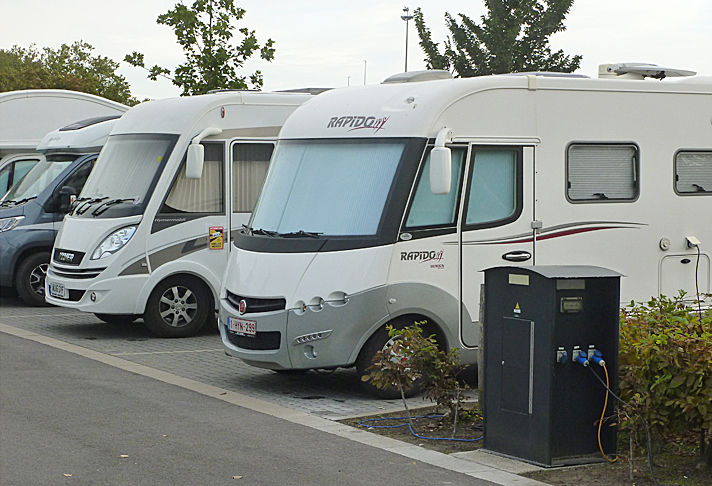
Nor are many RV “parks” the least bit park-like, more closely resembling parking lots than a campground—and not a tent in sight, either. Any grass tends to be in a centralized strip and is more landscaping than lawn. (Perhaps explaining why many European RVs don’t appear to have awnings.) Water and sewer dumps typically are available at a centralized location, and electricity can be tapped from a common pedestal that can have as many as half-a-dozen outlets. Because Europe transmits electricity at 220 volts, rather than the 110 common in the U.S., the correspondingly lower amperage allows RVers to run their connecting (and thinner) wire over longer distances, resulting in RV cabling running across roads and around other RVs for considerable distances.
(As a side note: perhaps because of this greater hook-up flexibility, there seems to be no standardization among European-made RVs for utility hook-up placement. American RVs have all their hook-ups on the left side, preferably near the rear on large units; in Europe, anything goes. Driver side, passenger side, back, middle . . . Just one thing to assess by Americans thinking of buying a European model for use in the States.)
All of this makes for a more Spartan “camping” experience than most Americans expect when they go RVing, with little to suggest that European RVers are looking to embrace the Great Outdoors. While I did see campers sitting on folding chairs outside their units for a morning cup of coffee, the sighting was rare and looked like a tightly hemmed-in experience—although these are people who also eat a lot of meals at sidewalk cafes, so who’s to say they felt the least bit discomfited? On the plus side, on the other hand, their RVs are suitably sized for narrow European streets, undoubtedly slurp less (expensive!) gas than American road hogs, and the RV parks they occupy charge rates that the U.S. hasn’t seen since the last decade.
A Walmart parking lot it ain’t—nor a Margaritaville resort.
 Renting Dirt