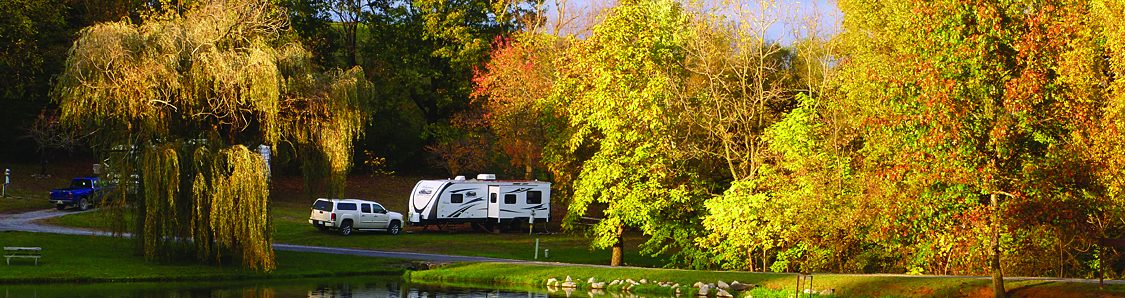
If Rvers can be divided into two main categories–full-timers and vacationers/tourists–it’s the second group that risks killing the goose that lays the golden egg. Vacationing Rvers are swarming the landscape in ever larger numbers, over-running national parks and forests, crowding festivals and tourist attractions and jostling each other for campground sites, often while projecting an oblivious sense of self-entitlement that infuriates all those they encounter.
This being America, however, all that smells a lot like opportunity for those looking for the next big thing. No surprise, then, that investors and developers are falling all over themselves to build ever-bigger RV parks wherever possible, but ideally adjacent to a big “draw,” such as a lake or ocean beach, or a large amusement park or casino. And as they do, long-term residents of the impacted areas eventually realize–often belatedly–that they’re being invaded by economic interests that regard them as dispassionately as the trees they’ll be chopping down, the waterways they’ll be imperiling or the undersized roads they’ll be pounding, first with construction equipment and later with oversized RVs.
My last post got into that a bit as it related to the Foxwoods Casino in Connecticut, where local residents appear to be on the losing end of a bid by the Pequot tribe to build a $25 million RV resort–not on the reservation itself, but on a nearby 65 acres it purchased with casino proceeds. On one level, the addition of a mere 280 camping sites is just a blip in the ongoing expansion of a mega-complex that pulls in nearly 13 million visitors a year. On another, it’s one more accretion of outsiders with an outsized impact on an area they know and care nothing about–“outsized” because RVers leave a considerably larger footprint than day-trippers arriving by car or tour bus, or even overnighters booking one of the resort’s 2,224 hotel rooms, suites and villas.
There is a different way to do things–exemplified, unfortunately, by a tourist destination not known for its RVing opportunities. Still, there are lessons to be drawn from Hawaii’s rethinking of the way it presents itself.
Long renowned for its beaches, luaus and laid-back vibe, the island state–with half the population of Connecticut spread across twice the area– hosted a record 10.4 million visitors in pre-pandemic 2019. And felt over-run. A year earlier, a survey by the Hawaiian Tourism Authority found that two-thirds of respondents agreed that “this island is being run for tourists at the expense of local people.” As summarized by an independent tourism consultant speaking to a New York Times reporter, “We’re so well known as a sun destination that people overlook the other aspects, the Hawaiian culture, the royal past, the interesting geological and natural attractions.”
Despite a slowdown in 2020, the tourists came roaring back last year–July arrivals exceeded their 2019 level by 21%. Rental cars were so scarce tourists were driving around in U-Hauls, and prices for everything started skyrocketing. The impact “was like putting 220 volts of electricity through a 110-volt circuit,” John De Fries, the newly appointed president of the Hawaiian Tourism Authority, told a Bloomberg reporter.
Now the Hawaiians are pushing back, and in the process could be writing a playbook that their mainland counterparts might want to copy–and in some cases already are. Among the changes: reservations are now needed for popular natural attractions, the number of visitors is being capped and non-residents are charged higher fees than locals. Informational videos about the history, environment and cultural significance of various features are becoming required viewing. Conservation fees for natural resource management are in the works, and cliched versions of Hawaiian culture and cuisine are being supplanted by the real thing.
Most critically, these and other changes are being driven by Hawaiian natives– rather than mainlanders with “hospitality” degrees–who for the first time comprise the majority of the state’s tourism authority. Drawing on input from locals, Hawaii’s four counties have devised three-year strategic plans that focus on the sustainability of their resources rather than on marketing. Last November, the tourism authority launched a campaign to introduce the concept of malama, or caring for the land, which De Fries contends is emerging as the “sister value” of aloha. Today, the campaign claims 110 hotel and airline partners who will reward guests with a free night’s stay if they spend a day helping to clean beaches or reforest land.
There’s no reason why the Pequot couldn’t do something similar, harnessing their revenue-generating casino to promote Native American culture with something a little more ambitious than a 24-year-old museum that attracts fewer visitors in a year than its casino averages each day. Instead, the tribe continues pushing aside its neighbors while adding more of the one-note “attractions”–another hotel, another indoor water park, another RV “resort”– that are to recreation what monoculture is to farming.
Nor is there any reason why RV parks across the United States couldn’t offer the same malama approach to what they do–no reason other than lack of leadership at the national level, that is. But here’s what will come from such short-sightedness: that other main category of RVers? The full-timers? They increasingly will find themselves elbowed aside and priced out of their lifestyle.
Most recent posts
 Renting Dirt