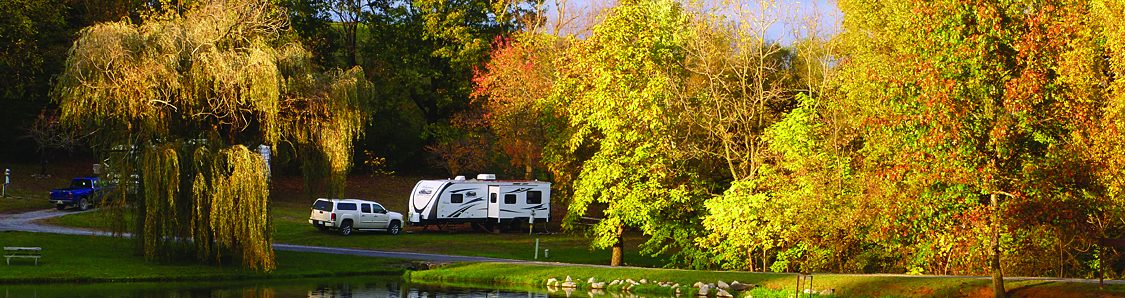
RVers’ public image is less than great

Where an RV park developer sees a blank slate, at right, Mansfield’s residents see a looming catastrophe threatening their town’s only elementary school, just across N. Caldwell Avenue.

At a tad more than two square miles, Mansfield is so far west in Arkansas it’s almost in Oklahoma. Its population is virtually unchanged from 1940, when it barely topped out over a thousand. The town’s name, according to one story cited by the Encyclopedia of Arkansas, was coined by a line surveyor who, at the end of the day, reported he had gotten as far as some “man’s field.”

Mansfield, in other words, is about as far as you can get from the rah-rah impulses of contemporary American society. But that doesn’t mean its residents don’t know what’s going on in the wider world, and judging by their response to a proposed RV park, what’s going on has no place in Mansfield—or in a man’s field. Not if that field is across the street from the town’s only elementary school. As one local resident put it, “Last thing we need is strangers across from our kids. Everyone in this town watches out for the children, let’s keep it that way.”

So it was, earlier this past week, that the Mansfield City Council unanimously voted to deny a rezoning application that would have opened the door for such a development. That no actual plans for an RV park had yet been submitted was irrelevant. The number of possible sites, the kind of RVing public to be targeted, the amenities and additional facilities that would be incorporated—all unknown. No traffic studies, environmental impact statements or projected economic benefits to the area had been prepared. The rezoning applicant, Don Wheeler, owner of a roofing and construction firm, spurned an invitation to attend the council meeting and wasn’t on hand to answer the inevitable questions.

The Mansfield City Council, in other words, didn’t reject a proposed RV park. It rejected the idea of an RV park, and that should concern anyone with a vested interest in RVing and RV parks and campgrounds.

In that regard, the concerns and anxieties that prompted the city council’s adverse vote are eye-opening. For a very vocal segment of the Mansfield population, RV parks are a threat to public safety and social order, teeming with child molesters, drug addicts and vagrants. “No one wants strangers with unknown backgrounds that close to their little ones,” one local resident protested. Another contended that RV park residents would find it “easy to hand drugs to kids through the fence and no telling what they [students] might witness from their schoolyard.”

Although a couple of voices were raised on behalf of the economic benefits an RV park would bring to town, they were drowned out by the paranoia that prevailed. “I can tell by the looks on your faces, I know how you will vote,” local resident Bobby Musgrove was quoted by the Resident News Network. “But we are losing businesses in this town . . . with this RV park, the city could charge a 2% tourism tax. You have got to think about the city. We have run businesses out of town out of stupidity . . . I can see all your points, you’re afraid that some kids might get kidnapped, raped or molested, but that can happen anywhere, at any time.”

That’s hardly a reassuring point on which to conclude, but Musgrove’s defense of campgrounds also didn’t address the over-riding question: as one local resident asked in a Facebook exchange, why would anyone stay at an RV park in Mansfield in the first place? The answers were blunt. “Property values and rental prices for stick and brick houses is [sic] continuing to rise,” came one response. “Living fulltime in an RV is much more affordable.” Answered another, “homeless people are now living in campers.”

And then there was this satisfied response to the council’s decision: “Good move, really,” wrote Stephen Leonard. “Would have ended up with a bunch of raggedy, rundown eyesores people called campers/RVs parked in there, with a bunch of junk piled up around them. Last thing we need in Mansfield is more eyesores. The town is making headway toward being better, cleaner and more visually appealing, no need in back-tracking now for an RV park that would just end up looking like a slum park in the long run.”

That’s a pretty bleak prediction triggered by nothing more than the words “RV park.” But as this unintended word-association test suggests, some significant portion of rural America looks at RVs and doesn’t see the adventurous, freedom-seeking community of self-sufficient nomads that the RV industry promotes with unrelenting enthusiasm. It sees the scrapings of society, a pestilent horde of parasites preying on communities that are themselves struggling for survival. There’s no economic benefit from inviting the destitute to move in, but there’s no end to the grief attached to such hospitality.

To some extent, alas, the RV industry has brought this PR problem on itself, by resolutely ignoring the increased use of RVs for full-time living. And RV parks and campgrounds have played along by making a growing percentage of site inventory available for long-term stays, seduced by the lower costs and easier money to be made by having less turn-over. But as the Mansfield example illustrates, the industry’s anticipated solution to overcrowding—just build new campgrounds!—is running up against a growing community resistance of the kind that might meet a proposal to build, say, a local whorehouse.

Think about that the next time you’re trying a book a site and can’t find anything available.
More RV sites don’t mean more room

If you’re a recreational RVer—someone who bought a travel trailer or class C motorhome thinking you’d like to take the kids camping—a pair of reports this past week by two long-time campground observers could make your head spin.

The first, by industry reporter Jeff Crider writing in RVBusiness News, tells readers they can “expect more than 18,000 new campsites through 2027,” thanks to 90 new campgrounds being built across the country, as well as new sites being added at 66 existing parks. For RVers who had been complaining since the pandemic about the increased difficulty of finding a place to camp, that sounds like incredibly good news—or it could be an instance of being a day late and a dollar short, given more recent reports of reservations loosening up. But hey—either way, it can’t hurt that more RV sites are coming, right?

Well, maybe not. Because as the second report suggests, much of that new RV site inventory is already spoken for, and even then there’s not going to be enough inventory to meet growing demand from residential RVers. Or as Frank Rolfe asks rhetorically, in yet another post promoting the investment rewards of RV park ownership, “What’s up with customers moving into RV parks full-time?” The answer, he quickly responds, is that “millions of Americans are starting to realize that they can live in their RVs fulltime and save a fortune on housing costs, with the additional benefits of pleasant surroundings and camaraderie of the RV park.”

Against that backdrop of “millions of Americans” looking for a home, even 18,000 new campsites becomes a negligible expansion. Indeed, if Rolfe is to be believed, the entire RV park segment is rapidly becoming a tricked-out version of the trailer courts that long ago became a depository of America’s most impoverished class.

Now, Frank Rolfe is not someone to be trusted if you don’t have a firm grip on your wallet, so take whatever he says with a grain of salt. He’s not a reporter but a promoter, one who years ago made a name for himself by recognizing that the residents of mobile home parks are a captive customer base, sitting ducks for ever higher lot rents and add-on fees for even the most basic services. But as affordable sticks-and-bricks homes remain in short supply (thanks in part to speculators at the other end of the vulture spectrum, with hedge funds snapping up single-family homes by the thousands), resulting in a 30-year low in home sales in 2023, the resulting demand for mobile homes has made that an increasingly pricey option as well: indeed, the growth in mobile home prices has outpaced that of single-family homes since 2017, soaring 77% to an average nationally of $127,300.

With the average mobile home in 2022 costing more than $100,000 in every state in the country, and as high as $168,500 in Idaho, house trailers have yielded their lowest-cost housing status to travel trailers—which, it should be noted, are explicitly not designed or built for full-time residency, but which are a damn sight better than living in a tent full-time. And if that carries a whiff of desperation, well, that’s exactly the kind of odor that appeals to a bottom-feeder like Rolfe.

So it is that Rolfe has taken to pounding the drum on behalf of RV parks as the next great real-estate cash machine, extolling their role in solving America’s “worst affordable housing crisis since 1776.” (Really?) Sure, RVs are smaller than mobile homes, built to less durable standards and rarely designed for four seasons, but they’re . . . cozy. And they’ve got those “pleasant surroundings and camaraderie” of an RV park to distract their occupants from their narrowed horizons. To make such privation sound more attractive, Rolfe links to a story about a 38-year-old woman living in a 20-foot travel trailer in Austin who simply loves “tiny living.” It helps, of course, that she’s single, has no kids and is healthy enough to bike to work each day, and whose primary motivation—as detailed in a different, more extensive story— is to save a million dollars by the time she’s 45.

That this is not your typical full-time RV dweller should be obvious, but Rolfe is in any case more interested in convincing RV park owners to convert their properties into something that looks more like a mobile home park. “The average RV park customer stays for 14 days per year” (Again—really?), while a full-timer stays for 365 days, “so one full-time customer is as important for your business as 180 normal customers.” The math doesn’t add up (Rolfe divided 365 by 2 instead of 14, mixing up weeks and days), nor do the dollars, since full-timers get a significant pro-rated discount from nightly rates. But as Rolfe goes on to point out, there are other benefits to having year-round residents, including fewer marketing requirements, more consistent cash flow and more stable management.

Indeed, if the Austin “tiny living” enthusiast is an example of what Rolfe is seeking, there are wads of cash to be made by pushing full-time occupancy in RV parks: in this example, lot rent of $750 a month, plus $42 for utilities, or $9,504 a year. Given that a large RV park may cost as little as $10,000 a site to build, those are the kinds of numbers that will have institutional investors falling all over each other to get into the business, and even more so if they’re shown how to run an RV park with minimal fuss—which is to say, with year-round residents rather than transients. So what’s not to like?—unless, of course, you’re the unfortunate RVer looking for a long weekend where your kids can get some fresh air and wood smoke.

RVer dilemma: death by fire or cold

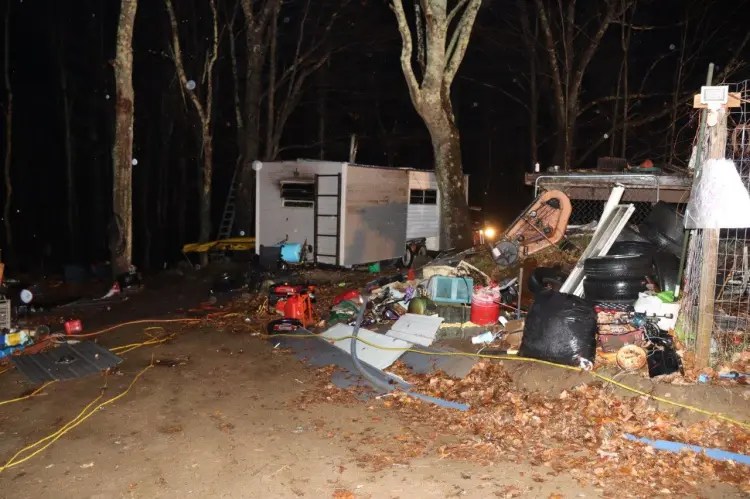
The site of a fatal RV fire in Windsor, Maine, in early November. Note the multiple extension cords criss-crossing the area, indicative of the jury-rigged nature of this encampment.

Now that we’re well into meteorological winter, one sure-fire prediction is that we’re going to see a rising crescendo of reported RV fires. A Google search for “RV fires,” for example, turned up the following news reports over just the past 24 hours:

  • “Putnam County Fire Rescue responded to a 30-foot RV fire off Mackey Avenue,” but were unable to save two family dogs.
  • “Firefighters are investigating what caused an RV to go up in flames in northwest Fresno.”
  • “An investigation is underway after a RV fire briefly threatened a home in Sparks Tuesday night. “

Expand the time frame and you’ll encounter some truly chilling headlines, such as the following from a week ago: “Mom listens to baby scream in burning RV until he falls silent, Arkansas cops say.”

It’s hard to ascertain, in the first three examples, how many of the immolated RVs were being used as full-time housing, but it’s a pretty good guess that such was the case in the older story. Such incidents have become commonplace, and will become more so as time goes by: more than 650,000 people nationwide are sleeping outside or in shelters, according to the latest snapshot census (another will be conducted next month), thanks in no small part to a critical shortage of affordable housing. The real estate group Redfin reported last week that just 15.5% of homes for sale are affordable for the typical U.S. household, the lowest share in at least a decade.

For those unable to afford a home, the opportunity to live in an RV must seem immeasurably better than joining the army of pavement dwellers. A roof and four walls, a door that can be locked, possibly functioning electrical outlets—even the shabbiest travel trailer can be a refuge against rain, prying eyes and human predators. Indeed, if first occupied during summer months, such an RV can seem like a godsend, allowing fantasies of outdoor vacationing and only temporary inconvenience, a pitstop on the road back to “normal.” And then harsh winter intrudes.

Last month the Waldoboro, Maine, Select Board heard about people living in RVs without appropriate hookups. Sewage was being dumped on the ground. In at least one instance, an RV dweller had cut a hole through the roof for a chimney pipe so he could heat the interior with a wood stove. Referring to an RV fire in nearby Windsor the previous week, in which a 25-year-old man had been killed, Waldoboro’s code enforcement officer, Mark Stults, observed that existing ordinances were insufficient to deal with such conditions. “I would rather be the bad guy in town, forcing people to find safe places to reside,” he said, urging adoption of more stringent regulations.

A month later he got his wish, as the Select Board proposed an ordinance that for the first time will set “limitations on the use of RVs and other non-permanent structures for permanent habitation,” including a maximum stay of 120 days and required installation of smoke detectors and fire extinguishers. More action is expected. Yet even as the Waldoboro town fathers attempt to limit the deaths and health hazards resulting from full-time RV residency, they remain flummoxed by the economic factors that contribute to the problem.

As recently as last August, for example, the Waldoboro Economic Development Committee conceded that the town had been “remarkably bad at having affordable housing for people to work and live here.” The area’s affordability index had gone from 75% to 51% in just two years—considerably better than the 15% national figure cited by Redfin, but still leaving half of the area’s workers with less than the $48 hourly wage they would need to afford a home. All of which makes Mark Stults’s preferred option of “forcing people to find safe places to reside” a non-starter.

Or as Waldoboro Select Board Member Bob Butler said, “there’s a lot of homeless people now. What are we going to do with them? They could die from the cold or they could die from the fire, but they’re still dead.”

Waldoboro is just a microcosm of a far larger problem that will become an ever more in-your-face national crisis, but give it credit for at least wrestling with the issues. Not so elsewhere, where it’s less common to connect the dots between low pay, astronomical rents, an inadequate housing stock and an explosion of beat-up, rattletrap RVs parked virtually anywhere. There are lots of reasons for that willful blindness, in a world that can seem irredeemably broken, from a feeling of being overwhelmed to the silent hope that someone else will fix things to a reflexive turning inward. Most can be addressed, by people of good will.

But the most difficult reaction to overcome, alas, is a hardening of the heart that objectifies and dehumanizes the unfortunate. Consider, for example, the reaction of an “I’ve got mine” RVtravel subscriber who, on reading its account of the proposed Waldoboro ordinance—an account that not once described those who were living in the town’s RVs—wrote: “I’m all for the regulations. It’s lazy, filthy people like this that screw it up for hard working RV’rs.”

That’s the Christmas spirit, Bub.