RVing shenanigans of the past year

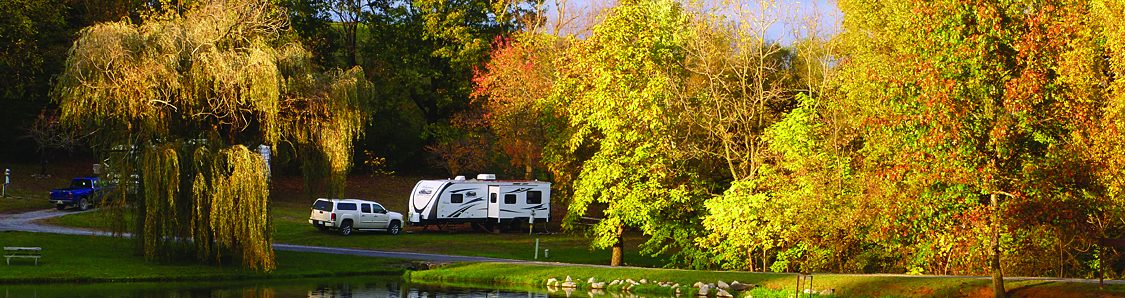
No, this is not a glamping tent, no matter how much it looks like one. It’s an Airbnb rental, which means it sits not in a campground but on a residential site—along with 12 others in Minnesota.

The end of one year and the start of another frequently prompts retrospectives by those seeking closure or looking to demonstrate their cleverness. Sometimes it would be better if they didn’t.

This week, for example, the RV Industry Association breathlessly announced its “top 10 highlights from 2023!” and led off with its 2023 Vacation Cost Comparison Study. Released last April, this 125-page analysis “found” that “RV vacations cost much less than other types of vacation travel, even when factoring in fuel prices and the cost of RV ownership.” “Found”— rather than “established” or “determined”—was an apt choice of verbs, given its overtone of accidental discovery.

Indeed, as I wrote here and here, the “comparison study” suffered from several analytical errors and oversights, leading me to conclude that “the argument that RVing is an economical way to vacation works only if such a vehicle gets deposited in your driveway for free and it never suffers any mechanical issues.” But at least RVIA was touting its cost-benefit analysis in an understandable if flawed attempt to bolster sagging RV sales, which despite such efforts continued their plunge right through the end of the year. There’s less excuse, however, for RVIA to continue promoting such questionable claims today, even if in the guise of a top-ten list of the past year. That’s like the White Star Line citing the April 2 completion of RMS Titanic as one of its highlights of 1912.

Perhaps RVIA leadership is just too lazy or too innumerate to engage in a bit of critical thinking about its output. As much can’t be said for the outright grifters that the campground industry has attracted the past couple of years, few of whom can claim ignorance of the scams they’re peddling. Take Travis John, for example. As I wrote last January, John was looking to raise $8 million from 10,000 or so investors so he—and they—could buy a campground. The sales pitch included a lot of trendy jargon about non-fungible tokens and how John’s company, Campers DAO, would use “latest blockchain technology and an innovative business model to turn a membership into an NFT asset.”

Apparently that innovative business model didn’t find a lot of buyers. And, of course, the whole airy-fairy world of cryptocurrencies and non-fungible anything began wavering, culminating in the November conviction of Sam Bankman-Fried. But by then John had already retreated to a hidey hole somewhere, announcing in April an indefinite delay of the Campers DAO launch while it went about “building more value.” Not a peep out of him since.

Meanwhile, the unbelievable promise of a full year of luxury RV camping for just $3,100 a year has proven to be just that, as two of the four partners in the Whispering Oaks Luxury RV Park in Arkansas filed suit in December against the other two. The aggrieved partners averred that it is “no longer reasonably practical to carry on” the business, not least because, they allege, Brian and Stacy Sides misappropriated business assets for personal gain, bounced checks and otherwise acted in ways that “damage and destroy the business.”

How shocking was that? It shouldn’t have been. As I wrote in April (what’s with this April thing?), Sides already had a record that included defrauding three Joplin, Missouri women out of a combined $29,000 for work he never performed. But when a local reporter earlier this year asked him about the incident, he responded with the classically moronic “there is another guy that done that” riposte. It goes without saying that not a shovelful of dirt has been turned at the luxury RV park site, its website has vanished, and so has the entrance billboard.

Other fantastical campground deals announced last year remain to be played out, including a luxury (aren’t they all, these days?) RV park in Danville, VA proposed by developer Joe Cubas, whose other bright idea is to make that town a Virginia version of Sturgis, SD. And, of course, there’s the grand design by failed Florida real estate developer Ricky Trinidad to build a “white glove” RV resort in Pennsylvania covered by a massive, transparent air dome. Local politicians in both municipalities have been tripping over each other in their eagerness to welcome these so-called revitalization projects, so one can only hope a brisk winter will shock some sense into them.

The seductive—if empty— promise of a financial bonanza for the locals is often enough to mute the critics when someone proposes a multimillion tourist development, but several notable exceptions were notched in 2023. Among them was the victorious campaign in Saugerties, NY against a proposed KOA glampground under the Terramor name plate, and the less heralded deep-sixing of a $30 million luxury (yes, again) campground proposed for New Hope, Tennessee. While the Saugerties battle featured a relatively media-savvy grassroots movement in a relatively economically resilient area, New Hope is “a wide spot on two-lane Route 156 that has one Dollar General, two beauty shops and a meat processing business,” as I wrote in, yes, April. But in July, after a bit of local agitation and a petition drive, the developer backed out.

Local resistance isn’t always effective, though, if an RV resort developer has exceptionally deep pockets and the locals are slow to cotton on to what’s happening. That’s been the story in Midway, Kentucky, where town fathers initially welcomed and then belatedly backpedaled from a monster project known as the Kentucky Bluegrass Experience Resort, projected to become one of the ten largest RV resorts in the eastern U.S. When the full scope of the proposal—and how it would impact the local community—finally sank in, Midway’s city council tried to block the project by refusing to extend municipal water and sewer to the site.

That was more than two years ago, but despite the lack of subsequent headlines, the developers didn’t just go away. Instead they played the long game, culminating in October in approval of an ordinance allowing RV parks to operate private sewer plants. Such private plants had been banned a couple of decades ago, after several local mobile home parks had private systems that failed, spilling raw sewage into local waterways. But history doesn’t repeat—does it?

Finally, one more example of perseverance against local opposition deserves spotlighting. Christine Wyrobek, told by her local planning commission in May (not April!) that she could not build a glampground on her 45 acres abutting Lake Vermilion, Minnesota, went ahead and did so, anyway. She’s just not describing it as a campground. As she explained to a Star Tribune reporter in September, her 13 campsites “fall securely within the county ordinance allowing short-term rentals for fewer than 180 days on residential property—which also allows for VRBO and Airbnb rentals.” And so glampground out, Airbnb rentals in.

Just when you thought all possible blurring of the lines about “camping” had been achieved. . . .
Shady side of Caesars-linked RV park

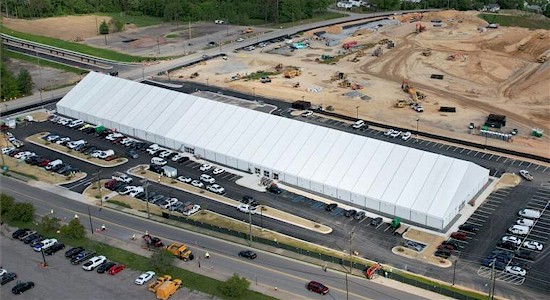
That’s not just a tent, it’s a 40,000-square-foot temporary casino in Danville, VA. But the opportunists are already circling, including, of course, a would-be “luxury RV park” developer.

The storied city of Danville, Virginia—among its historical mileposts, it was briefly the last capital of the Confederacy—has had a bumpy ride the last couple of decades. Once a railroad hub fed by robust textile and tobacco industries, it started veering toward decay when all three of those economic pillars crumbled. A brief renaissance based on revitalizing the tourist trade foundered on the shoals of the 2008 recession, but then regained its momentum, and especially when Caesars Entertainment announced last year that it would be coming to town!

Yup. Casino gambling—coming to a town known also as “the city of churches” because of its numerous monuments to piety.

Nor will this be some minor-league operation. Caesars said it would be sinking more than half-a-billion dollars into building a resort with a 500-room hotel, a 2,500 person “entertainment venue” and 40,000 square feet of meeting and convention space, not to mention at least 1,300 slots, 85 live game tables, 24 electronic game tables, a poker room and sportsbook. Can’t wait until the grand opening late next year? No worries: Caesars last month pitched a 40,000-square-foot white tent right next to the construction site as a temporary casino, including 740 slots, 25 live table games, yada yada—not exactly to your Las Vegas standards, but just about the biggest thing to happen locally since the Student Nonviolent Coordinating Committee set up shop in town in 1963.

The city’s leaders are understandably giddy at the thought that their town has a shot at reclaiming some of its former vitality—but as with people, towns should be careful what they wish for. A development as big as this is the social equivalent of a black hole, warping the space around it and sucking in other objects that might otherwise have passed by harmlessly. Danville may get the economic boost it’s seeking (although there’s no guarantee of that: see Atlantic City), but the casino already has attracted less savory camp followers who may provide more tarnish than glitter.

Case in point: J. Cubas Holdings of Coral Gables, Florida, which is seeking city approval for a 333-site luxury RV park on 46 acres zoned for residential use. As detailed by developer Joe Cubas, the so-called “Palace Resort” will be Roman-themed to complement the casino and will include pools, spas, a restaurant and bar, a gym and tennis and pickleball courts. The clientele will be high-end, Cubas has said, people “who know they’re going to spend $500, $1,000, even $5,000 gambling in a weekend,” and to help them spend that money the resort also will provide a shuttle service.

But the neighbors, perhaps predictably, are not happy. Cubas’ 46-acre parcel can be accessed only by a narrow two-lane road, Jenny Lane, which they contend is ill-suited to handle an additional 650 vehicles or more—the Palace Resort sites include both an RV pad and an additional parking pad—coming and going, shuttle be damned. The increased traffic, noise, litter and impact on local wildlife associated with such a development will destroy the residential nature of the neighborhood, they told planning commissioners in a May public hearing. “We’re not opposed to a campground, we’re just opposed to one in our neighborhood,” a Jenny Lane resident told the commission. “This needs to be relocated outside of a neighborhood.”

That doesn’t sound unreasonable—except that Danville’s zoning code, presumably dating back to a time when “campground” meant a few dozen water-and-electric sites for tents and travel trailers, actually requires campgrounds and RV parks to be located in residentially-zoned areas. Indeed, Cubas has said that’s exactly why he purchased this particular site—and the planning commission, whose approval of his application appears to be mostly a formality, is on board, voting 5-1 on May 8 to submit it to the city council for final ratification. The commission’s only stipulation is that a traffic impact analysis be conducted to address local residents’ concerns.

All of that, and the city council’s anticipated approval June 20, might be chalked up to just another example of the interests of an unfortunate few being sacrificed for the greater economic good—if not for all the red flags the city is ignoring.

There is, for example, Joe Cubas’ almost complete lack of relevant experience; although he claims to have built four RV parks, none were operating last fall when he sought approval for a 454-site RV park in adjacent Pittsylvania County, his first choice before coming to Danville. As reported by the Star-Tribune, when questioned by a county supervisor about his thin résumé, an offended Cubas replied that he’d been a developer his whole life and “running an RV park is much easier than building a residential development.”

That’s a clueless and unresponsive answer, but Cubas in any case has no desire to actually run an RV park. He just wants to sell them, even before they’re built, as evidenced by his “for sale” listing Feb. 22 of a 470-site RV resort on Albemarle Sound in North Carolina that “will [emphasis added] consist of 470 sites with first class amenities.” No such RV park yet exists, however, and the listing was withdrawn May 20, presumably so Cubas could turn all his attention to Danville. Even there, however, he’s been hop-scotching: last summer he was hawking a “potential development opportunity” on the west side of Danville, a 106-acre site just inside city limits that he touted as, yes, the Palace Luxury RV Resort; that listing was up less than a month, coming down Aug. 20 as Cubas turned his attention to the ultimately denied Pittsylvania County application.

Then there’s his unbridled enthusiasm for using his luxury RV park as a springboard for much bigger promotional schemes. Making the hugely questionable assertion that “most RVers also own motorcycles,” Cubas disclosed in his permit application that he’s been in discussions with Thunder Road Harley Davidson and unnamed city officials to have Danville host a bike week in 2025. That could mean really big bucks for Danville, according to the application, which cited the Sturgis, S.D. and Orlando, Fla. annual biker rallies as examples of what is possible; no estimate provided of what proportion of those half-million visitors could be described as “high-end,” or whether Danville—population 42,000—has either the room or the resources to cope with such a tidal wave.

But the biggest red flag, the one that attests to Joe Cubas’ questionable scruples, is his threat to stick it to the city if it denies his permit by . . . building between 92 and 230 single-family homes on his 46 acres. Those new homes obviously will impact city services, his application pointed out, and just one of those impacts would be as much as a $1.5 million annual hit to school budgets to accommodate all those new students. The RV resort, by contrast, “will have no impact on the city’s or county’s social services”—an assertion that ignores police, fire and other tax-funded services—but “will potentially generate in excess of $1.3 million dollars [sic] a year in transient lodging, occupancy and meal tax revenue for the City of Danville.”

That’s a pretty blatant economic threat, especially coming from a Floridian whose avowed interest in southern Virginia is to capitalize on a casino, not to provide housing in an area to which he has no ties. But it’s exactly the sort of thing that gambling fever encourages: a get-rich-quick attitude that isn’t limited to slot machines or card tables. Even a Roman-themed RV luxury park will suffice, especially if it’s easy-in and easy-out. The locals, as usual, can pick up the pieces.

Most recent posts