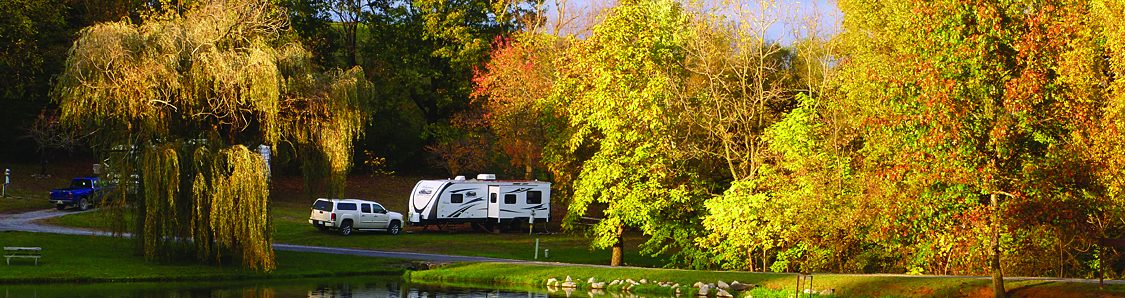
KOA takes a holistic view of glamping

It’s been a couple of months since KOA released its latest annual report on North American camping, and as usual, subsequent industry coverage was faithfully upbeat. Most stories homed in on the economic numbers, proof that camping has become a force with which to be reckoned : 58 million households camped in 2022, spending $52 billion, an $8 billion increase over 2021. Campers spent on average $332 per day, up $19 per day compared to the previous year. Nor are these campers a bunch of vagabonds: 28% have annual household income of more than $100,000, compared with a nationwide rate of 21%.

But take a closer look at the 60-page report and a few dissonant notes can be discerned—starting with the title, North American Camping and Outdoor Hospitality Report 2023, which for the first time includes that bit about “outdoor hospitality” under its umbrella. As explained in the introduction, KOA decided it was time to look “more holistically at outdoor hospitality” because—well, because why isn’t exactly clear. As the introduction further explains, in a mystifyingly abstract and circular manner, “As more leisure travelers choose the outdoors over other alternatives, it is critical to view this growing space inclusively.”

Suffice to say that the 2023 camping report wanted to look at glamping—perhaps because KOA is itself getting into the glamping business, perhaps because it wants to acquire more ammunition in its quest to have KOA campgrounds pick up their pace of gentrification—even if that required some contortions. There is, for example, its statement that “glamping, formerly viewed as a subset of the camping industry, attracts guests who had not previously considered camping.” Translation: glamping has become so popular (10 million households in 2022) that we’ll drop that “subset” business and put those glampers in the same camping basket as everyone else. The result, alas, is a relatively unfocused report on shifting categories of campers, glampers, RVers and even leisure travelers, at times broken out separately and at other times combined into one undifferentiated statistical mass, under the “outdoor hospitality” rubric, and let the reader puzzle it out.

Having thus muddied the waters, the KOA report doesn’t go out of its way to explain precisely what qualifies as “glamping.” A glossary at the end of the document describes it as “staying in unique accommodations with enhanced services and amenities,” which is as slippery as nailing Jell-O to a wall: unique? enhanced? Meanwhile, the only glamping example in the report’s text is a reference to “renting a canvas tent at a glamping resort,” which despite its circular reasoning, could describe any number of regular campgrounds with a few teepees or yurts available. Is that glamping?

That lack of precision may explain the report’s most mystifying set of numbers, average daily expenditures—for accommodations, food and beverages— of $155 for “campers” vs. $184 for glampers. The first total seems excessively high, given that more than half of all campers are sleeping in family tents (or in backpacker tents in the backcountry), but the glamper total seems even more out of whack, considering that relatively few glampsites can be had for as little as $184 a night (and forget about food and beverages) and nightly rates of $400 and $500 are not unusual. Who are these glampers, and what is their secret?

But campers or glampers—what’s the difference, and who cares? Actually, campground owners should care, because glampers are by definition not camping in their own RVs or tents, a traditional campground’s bread and butter. Glampers are in search of “unique accommodations,” which means not only that the pressure is on for commercial campgrounds to make significant capital investments “to meet guest expectations,” as KOA would have us believe; but also to keep changing the lodging mix to maintain that “unique” draw. Heaven help those who fail. As another unheralded report finding notes, the biggest reason why campers are least likely to repeat the experience is because they’re “bored while camping.” How precious is that?

It’s ironic, then, that even as KOA has taken a more “holistic” approach to “outdoor hospitality,” all signs are that the entire enterprise has reached some kind of plateau. Camping overall made up 32% of the report’s undefined “leisure travel market” in 2022, a 20% drop in share from 2021. The surge in glamping interest, which saw 4.8 million new glampers in 2020 and 4.9 million in 2021, took a big step back in 2022, to 2.1 million—still a hefty number, to be sure, but suggestive of a certain faddishness that may be peaking. And while a record high 15.2 million households self-identified as RVers in 2022, that represented just a 2.6% increase over 2021, compared with double-digit increases the previous two years, also suggesting a marked slowdown.

But here’s the most sobering—if largely unremarked—finding in KOA’s report: even as the growth in camping households of all stripes is leveling off, more and more of those campers are going elsewhere. Last year, only 18% of all camping nights were spent in private campgrounds, down from 22% in 2021 and continuing a steady decline from the 25% posted in 2018. National and state parks have seen a similar drop-off, from 40% of all camping nights in 2018 to 35% in 2021 to 31% last year.

Where did everybody go? A big chunk of them went boondocking, at 16% of the total in 2022, more than double the 7% in 2021. Looks like glamping is not the be-all and end-all, after all.

P.S. One additional finding in the KOA report merits attention: 40% of all campers report they have difficulty walking or climbing stairs. ‘Nuff said.

Most recent posts

The new ‘campers’ really aren’t

If there’s one trend that has many veteran campground and RV park owners shaking their heads, it’s the largely pandemic-driven phenomenon of “the new camper.” Considerably younger, more diverse and more urban than their predecessors, the newcomers have changed not just the quantity of campers, but their overall quality—and not always in a good way. At least not from a traditionalist perspective.

Perhaps no one statistic sums up this new reality more succinctly than the answers to a Campspot survey, taken this past August, that among other things asked campers why they camp. A less than overwhelming 10% of 1,556 respondents answered “to spend time in nature.” The three larger responses could as readily have applied to an ocean cruise, a hotel stay or a ski resort: 23% for vacation family time, 19% for relaxation and 17% for proximity to outdoor activities. In other words, the one characteristic that traditionally set camping apart from all other vacation options has become the least important reason for doing it.

A summary of the Campspot survey was distributed at a breakout session at the National Association of RV Parks and Campgrounds annual convention last week, which was only fitting. Campspot, a cloud-based campground reservation management system, has been a principal driver behind both the swelling tide of new campers—who are most comfortable in the online universe—and of the increasingly transactional nature of “the camping experience.” With more than 2,000 campgrounds in its customer base, for which it processed more than $1 billion in gross bookings within a recent 12-month period, Campspot has been a leader in pushing “revenue optimization” in all its various incarnations, including demand pricing, site-lock fees and increasingly onerous cancellation fees.

But other industry representatives at the ARVC convention sang the same tune, usually to lay the groundwork for urging campground owners to accommodate the changing demographics. Typical in that regard was the observation by Jon Gray of RVshare, a peer-to-peer RV rental company, that the new campers are “looking for hotel-type amenities,” which he contended is a “great opportunity” for campground operators. In real-world terms, “great opportunity” means the opportunity to spend more money on various upgrades, increased amenities and all the marketing bells and whistles that go along with that. More spending, in turn, will necessitate higher rates, but the new campers, everyone seems to agree, not only can afford to foot the bill but won’t even notice the difference. “They’re conditioned for it—nobody says anything,” piped up an audience member at the Campspot presentation.

Indeed, KOA’s North American Camping Report 2022, released in late April, found that nearly 40% of the new campers have annual household incomes exceeding $100,000. Moreover, nearly half went glamping in 2021 and the rest planned to glamp this year, which is to say, planned on the least outdoorsy—and most expensive— way to “camp.” That high level of glamping interest contributed to KOA’s broader finding that 36% of all campers went on a glamping trip for the first time in 2021, with 50% saying they would seek a glamping trip this year.

While industry purists may shake their heads at such trends, others are all too willing to jump aboard what they see as a gravy train. As one such campground owner observed at a cracker barrel discussion about managing RV parks in a softening economy, “When we first started we welcomed everyone, but then we started upgrading our clientele.” Added another campground manager, who runs a large Florida park, ” People will pay to have fun. That will never go away.”

Just how pervasive the change has become was evidenced by ARVC’s choice of campgrounds for its prospective owners’ workshop, a pre-convention one-day session attended by approximately 30 people learning the business as they prepare to build or buy an RV park of their own. Following a morning of quick-and-dirty workshops, the prospective owners piled into a bus to drive an hour to . . . Camp Margaritaville RV Resort, the only example of what an RV park looks like that they would be shown.

Nice place, Margaritaville. Two restaurants, 401 sites that include 75 RV park models, 650 imported palm trees, artificial turf throughout, its own call center, a cashless economy—everything that’s needed, said one of its amiable owners, “to propel old-style RV parks into the present day.”

[Next post: Whistling past the graveyard? Despite all the upbeat emphasis on “the new camper,” a softening economy has some campground owners scrambling.]

Most recent posts

Wealth, racial disparities widen

Camping and RVing have long been dominated by non-Hispanic whites, prompting efforts by industry leaders to identify and address barriers to entry blocking greater Black and Hispanic-American participation. (Asian-Americans have a slightly higher participation rate than whites, but a smaller piece of the demographic pie.) Symbolizing the push for greater inclusivity, KOA even featured a Black (curiously mother-less) family roasting marshmallows around a campfire on the cover of its 2021 North American Camping Report, which went on to celebrate “the changing diversity of camping.”

Yet the actual numbers within the KOA report–released late last year–present a more nuanced picture, and other studies suggest camping’s racial profile may be paling. Moreover, the wealth gap within the camping population is starting to shift, driven in part by the pandemic and partly by the higher cost of camping itself, with still unmeasured implications for the pastime’s racial makeup.

The most recent red flag in this respect is a Penn State study, published in the journal Land, which found that while almost all outdoor recreation locations saw huge increases in visitation during the pandemic, more than 13% of Americans stopped participating in outdoor recreation during the same time. And while as many as 20% of those getting outdoors were doing so for the first time, their numbers were predominantly white and upper income, even as those who quit were more likely to be non-white and from lower income brackets.

Comparing the ethnicity of those who had dropped out of outdoor activities during the pandemic with those who regularly took to the outdoors for the first time, the study found that the drop-outs were 61.8% white, 11.9% Latino and 14.7% Black; the newbies, meanwhile, were 76.6% white, 7.5% Latino and 8% Black. When compared by income, 47.2% of the drop-outs had annual household income under $40,000, while 19.5% had household incomes of more than $80,000. Of the newcomers, 39.3% were on the low end of that range, while 25.1% were on the upper end.

The Penn State study threw a wide net, looking at outdoor recreation broadly and not just camping, which may explain why some of its ethnic findings differ from KOA’s. The latter, for example, claimed that 24% of first-time campers in 2020 were Black and 15% Latino, or more than double the rates in the Penn State study. But while KOA’s statistics for Black first-timers have seen a steady rise since 2016, its own numbers for Latino first-timers have been on an overall decline since 2017.

To further muddy the waters, the 2021 Outdoor Participation Trends Report, released by the Outdoor Foundation, concluded that Black and Hispanic Americans “remained significantly underrepresented outside.” Indeed, Black participation in outdoor activities has actually decreased since 2007, despite occasional fluctuations–or as the foundation summarized, has remained “stubbornly low compared to other groups.”

Mixed though the ethnic picture may be, however, there’s little question that the people getting to play outdoors are ever wealthier. When it comes to wealth disparities among first-time campers in 2020, KOA’s findings were even more stark than Penn State’s: 41% had household incomes of more than $100,000, with an additional 17% in the $75,000-$99,999 range. The implications of that income surge on camping’s ethnic profile? The average household income in 2020 for Hispanics was $55,321; for Blacks, it was $45,870.

You can do the math.