
More RV sites don’t mean more room

If you’re a recreational RVer—someone who bought a travel trailer or class C motorhome thinking you’d like to take the kids camping—a pair of reports this past week by two long-time campground observers could make your head spin.

The first, by industry reporter Jeff Crider writing in RVBusiness News, tells readers they can “expect more than 18,000 new campsites through 2027,” thanks to 90 new campgrounds being built across the country, as well as new sites being added at 66 existing parks. For RVers who had been complaining since the pandemic about the increased difficulty of finding a place to camp, that sounds like incredibly good news—or it could be an instance of being a day late and a dollar short, given more recent reports of reservations loosening up. But hey—either way, it can’t hurt that more RV sites are coming, right?

Well, maybe not. Because as the second report suggests, much of that new RV site inventory is already spoken for, and even then there’s not going to be enough inventory to meet growing demand from residential RVers. Or as Frank Rolfe asks rhetorically, in yet another post promoting the investment rewards of RV park ownership, “What’s up with customers moving into RV parks full-time?” The answer, he quickly responds, is that “millions of Americans are starting to realize that they can live in their RVs fulltime and save a fortune on housing costs, with the additional benefits of pleasant surroundings and camaraderie of the RV park.”

Against that backdrop of “millions of Americans” looking for a home, even 18,000 new campsites becomes a negligible expansion. Indeed, if Rolfe is to be believed, the entire RV park segment is rapidly becoming a tricked-out version of the trailer courts that long ago became a depository of America’s most impoverished class.

Now, Frank Rolfe is not someone to be trusted if you don’t have a firm grip on your wallet, so take whatever he says with a grain of salt. He’s not a reporter but a promoter, one who years ago made a name for himself by recognizing that the residents of mobile home parks are a captive customer base, sitting ducks for ever higher lot rents and add-on fees for even the most basic services. But as affordable sticks-and-bricks homes remain in short supply (thanks in part to speculators at the other end of the vulture spectrum, with hedge funds snapping up single-family homes by the thousands), resulting in a 30-year low in home sales in 2023, the resulting demand for mobile homes has made that an increasingly pricey option as well: indeed, the growth in mobile home prices has outpaced that of single-family homes since 2017, soaring 77% to an average nationally of $127,300.

With the average mobile home in 2022 costing more than $100,000 in every state in the country, and as high as $168,500 in Idaho, house trailers have yielded their lowest-cost housing status to travel trailers—which, it should be noted, are explicitly not designed or built for full-time residency, but which are a damn sight better than living in a tent full-time. And if that carries a whiff of desperation, well, that’s exactly the kind of odor that appeals to a bottom-feeder like Rolfe.

So it is that Rolfe has taken to pounding the drum on behalf of RV parks as the next great real-estate cash machine, extolling their role in solving America’s “worst affordable housing crisis since 1776.” (Really?) Sure, RVs are smaller than mobile homes, built to less durable standards and rarely designed for four seasons, but they’re . . . cozy. And they’ve got those “pleasant surroundings and camaraderie” of an RV park to distract their occupants from their narrowed horizons. To make such privation sound more attractive, Rolfe links to a story about a 38-year-old woman living in a 20-foot travel trailer in Austin who simply loves “tiny living.” It helps, of course, that she’s single, has no kids and is healthy enough to bike to work each day, and whose primary motivation—as detailed in a different, more extensive story— is to save a million dollars by the time she’s 45.

That this is not your typical full-time RV dweller should be obvious, but Rolfe is in any case more interested in convincing RV park owners to convert their properties into something that looks more like a mobile home park. “The average RV park customer stays for 14 days per year” (Again—really?), while a full-timer stays for 365 days, “so one full-time customer is as important for your business as 180 normal customers.” The math doesn’t add up (Rolfe divided 365 by 2 instead of 14, mixing up weeks and days), nor do the dollars, since full-timers get a significant pro-rated discount from nightly rates. But as Rolfe goes on to point out, there are other benefits to having year-round residents, including fewer marketing requirements, more consistent cash flow and more stable management.

Indeed, if the Austin “tiny living” enthusiast is an example of what Rolfe is seeking, there are wads of cash to be made by pushing full-time occupancy in RV parks: in this example, lot rent of $750 a month, plus $42 for utilities, or $9,504 a year. Given that a large RV park may cost as little as $10,000 a site to build, those are the kinds of numbers that will have institutional investors falling all over each other to get into the business, and even more so if they’re shown how to run an RV park with minimal fuss—which is to say, with year-round residents rather than transients. So what’s not to like?—unless, of course, you’re the unfortunate RVer looking for a long weekend where your kids can get some fresh air and wood smoke.
CalOHA has lost sight of its roots

Here’s a rule of thumb for understanding how well an organization can identify its core mission: the more abstract and non-specific its name, the more muddled its messaging and the more unmoored its members become.

Take, for example, the California Travel Park Association (CTPA), birthed in 1975 with a name that identified its geographic focus (California) and the nature of its membership (an association), but most critically its constituents: travel parks—what we think of today as campgrounds and RV parks, and most definitely not trailer parks.

Thirty-three years later, however, CTPA had become a member of the National Association of RV Parks and Campgrounds (ARVC), and in a fit of solidarity, renamed itself the California Association of RV Parks & Campgrounds, or CalARVC. Fair enough. But when it decided in 2019 that it no longer wanted to have anything to do with ARVC, CalARVC had to change its name again—and thus was born the word salad known as CampCalNOW RV Park and Campground Alliance. No explanation for the bold “NOW.” No explanation for the conversion from association to alliance, either, or what that meant, but at least the RV parks and campgrounds were still getting acknowledged.

But fast-forward another three years, and it’s obvious someone got tired of lugging around that ponderous name plate. Or as explained on its website, “In 2022 CampCalNOW reexamined its branding and how that measured up with the associations [sic] goals for the future, taking into account the complexity of today’s advocacy efforts and the importance of unity within our industry, and settled on today’s name, the California Outdoor Hospitality Association.”

Back to being an association? Check. A continued focus on California? Check. But “RV parks and campgrounds”? Gone. Tossed into the same semantic trash heap that had already claimed “travel parks,” replaced by the mealy-mouthed “outdoor hospitality” umbrella.

So who cares? What difference does it make?

To answer that, mull over the muddled and even incoherent call to arms issued by CalOHA president Dyana Kelley this past week. In a message distributed to her members and published in RVBusiness and Woodall’s Campground Magazine, Kelley obscurely laments what she describes as “RV parks . . . being bookended into a death spiral,” with the following introductory paragraph, copied here in its entirety (including missing punctuation):

“Historically, RV parks and campgrounds tend to fly under the radar avoiding some of those bills that wreak havoc on our counterparts, in the mobile home space however as more RV parks are moving to an extended stay model our industry is now suddenly being included in everything from Narcan dispensing, fee transparency, rent control, affordable housing bills and even updating the Special Occupancy Parks Act (SOPA).”

Which, if I understand her correctly, means that Kelley acknowledges that her state’s RV parks increasingly are less about “outdoor hospitality” and more about being residential facilities—trailer courts more than travel parks. But that’s a problem, because state legislators therefore increasingly expect RV parks to conform to the same regulations as are applied to mobile home parks. All that those myopic legislators see, Kelley wrote, “is parks filled with long-term residents. Without context, independent RV parks have taken on the look of affordable housing but what isn’t seen is that parks provide a service to the community,” she continued. “They house teachers for a season, line workers bringing new power, traveling nurses and even state legislators.”

In other words, what’s important is not how long someone lives in an RV in a particular facility, but why. Rules about fee transparency or Narcan dispensing or what-have-you should be applied only to those parks or campgrounds where people are living because that’s what they can afford, not so they can “provide a service to the community.” Or as Kelley explicitly notes, “Little understanding is given to the ‘intent’ by which a traveler chooses to stay at a park, and they [state legislators] are blissfully ignorant of the role RV parks play in supporting travel and tourism during the winter months when our parks fill with snowbirds.”

There are so many things wrong with this convoluted logic that it’s hard to figure out where to start unpacking it. There is, for starters, the astonishingly frank admission that California’s RV parks are in fact, and by choice, becoming less recreational and more residential in nature—yet in CalOHA’s view, at least, those parks should not have to comply with residential regulations despite that evolution. That’s like saying that the rules allowing a small home business to operate in a residential area should still apply when it becomes a large workshop, and then a small factory. At what point do we acknowledge that a shade-tree mechanic has become a full-service garage, or that a seamstress is now operating a dress shop and fabric store?

Then there’s Kelley’s fallback position, which in essence amounts to a thorny “intent” litmus test. We have to ask “why” all these people are staying nine months or a year or two years in the same RV park, and depending on the answer, may conclude that normal residential rules should not apply to a particular RV park despite the appearance of permanence. Just how that determination would be made, Kelley hasn’t said. Nor has she indicated what minimum number of “community service” residents would be sufficient to give an RV park a pass: 20% of the residents? 50%? 70%?

There’s lots more than can be said, but I don’t want to get snarky. Suffice to say that what it all boils down to is that CalOHA and its members apparently want to have their cake and eat it, too: to “fly under the radar” as campgrounds without having to conform to the same rules as their “counterparts in the mobile home space,” even as they increasingly—even blatantly—get “filled with long-term residents.” But while there are numerous reasons for this shifting business model, it’s all made easier by the fact that CalOHA has taken its eye off the ball. Instead of pushing back against the adulteration of its original brand—of promoting RV parks and campgrounds qua RV parks and campgrounds, not as alternative housing—CalOHA has embraced the vacuous notion of “outdoor hospitality.”

Which, apparently, means whatever CalOHA says it means.

Most recent posts

Let ’em eat cake: gentrifying trailers

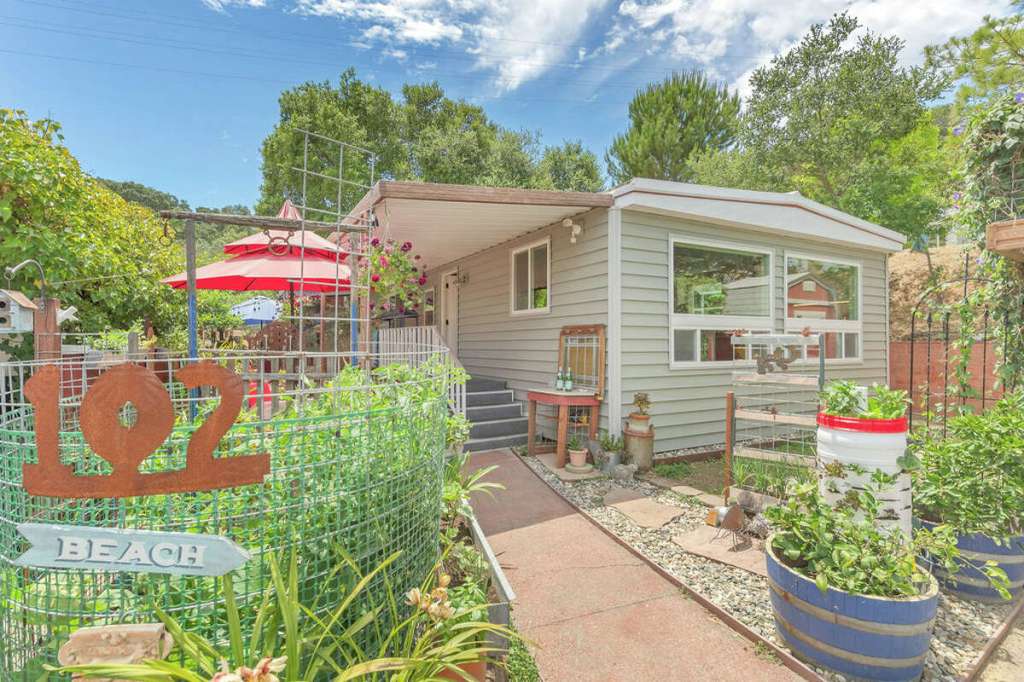
Built in 1973, this 800-square-foot mobile home has one bedroom and one bath. Care to guess how much it sold for?

The gentrification of the American economy, given a powerful push by the pandemic, has filtered down to even the lowest classes—and it’s never as painful as when it affects housing. Scarcely a week goes by without several stories of mobile home parks boosting rents by 30%, 40%, even 50% almost overnight, often with the rationale that their owners are merely seeking “market rates.”

In other words, if Trailer Park A raises rates from $650 a month to $800 and Trailer Park B does the same, Trailer Park C—which had been renting sites for $400 a month—now feels justified in doubling the rent. That’s “the market,” you see, at least until the next round of increases. And it “works” because conventional sticks-and-bricks homes have become so much more outrageously expensive, whether to buy or rent—assuming you can find something available in the first place—that the residents of such immiserated compounds often have no options other than homelessness.

Given the above, perhaps it shouldn’t come as a surprise that house trailers—um, “manufactured homes”—are acquiring an upscale vibe. Or if not the vibe, then definitely the price tag. Consider the house trailer pictured above, featured today in a San Francisco Chronicle story that described it as a “bungalow in Novato’s coveted Marin Valley Mobile Country Club.” It was snatched up after being on the market for just one day—for $346,750.

True, the “bungalow” had been extensively remodeled. And yes, it is in an expensive neighborhood—but as with most mobile home parks, the residents don’t own the land under their units, so that $433-a-square-foot price tag doesn’t include any real estate. The saving grace here is that the property is owned by the city of Novato, which apparently doesn’t feel a need to charge market rates; rent at the Marin Valley Mobile Country Club ranges between $600 and $700 a month. So: a high cost of entry but relatively modest costs thereafter, which is precisely the opposite of most mobile home owners’ experiences.

Ironic, huh?

So can you imagine how much the same house trailer might fetch if the land it sits on was part of the package, the way most American homes are sold? Actually, you don’t have to imagine that at all, thanks to reporting a couple of weeks ago in the New York Post: the answer is, almost exactly ten times more. An off-market purchase of, yes, an 800-square-foot house trailer in Montauk Shores—Long Island’s Marin County equivalent—went for a record $3.75 million. To be sure, the two-bedroom, two-bath mobile home is a custom-built job with high-end finishes, but as the Post points out, its per-square-foot price is putting it in the same class as New York City’s luxury market. As in “Tribeca penthouse.”

Moreover, the real state agent repping the unnamed buyer was quick to claim that while the Montauk Shores complex is often referred to as “the trailer park,” the trailers are “not technically mobile homes.” Precisely why was not made clear, as the realtor explained only that the trailers are all “on slabs and do not have foundations,” which is true of any mobile home park. But he did add that the owners of the trailers do own those slabs as well, so there you have it.

Public reaction has been mixed, albeit leavened with a fair amount of scorn. Some social media comments claimed that the location alone makes the price worthwhile, but others averred that real estate “is the oldest Ponzi of them all.” Or as one noted: “Only in America. A buyer is plunking down $3.75m for a luxury mobile home in a trailer park in the Hamptons. Gives a whole new meaning to trailer trash.”

Meanwhile, the folks traditionally dismissed as “trailer trash” are waging increasingly bitter battles to maintain their homes, one step removed from being out on the street. They’re everywhere, in every state and in just about every city of any size, and their world is unimaginably distant from the excesses described above. You have to wonder how long a society of such extremes can retain its cohesiveness before fragmenting into warring factions—oh, that’s right. Never mind. . . .

Most recent posts

Growing identity crisis for RV parks

Despite the entrance sign at right, the R.V. Park of San Rafael is home to an eclectic mix of travel trailers, mobile homes and a park model, all visible from the entrance.

RVtravel has an interesting story today, by Randall Brink, which misses the forest for the trees but which nonetheless sounds yet another warning about a dystopian outlook for RV full-timers.

The piece, headlined “RV park tenants evicted after court ruling,” relates how residents of the R.V. Park of San Rafael, California, will lose their homes after the park’s owners ran afoul of the city’s rent stabilization ordinance—an ordinance expressly designed for mobilehome parks. In a nutshell, the property owner’s management firm, Harmony Communities, tried to raise rents by more than the ordinance permits, and on being sued by the city, argued that an RV park should not be subject to a mobilehome ordinance. A three-judge panel of the Ninth Circuit Court of Appeals disagreed, pointing out that the ordinance has been on the books since 1991—15 years prior to the current owner buying the property—and that the matter had already been adjudicated in state court.

Harmony’s response? Issue eviction notices earlier this month to 40 of the RV park’s 45 residents, giving them until Oct. 31 to vacate the premises, presumably to prepare the land for sale. “The city wants a private property owner to singlehandedly subsidize affordable housing in San Rafael but the park has no cash and is losing money every month,” Harmony explained in a press release. “Since the city has refused to honor its own ordinance, the only choice is to shut down the park. We anticipate all residents moving out by October and look forward to redeveloping the property towards a higher and better use.”

Note that even after losing its court case, Harmony is still insisting that the city’s ordinance should not be applicable to an RV park—but is that an accurate description of the R.V. Park of San Rafael? As the photo above illustrates, the one shared aspect of the various dwellings on this property is that they all have wheels. Calling this conglomeration an RV park is no more accurate than calling it a mobile home park or trailer court—indeed, it could as easily, and accurately, be called the Mobilehome Park of San Rafael. Moreover, that blurring of distinctions is not helped in the least by California’s statutes, which define a mobilehome park as a property “that has at least two mobilehomes, manufactured homes, recreational vehicles, and/or lots that are held out for rent or lease.” [Emphasis added.]

Why does it matter? For one thing, such state laws and court rulings continue to mock efforts by the RV industry to draw a bright line between its products, which it contends are not intended for full-time residency, and actual dwellings that must be built to national housing standards. Successfully making that distinction helps the industry avoid such pesky regulations as requiring their electricians to be licensed, to cite a particularly egregious example, and it enables enormous cost-savings on construction materials and quality. If national standards for manufactured housing—the more contemporary label for mobile homes—were applied uniformly to mobilehome parks, RVs would never be admitted.

But that’s the forest that gets obscured by individual trees like the R.V. Park of San Rafael, where press coverage tends to focus on the need for affordable housing and not so much on what standards that housing should meet. What’s obscured is that RVs, park models, tiny homes and house trailers increasingly have become an undifferentiated mass of last-resort shelter, jostling each other for a place to chock their wheels in a mad campground game of musical sites—single-wides moving into RV parks, travel trailers finding room in trailer courts, park models and tiny homes springing into any chinks that can be found.

All these disparate forms of housing are not created equal, so why do we pretend that they are—except, of course, when it suits an outfit like Harmony Communities (really? Harmony?) to draw a belated, self-serving distinction? Are standards for manufactured homes too stringent, and therefore should be relaxed, if only to make house trailers more affordable? Or are those standards the bare minimum for ensuring safe and durable shelter for people with wheeled homes, even if those homes are called park models, fifth-wheels or travel trailers—in which case, what will it take to extend those standards?

Most recent posts

Mobile-home Monopoly not a game

[Part II of a two-part look at the growing economic pressures squeezing mobile home parks, foreshadowing the future for many RV parks.]

As deep-pocketed investors continue vacuuming up mobile home parks at exorbitant prices, they have only two ways to make their purchases profitable. One is by replacing trailer pads with higher density housing, such as single family homes and apartments. The second is to jack up rents on the existing sites, in some cases simultaneously slacking off on maintenance and upkeep to reduce operating costs.

The first approach reduces the overall inventory of low-cost housing. The second raises the affordability bar for people most in need of low-cost housing, pushing them out of homes they may have occupied for decades and into the streets, for lack of anywhere else to go. Either way, the result is skyrocketing housing costs that add to inflationary pressures, even as county and city governments grapple with a tidal wave of homelessness that strains taxpayer revenues.

Meanwhile, the people profiting from the economic forces they’re unleashing rationalize their actions by blaming–well, anybody but themselves. Frank Rolfe, offering a prime example of deeply cynical self-serving rhetoric, contends that the U.S. is “in deep trouble” for one basic reason: “A dysfunctional Fed has driven rates up too far and too fast and there will be great economic suffering as a result.” In other words, the patient is sick only because of the medicine prescribed for an economic disease–a disease for which Rolfe is a primary but unacknowledged vector.

But Rolfe doesn’t stop there. “Bad times yield greater demand for affordable housing,” he writes. “So while Jerome Powell is busy raising rates and destroying the U.S. economy, he’s also acting as a powerful force to push mobile home park demand even higher.” The uncoupling of “affordable housing” from “mobile home park,” thanks to Rolfe’s (and his peers’) self-enriching actions, goes unremarked. In his own eyes, Rolfe is a savior of the working class, providing a praiseworthy safety net against the Fed’s recklessness.

The Frank Rolfes of the world owe their success not to any great investment brilliance, but simply to their understanding that residents of mobile home parks a) almost never own the land on which their mobile homes are sitting; and b) that “mobile homes” are almost never mobile. All of which means that the poor unfortunates inhabiting these homes are a captive audience, ripe for the plucking.

It doesn’t have to be that way, but creating the exceptions takes a lot of money and a fair amount of luck. Boston Trailer Park, for instance, which sits cheek-by-jowl with an apartment complex in which one-bedrooms go for $3,000 a month, is that city’s only mobile home park–but it exists today only because former mayor Tom Menino helped its residents take ownership of the land more than a decade ago. As a result, Boston has a little working class oasis in which residents pay just $425 a month for their sites.

Unfortunately, that sort of intervention is becoming increasingly difficult, thanks in no small part to the $4.5 billion in investment money that poured into mobile home parks across the country last year alone. Even though Massachusetts is one of a handful of states with legislation giving residents of mobile home parks a chance to match any purchase offers, outside investors are driving prices to unmatchable levels. Without government help and nontraditional financing, most mobile home residents may as well dream about living in Palm Beach or Beverly Hills.

Despite those odds, some successes have been notched. As NPR’s Morning Edition recently reported, the 200 or so residents of a mobile home park in Wareham, Mass. were able several months ago to match a $12 million offer from an Arizona-based investor–but only after obtaining loans from a nonprofit, ROC USA, and a $1.9 million grant from the state’s Affordable Housing Trust. Approximately five years ago, ROC USA also provided the financing that fended off an outside buyer seeking to acquire the 430-home Halifax Estates in Halifax, resulting in the country’s largest resident-owned mobile home community.

Colorado, where fewer than 10 of the state’s 900 mobile home parks have been purchased by their residents, recently had a similar success story. The approximately 200 adults and 100 children of the Parklane Mobile Home Park were able to recruit county assistance in tapping American Recovery Act funds for a $1 million forgivable loan, which in turn encouraged the private, family-run Bohemian Foundation to underwrite a $2.8 million low-interest rate loan . The balance of the $6.8 million purchase was then provided via a $3 million loan from the Impact Development Fund, a quasi-public financial organization.

Yet as these examples also illustrate, constructing such buyouts is a precarious business, requiring multiple financing streams of limited supply. Non-profits almost by definition have more limited financial resources than their investor-driven adversaries. Funding resources from the American Rescue Plan will be exhausted within a couple of years, if not sooner. And while some state governments are belatedly waking up to the housing crisis on their doorstep, their response is typically hesitant and restrained, hamstrung by concerns over interfering with market dynamics and worries about using tax dollars to intervene in the private sector.

Meanwhile, the mobile home version of Monopoly continues unabated. Earlier this month, it was the residents of Hi-Acres Mobile Home Park in Palm Beach County, Florida, who got their eviction notices, letting them know that the park’s new owners have other, unspecified ideas for their acquisition. One look at an aerial map of the property leaves little room for guessing what that might be: Hi-Acres is surrounded on three sides by a suburban development of single-family homes, and butts up against a golf course on the fourth. This is not an area that will long tolerate “affordable housing.”

Most recent posts

You can’t extinguish fires w/ gasoline

[Part I of a two-part look at the growing economic pressures squeezing mobile home and RV parks.]

In a harbinger of what lies ahead for a growing number of RV parks, the San Jose Mercury News reported this week that a family trust in California has just paid $40.7 million for the Rancho Santa Teresa Mobile Home Estates in San Jose. The mobile home park has 315 spaces, which means the purchase valued each site at $129,200.

Think about that. What kind of astronomical rents will it take to make that a profitable transaction?

And this was hardly the first or even the highest-priced acquisition of mobile home parks in California, which suffers the country’s most expensive real estate. As one example, the 116-site Mary Manor Estates in Sunnyvale sold in March for $39 million, which works out to $336,207 per mobile home pad. And the 110-site Winchester Ranch Mobile Home Park in San Jose changed hands last year for $50 million, or a whopping $454,545 per pad.

Given that price, Winchester Ranch clearly wasn’t purchased as a mobile home park but for its land, so there’s no surprise that it’s been bulldozed to make way for 320 single-family homes and 368 apartments. A similar fate may await other, similarly high-priced acquisitions. Then again, housing costs have become so extraordinarily distorted that even the most bloated valuations may be sustainable if rents are pushed to even more stratospheric levels.

Consider the average Los Angeles monthly rent for a mobile park site last year, which according to the commercial real estate services company Jones Lang LaSalle was $1,103–significantly higher than anywhere else in the country, yet the market still had the nation’s lowest vacancy rate, at 1%. With an average expense ratio of just 43%, that resulted in a market net operating income of $8,600 per site, or just shy of a million bucks for a park the size of Mary Manor Estates. That’s a number sturdy enough to support an awful lot of debt–and if it’s not enough, well, just raise the rates some more. With comparable apartments renting for triple that amount, the market will bear it.

Los Angeles in particular and California in general are high-cost outliers, but where they lead the rest of the country so often follows. It’s instructive, therefore, to read the latest musing from Frank Rolfe about why mobile home parks are better positioned to weather the Federal Reserve’s ongoing efforts to curb inflation by increasing interest rates. Rolfe, who has been flogged by me (here and here, for starters) and the media in general for his predatory approach to mobile home parks, contends that “mobile home park rents are ridiculously low and have massive potential for increases,” so higher interest rates are nothing to worry about.

But juxtaposing Rolfe’s further comments with recent mobile home park sales underscores the tragic transition that occurs when trailer parks–as well as RV parks and campgrounds–are sold by mom-and-pop operators to corporate and investment buyers. “How did mobile home park rents get so low to begin with?” he asks rhetorically. “To understand, you have to go back to the 1960s when the industry was young. Moms and pops owned virtually all of the mobile home parks and they simply were not good about increasing rents. . . . Moms and pops only raised rents at about half the level of inflation, resulting in rents being so ridiculously low.”

Put another way, moms and pops were putting the brakes on inflationary pressures, but now that moderating influence is being steadily reduced, even as inflation is reemerging as a global economic concern. From Rolfe’s vantage point, however–and that of the other investors snapping up such properties–“the greater demand that recession brings for affordable housing will allow offsets–such as higher lot rents–that will battle back the higher rates on loans.”

Those “offsets,” it should go without saying, only throw more gasoline on the inflationary fire.

[Next post: Part II, taking a look at the hypocrisy behind promoting mobile home parks as “affordable housing” by investors who are making them unaffordable, and the increased pressure that puts on RV parks as housing of last resort .]

Trailer parks a risky refuge for RVs

An increasingly common sight: RVs tucked among house trailers in “mobile home communities.”

As the U.S. housing crisis continues unabated, forcing growing numbers of low-income people into RVs as their housing of last resort, the question of where to park all those vehicles has become ever more confounding. Some end up on the streets, of course, and some in those RV campgrounds that have long-term sites available. But a significant if uncounted number end up in trailer courts, which superficially appear to provide a perfect fit.

Yet that security is increasingly illusory, as mobile home communities are being squeezed like never before. Just in the past couple of weeks, for example, the Holiday Park in Minot, ND, told its residents their lot rents were being increased by $400 a month, while residents of several mobile home parks in Mercer County, WV, were told to expect a near-doubling of their rents, by as much as $525. But at least they still have a place to live: residents of Lesley’s Mobile Home Park in Riverdale, UT, have started getting eviction notices months ahead of a May, 2023 planned redevelopment of the property.

One explanation for such jarring developments is the growing appetite for trailer parks among institutional investors, who swept up 23% of all park sales in the past two years, doubling their acquisitions from the prior two-year period. Blackstone, the Carlyle Group, Apollo Global Management, Stockbridge Capital Group and Brookfield Asset Management are just some of the major “investors,” who invariably follow-up on their purchases with major rate increases–or by razing their newly acquired real estate to make way for more profitable uses.

Some of this can be chalked up as the inevitable, if deplorable, result of market economics. An extraordinarily large number of mobile home parks, for example, are located in once-rural areas that over the past 40 or 50 years have been engulfed by urban sprawl, transforming land of marginal value into real estate gold. But sprinkled among those flinty-eyed opportunists with big checkbooks and an unquestioning belief in “highest, best use” is a more loathsome creature, the unalloyed bottom-feeder who not only sucks his prey dry of anything of value, but also welshes on his debts and other obligations.

A leading example of such predatory capitalism is Alden Global Capital, co-founded by Randall Smith, which for more than a decade has feasted on the bones of scores of community newspapers. Its depredations have spanned the American journalistic landscape, from the Hartford Courant (the country’s oldest daily) to the Chicago Tribune, the St. Paul Pioneer Press, the Denver Post and the Oakland Tribune–to mention only a few of its victims. Its initial modus operandi was to gut newsrooms by laying off staff, even as it raised ad and subscription rates. More recently, however, and as comprehensively reported by Julie Reynolds Martinez and by the News Guild, it has resorted to simply not paying its bills and walking away from leases after falling a year or more in arrears.

Newspapers have been in terminal decline for at least 15 or 20 years, making them–like an aging gazelle spotted by a a pack of hyenas–an irresistible target for the Aldens of the world. It’s therefore noteworthy, as also reported by Martinez, that Randall Smith has now become transfixed by . . . mobile home parks. Working under a variety of limited liability corporate names, Smith has acquired approximately 20 such parks in North Carolina and a publicly untallied number elsewhere. And as might be expected from someone with his track record, his first step upon making each acquisition is an immediate rent increase, backed by eviction threats.

Residents of North Carolina’s Big Oaks Mobile Home Park, for example, received a 90-day notice of a rent increase that in at least some cases jumped 60%, from $440 a month to almost $700. Similarly, and at the other end of the country, residents at the Ridgewood Mobile Home Park in Orange County, CA, another Smith-acquired property, were notified early this summer that their rents were being hiked by up to 40%. Adding insult to injury, the notices were all in English, even though nearly all the Ridgewood households speak only Spanish.

While on one level it doesn’t matter which investor is putting the squeeze on a captive client base–a 40% rent increase may be equally intolerable regardless of who’s pocketing it–on another level it can matter a great deal. Sam Zell or Blackstone may be out for every last nickel, but Alden Global Capital and Randall Smith will take every last nickel while turning their properties into cesspools and garbage dumps. They’ve done it with newspapers, which once might have blown the whistle on such predatory behavior, and they’re doing it now with the last places some people have to live.

That’s bad news for RVers looking for safe harbor in a mobile home park, who face the unenviable task–if they’re going to be prudent–of attempting to pierce the corporate veil to find out who actually owns a property. Failing to do so, however, may mean even more heartache down the road for people who’ve already had more than their fair share.

[Full disclosure: I was for about a decade an employee of the News Guild and had a front-row view of Alden’s rapacity. It has gotten only worse since then.]

Most recent posts

Should park managers be certified?

The blurred distinction between mobile home parks and RV parks is growing even more fuzzy in California, where a Senate bill that would require managers of trailer courts to get annual training and certification is in the legislative hopper. Trailer courts–and, almost incidentally, RV parks as well.

SB 869, introduced in January by Senator Connie Leyva, would require “each person employed or acting in an onsite or offsite managerial capacity or role, on behalf of a mobilehome park or recreational vehicle park to receive appropriate training of at least 18 hours” by May, 2024, and additional training each year thereafter. Trained park managers would receive a certificate of completion, to be posted “in a conspicuous location onsite.” Failure to get the training or to post the certificate could result in civil penalties and a suspension of a facility’s operating permit.

The bill is vague on the training specifics, leaving it up to the state’s Dept. of Housing and Community Development to fill in the blanks. But it does specify that the department “shall review the complaints it has received” from park residents when designing the curriculum, paying particular attention to complaints about evictions, fees, management of utilities, homeowner communications and how sales of a campground are handled. The training is also to include parks’ contingency planning and how they will respond to medical and other emergencies.

There is more, but it may all be moot, as the bill has been assigned to the Senate Appropriations Committee Suspense File. A potential graveyard for all legislation with an annual price tag of $150,000 or more, the Suspense File’s hundreds of bills will be reviewed by the committee May 18 and either approved for floor vote or quietly allowed to expire. Which way SB869 will be decided is uncertain, but clearly CampCalNOW, the state’s trade association for RV parks and campgrounds, believes it’s a done deal, emailing its members with the assurance that the bill has been “shelved.”

Perhaps. On the other hand, Eric Guerra, a consultant for the Senate Select Committee on Manufactured Home Communities, believes that “things are still open.” The bill “is a pretty high priority” for Senator Leyva, who chairs the committee, following a rising chorus of complaints from park dwellers about predatory practices by park managers. Unlike neighboring Oregon and Nevada, both of which mandate training and licensing for park managers, California has no standards for such employees, even though the managers may be responsible for the safety of more than 200 residents, sometimes in remote areas.

Although most complaints that triggered the proposal have come from trailer parks, RV parks got swept into it because in many cases “they have become de facto mobile home parks,” Guerra explained. And while CampCalNOW argued that most RV parks in the state don’t have the kind of long-term residents that the bill is seeking to protect, the exceptions have been disturbingly stark. Most notably, the Fairplex RV Park in Pomona, a former KOA, was the subject of a blistering 2016 L.A. Times investigation that resulted in a state audit issuing several safety violations, including for frayed overhead electrical wires and bathrooms in disrepair. That memory lingers, Guerra said, and the Fairplex park was not unique.

It’s entirely possible, if Senator Leyva gets a sense that the political winds are unfavorable, that SB869 will yet be amended to modify its RV park aspects, while leaving stronger measures in place for mobile home parks. But whose interests would be served by a more narrowly tailored bill? A training requirement of 18 hours–which the bill expressly allows to be done online, in as many installments each year as desired–is at most a nominal obligation. RV parks, like trailer courts, increasingly are home to economically and physically vulnerable populations, in a state that is at growing risk of wildfires and mudslides. Ensuring that the people most directly responsible for maintaining a safe environment have just a teeny bit of instruction about their duties would seem a no-brainer.

The wonder is not that RV parks might be opposed to legislation that would set some minimum operational standards, but that more campground owners are not proactively implementing policies and practices that would safeguard their customers. Consider this, for example: when’s the last time you stayed at an RV park that had an automatic external defibrillator that you could readily access, in case your traveling companion had a heart attack? As with so many other common sense precautions, most RV park owners simply hope for the best and reflexively push back against anything that smacks of government regulation.

Leyva’s bill does not mandate AEDs, but by raising the subject of how campgrounds respond to emergencies, certainly opens the door for discussing this and other measures. RVers in California should be thankful for that, even if campground owners are less enthused.

Most recent posts

One death a sign of two big problems

Toni Covington was only 60 when she died last week, just days after being forced out of the mobile home park she had lived in for more than 30 years. As reported by the Fresno Bee, she was found dead in an employee dorm room during a wellness check by the local sheriff’s department, called in after she didn’t show up for work at a Yosemite National Park concession.

Covington first arrived in Yosemite for a summer job when she was 19 and was so smitten with the place she never left, eventually moving into a mobile home at the El Portal Trailer Park, located along the Merced River just outside Yosemite’s western entrance. In the years that followed, starting around 2000, she and the other trailer park residents kept hearing that the park was about to be closed down for one reason or another. It never was–until it was, this time on the grounds that the overhead electrical lines had degraded so badly that they had become a fire hazard. That much probably was true.

But there are other truths. One is that, as is true in mobile home parks across the country, the residents own their homes but not the underlying land–and those homes are so old that they are anything but “mobile.” Being forced to move therefore amounts to becoming homeless, which is how Covington ended up spending her last days in a dorm room too small for her possessions, with a shared bathroom and kitchen, rather than in the three-bedroom residence she had called home for three decades.

Another truth is that some states–including California– recognize the extreme vulnerability of trailer park residents, as exemplified by Covington’s story, and therefore have mandated certain protections for them. Tenants are supposed to be given a year’s notice when their trailer park is going to be closed down; they’re also supposed to be offered appropriate relocation assistance. But the El Portal Trailer Park is on federal land, and so beyond the reach of state regulations; its residents weren’t notified until shortly before Christmas (happy holidays!) that they had 90 days to move or lose their mobile homes. No compensation or assistance to do this was offered.

The plight of El Portal’s now dispersed residents inadvertently highlights two developments that will only get worse without public policy intervention. One is the growing marginalization of people living in trailer courts, some by choice but many more out of necessity, as sky-rocketing rents and real estate prices have left few affordable housing alternatives. The second is the steadfast refusal of resort and recreational facility developers and operators to ensure adequate housing for the (typically underpaid) workforce they need to serve their customers.

Although a shared dorm facility may be a nifty experience for a 19-year-old working a summer job between college semesters, it’s hardly suitable for a 60-year-old woman who has spent two-thirds of her life working in the same community. Other resort areas have it even worse, with hotel, restaurant and giftshop workers living in tents or in their vans on national forest land–and the pricier the resort, like Vail in Colorado or Jackson Lake in Wyoming, the worse the problem. Developers of new properties, including the growing roster of proposed large RV parks, rarely include an analysis of local employee housing options along with their traffic surveys and environmental impact statements.

For Toni Covington, these are no longer matters of concern. Just why she died, less than a week after her involuntary move, isn’t known, but her autopsy was scheduled for today. It may not be able to determine if a broken heart played a role.

The RV park bubble is growing

If the pandemic has been bad news for many businesses, just the reverse has been true for RV campground valuations, with prices ratcheting steadily upward. But as is becoming increasingly clear, the buying frenzy is creating a real estate bubble of asking prices that aren’t supported by economic fundamentals.

Take, for example, the Tennessee RV and motorhome campground that just got listed for sale, scarcely more than two years after the current owners acquired it. The 8.1-acre Tiny Town RV and Motorhome Park has 54 RV sites, plus sites for 10 single-wides and one double-wide, and accepts only monthly rentals. That means it also has minimal amenities, but the park does include a 3,600-square-foot house, a laundry facility with bathroom and connected maintenance area, and a zero-turn mower and diesel tractor.

Asking price? $3.4 million.

Sound pricey? Indeed it does, and a quick back-of-the-envelope calculation demonstrates how much so. The campground’s current rates include $550 a month for 26 RV sites at the front of the park (where there’s more road noise) and $575 a month for 28 sites in the rear. The single-wides, whose occupants pay their own utilities, are charged $250 a month; the solitary double-wide pays $320 a month. Assuming 100% occupancy year-round–which isn’t really a thing–that works out to a maximum of $398,640 a year in revenue. In other words, the aspiring sellers want someone to pay them 8.5 times their maximum annual cash flow.

How crazy is that? Let’s assume a buyer comes in with a typical 30% down-payment, or a smidge over a million dollars. Further assuming that the balance of $2.38 million is financed over 25 years at 6%, that means a monthly mortgage payment of $13,913, or $184,008 a year, leaving $214,632 a year to cover utilities, insurance, taxes, payroll (assuming the new owner can’t do all the needed work), maintenance and upkeep. If operating expenses can be kept to 40% of annual revenues, or $159,456–a highly optimistic assumption–the buyer will be left with annual income of $55,176 plus a home. At a more realistic 50% of revenues, or $199,320 in operating expenses, that drops to just $15,312 a year for the owner to live on.

Is it possible? Yes–if everything meets best-scenario expectations, nothing goes awry and there’s no expectation that the park will ever need capital improvements . Keep in mind, though, that buying an annual income of no more than $55,000 will cost the new owners a million bucks that they could have invested a lot more profitably elsewhere, and without years of hard work ahead of them. The more likely outcome is that if this property sells at anywhere near its asking price, it’ll be because the buyer is planning a sharp increase in site rates.

It might be time, in other words, for the park’s residents to start thinking about their next home.