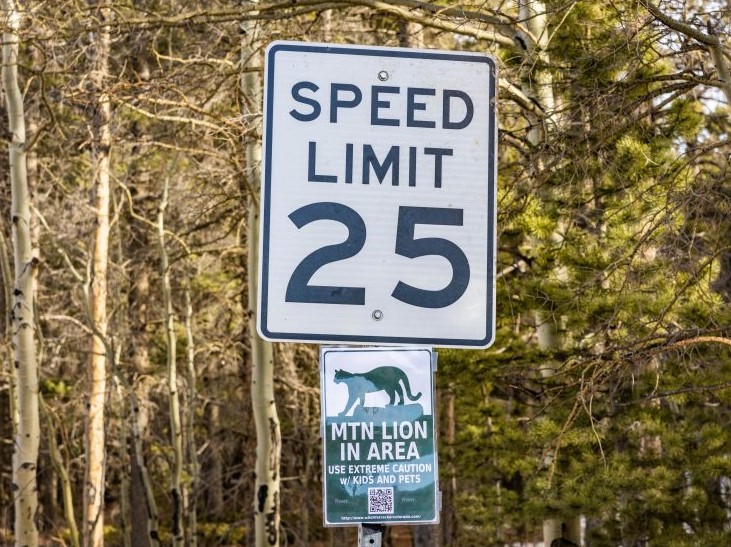
One of 80 signs warning of mountain lions in the area around Nederland.
My recent post about the one-year anniversary of the Marshall fire in Colorado cited a U.S. Fire Administration report, issued last June, that raised the alarm about urban encroachment on undeveloped land. Titled “Wildland Urban Interface: A Look at Issues and Resolutions,” the report was an unabashed effort to “trigger a sense of urgency and motivation” about safeguarding exurban communities from wildfires.
It’s a report worth reading, but given its narrow focus, only scratched the surface of an increasingly complex subject. While the intrusion of human dwellings into wildland areas increases fire risks, “wildlands” don’t consist solely of vegetation: there’s fauna associated with that flora. And while wildfires can cause destruction on an epic scale—the Marshall fire consumed more than 1,000 homes—wild animals can be just as lethal in the number of human lives they claim. Moreover, predators increasingly are moving into fully urbanized areas, where they’re greeted with a mixture of fear and anthropomorphizing wonder that complicates an appropriate human response.
An extreme example of this phenomenon played out in Los Angeles last month, where a mountain lion known as P-22 was euthanized after spending more than a decade prowling the city—euthanized not to remove a potential threat to adults, children and pets, but because of its long-term health problems exacerbated by being struck by a car. The “bona fide celebrity,” as the lion was described in news stories, was finally trapped after reports that it had attacked three dogs within a month and had several near-encounters with hikers. Veterinarians found that the emaciated puma’s injuries from the accident included a skull fracture, an injury to its right eye, herniated organs and a torn diaphragm. But the lion also had lost about a quarter of its body weight and had heart, kidney and liver disease, a thinning coat and a parasitic infection—hardly the stuff of an uplifting “Born Free” sequel.
While news coverage of an apex predator’s life and death in the country’s second-largest city was inexplicably fawning, the problem of large wild animals penetrating towns and cities is growing coast to coast. The resulting human toll is still limited, although not negligible, but the worry is that increased habituation to humans coupled with growing wildlife population pressure will lead to more attacks. Pets, meanwhile, have decidedly more to worry about than do their owners.
As reported last week by the Colorado Sun, residents in and around Nederland, a Colorado town in the Rocky Mountain foothills west of Boulder, have been complaining to state wildlife officials that mountain lions had killed 15 dogs over a recent 30-day period and have been stalking their horses. As one woman from nearby Rollinsville said, about an incident Dec. 26, “Our beloved Aussie shepherd was snatched off the porch by a massive mountain lion right in front of me as I ran to open the door. . . . I’m now scared for our children.” With an estimated four mountain lions per 36 square miles in an area that stretches from the Continental Divide to Interstate 25, more such incidents are all but inevitable. “That’s yeah. That’s a lot of lions,” as one wildlife manager acknowledged at a local meeting.
But mountain lions are only one among a handful of beasts with large teeth and claws adapting to the human landscape, a list that includes wolves, coyotes and black bears. And while all tend to avoid humans when possible, that aversion may be lessening with increased interaction among the species. Wolf attacks on humans are extraordinarily rare, for example, but not unprecedented. The Norwegian Institute for Nature Research recently compiled a list of 489 wolf attacks between 2002 and 2020 in North America and Europe, most by rabid animals, but also including 67 people who were victims of predatory attacks; nine of those victims were killed, for an average of one every two years.
Coyotes, meanwhile, historically far more wary of humans than either lions or wolves, have proliferated across the continent and appear increasingly capable of regarding people as a food source. After an aggressive pack in the Cape Breton Highlands killed a 19-year-old Canadian woman in 2009, followed by 32 other reports of “coyote-human incidents”— including seven in which people were bitten—a research project concluded that such emboldened behavior is a result of the pack acquiring a taste for larger prey. Because of changing environmental conditions that depleted the supply of the smaller mammals they usually hunt, the coyotes began to learn how to take down moose, which average 1,000 pounds apiece. Attacks on people “are at least partially the result of prey-switching,” concluded the study, according to an article last month in the National Post.
Although the Cape Breton coyotes may be an extreme example, the species is expanding by leaps and bounds elsewhere, and frequently in menacing ways. The Massachusetts coastal town of Nahant reportedly has at least a dozen coyotes that have grown increasingly brazen about going after pets, with some owners outfitting their dogs with spiked “coyote jackets” to repel attacks. Yet despite 500 or more coyotes killed in Massachusetts each year, the number keeps growing and coyotes are now in every part of the state except for the islands of Nantucket and Martha’s Vineyard. Just how large a problem this can become is illustrated by South Carolina, where annual hunting and trapping has yet to make a dent in a population of 25,000 to 30,000 coyotes.
Meanwhile, the growth in black bear populations has been almost as remarkable, with current U.S. estimates ranging from 300,000 to twice that number. Although omnivorous, rather than carnivorous, and far more shy than their aggressive brown cousins, black bears are so ubiquitous that their encounters with humans are increasingly inevitable, with occasionally tragic consequences—and especially so if a bear cub is involved.
There’s other wildlife of varying degrees of concern, of course. Every year seems to include at least one story of someone becoming an alligator snack. Raccoons can be incredibly destructive of private property, but also pose an acute physical threat to anyone foolishly trying to ward them off. Muskrats, beavers, porcupines, skunks—the list of creatures that don’t mesh well with urban and suburban environments is extensive and often problematic. The problem is not that we share this planet with other animals, however—it’s that we don’t acknowledge their essentially wild nature. Too often we treat this wild element as something that exists for our amusement (see P-22 above), but we’re just as foolish when we perceive such animals as being on par with a tree or boulder—as just another piece of landscape.
A comprehensive understanding of the wildland urban interface must include more than trees, grasses and underbrush; it also must include the four-legged critters that call the woodlands home. It’s a wildlife urban interface, too, with obvious implications for every campground owner, boondocker, backpacker and other outdoor enthusiast.
Most recent posts
 Renting Dirt