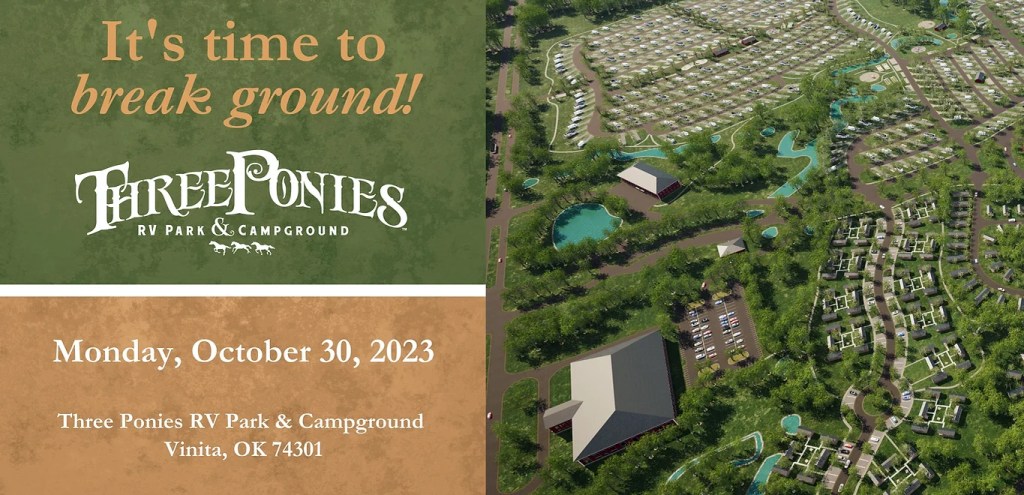
Three Ponies RV Park and Campground, announced with great fanfare last July, officially broke ground the last day of October amid predictions it would open for business spring of 2026. Given that plans call for construction of 750 RV sites and 300 cabins, not to mention a 300- or 400-room hotel (plans keep changing), an indoor waterpark, a restaurant, and other buildings and amenities, an 18-month construction schedule might appear optimistic—but hey, this is Oklahoma, land of sunny optimism and grand ambitions.
And tornadoes . . . but more on that later.
Right now, the problem is much more mundane. As disclosed last week, in response to Vinita city officials who had started wondering why the grand project isn’t moving along more quickly, it turns out a piece of the campground sits in a floodplain. Oops. Apparently this came as a surprise to the developer, Mansion Entertainment Group, who you might think would have known about this before even a shovelful of dirt was turned, but which now is scrambling to deal with the problems it presents. Mansion executive Steve Hedrick acknowledged to the city council that construction is “lagging a little behind,” in part because the government now wants a new survey— and, well, you know how “nothing in government moves quickly.” In other words, it’s not us, it’s the bureaucrats.
But, Hedrick added, somewhat confusingly, the delay “gives us some extra time to work with FEMA and get that flood plain resurfaced.” Meanwhile, it seems there are other problems slowing things down, including a design flaw that made the RV spaces too long. As a result, Hedrick added, the park’s designers have been asked to “compress” the RV park’s 320 acres, presumably to minimize flood plain encroachment.
None of this augurs well for a multi-billion-dollar—yes, billion with a ‘b’—1,000-acre tourist attraction, of which the Three Ponies RV Park is just a small piece. The main draw is supposed to be the American Heartland Theme Park and Resort, the Midwest’s answer to Disneyland and Disney World, featuring six Americana-themed environments with “thrilling rides and heartwarming shows,” including Great Plains, Bayou Bay, Big Timber Falls, Stony Point Harbor, Liberty Village and Electropolis. All this is being plunked down on the Oklahoma prairie just east of Vinita, population 5,100, along the north side of U.S. Highway 60, currently a narrow, two-lane strip of cracked asphalt. Opening day, originally scheduled for early 2026, has been pushed back to the latter part of the year, presumably because of the RV park construction delays.
Oh, and the original $2 billion price tag is slipping, too.
Does this sound a little over the top? Maybe more than a little? Apparently at least some industry observers think so, albeit reservedly so. Robert Niles, editor and analyst with the Theme Park Insider, pointed out last year that the projected $2 billion price tag matched the market cap of the entire Six Flags chain of amusement parks; he was too polite to specifically criticize Mansion Entertainment Group, which owns and operates a successful 3,000-seat theater for the performing arts in Branson, Missouri, for having absolutely no experience with this sort of venture, much less on this scale.
“I always greet new theme park development proposals with skepticism,” he acknowledged last year, adding more broadly: “New parks pitched by companies with extensive theme park development experience don’t always end up getting built. Parks proposed by companies new to the industry even more rarely happen. And the higher the price tag attached to a proposal, the more skeptical I become.”
Then there are the unanswered questions about location and infrastructure—questions that remain unanswered because, it turns out, Vinita’s political leadership signed a series of non-disclosure agreements (NDAs) with Mansion Entertainment Group, which means few details about the project have been made public. As disclosed last November by Samson Tamijani, television reporter for 2 News, Mansion told city leaders that the NDAs were “a standard business practice” and were needed “to safeguard any proprietary information.” Local residents say that as a result they don’t know even the most basic facts about the project’s impact on their livestock, water supplies and overall land use.
“We’ve been told that there will be bumps and humps to go over and that we’re just a small population and that we should be willing to sacrifice for the better good for more people,” local farmer Sara Shelton told Tamijani. Added farmer Cory Poole, “In my opinion, they’ve really put the cart before the horse and kind of sold us a lot of promises on what may or may not happen based on the development of this theme park.”
Indeed, without a theme park there’s really no rationale for building a campground in the middle of a sere stretch of high plains grassland with not much else to see or do. But with or without such a park, you have to wonder why anyone would think it’s a good idea to spend more than $2 billion on a recreational attraction that sits squarely in the middle of a tornado alley that runs up I-44 from Tulsa, just past Vinita and on to Joplin. The National Oceanic and Atmospheric Administration rates this a “very high risk area” for tornadoes, and Vinita itself has a tornado index value of 352.83, or two-and-a-half times the U.S. average—hardly the place you’d want 3,000 people setting up their travel trailers.
Last weekend saw tornadoes and flash flooding swarm Oklahoma southwest of Vinita along that same I-44 corridor, wiping out homes, killing at least four people and devastating the communities of Sulphur and Marietta, among others. That’s an aspect of the American Heartland that no theme park should seek to replicate, but this one may be ideally situated to do so. It should be put out of its misery before that happens.
 Renting Dirt