
Need RV repairs? Be prepared to wait!

RECT is an acronym for Repair Event Cycle Time—the time from the start date of an RV repair order to its completion. Note that RECTs that took longer than two years (!) are not included.

Last summer I reported on a possible silver lining to the grey cloud of plunging RV sales: the decline in high-margin sales meant dealers had more incentive to beef up their servicing efforts. Complaints about months-long waits to get even basic repairs had been exploding, thanks in part to shoddy workmanship and substandard parts as manufacturers rushed product out the door—then dragged their heels on approving warranty repairs. Add a resulting shortage of replacement parts, and the completely predictable result was an average wait time last May of 34 days for non-warranty work—but 50 days for warranty repairs.

And if even one part was out of stock? That national average jumped to 73 days for non-warranty work, 89 days for warranty repairs.

Crazy, right? But that was actually an improvement over December 2022, when the national repair time had averaged 53 days, and the wait time for both warranty and out-of-stock repairs had nudged down a bit. Not a huge change overall, true, but moving in the right direction and with every reasonable expectation that the improvement would continue.

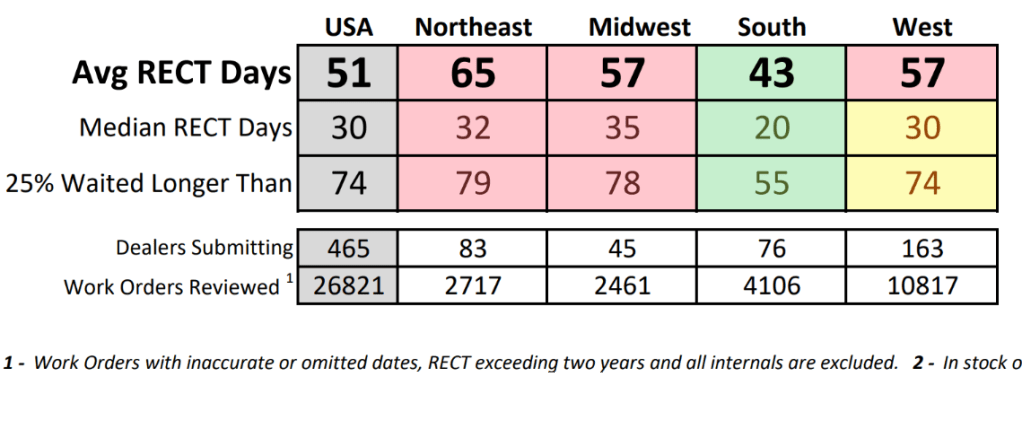
But that was then, and this is now. The average national repair time this past December shot back up, to 51 days—and if you’re unlucky enough to be in the northeast, that average was 65 days. In May, 25% of all customers had to wait longer than 33 days for their repairs to be completed; in December, that wait time for the unlucky 25% had more than doubled, to 74 days. The national average wait of 50 days for warranty repairs in May had jumped to 67 days in December, and to a whopping 90 days in the northeast. Meanwhile, the percentage of repairs that languished because parts were out of stock jumped to 33% in December from 21% in May, extending those repairs by another week.

It wasn’t supposed to be like this. The number of RVs cranked out by manufacturers last year was roughly half that of 2022, which one might think would mean more time for quality control on production lines. Lower production and the repair of pandemic-disrupted supply lines should have replenished parts stocks, not squeezed them further. And after several years of pumping money into its technical institute, the RV Industry Association was boasting in December of having the largest number of certified techs in the RV industry’s history.

So where’s the bottleneck?

A good question, and one the industry hasn’t yet acknowledged, much less answered. To be sure, some of the numbers above may be attributable to seasonal variations, if inexplicably so: repair times seem to peak in December and January, then gradually decline through the spring and summer before bottoming out around October. Still, the latest peaks are significantly higher than those of a year ago, so progress this ain’t. The only thing certain is that RV owners who need repairs are still twisting in the wind, their expensive and frequently highly leveraged adult toys sitting on a dealer’s lot somewhere for months on end.


The data above, utilized by the RV Dealers Association for the benefit of its members, is extracted from much more extensive research conducted by a systems software company called Integrated Dealer Systems. Number nerds who would like to explore that information more thoroughly can go deeper here. 

Do soft sales mean quicker repairs?

As shipments of new RVs stagnate at a hair above 30,000 a month, posting a near 50% decline year-to-date over 2022, the dealers who sell those RVs likewise are getting a severe haircut. May sales revenue dove 26% from May of last year and was down 28% compared with May of 2021, according to a recent report from the RV Dealer Association (RVDA). But here’s a bright note amid the gloom: all that loss of sales business may mean it’s taking less time to get your RV repaired.

That suggestion—and thus far, that’s all it is—can be teased out of the report’s RV Repair Event Cycle Time (RECT), which the association defines as the time between the start date of a work order and its completion. After reviewing 41,538 work orders around the country, the RVDA concluded that the average RECT in May was 34 days. The good news: that’s down significantly from a 53-day peak in December, and an improvement over the 40 days recorded last May, attributable perhaps to dealers having more incentive to focus on repairs as more profitable RV sales withered.

The bad news? An average score can hide a whole mess of ups and downs.

Just how much variation can be concealed within an average is suggested by another statistical measure in the RVDA report, the median. While the average RECT was computed by adding up all the days it took to complete 41,538 repairs and dividing that total by 41,538, the median establishes the midpoint at which half of all repairs lasted longer and half less. And as the RVDA reported, the median RECT in May was just 11 days.

How can the median be so much less—just one-third—than the average? Because the repairs that took longer than 11 days took a lot longer, as many RV owners already know. Indeed, 25% of all repair customers in May had waited more than 33 days for the job to be done. And while RVDA’s report did not add any additional data points on the long end of the scale, it did note that it had excluded any RECTs exceeding two years. (!) Meanwhile, it’s also worth noting that the median got shifted toward the short end of the time scale because 25% of all customers waited less than three days for the job to be done, presumably because those repairs were relatively minor.

That’s the big picture. The reality, however, becomes more stark when a couple of variables get pulled out of the data: whether repair work is done under warranty, and whether the job requires parts that are not in stock. If the repair was under warranty (42% of the total), the average RECT jumped from 34 days to 50 (RVDA did not break out medians), and if one or more parts are not in stock (24% of the time), the RECT soared to 73 days. Have a warranty repair that also required ordering parts? You looked at an average of 89 days in the shop. Conversely, a non-warranty repair with in-stock parts got you out in 15 days.

Those are national averages, but RVDA also broke out regional numbers, dividing the country into West (11 states), South(16 states), Midwest (12 states) and Northeast (nine states) regions. While the overall RECT averages hardly varied from one to another, the southern states had a clear advantage on both warranty work (a RECT of 46) and when needing to order parts (a RECT of 66). The Midwest fared worst on warranty work (a RECT of 56) and almost worst on the out-of-stock measure (a RECT of 79, just slightly behind the Northeast’s leading 81), which is ironic, considering that Indiana is ground-zero for RV production.

There’s even more variation within those numbers, as warranty RECTs can vary considerably not only within a region but by brand. So, for example, Jayco Eagles had a 108-day RECT in the Northeast states, significantly longer than the next lengthiest RECT by brand, Grand Design’s Solitude in the Midwest, at 99 days. One shouldn’t read too much into those findings, because all that slicing and dicing results in increasingly shaky statistical certainty. The Jayco Eagle, for example, was the tenth most frequently repaired RV under warranty in the Northeast in May, out of a total of 2,612 warranty jobs altogether and an unspecified total number of brands. On the other hand, those statistics indicate just how bad things can get. . . .

In addition to its eye-opening repair statistics, the RVDA report also included purchase figures that underscore the magnitude of the investment RV buyers are making—and therefore why they may get furious when that investment ends up sitting in a repair bay for two, three or more months. The average selling price of an RV in May was $51,896, the association reported, with an average down payment of $8,957 and an average of $50,844 financed over 16 years at an APR of 9.61%. The resulting average monthly payment of $517 means that RV will end up costing $99,264 in monthly installments, or more than $108,000 when adding in the down payment—and more than double the alleged “selling” price.

No one can claim a rapidly depreciating RV makes sense as an investment—but if it’s not that, it should at least be usable.

Most recent posts

RVDA pushes back against sales regs

Earlier this week I wrote about a proposed new rule from the Federal Trade Commission that seeks to “prohibit motor vehicle dealers from making certain misrepresentations in the course of selling, leasing or arranging financing for motor vehicles.” Turns out, that doesn’t apply just to your Ford F-150 or Mazda Miata: “motor vehicles,” as defined in the Dodd-Frank Wall Street Reform and Consumer Protection Act, includes recreational boats, motorcycles, motor homes, recreational vehicle trailers and slide-in campers–to RVs in general.

No surprise, then, that the motorcycle, automobile, RV and marine trade associations have come down with both boots on this one. Mark Steinbach, a past member of the board of directors of the National Association of Consumer Advocates, suggested as much back in July, when his written comments to the FTC warned that the various associations “will be circling the wagons” and claiming “that there is no need for the new rule, that everything is hunky-dory” just the way it is. If only.

Start with the claim that the proposed rule is “ill-conceived, ill-supported, ill-coordinated, untested and unlawful.” That’s just one of the opening broadsides from the National Automobile Dealers Association, which filed a 364-page series of arguments to expand on the idea that each problem the proposal addresses “is already regulated under existing law”– which is to say, hey, everything is hunky-dory. That 364-page rebuttal, by the way, is only ten times as long as the FTC’s actual proposal, which brings to mind that old line about brevity being the soul of wit. This is wit-less.

NADA’s submission, as was true of all industry responses, was filed Sept. 12, on the very last day of an 80-day comment period. This was true as well of the RV Dealers Association, which chipped in with its own 13-page argument–which the FTC didn’t post on its website until Sept. 16– detailing why RVs shouldn’t be lumped in with other wheeled conveyances that are sold, financed and titled by dealers. Given all the time it had to prepare its brief, one might wonder why the RVDA did such a skimpy job of it.

The RVDA’s basic line of reasoning begins with the observation that RVs are discretionary purchases, unlike other motor vehicles, and for their buyers are “not essential for their daily life activities, but a means to escape from their daily lives.” That distinction is important to the RVDA because the FTC’s “stated purpose” for the proposed rule is “to protect consumers for essential motor vehicle purchases used for daily activities.” Translation: federal regulations that apply to “essential” purchases are too rigorous for an industry that sells non-essential ways for its customers to “escape from their daily lives,” even if those purchases may easily cost several times more than “essential” ones. Escape that, you yahoos.

There are a lot more specious arguments of this sort in the RVDA brief, from the observation that the RV market is considerably smaller than its automobile counterpart, to a somewhat strained claim that the RV industry needs special regulatory treatment because RVs are not as standardized as automobiles—that “in the RV industry it is customary to prepare a vehicle before a customer is able to use the RV.” At bottom, however, the RVDA is simply claiming that the FTC is trying to solve a non-existent problem—but that if there is a problem, “enforcement should focus on the bad actors, and not treat every dealership as if it is a bad actor.”

Yep–more of the same hunky-dory.

Given that the proposed rule has drawn almost 28,000 comments, scarcely more than a handful of them addressing the implications for RV dealers, it’s entirely possible that the FTC might not even take note of the RVDA’s hyperventilating. But if it does, one may hope it’ll also give a passing glance to the brief comments of Michael Nicholas, an automotive sales manager for the last 25 years who thinks his industry has become immeasurably more transparent over that time period.

“If you really want to go after a business that isn’t transparent,” he wrote in early September, “you may need to look into boat, RV, furniture and jewelry sales, where their markup is huge and a customer has no way of getting [the actual] cost. . . . Try to find the actual cost of a ring or an RV–YOU CAN’T.”

Most recent posts

Taking the ‘vehicle’ out of RVs

“RV” is shorthand for “recreational vehicle,” a point strongly emphasized by trade groups like the RV Industry Association–which represents RV manufacturers–any time someone begins confusing RVs with housing. Sure, a travel trailer or park model may look an awful lot like a single-wide house trailer, but they’re built to different standards and no one, for example, should expect to live year-round in an RV. “RV housing?” No such thing, regardless of what it might look like.

But once you’ve declared yourself to be either fish or fowl, you can end up in some pretty strange contortions trying to straddle the divide. Take the Recreation Vehicle Dealers Association, for example, which is embarrassing itself these days by claiming that the vehicles its members sell are, well, not just vehicles. Yes, the automobile industry sells vehicles, but those wheeled conveyances rolling down the nation’s highways are “standardized.” In the RV industry, on the other hand, “it is customary to prepare a vehicle before a customer is able to use the RV.”

See the difference? RVs are non-standard. They deserve non-standard regulatory treatment. Special treatment.

What’s got the RVDA all twisted up like that is a proposed new rule from the Federal Trade Commission that seeks to better protect consumers from being ripped off by unscrupulous dealers. Specifically, “the proposed rule would prohibit motor vehicle dealers from making certain misrepresentations in the course of selling, leasing or arranging financing for motor vehicles.” Any RV buyer who has found himself with a 20-year loan for a rolling box that will have a resale value approaching zero in half that time will applaud the sentiment.

While the RVDA may insist that a Class B Sprinter RV is nothing at all like a Sprinter cargo van, both can be subject to the same high pressure sales tactics that the FTC wants to clamp down on: vaguely explained additional charges, deceptive pricing, reams of paperwork that serve as a graveyard of land mines for the rushed buyer. If adopted, the new rule “would significantly alter the way motor vehicles are sold, marketed and financed in the U.S.,” the RVDA laments on its website, “by adding additional disclosures on pricing, vehicle add-ons and onerous new recordkeeping requirements.” The horror, the horror!

Curiously, the RVDA website also states that the association on Sept. 12 had filed formal comments “highly critical” of the proposed rule, asserting that the proposal would “increase sales transaction times for customers and add to the cost of the RVs.” But while the RVDA thereby poses as a champion of the little guy, the supposed filing is nowhere to be found on the FTC’s very comprehensive online repository of comments. Indeed, of the 26,356 comments the FTC had received as of today, apparently only one came from the RVDA: an Aug. 2 request that the FTC extend its Sept. 12 deadline for comments. The FTC declined.

Anyone around this industry for any amount of time knows there’s a huge need to rein in the flim-flam artists–which is not to say that every RV dealer is a con man, but that there’s no easy way to separate the white hats from the black. Government oversight would go a long way toward leveling the playing field, in an industry that is selling the second-most–and sometimes the most–expensive things most people will ever buy. Moreover, adoption of this rule or something quite like it might set the stage for the next glaringly obvious regulatory need: a crack-down on the industry’s deplorable track record on after-sale warranties and repairs, so that newly sold RVs don’t spend their first year in and out of service bays.

Meanwhile, fish or fowl? If RVIA wants to assert that RVs are not housing, while the RVDA is similarly adamant that they’re not vehicles–at least in the conventional sense–then maybe it’s time for a whole new classification with a whole new set of rules. Perhaps RVs are modern society’s chimera, a fire-breathing female monster with a lion’s head, a goat’s body, and a serpent’s tail. But even a chimera needs rules to live by, for the protection of the rest of us.

SEPT. 18 UPDATE: Turns out that the RVDA submission to the FTC, although dated Sept. 12, took four days to make it into the online databank. To learn more about it, see the post that follows this one, probably late Sept. 18.

Most recent posts