You say tomah-to, I say . . . cabbage?

A Class C by any other name is neither a fifth-wheel nor a motorhome—unless you write for Rolling Stone.

It’s the little things.

The RV Industry Association regularly cranks out an email blast, called “News and Insights,” in which it promotes various aspects of the RVing business—upcoming lobbying efforts, various new products or services, RVing research of one kind or another. It also provides summaries and links to other sources that have said or written something to its liking, such as today’s suggestion that readers “take a look” at a recent Rolling Stone article, “From Road trips to Staycations, Here’s Why RVshare Is Our Go-To for Festival Camping.”

Wow. So this is why Rolling Stone has tumbled into obscurity.

It’s pretty clear that Tim Chan, who wrote this puff piece, found himself a nifty way to score a posh free stay while attending the Stagecoach music festival, held in April near the Coachella Lakes RV Resort. But you’d think that he’d at least do a little homework before cranking out such a thinly disguised advertorial. Instead, he liberally stroked RVshare, which presumably arranged and paid for his digs; gave a quick shout-out to “Al,” who not only provided the RV but also delivered it from Temecula, set it up, and then packed it up when Chan was done jamming out to Post Malone and Miranda Lambert; and repeatedly assured his readers how swanky RVs have become.

“That image of a run-down trailer with creaking parts and dusty furniture?” he wrote. “Consider that a relic of the past, and RVshare [stroke, stroke] a leader in the future of travel.”

Well, yeah—if what you’re staying in is “a luxe, 43-foot fifth wheel camper,” with electric fireplace, massage chairs and a master bathroom with his-and-her sinks. Or as Chan also raved, “While RVs often (unfairly) have a reputation of being pedestrian and basic, this was glamping at its finest, and we were spoiled with more space and amenities that [sic] we could have imagined.” Which is like staying at the Palms Casino Resort in Las Vegas and concluding that Motel 6-type accommodations are so ‘Fifties.

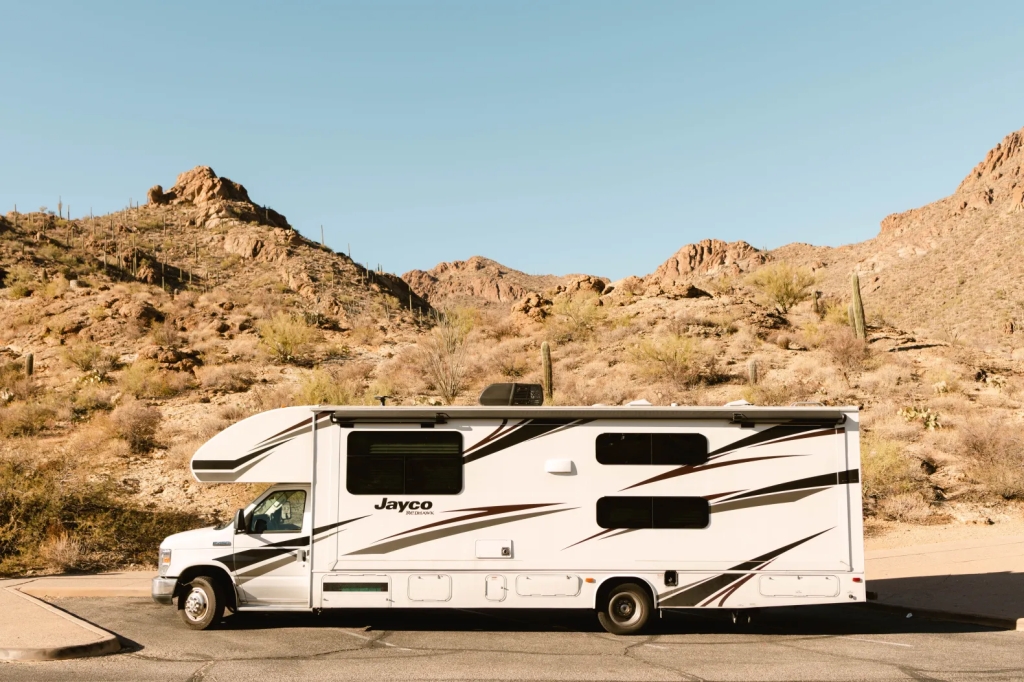
Well, we think Chan stayed in a 43-foot fifth-wheel. His article led off with a photograph of a Jayco Class C (above), which is neither a fifth-wheel nor 43 feet long. He then wrote about having his “motorhome” delivered to the resort, in the next breath describing how Al “was quick to walk us through the trailer settings.” The article wasn’t long enough to throw in truck campers, Class Bs or pop-ups as additional points of confusion, but be forewarned about reading any Chan reviews of automobiles, athletic equipment or electronic gear—it’s all pretty much a blur of undifferentiated products to him.

So why would RVIA highlight this particular piece of froth? Perhaps because Chan’s money graph focused on one of RVIA’s current obsessions, the upcoming travel season and why RVs ostensibly are the most economical way for families to vacation. Indeed, the same RVIA “News and Insights” includes a lengthy nod to the association’s ongoing fiction that “family RV travel to some of the country’s top vacation spots costs an average of 60% less than traditional travel methods.” Although that claim is based on a deeply flawed “study” that I dissected last year, RVIA continues to trumpet its findings as gospel—and is equally ready to repeat even the most sophomoric accounts that seem to bolster its assertion.

In Chan’s money graph, that comes with his observation that “If you’re staying in a hotel, those days and nights can add up, but the average rental price on RVshare.com is only about $150 a night.” Besides the imprecision of that comparison (“add up” to how much?), a “luxe, 43-foot fifth wheel” is going to be on the high end of whatever range produces a $150 average. Apples and oranges. Then there’s the unstated costs of having your RV delivered and set up, as well as site rates that at Coachella Lakes start at $120 a night. That’s not to say it’s not all worth it, but Chan’s lack of transparency about these (and possibly other) costs simply plays into RVIA’s hollow narrative.

RVing can still be a relatively affordable way to travel and vacation, although it’s taking a lot more work than was needed even five years ago. But that’s not going to happen by using 43-foot fifth-wheels (or motorcoaches or whatever) or five-star resorts as points of reference, and any comparisons to other travel options can be highly problematic. RVIA’s readiness to embrace so shallow a piece of reporting as the Rolling Stone story to bolster its claims of affordability, alas, smacks either of carelessness or desperation.

It’s the little things, rubbing you the wrong way, that eventually become a pus-filled blister.
Need RV repairs? Be prepared to wait!

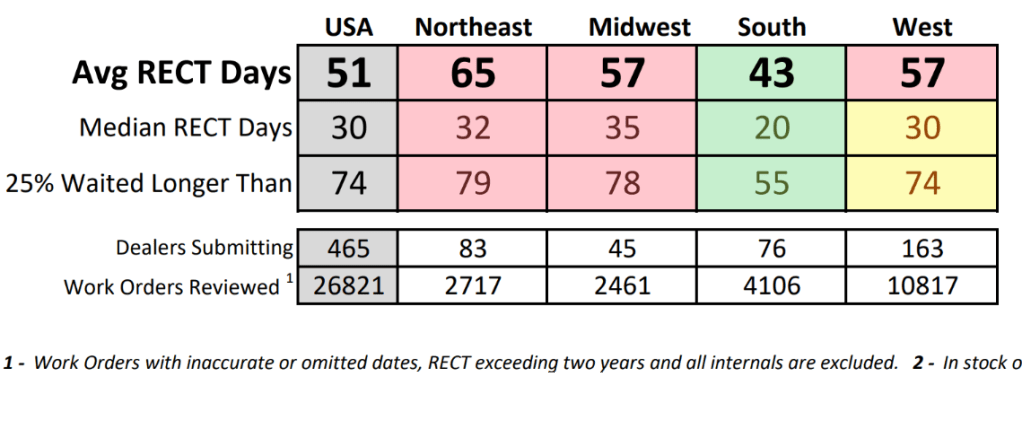
RECT is an acronym for Repair Event Cycle Time—the time from the start date of an RV repair order to its completion. Note that RECTs that took longer than two years (!) are not included.

Last summer I reported on a possible silver lining to the grey cloud of plunging RV sales: the decline in high-margin sales meant dealers had more incentive to beef up their servicing efforts. Complaints about months-long waits to get even basic repairs had been exploding, thanks in part to shoddy workmanship and substandard parts as manufacturers rushed product out the door—then dragged their heels on approving warranty repairs. Add a resulting shortage of replacement parts, and the completely predictable result was an average wait time last May of 34 days for non-warranty work—but 50 days for warranty repairs.

And if even one part was out of stock? That national average jumped to 73 days for non-warranty work, 89 days for warranty repairs.

Crazy, right? But that was actually an improvement over December 2022, when the national repair time had averaged 53 days, and the wait time for both warranty and out-of-stock repairs had nudged down a bit. Not a huge change overall, true, but moving in the right direction and with every reasonable expectation that the improvement would continue.

But that was then, and this is now. The average national repair time this past December shot back up, to 51 days—and if you’re unlucky enough to be in the northeast, that average was 65 days. In May, 25% of all customers had to wait longer than 33 days for their repairs to be completed; in December, that wait time for the unlucky 25% had more than doubled, to 74 days. The national average wait of 50 days for warranty repairs in May had jumped to 67 days in December, and to a whopping 90 days in the northeast. Meanwhile, the percentage of repairs that languished because parts were out of stock jumped to 33% in December from 21% in May, extending those repairs by another week.

It wasn’t supposed to be like this. The number of RVs cranked out by manufacturers last year was roughly half that of 2022, which one might think would mean more time for quality control on production lines. Lower production and the repair of pandemic-disrupted supply lines should have replenished parts stocks, not squeezed them further. And after several years of pumping money into its technical institute, the RV Industry Association was boasting in December of having the largest number of certified techs in the RV industry’s history.

So where’s the bottleneck?

A good question, and one the industry hasn’t yet acknowledged, much less answered. To be sure, some of the numbers above may be attributable to seasonal variations, if inexplicably so: repair times seem to peak in December and January, then gradually decline through the spring and summer before bottoming out around October. Still, the latest peaks are significantly higher than those of a year ago, so progress this ain’t. The only thing certain is that RV owners who need repairs are still twisting in the wind, their expensive and frequently highly leveraged adult toys sitting on a dealer’s lot somewhere for months on end.


The data above, utilized by the RV Dealers Association for the benefit of its members, is extracted from much more extensive research conducted by a systems software company called Integrated Dealer Systems. Number nerds who would like to explore that information more thoroughly can go deeper here. 

As ’23 winds down, so does the party

Easing into various seasonal celebrations, and from there into year’s end, various RV industry representatives have been spewing predictions for 2024 that are short on context and long on wishful thinking and data cherry-picking. Call it the holiday effect, an irresistible compulsion to make things merry by spiking the statistical punch, morning-after hangover be damned.

Consider, for example, the glowing news announced at KOA’s recent annual convention by CEO Toby O’Rourke that the franchise behemoth had crossed the $500 million mark in annual revenues, up 36% since 2019. Receiving considerably less emphasis was the news that camper nights in 2023 were actually down 4.8%, and up only 5% over 2019, an increase initially notched by a pandemic-driven camping explosion that now seems to be waning. Revenues going up even as camper nights decline can be explained only by higher rates—and, indeed, escalating fees may explain in part why camper nights are down. Camping is getting just too damn expensive.

Indeed, the annual Generational Camping Report, released by RMS North America last week, found that “price is still a driving factor in campground destination decisions,” with a third of respondents “selecting the cost of reservation as their top concern.” Contrasted with O’Rourke’s ambition to increase camper nights by 2% next year, even as she projects a further 5% annual growth in revenue, that concern appears to be a circle that can’t be squared.

Or consider the persistently upbeat outlook propagated by the folks who build RVs. In one trade show after another this fall, dealers and manufacturers conceded that yes, traffic was down—“attendance might not have broken any records,” “traffic was clearly off somewhat”—but that they were optimistic about 2024 and beyond. Precisely why was never made clear, but it might have something to do with an industry penchant for pulling numbers out of the air. On Sept. 1 of last year, for example, the RV Industry Association was forecasting wholesale shipments in 2023 of 419,000; as of Dec. 6, that had slipped only a bit, to 391,499. Today it looks unlikely that even 290,000 RVs will roll out the door in 2023—but that hasn’t prevented RVIA’s statistical geniuses from calling for a rebound to 369,700 units in 2024. Why? Well, why not?

There are a few—a very few—voices calling out this forecasting malpractice. Industry consultant John Spader, for example, has observed that as of June 30, the average North American RV dealer’s debt to equity ratio had ballooned from .97:1 in 2021 to 1.73:1 in 2022 to 3.64:1 in 2023. As he notes, the debt-to-equity ratio is “arguably the most important measure of a dealer’s financial health” and its ability to manage debt. Most lenders want to see a ratio of 4.0:1 or less, so as this trend continues in the wrong direction, expect to see a growing number of RV dealerships going belly-up as they fall afoul of financing covenants. Disappearing dealerships don’t do much to increase sales

A more extensive—and bleak—analysis of this trend by Gregg Fore, whose industry-friendly credentials include induction into the RV/MH Hall of Fame, was published by RVBusiness a week ago. “Margins on sales have dropped, costs of nearly everything has risen, and maintaining safety in cash flow is more critical than ever,” he wrote. “Some dealers will see the handwriting on the wall and close voluntarily rather than lose their entire personal asset base. Others will be forced to do the same as cash flow reaches critical levels.”

RV park promoters and investors tend to be cavalier about such developments, claiming that with so many millions of RVs already cluttering the landscape, a constriction in the supply pipeline will be immaterial to campground owners. But RV parks are part of a larger ecosystem; when any part of it is diminished, the greater whole will feel the effects. Or as Fore also points out, fewer RV outlets will result in a higher percentage of larger dealers, “meaning the consumer will be forced to work harder to make a purchase and to get service (emphasis added).” In other words, owning an RV is going to become more expensive and more of a headache than it already has been.

The same economic forces that are crippling the RV industry are battering the camping public as well, with predictable results. Persistently high interest rates, two overseas wars, the ongoing threat of a federal government shutdown and a polarized, fractious political climate have soured consumer sentiment, which now has fallen for four consecutive months. Consumer spending has followed suit, dipping 0.1% in October, just ahead of the holiday season and the first decline since March. With two-thirds of Americans saying their household expenses have risen over the last year but only one in four saying their income has increased in the same period, it’s perhaps predictable that credit card debt is shooting up and retirement accounts are being ravaged through hardship withdrawals.

None of that adds up to a rosy outlook for next year—at the very least, it’s going to challenge the airy notion, advanced by some (I’m looking at you, Frank Rolfe), that the RV park industry is somehow immune to the economic forces that affect everyone else. Yes, people who already own RVs will want to use them—but not if they can’t afford ever-higher site fees, or if they can’t get their RVs serviced at a reasonable price within a reasonable time frame. Not if they can’t keep up with the outsized payments on their over-leveraged RV loans and have to unload their white elephants. Not if a tightening job market slowly makes that “work from anywhere except the office” lifestyle ever more fanciful.

The party was fun while it lasted, but they’re taking away the punchbowl and tomorrow you’ll wish they’d done so sooner.

PMRVs: the tail that wags the RV dog

PMRV, for the uninitiated, means “park model recreational vehicles,” which is a nonsensical word salad. Consider, for example, that the La Plata County, Col. building code defines park model RVs as “a special subset of recreational vehicles that are constructed for the purpose of permanent placement in a park or a residential site.” (Why cite a Colorado county code to make a point? More on that in a moment.) The point here is that “vehicles,” defined as “things that transport goods or people,” ipso facto become non-vehicles as soon as they are in “permanent placement.”

Still, the obvious fiction that park models really are just RVs persists, thanks to vociferous industry lobbying. An interview in the current issue of Woodall’s Campground Magazine with Dick Grymonprez, who’s retiring as the longtime director of park model sales for Skyline Champion, has him triumphantly acknowledging that the RV Industry Association—on whose board he served for a decade—was in the forefront of rebuffing federal efforts to regulate park model designs and construction. “A few years ago, the Department of Housing and Urban Development was trying to say that park model RV manufacturers were advertising and selling the units as housing,” he recalled dismissively, without disputing the claim.

Park models were a cash-cow not easily relinquished, so it’s not surprising that the industry pushed back vigorously. But after defeating HUD’s efforts, it also did nothing to dispel the notion that park models are so much more than an RV. “I think a lot of people that buy park models are buying them for a second home or vacation home”—or more, Grymonprez added, with a “what are ya’ gonna do?” shrug of his metaphorical shoulders. “If you think about it, a person’s going to live wherever they want to live. The RV business doesn’t want to admit this, but there are people that live in RVs year-round, full-time. There are people that live in park models year-round.”

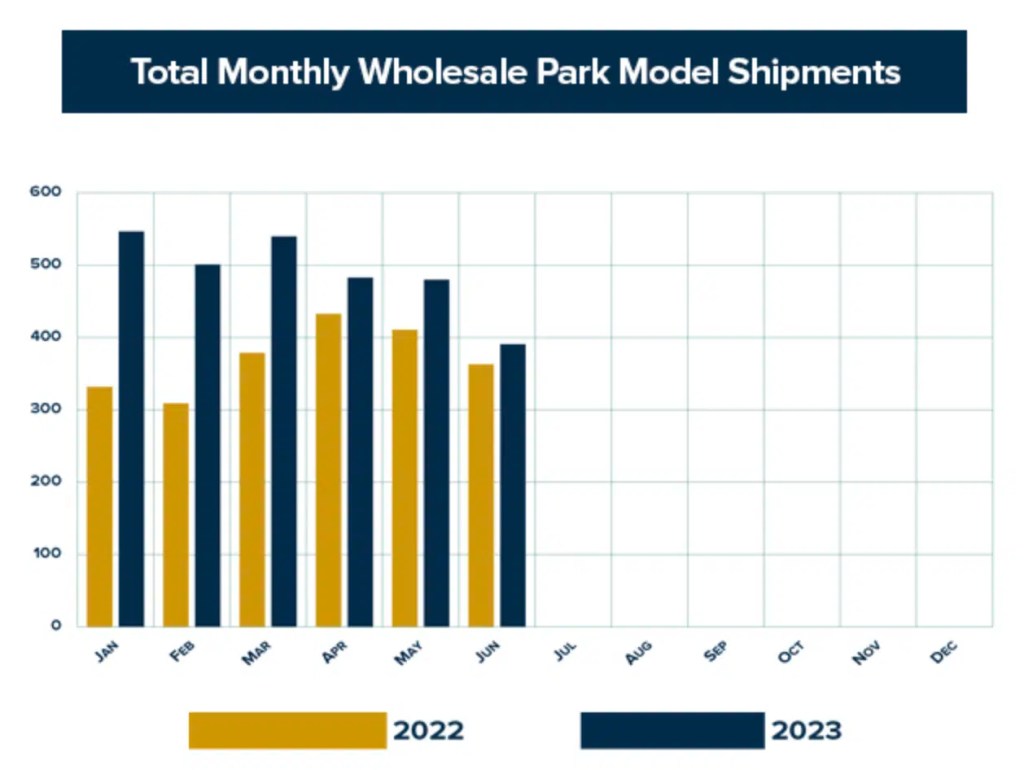
In some ways, this is old news; what’s more recent is the blasé attitude by industry leaders toward the possibility of serious challenges to the housing hybrid they’ve created. And why not? At a time when RV shipments across the board are plunging by 40% to 50% over year-earlier numbers, RV park models—as seen in the bar chart above—are the stunning exception. Month after month, park model shipments have strengthened over last year and are up 32.1% for the year through the end of June. And while total park model numbers are a fraction of overall RV shipments, they’re also significantly pricier pound-for-pound than their rolling counterparts and have seen the greatest price appreciation over the past few years.

(They’re also increasingly boxier. While limited to no more than 400 square feet [500 in Florida] by HUD standards, all but a handful of this year’s shipments have been more than 8.5 feet wide—the maximum width permitted for real RVs and tiny homes on wheeled chassis. Of the 2,942 park models shipped the first six months of this year, 2,921 were too wide to be wheeled down a highway without a special permit.)

Just how costly these putative “RVs” can become is suggested by an email I received last week from a reader who wants to build his own winter ski chalet at a resort in Colorado. In 2017 he purchased a 20′ by 102′ lot in a private gated campground for $19,000, with the thought of eventually putting a park model on the site. After grading and leveling, installing retaining walls, upgrading to 100-amp electrical service and installing a heated hydrant 12 feet deep, he figures his property value is now $135,000. But in the interim, park model prices increased so much that “what was 50k for a custom model is now in excess of 100k for a cookie-cutter standard model,” making him wonder whether it’s all worth it.

Spending upwards of $200,000 for 400 square feet on a sliver of land no wider than can fit a standard automobile cross-wise isn’t how I would spend that kind of money, assuming I had it to spend. Then again, I’m not a skier. On the other hand, this kind of housing development, disguised as a resort community, is becoming ever more common, and it makes its inroads by maintaining the fiction that 12- and 14-foot-wide park models are just RVs and therefore should be admitted wherever the rolling variety is allowed.

In La Plata County, as referenced at the top of this post and as I’ve written before, Scott Roberts, an Arizona-based developer, has advanced his plans to build the so-called Durango Village Camp on the banks of the Animas River. When first presented to local residents and planners last December, the proposal foresaw creation of a 306-site RV park that would include an initial 42 or maybe 49 park models, with more to be added in some indefinite future. According to Roberts’s business model, the park models would eventually be sold—perhaps for as much as $450,000, as they currently are at some of his other properties. Still, regardless of how much that may look like a housing development, Roberts argues that Durango Village Camp “most closely resembles an RV park,” and that’s one of the allowed uses on the property as currently zoned.

But that was then, and this is now. Earlier this month, the final Village Camp paperwork was filed with La Plata County—and in the intervening eight months the proposal’s make-up has changed considerably. Instead of the 306 sites Roberts initially proposed, Village Camp would have only 277—but of those, fewer than half would be RV sites. The balance would include 54 undefined “RV cabin sites” as well as 86 park models, or roughly double the initial number. The narrative laying all this out helpfully observes that the park models “are technically RVs, but their fit and finish is similar to an upscale hotel room with beds, a kitchenette, a bathroom and living room.”

Whether this would be an appropriate use for the property in question is best resolved by the people of Durango. But their job would be much simpler if the whole process were more honest and the evidence of our senses was accepted over industry word-play and obfuscation: a park model is no more a recreational vehicle than a mobile home is mobile. They’re both fixed dwellings, separated by an arbitrary dividing line based on square footage. Nor does it help that zoning regulations all over the country—not just in La Plata County—are years behind the times in recognizing changes in the definitions of camping, campgrounds, RV parks and, now, glamping.

Most recent posts

Whistling past the RV sales graveyard

Heading into the Memorial Day weekend, camping industry cheerleaders were cranking out comparisons and forecasts to support their contention that the industry’s best days still lie ahead. But coming on the heels of some truly astonishing declines in factory shipments of new RVs, the chorus had a distinctly plaintive tone.

RV shipments for the first four months of the year were notably grim, down 52.1% compared to the same period last year—and down even more sharply for towables (which include travel trailers, fifth-wheels, pop-ups and truck campers), down 55.8%. Motorhomes (types A, B and C), meanwhile, were down a mere 14.9%, but the motorhome segment is less than one-fifth that of towables. Forecasts for the rest of the year have been revised steadily downward each month, with expectations now that 2023 will be the worst year for RV production in more than a decade.

Industry leaders have attempted to brush away this news with the assertion that 2023 was bound to show a decline after the pandemic-driven bumper-crop years of 2021 and 2022, and there’s certainly some truth to that. It’s the magnitude of the plunge that accounts for the barely concealed jitters, however—how many businesses can withstand half of their business evaporating in a year?—with no reasonable way to discern whether we’re in the throes of a minor correction or whether this is a deeper secular trend. But industry attempts at reassuring investors and customers have produced some near-comical contortions.

For example, Winnebago Industries, one of the biggest RV manufacturers, issued a cheery consumer survey this week that was long on insinuation but short on details to make a tenuous case that RV interest remains healthy. “Winnebago Survey Shows Growing Outdoor Activity,” its press release proclaimed, fudging the distinction between RVing and “outdoor activities,” such as hiking, cycling and boating. By the time the release got around to its ostensible subject, in a section subtitled “The Summer of RV Travel,” it was to present such carefully worded observations as “almost two-thirds of respondents have considered [emphasis added] using an RV for a vacation rather than traveling by plane,” and “over two-thirds of respondents have considered [emphasis added] using an RV for travel instead of a flight, hotel and rental car.”

Well, that’s reassuring—but what did those respondents actually do? Your guess is as good as any, but it’s clear that the airlines are not feeling any heat from RVs or other modes of transportation. As just reported by the Transportation Security Administration, its agents nationally screened 9.8 million passengers over the Memorial Day weekend, or 300,000 more than in the pre-pandemic year of 2019.

The idea that RVing is a cheap alternative to flying or driving on vacation nevertheless has captivated the industry, resulting in some highly questionable cost comparisons. The RV Industry Association, for example, reported May 18 that “an outside, independent firm has found that RV vacations cost much less than other types of vacation travel, even when factoring in fuel prices and the cost of RV ownership.” Aside from the problematic issues that come with any apples-to-oranges comparisons (what kind of RV compared to what kind of air fare or car rental plus what types of hotel accommodations? etc.), the lack of a publicly defined “cost of RV ownership” makes the analysis meaningless. For instance, is that the cost of an RV purchased outright, or one with a 10- or 15-year loan? With how much down and at what interest rate?

(One detailed example, from the several that were included in the RVIA-backed study: the costs for a family of four traveling from Dallas, TX to the Grand Canyon for a 14-day vacation would be $8,801 if the family took a plane, rented a car and stayed in hotels, according to the study, contrasted with an equivalent Class C motorhome vacation expense of just $5,627. But Go RV Rentals apparently occupies a different reality. Its unrelated press release this month (touting the economics of RV rentals) calculated that using a Class C motorhome for 20 days costs $911 per day “when you factor in the total cost of ownership”—or $12,754 for 14 days, more than double RVIA’s rosier assessment. As with the RVIA study, no explanation here of what comprises the costs of RV ownership.

(Meanwhile, want to rent rather than own? Go RV Rentals says that same Class C goes for an average base rate of $217 per day, plus as much as an additional 50% for insurance, service charges, optional equipment and sales tax. That’s $4,557 for the Dallas-Grand Canyon trip—before gas, any excess mileage charges and campground fees. Throw those in and you’ll certainly exceed the RVIA’s estimated $5,627.)

The argument that RVing is an economical way to vacation works only if such a vehicle gets deposited in your driveway for free and it never suffers any mechanical issues. And with the pandemic essentially a non-issue for most Americans, the ability to travel and cocoon in a personal bubble is no longer the enticement it was the past three years. Add to that the shrinking number of American workers who remain able to work remotely, and all of a sudden the main reason to go RVing reverts to what it was before all the craziness started: to go camping!

But is that enough?

Interestingly enough, that very question—with a perhaps predictable answer, after an initial tease— was posed by Toby O’Rourke, president and CEO of KOA, at the 2023 RV Industry Power Breakfast in Elkhart on May 11. “For the past couple of years, when I’ve been asked about all these new people camping, I have always said there is going to be a natural drop-off,” she told an industry audience of more than a thousand. “Camping is not going to be for everybody.” Indeed, she noted, 32% of people who went on an RV trip for the first time said the experience was good or great—raising the question, what was less than okay for the other 68%?

But while O’Rourke used to think that camping isn’t for everyone, now “I really don’t accept that anymore and I don’t think you should, either.” Although she didn’t explain what led her to change her mind, O’Rourke said she now believes those unimpressed campers are simply in need of special attention. They’re a marketing and education challenge, blocked from a full-throated embrace of the joys of camping by a number of “pain points” that the industry must address if it wants to keep growing. “Here’s the problem as I see it: the reality is that camping is an easy choice, but it’s not always easy,” O’Rourke told her audience. “If we don’t smooth over these pain points, we are at risk of losing those 70% of people that are lukewarm about continuing to camp.”

Or maybe O’Rourke had it right the first time: camping isn’t for everyone, not because of “pain points” but because nothing is for everyone. That’s not what the industry wants to hear, of course. Much better to believe that it’s just a matter of better messaging, of becoming more customer obsessed. Desperate times call for desperation.

Most recent posts

IndyStar blasts RV industry big-time

Kate Mercer photo

Okay, class. Today we have a pop quiz–but don’t panic! There’s only one question, and the answer is multiple-choice, so you have at least a 25% chance of getting it right:

What do you get when an industry pressures an inadequately staffed and poorly-trained workforce into increasing output by almost 50%?

a) A lot of shoddy product.

b) A lot of sick and injured workers.

c) Record industry profits.

d) All of the above.

If you answered d), congratulations! You’ve just described Elkhart, Indiana, which is to recreational vehicles what Detroit once was to automobiles. Four out of every five RVs in the U.S. roll out of Elkhart, an area dominated by three major players the way Detroit was once dominated by Ford, Chrysler and GM: Thor Industries, Forest River and Winnebago Industries. Unlike Detroit, however, Elkhart is union-free in a so-called “right-to-work” state. And unlike Detroit in past decades, Elkhart has been ravaged by the Covid-19 coronavirus.

The result, as documented October 19 by the Indianapolis Star in a damning 15,000-word, four-part, multi-media series, is an industry riddled with broken bodies and a record number of recalled RVs, even as the major manufacturers all have been posting unsurpassed revenues and profit margins. Covid drove an unexpected surge in demand for RVs, much of it from first-time buyers who were looking for a safe way to travel. But Covid also decimated the ranks of RV factory workers, even as they were being pushed to increase production by almost 50%.

Two results were inevitable. One was a volley of Covid-19 complaints to the underfunded, undermanned and industry-friendly Indiana Occupational Safety and Health Administration, which responded not with inspections but with requests to employers to submit documents “proving” they were following Covid-19 safety protocols. Indeed, IOSHA’s response was so perfunctory that it physically inspected only 44 of more than 6,000 Covid-related complaints state-wide–the worst inspection rate in the U.S.–including just two in Elkhart County, neither involving major RV makers. The county eventually recorded nearly 700 Covid deaths.

But as the Star also found, problems in the RV plants had been brewing long before the epidemic, which the virus only exacerbated. “Workers told Indy Star about injuries from lax safety rules and the fast pace, drug use, unfair pay structures, a disciplinary system that punishes workers for taking sick time, a lack of training, and quality issues with products that leave factories,” the Star reported. “Several RV workers said they and others inside the factories needed daily uppers such as energy drinks, Ritalin or Adderall–even methamphetamine–to keep up with the pace.”

The other predictable result was that as the work pace picked up–one Winnebago employee said he went from working on 16 RVs a day to 36 during the pandemic–the products coming off the line were increasingly substandard. Ron Burdge, an Ohio attorney who has been suing RV manufacturers for years over defective products, told the Star that RV quality had been declining for at least 15 years prior to the pandemic, but took a nosedive once it hit. Record-setting recall numbers bear him out. Companies owned by Thor Industries recalled more than 156,000 RVs this year alone, while Forest River–a subsidiary of Berkshire Hathaway–recalled nearly 200,000 and Winnebago Industries recalled more than 125,000.

“All are among the highest for each company in the last five years,” the Star reported. “Among the problems that led to recalls: gas leaks, various electrical issues, increased propane pressure and poorly installed awnings.” One example it offered of the life-threatening dangers unwitting RV buyers have been accepting: an Oregon family that purchased a 40-foot Heartland Road Warrior for more than $100,000, only to have it burst into flame in Montana on the return trip home, totaling it and the tow vehicle. The cause appears to have been faulty wiring in the fifth-wheel’s electrical panel, yet as the Star observed, RV workers don’t need a license or certification to do electrical work.

Industry response to the Star’s findings, grim as they are, thus far consists either of stonewalling or of denying there is a problem in the first place. Thor Industries responded to the newspaper’s requests for comment by claiming the quality of its units had actually improved, even as it was making more of them, as evidenced by a lower level of warranty claims–without acknowledging not just this year’s 156,000 recalls, but the 371,384 recalls it had in 2021. Forest River, meanwhile, didn’t respond at all to the Star’s requests for comment, while Winnebago declined to answer the newspaper’s questions about quality issues.

The industry overall seems to be hoping the Star’s blockbuster series will sink out of sight. RV PRO, an online site “for the RV professional,” ran a terse and nonspecific news item about the series on the day it was published, much of it devoted to quoting an equally nonspecific response from the RV Industry Association, the trade association for RV manufacturers. Lamenting that it had been answering the Star’s questions for nearly a year, “emphasizing the high priority the RV industry places on workplace safety and the safety of our products,” the RVIA insisted that “protecting the safety of these valued employees is of paramount importance to our industry.”

RVIA’s own website, however, has none of that. Indeed, at this writing, the RVIA website makes no mention at all of the IndyStar story and its withering critique.

Putting an ironic frosting on the cake, so to speak, it must be noted that Winnebago Industries held a previously scheduled earnings call at 10 a.m. October 19, even as the Star’s report was being published online. Business was gangbusters, financial investors and analysts were told: fourth-quarter net revenues were up 14%, year over year, for a gross profit of $210.4 million. Net revenues for the year were $5 billion, for a record gross margin of 18.7%.

No questions were asked–and no information was given–about workforce or production issues. Chief financial officer Bryan Hughes, however, did offer the observation that “the company and our culture are successful because all our employees care deeply about our end customers, strategic business partners and each other.”

[The full Indianapolis Star series can be accessed here, but readers should note that virtually all of it is behind a paywall–non-subscribers will instead be shown a graphic novel that capsulizes some of the reporting, followed by an invitation to subscribe. The good news is that an introductory subscription can be had for just $1, with subsequent cancellation always an option.]

Most recent posts

Taking the ‘vehicle’ out of RVs

“RV” is shorthand for “recreational vehicle,” a point strongly emphasized by trade groups like the RV Industry Association–which represents RV manufacturers–any time someone begins confusing RVs with housing. Sure, a travel trailer or park model may look an awful lot like a single-wide house trailer, but they’re built to different standards and no one, for example, should expect to live year-round in an RV. “RV housing?” No such thing, regardless of what it might look like.

But once you’ve declared yourself to be either fish or fowl, you can end up in some pretty strange contortions trying to straddle the divide. Take the Recreation Vehicle Dealers Association, for example, which is embarrassing itself these days by claiming that the vehicles its members sell are, well, not just vehicles. Yes, the automobile industry sells vehicles, but those wheeled conveyances rolling down the nation’s highways are “standardized.” In the RV industry, on the other hand, “it is customary to prepare a vehicle before a customer is able to use the RV.”

See the difference? RVs are non-standard. They deserve non-standard regulatory treatment. Special treatment.

What’s got the RVDA all twisted up like that is a proposed new rule from the Federal Trade Commission that seeks to better protect consumers from being ripped off by unscrupulous dealers. Specifically, “the proposed rule would prohibit motor vehicle dealers from making certain misrepresentations in the course of selling, leasing or arranging financing for motor vehicles.” Any RV buyer who has found himself with a 20-year loan for a rolling box that will have a resale value approaching zero in half that time will applaud the sentiment.

While the RVDA may insist that a Class B Sprinter RV is nothing at all like a Sprinter cargo van, both can be subject to the same high pressure sales tactics that the FTC wants to clamp down on: vaguely explained additional charges, deceptive pricing, reams of paperwork that serve as a graveyard of land mines for the rushed buyer. If adopted, the new rule “would significantly alter the way motor vehicles are sold, marketed and financed in the U.S.,” the RVDA laments on its website, “by adding additional disclosures on pricing, vehicle add-ons and onerous new recordkeeping requirements.” The horror, the horror!

Curiously, the RVDA website also states that the association on Sept. 12 had filed formal comments “highly critical” of the proposed rule, asserting that the proposal would “increase sales transaction times for customers and add to the cost of the RVs.” But while the RVDA thereby poses as a champion of the little guy, the supposed filing is nowhere to be found on the FTC’s very comprehensive online repository of comments. Indeed, of the 26,356 comments the FTC had received as of today, apparently only one came from the RVDA: an Aug. 2 request that the FTC extend its Sept. 12 deadline for comments. The FTC declined.

Anyone around this industry for any amount of time knows there’s a huge need to rein in the flim-flam artists–which is not to say that every RV dealer is a con man, but that there’s no easy way to separate the white hats from the black. Government oversight would go a long way toward leveling the playing field, in an industry that is selling the second-most–and sometimes the most–expensive things most people will ever buy. Moreover, adoption of this rule or something quite like it might set the stage for the next glaringly obvious regulatory need: a crack-down on the industry’s deplorable track record on after-sale warranties and repairs, so that newly sold RVs don’t spend their first year in and out of service bays.

Meanwhile, fish or fowl? If RVIA wants to assert that RVs are not housing, while the RVDA is similarly adamant that they’re not vehicles–at least in the conventional sense–then maybe it’s time for a whole new classification with a whole new set of rules. Perhaps RVs are modern society’s chimera, a fire-breathing female monster with a lion’s head, a goat’s body, and a serpent’s tail. But even a chimera needs rules to live by, for the protection of the rest of us.

SEPT. 18 UPDATE: Turns out that the RVDA submission to the FTC, although dated Sept. 12, took four days to make it into the online databank. To learn more about it, see the post that follows this one, probably late Sept. 18.

Most recent posts

Manchin, scorpions do what they do

Just a bit more than five weeks ago, the RV Industry Association demonstrated either its hypocrisy or its gullibility by presenting its “National Legislative Award” to Senator Joe Manchin of West Virginia. The association justified this astonishing misstep by claiming that Manchin “recognizes that investments in outdoor recreation are vital to our economic, emotional and societal well-being,” those “investments” devoted largely to the “recreation” half of the “outdoor recreation” dyad.

The “outdoor” half? Not so much.

Indeed, as I posted June 10, Manchin arguably is the one person most directly responsible for torpedoing this country’s efforts to combat global warming and the calamitous climate change it is causing. That he would undermine any efforts at breaking our fealty to carbon-based energy sources is only to be expected, given the significant extent to which Manchin’s political and personal fortunes are tied to coal, gas and oil interests. No one playing with a scorpion should be surprised when it stings.

What is surprising is the cringe-inducing meekness with which the Democrats have tiptoed around Manchin’s constantly shifting rationale for being an obstructionist, avoiding confrontation for fear of giving offense, meekly giving up on one proposed initiative after another in a vain attempt to win an acquiescence that was never forthcoming.

Two days ago, Manchin abruptly made official what any objective observer would have concluded several months ago: he will not support any funding for climate or energy programs, nor support raising taxes on wealthy Americans and corporations to pay for such programs. As “explained” by a spokeswoman, “Senator Manchin believes it’s time for leaders to put political agendas aside, re-evaluate and adjust to the economic realities the country faces to avoid taking steps that add fuel to the inflation fire.”

Instead, thanks to a man who represents a state of 1.8 million people in a country of 320 million who overwhelmingly support climate change policies, we’ll continue adding real fuel to the fire in the sky.

Texas is baking in a record heat wave that incidentally is producing the worst smog pollution in at least a decade, which makes “outdoor recreation” an oxymoron. The entire western expanse of the country is a tinder box, producing not only a bumper crop of wildland fires but further depleting already record-low water supplies in a process called aridification, a/k/a drought on steroids. And it’s not just the U.S. Glaciers are collapsing in Italy and Kyrgyzstan, Britain has issued its first-ever heat red alert for this coming Monday and Tuesday, and wildfires are breaking out across southern Europe, forcing thousands to evacuate.

Dealing with a crisis of such proportions is not a “political agenda,” as Manchin’s spokeswoman would have it–it’s a matter of life and death. That a member of what’s mistakenly been called “the world’s greatest deliberative body” should ignore such a self-evident reality is tragic. That the RVIA and similar self-serving organizations would act as his cheerleaders is contemptible.

Most recent posts

RVIA honors the fox in the henhouse

Just in case anyone was wondering about the RV Industry Association’s priorities, all questions were dispelled yesterday, when it bestowed its “National Legislative Award” on Senator Joe Manchin of West Virginia. RVIA president Craig Kirby justified the trade group’s misfeasance by asserting that Manchin “recognizes that investments in outdoor recreation are vital to our economic, emotional and societal well-being” before adding, in an apparent non sequitur, that Manchin’s “home state sports stunning public lands that bring tourists from around the nation.”

While Manchin bears no responsibility for West Virginia’s stunning public lands, he very much shares responsibility for their ongoing degradation from coal mining. Despite being the chairman of the Senate Energy and Natural Resources Committee, Manchin continues to rake in the Senate’s largest campaign contributions from oil, gas and coal industries, and has a long history of serving their interests. He also has profited for decades from his stake in Enersystems, a supplier of “coal” to a highly polluting power plant near Fairmont, WV.

(Why the quotation marks around “coal”? Because the stuff Enersystems shovels into the Grant Town Power Plant is just one step above peat, a highly polluting mix of low grade coal, clay and rock contemptuously dismissed in the trade as “gob,” short for “garbage of bituminous.”)

But Manchin’s self-serving position in the Senate goes far, far beyond how he makes his money. It’s fair to say that no one person has done more to derail this country’s already fractious efforts at dealing with global warming than Manchin, who single-handedly blocked the Biden administration’s Build Back Better Act and its $550 billion in proposed climate spending, much of it to phase out fossil fuels over the next decade. Yet despite his glaring conflicts of interest, the West Virginian justified his obstructionism by claiming a higher purpose, insisting that the nation would be better off if climate legislation had bipartisan support–and so he, Joe Manchin, would turn his energies toward winning that Republican buy-in.

And so there matters stood–the Build Back Better Act in suspended animation–for weeks on end, as the rest of the Democratic party tip-toed around Manchin and Manchin supposedly showed them how this legislating thing is supposed to work. Hands across the aisle and all that, even though the GOP has long made it abundantly clear that the only hand it’s going to show has its middle finger extended. Then again, that wasn’t really the issue, anyway.

It therefore came as no surprise that yesterday–yes, the same day that RVIA gave Manchin its “National Legislative Award”–was also the day that the Washington Times reported that the so-called bipartisan talks were finished. Six weeks and no deal. The Democrats’ self-imposed Memorial Day deadline to get some action on Build Back Better come and gone, with nothing to show for it. The chair of the Senate Energy and Natural Resources Committee had run out the clock, and even though the Democrats are now scrambling for a renewed effort and hoping they can get something done by August 1, they still have not come up with a way to get around the obdurate gob man.

Don’t expect RVIA to weigh in on that issue, however. It’s just happy that Manchin has been supporting much-needed maintenance on public lands–you know, roads and campgrounds for the RVs its members are manufacturing. For RVIA, “outdoor recreation” starts and ends with the wheels. The carbon dioxide-laced air we breathe, the forest fires caused by global warming, the increasingly turbulent moisture-laden atmosphere that produces cataclysmic rains, the years of drought that have sucked the West dry–all the consequences of fossil fuel burning that Manchin continues to protect are for someone else to worry about.

“Economic, emotional and societal well-being”? RVIA, you’ve got to be kidding.

Most recent posts