Milking a hollow Senate hearing

The outdoor recreation industry’s ambivalence about climate change and what it means for business was on ample display this past Wednesday, when the Senate Budget Committee held a public hearing titled “Recreation at Risk: The Nature of Climate Costs.” Scarcely longer than an hour in duration and sparsely attended by less than a handful of its 19 committee members, the hearing featured five witnesses, only three of whom paid attention to its ostensible subject matter.

Those threadbare qualities did not, however, prevent the Outdoor Recreation Roundtable (ORR) from trumpeting the event as an example of how it’s fighting the good fight on behalf of the environment. In a press release headlined “Outdoor Industry Highlights Impacts of Climate Change,” faithfully reproduced by RVBusiness, the roundtable reported that its president, Jessica Wald Turner, “emphasized the economic implications of climate change on one of the world’s largest and fastest growing industries.”

“As we’ve heard today,” the release quoted Turner as saying, “climate change is increasingly impacting how people can recreate outside, and businesses of all types and all activities know the climate crisis needs to be addressed.”

All of which may be true—Turner may indeed have said as much—but it wasn’t before the committee. The roundtable didn’t have a seat at the hearing. Nor did any of the largest outdoor recreation industries or businesses that one might think would have the most at stake in a fraying environment: not OHI, representative of the “outdoor hospitality” segment, nor the RV Industry Association, nor any of the big RV manufacturers, like Thor or Winnebago. Instead, the “outdoor industry” was represented by Theresa McKenney, a director of NEMO, a family-owned camping gear manufacturer with 50 employees; a Montana-based fly-fishing guide and shop owner; and a 23-year-old Nordic skier.

All had compelling stories to relate about how a warming climate and increasingly violent weather have severely affected their businesses and outdoor passions, but they were no more “the outdoor industry” than any cluster of three or four words on this page tell the story I’m unfolding. Arrayed against them, meanwhile, were two suits and one smarmy Louisiana politician. And the first suit, Joao Gomes of the Wharton School of Economics, must have wandered into the wrong hearing, because all his remarks were about “the dangers of excessive U.S. debt,” which while compelling, never once touched on the hearing’s subject of outdoor recreation.

The smarmy politician? That would be the unfortunately named Sen. John Kennedy of Louisiana, who sidled into the hearing apparently for the sole purpose of rattling an earnest but still young world-class skier by demonstrating the latter’s jejune understanding of greenhouse gases and carbon economics. Were this a debating society, Kennedy would have won hands down. Were this a serious exploration of an existential issue in which Kennedy was seeking to expand his own understanding—but that’s a silly supposition. (Kennedy’s 7-minute assassination can be seen here, starting at around the 1:08 mark, after which he just as promptly exited the hearing.)

The second suit, meanwhile—Scott Walter, president of the Capital Research Center—opened by lamenting the lobbying efforts of outdoor apparel manufacturer Patagonia, as though that were somehow un-American. His expertise, he claimed, is “in political operations from groups that try to influence public policy while enjoying complicated funding streams enriched by billionaires. The phenomenon often appears in environmental debates, including with pressure groups that claim to represent outdoor recreation interests but often engage in merely partisan political battles.”

Not, of course, that there’s any money on the opposite side of environmental debates—or that there’s any unraveling of outdoor recreation interests from partisan politics.

But to give Walter his due, the second half of his remarks touched on the inherent contradiction within the positions staked out by those outdoor recreation interests—the same contradiction that explains why those interests had such thin representation at Wednesday’s hearing. It’s the same contradiction that explains why the ORR’s press release highlighted its support of the America’s Outdoor Recreation Act and the Expanding Public Lands Outdoor Recreation Experience Act, both of which are designed to increase use of public lands—but completely ignored the Inflation Reduction Act and efforts to modernize the Farm Bill, both intended to reduce greenhouse gases, and both explicitly endorsed by McKenney in her committee testimony.

Reducing greenhouse gases requires moving away from a carbon-based economy, which is why a Louisiana politician can’t stoop too low to shoot down the idea. And it’s why the ORR, whose members include motorcycle, power boat, snowmobile and off-road vehicle interests—and, yes, OHI and the RV Industry Association—censors any mention of the subject even while patting itself on the back for its advocacy for “healthy people, places and the planet.”

Walter, on the other hand, pointed out that such lobbying efforts “never mention some obvious, powerful threats to outdoor recreation” posed by those very same business interests. “For example,” he contended, “it is obvious that in the foreseeable future, outdoor recreation cannot flourish without the availability of inexpensive transportation for ordinary Americans. And that transportation will require fossil fuels for cars, trucks and planes, and support for the roads and parking needed for those cars and trucks. . . . The hostility of environmental extremist groups to forms of travel that most Americans now take for granted is intense.”

One doesn’t have to accept Walter’s questionable conclusion about requiring more fossil fuels—there are alternatives—to acknowledge his underlying observation: more people traveling to outdoor recreation destinations adds to the environmental burden. So do the people flooding outdoor spaces in their boats, all-terrain vehicles, RVs and snowmobiles. No wonder, then, that those who profit from selling, servicing, accommodating or otherwise feeding off the motorized exploitation of outdoor spaces stay silent about the environmental consequences of such activities—even as they seek to make them more widely available.

The upshot was a meaningless public hearing that a shameless ORR nevertheless presented as some kind of bold statement by outdoor interests that would just as soon not look too closely at their complicity in a worsening crisis. On that score, a comment by committee chair Sen. Sheldon Whitehouse during his opening remarks should be especially eye-opening: one-third of this country’s prodigious national debt, he averred, was created in response to climate emergencies. Without a change in how we do business, that proportion will just keep growing. Tick-tock.
The seal on your RV? Just a tax stamp

Buy a manufactured RV, and chances are that somewhere in a prominent location near the main entrance you’ll see a badge that looks much like the one at right—gold if it’s a motorhome, silver for travel trailers and fifth-wheels. Truck campers and folding campers, alas, are relegated to plain-vanilla white.

The badges, or seals, are your supposed assurance that the recreational vehicle you’ve just purchased meets certain quality and safety standards, but the truth is that they’re bought by the manufacturer even before a vehicle is built. No one has inspected your RV to determine that it complies with NFPA 1192. Such seals are aspirational statements by RV builders, self-certifying about something that may or may not be true—and as a chorus of voices has attested, that can be a hollow assurance indeed.

Put another way, the seals are little more than private-sector tax stamps, saying as little about the product to which they’re affixed as government tax stamps say about a pack of cigarettes. They’re not a legal requirement. RV manufacturers who aren’t members of RVIA—admittedly a rare breed—don’t have them. But they are a revenue generator for the Recreational Vehicle Industry Association, and as such the income they generate dwarfs all other RVIA revenue sources: of RVIA’s total 2023 revenues of $9.4 million, $5.3 million came from seal sales. Membership dues, the next highest revenue generator, brought in only $2.9 million, with the balance coming from events, sponsorships and other sources.

Here’s the problem with that: when RV production exploded in 2021, hitting more than 600,000 units, so did revenue from seal sales, hitting a record $13.4 million. And when RV sales tapered off, and then swooned, so did seal revenue, plummeting 60% over the next two years—even though spending remained largely unchanged. The bottom line is that RVIA’s total revenues last year, with seal sales still being the main income contributor, covered only 73% of the association’s $12.9 million in expenses.

Although that is a sizeable shortfall, RVIA President Craig Kirby opted not to highlight it in this past week’s annual message to members, stressing instead that he “can’t help but feel optimistic about the direction we are heading.” A financial report footnote, meanwhile, asserted that the association and its related parties “strategically planned for a material loss in 2023,” drawing on operating reserves accumulated in recent years to cover expenses. Those expenses, it’s worth noting, were reduced by only $171,285 year-over-year and were still $860,000 higher than they were two years ago.

Meanwhile, other financial storm clouds are forming. The “related parties” mentioned in the footnote include its promotional arm, GoRVing, which hasn’t covered its expenses in several years—and the hole is getting deeper. Much of GoRving’s revenues come from additional fees added by RVIA to its seal sales—a surcharge, if you will—that brought in $24.9 million in 2021, for example. Yet that same year GoRVing’s expenses outstripped revenues by $2.4 million, a gap that widened to $3.6 million in 2022 and to $9.3 million last year. All told, then, in just three years GoRVing has run up a deficit of $15.3 million, with no public explanation of how that hole is being filled.

And as with RVIA, GoRVing isn’t eager to indulge in belt-tightening: last year’s expenses of $26.9 million, while restrained in comparison with the $32.2 million expended the previous year, were just 1% lower than in 2021. Bottom line, GoRVing’s income covered only 65% of last year’s outgo, an even bigger shortfall than RVIA’s 73% deficit. How much longer can operating reserves make up the difference? RVIA isn’t saying, keeping those figures out of public view.

Kirby’s gamble, one assumes, is that RV production is going to bounce back in 2024, and with it the sale of RVIA seals and GoRVing surcharges. He could be right, although the 11.8% increase RVIA is currently projecting—to 350,000 shipments in 2024, up from 313,174 reported for 2023—is far from enough to cover the gaps. Moreover, even some of the industry’s most seasoned participants have warned that the storm clouds may persist right through the end of the year, and the current economic outlook is wobbly, at best. And as last year’s record of repeatedly downgraded production forecasts suggests, RVIA has a tendency toward overly rosy expectations.

So what’s the answer? Only the usual: raise taxes. Seals will cost more, the GoRVing surcharge will jump even more and RVIA membership dues will go up. RV buyers will pay a little more, but any question about the line charge on their invoice for an RVIA seal will be explained away as the cost of a good housekeeping assurance. And, of course, the lobbying on behalf of RV manufacturers will continue as always, funded by those gold and silver (and plain-vanilla white) stickers. That’s how the system works.

RVing shenanigans of the past year

No, this is not a glamping tent, no matter how much it looks like one. It’s an Airbnb rental, which means it sits not in a campground but on a residential site—along with 12 others in Minnesota.

The end of one year and the start of another frequently prompts retrospectives by those seeking closure or looking to demonstrate their cleverness. Sometimes it would be better if they didn’t.

This week, for example, the RV Industry Association breathlessly announced its “top 10 highlights from 2023!” and led off with its 2023 Vacation Cost Comparison Study. Released last April, this 125-page analysis “found” that “RV vacations cost much less than other types of vacation travel, even when factoring in fuel prices and the cost of RV ownership.” “Found”— rather than “established” or “determined”—was an apt choice of verbs, given its overtone of accidental discovery.

Indeed, as I wrote here and here, the “comparison study” suffered from several analytical errors and oversights, leading me to conclude that “the argument that RVing is an economical way to vacation works only if such a vehicle gets deposited in your driveway for free and it never suffers any mechanical issues.” But at least RVIA was touting its cost-benefit analysis in an understandable if flawed attempt to bolster sagging RV sales, which despite such efforts continued their plunge right through the end of the year. There’s less excuse, however, for RVIA to continue promoting such questionable claims today, even if in the guise of a top-ten list of the past year. That’s like the White Star Line citing the April 2 completion of RMS Titanic as one of its highlights of 1912.

Perhaps RVIA leadership is just too lazy or too innumerate to engage in a bit of critical thinking about its output. As much can’t be said for the outright grifters that the campground industry has attracted the past couple of years, few of whom can claim ignorance of the scams they’re peddling. Take Travis John, for example. As I wrote last January, John was looking to raise $8 million from 10,000 or so investors so he—and they—could buy a campground. The sales pitch included a lot of trendy jargon about non-fungible tokens and how John’s company, Campers DAO, would use “latest blockchain technology and an innovative business model to turn a membership into an NFT asset.”

Apparently that innovative business model didn’t find a lot of buyers. And, of course, the whole airy-fairy world of cryptocurrencies and non-fungible anything began wavering, culminating in the November conviction of Sam Bankman-Fried. But by then John had already retreated to a hidey hole somewhere, announcing in April an indefinite delay of the Campers DAO launch while it went about “building more value.” Not a peep out of him since.

Meanwhile, the unbelievable promise of a full year of luxury RV camping for just $3,100 a year has proven to be just that, as two of the four partners in the Whispering Oaks Luxury RV Park in Arkansas filed suit in December against the other two. The aggrieved partners averred that it is “no longer reasonably practical to carry on” the business, not least because, they allege, Brian and Stacy Sides misappropriated business assets for personal gain, bounced checks and otherwise acted in ways that “damage and destroy the business.”

How shocking was that? It shouldn’t have been. As I wrote in April (what’s with this April thing?), Sides already had a record that included defrauding three Joplin, Missouri women out of a combined $29,000 for work he never performed. But when a local reporter earlier this year asked him about the incident, he responded with the classically moronic “there is another guy that done that” riposte. It goes without saying that not a shovelful of dirt has been turned at the luxury RV park site, its website has vanished, and so has the entrance billboard.

Other fantastical campground deals announced last year remain to be played out, including a luxury (aren’t they all, these days?) RV park in Danville, VA proposed by developer Joe Cubas, whose other bright idea is to make that town a Virginia version of Sturgis, SD. And, of course, there’s the grand design by failed Florida real estate developer Ricky Trinidad to build a “white glove” RV resort in Pennsylvania covered by a massive, transparent air dome. Local politicians in both municipalities have been tripping over each other in their eagerness to welcome these so-called revitalization projects, so one can only hope a brisk winter will shock some sense into them.

The seductive—if empty— promise of a financial bonanza for the locals is often enough to mute the critics when someone proposes a multimillion tourist development, but several notable exceptions were notched in 2023. Among them was the victorious campaign in Saugerties, NY against a proposed KOA glampground under the Terramor name plate, and the less heralded deep-sixing of a $30 million luxury (yes, again) campground proposed for New Hope, Tennessee. While the Saugerties battle featured a relatively media-savvy grassroots movement in a relatively economically resilient area, New Hope is “a wide spot on two-lane Route 156 that has one Dollar General, two beauty shops and a meat processing business,” as I wrote in, yes, April. But in July, after a bit of local agitation and a petition drive, the developer backed out.

Local resistance isn’t always effective, though, if an RV resort developer has exceptionally deep pockets and the locals are slow to cotton on to what’s happening. That’s been the story in Midway, Kentucky, where town fathers initially welcomed and then belatedly backpedaled from a monster project known as the Kentucky Bluegrass Experience Resort, projected to become one of the ten largest RV resorts in the eastern U.S. When the full scope of the proposal—and how it would impact the local community—finally sank in, Midway’s city council tried to block the project by refusing to extend municipal water and sewer to the site.

That was more than two years ago, but despite the lack of subsequent headlines, the developers didn’t just go away. Instead they played the long game, culminating in October in approval of an ordinance allowing RV parks to operate private sewer plants. Such private plants had been banned a couple of decades ago, after several local mobile home parks had private systems that failed, spilling raw sewage into local waterways. But history doesn’t repeat—does it?

Finally, one more example of perseverance against local opposition deserves spotlighting. Christine Wyrobek, told by her local planning commission in May (not April!) that she could not build a glampground on her 45 acres abutting Lake Vermilion, Minnesota, went ahead and did so, anyway. She’s just not describing it as a campground. As she explained to a Star Tribune reporter in September, her 13 campsites “fall securely within the county ordinance allowing short-term rentals for fewer than 180 days on residential property—which also allows for VRBO and Airbnb rentals.” And so glampground out, Airbnb rentals in.

Just when you thought all possible blurring of the lines about “camping” had been achieved. . . .

RV cost-analysis devil’s in the details

In recent months, as RV sales fell off a cliff and the industry scrambled for any suggestion that things aren’t quite as bad as they appear, an especially tenuous claim has been advanced that RVing is actually cheaper than other forms of vacation travel. Yes, RVs may be gas guzzlers, and yes, RV parks are charging more than ever for even basic sites. But given that RVs also provide shelter and cooking facilities, they emerge as clear winners when compared with flying and renting a car at a vacation destination, renting a hotel room, eating all meals in a restaurant, yada, yada.

All of which may be true as far as it goes, and even more so the more people you can load into an RV. But it doesn’t go far enough. As I wrote on Memorial Day weekend, in response to a report making such claims from the RV Industry Association, “the  argument that RVing is an economical way to vacation works only if such a vehicle gets deposited in your driveway for free and it never suffers any mechanical issues.”

One immediately obvious problem with the RVIA’s study, conducted by an outfit called CBRE Hotels Advisory, was that the operating costs it cited for various RV classes were seriously out of step with those reported by Go RV Rentals, which issued a contemporaneous study attempting to show the cost advantage of renting an RV vs. owning one. But the big unknown in both reports was the $64,000 question (almost literally) of what it actually costs to own an RV. How much overhead is there to owning an RV that the airline-flying, hotel-booking vacationer doesn’t have to shoulder?

A second potential problem with the RVIA study was how it had calculated RV purchase costs—or, more specifically, what it would cost to finance an RV at a time of high interest rates. As I wrote on the July 4 weekend,  the RV Dealers Association had reported that the average RV sold in May went for $51,896, with most of that amount financed over 16 years at a 9.61% interest rate. Those are huge numbers. What were the chances that CBRE Hotels Advisory was using anything close to being comparable?

As it turns out, none at all.

Now that I’ve seen the entire 125-page analysis, it’s clear that the old saw about the devil being in the details was coined with this study in mind. To start with the second point first, although the study is titled “The 2023 Vacation Cost Comparison,” the financing figures it uses are several years out of date and therefore applicable only to RVs bought before the pandemic. For example, the study assumes that a new travel trailer was financed over 10 years at a 5.49% interest rate, that a new Class B was financed over 12 years at a 4.69% interest rate and that a new Class A motorhome was financed over 20 years at a 4.49% rate. Nice numbers—if you already have them, but not anything you got this year, last year or in 2021.

But financing is only a piece of the overall cost of ownership, to which has to be added the initial cost of the RV and from which—as CBRE notes—can be subtracted the tax-deductible cost of interest, just as with second-home mortgages. For reasons it never explains, however, CBRE completely ignores the costs of maintenance and upkeep, which are not insignificant and arguably much higher for a vehicle than for a second home. Moreover, the study computes a hinky “weighted average” for what it misleadingly calls the “total cost of ownership,” by separately calculating costs for new RVs and for used ones, then combining the two, with 36.2% of the total based on new ownership and 63.8% on used ownership. In other words, your results not only may but definitely will vary, unless you somehow land one of those mythical part new, part used RVs.

Yet here’s the real curve ball CBRE throws into the mix: even before getting to the bottom line, the study assumes that every RV will be sold after seven years—and therefore that the true cost of ownership can be reduced by the anticipated “residual value” of the RV at time of sale. So, for example, a new Class B that was purchased for $93,000 will have an expected residual value in seven years of $55,800, which means its cost to you (before accounting for interest) is just $37,200. Mix in the fantastical financing costs and the weighted-average methodology and assume 25 days of use a year, and before you know it you’ve reduced your per-day cost of Class B ownership to just $197 (or of Class C ownership to $233, to cite another example).

It’s entirely understandable why RVIA would try to buck up the troops with claims of a supposed RV cost advantage, what with RV shipments continuing their relentless slide—down 49.2% through the end of June compared to last year. But it’s a bogus, or at least meaningless, juxtaposition. As the numbers above illustrate, the comparison is between hard and fast numbers on the non-RV side—the price of a plane ticket, hotel room and car rental that you can reserve today—and the assumptions and weighted averages applied to a hypothetical family that owns a hybrid new-used RV that never needs repairs. And while it may make some abstract accounting sense to discount today’s costs by future residual value, that kind of math is meaningful only for businesses, not for a family of four trying to figure out how to budget a trip to the Grand Canyon.

RVIA, alas, has waded into the weeds on this one.

Most recent posts

For RVIA, fed regs bad, fed $$ good

While temperature spikes get most of the press, it’s the steady rise in background temperature, graphed here, that sets the stage—and the prognosis is not good.

The news is chockablock these days with weather-related alarms, most—flooding in the Northeast aside—having to do with extreme heat: Phoenix breaking all records for consecutive days above 110 degrees, China setting an all-time high of 126, Iran winning top honors by hitting a heat index of 152 (!!). Given that the normal body temp is 98.6 and that brain damage will occur at 108, it’s clear that human survival increasingly is at stake.

So what are we to make of the continued ostrich-like posture of the RV Industry Association?

Even as the heat numbers hit new highs, the RVIA issued two press releases in the past week that a) suggest it exists in a parallel universe, in which there’s nothing to be concerned about; and b) that it’s not above trying to have its cake and eat it, too. The first, dated July 13, reported the association’s “comments” on new emissions standards being proposed by the Environmental Protection Agency because, you know, global warming; the second, dated July 18, conveyed its thoughts about the need for pull-through EV chargers because, you know, global warming.

Notably, neither press release mentions global warming, or even the more anodyne “climate change.” The closest either gets to acknowledging that there is anything environmentally amiss is to give a nod to “greenhouse gases” in the comments on emissions standards, but when it comes to EV chargers, even that goes unmentioned. Indeed, the EV release makes not even the slightest attempt to explain why such chargers have become topical—it’s as though we’re simply seeing a change in drive-train fashions. Hemlines go up, and hemlines go down. Internal combustion engines are in, and then they’re out. So it goes.

Regarding the proposed emissions standards, the RVIA correctly notes that the new regulations will, if adopted, “increase the cost of engines in both motorhomes and tow vehicles.” And really, what else do we need to know? Higher internal combustion engine costs “will severely limit the use and affordability of motorhomes,” which “will severely hurt motor home manufacturers, dealers, their employees, and their families.” And switching to electric drives wouldn’t be much better, because “the batteries would take up space that is otherwise necessary for housing the various elements of a motorhome.” Indeed, the batteries’ extra weight would leave RVs “no longer capable of being equipped with the components typically found in a motorhome.”

In other words, RVIA doesn’t think attempts to limit greenhouse gases are a good idea. Nor does it think that battery technology is a viable alternative—or it didn’t until July 18, when its second press release made the case “for federal funding to be used to install pull-through electric vehicle charging stations to meet the needs of RVers today and well into the future.” Federal regulation, bad. Federal dollars? That’s another story.

At stake, as the RVIA took pains to point out, is $5 billion for the states to install DC fast-chargers and an additional $2.5 billion for cities, counties, local governments and tribes to establish community charging hubs. RVIA wants to make sure that RVers aren’t overlooked. “Our team has been working to ensure that RVs are not left behind during the transition to electric vehicles,” the release quoted Jason Rano, RVIA’s vice president of government affairs. “This is a once-in-a-generation opportunity to deploy EV charging nationwide.”

The July 18 release included a link to an 8-page report and financial analysis, much of it focused on electric trucks pulling RV trailers and on electrified RV trailers, both of which are better served by pull-through sites than by more conventional head-in charging stations. But the report also avers that motorized RVs will be hitting the road as soon as next year, with Class Bs leading the way, followed by Class Cs and Class As—the ones that can’t be electrified without losing “the various elements of a motorhome”—starting in 2026.

Sometimes the left hand really doesn’t know what the right hand is doing. Or saying. Meanwhile, it bears noting that the EPA’s proposed new emissions standards wouldn’t start being phased in until 2027 and then over the subsequent five years.

It’s not unusual, of course, for a trade association to reflexively oppose any government regulation affecting its members, and especially so if it’s going to cost them money. Then again, these are not usual times. The economy is littered with industries that opposed necessary regulations—coal mining comes most prominently to mind—by claiming that such changes would create too much economic hardship. The changes came nonetheless, if not by government intervention then via more ruthless marketplace discipline, and the resulting economic pain was all the deeper and more extensive because its victims were less prepared than they would have been otherwise.

RVIA’s members would be better served if their trade association acknowledged that the old ways are unsustainable—that new emissions standards are being proposed because alarm bells are ringing about the air being on fire. Instead of reflexively opposing attempts to put out the conflagration, RVIA should take a leadership position and ask the question it has so far avoided: what can we do to sustain the RV industry in a rapidly deteriorating environment whose demise our products currently are hastening?

Most recent posts

March madness, campground-style

There’s a different sort of March madness that has nothing to do with basketball: it’s the annual flood of numbers and statistics for the previous year, compiled from various year-end reports and surveys. Some are revealing, some are of dubious value and some hint at truths that may unfold over the next year or so. Almost all get trotted out on behalf of one agenda or another, and all are enough to make anyone’s head spin.

One of the most questionable bits of accounting has to do with the size and economic impact of the outdoor recreation industry. A malleable business segment whose definition will vary from one person to another, it generally eschews any kind of government involvement—until there are tax dollars to be dispensed, at which time various PR engines kick into high gear to extol the importance of outdoor spending to the overall economy, to the health of the planet and to the wellbeing of all Americans. And so as the Outdoor Recreation Act lurches toward Congressional adoption, supporters have been underscoring its importance by claiming that outdoor recreation contributes a whopping $862 billion to the U.S. economy and therefore is not to be taken lightly. The RV Industry Association has chimed in by claiming that its piece of the action has been $140 billion, and of that, $35.7 billion is attributed to RV parks and campgrounds.

Yowza! $140 billion from RVing? Almost $36 billion from RV parks and campgrounds? Sounds impressive as hell—until you realize that the International Dairy Foods Association claims the dairy industry had an economic impact of $753 billion in 2021, or 3.5% of that year’s U.S. gross domestic product. Just for cow juice. Meanwhile, the bottled water industry says it expects its revenues to reach $95 billion this year, a bit more than the $91.4 billion in projected spending this year for beauty and personal care products, and even the justifiably maligned tobacco industry has U.S. sales of more than $100 billion a year. Those 11- and 12-digit numbers start adding up pretty fast, and as you slice and dice the economy into its various products and services, you soon realize that their combined “contributions” to the overall economy are larger than the whole. Since that’s mathematically impossible, could it be that each group of industry promoters has been just a wee bit fast and loose with definitions and numbers?

Realistic or not, though, industry representatives by their very nature will portray their businesses as economically important, growing and vital. In that regard it’s instructive to look at RVIA’s recently released survey profiling last year’s new RV buyers. A key finding: the new buyers are unquestionably younger than in past years, with 65% categorized as millennials and only 3% as boomers. With a median age of 32 and a median household income of $80,900, last year’s buyers were buying RVs priced at an average of $92,415—suggesting either that this is a generation with unexpected wealth or one that is willing, because of its youth, to take on some lengthy financing. The latter seems more likely, but either way, RVIA is intent on letting us know that this is a growth industry with a bright future and not just some fuddy-duddy backwater.

But there are other considerations. While the RVIA survey reports that almost a third of the new buyers expect to be camping at privately owned RV parks, a national survey released yesterday by the National Association of RV Parks and Campgrounds suggests those parks may not be as roomy as needed. Although 48% of campground owners had projected they would add a total of 81,000 new RV sites nationwide in 2022, the actual number was closer to 17,000. Moreover, fewer RV parks anticipate adding new sites this year—only 28%, for a projected increase of 44,000 sites—so given recent history, it’s fair to assume that the actual inventory increase may well be less than 10,000. That won’t go far in relieving the increased demand.

Meanwhile, although ARVC’s study is reasonably helpful in its national overview, its sample size is too small to draw definitive conclusions about various parts of the country—which is a shame, because the numbers it does have hint at significant regional differences. Overall, the study suggests that the campground industry is considerably stronger in the 12-state southern region than in the 13 states west of the 100th meridian, including a larger percentage overall of corporate-owned and franchised operations—and therefore deeper pockets— in the south than elsewhere. It therefore may not be surprising that only 18% of western campgrounds added sites last year, compared to 31%-32% in the rest of the country; this coming year, 50% of southern campgrounds plan to add sites, compared to just 10% in the west.

As mentioned, the sample sizes for each region (66 campgrounds in the west, 71 in the south) are too small to be more than suggestive. But they are in line with another set of regional differences: while only 9% of southern campground owners expect to sell their RV parks this year, that percentage doubles for the western operations. That could mean one in five western RV parks will change hands in 2023, making an an already turbulent industry even more so. On the other hand, a lot of those campground owners may have missed their best window and may end up changing their plans. According to an interview in the April edition of Woodall’s Campground Magazine, RV park prices have fallen from 10% to 30% in the past year, due not only to market conditions but to year-over-year revenue declines.

“Generally, the high interest rates are raising cap rates marginally, which is decreasing the overall value of properties,” Jesse Pine, a broker at NAI Outdoor Hospitality Brokers, told the magazine. “Also, 2021 was a banner year for most owners and in 2022 parks were down 5%-10% in gross income commonly across the country, [which] coupled with higher expenses like rising utility, labor and construction costs, [means] the result was lower than expected net income.”

Up, down, sideways—you can probably cobble together whatever scenario you find most pleasing from all the numbers getting slung around. The only thing certain is that being in the campground business these days means one helluva wild ride.

Most recent posts

More electrifying news for RVers

A pair of webinars this past week, one hosted by the RV Industry Association and one by the National Association of RV Parks and Campgrounds, underscored how seriously the campground world views the oncoming onslaught of electric vehicles. While campground and RV owners remain mostly skeptical, questioning the costs, range, recharging availability and environmental impact of a lithium-based technology, industry leaders are unwavering in their belief that the EV-RV revolution is already here and that the problems others see are either overblown or will be resolved in timely fashion.

“We are really at an inflection point which is amazing,” Ashis Bhattacharya, senior vice president for development and advanced technology at Winnebago Industries, told his RVIA audience. A “wave of electric adoption” is already washing over rental car agencies, delivery services such as Prime, UPS and FedEx, as well as school buses and other municipal vehicle fleets, all of which is normalizing the technology. The paradigmatic shift already underway, Bhattacharya added, is as significant as any ever experienced in the transportation sector.

Meanwhile, said Jay Landers, RVIA’s vice president of government affairs, state initiatives to outlaw internal combustion engines are giving the entire EV sector a kick in the pants. Five states, including California, already have voted to ban sales of new internal combustion vehicles by 2035, and others are looking to possibly follow suit. The state of Washington, which had the country’s sixth highest rate of RV shipments this year, is even more aggressive, adopting a 2030 cutoff deadline. Furthermore, expansion of the EV charging network nationwide is being super-charged by $5 billion in federal funding approved earlier this year.

None of which, all speakers agreed, is to minimize the problems confronting EV in general, and EV-RVs in particular. “The (EV) technology is still more expensive than what it’s replacing,” conceded MacKay Featherstone, Thor Industries’ senior vice president of global innovation. Moreover, he added, “the charging experience is utterly critical” and still inadequate for RVers in particular, both because most RVs need pull-through charging stations to be practical and because they have larger power needs than EV cars.

To their credit, RV manufacturers, frequently criticized for shoveling out hundreds of thousands of RVs without giving a thought to where their buyers might use them, are at least trying to get out in front of this development. And there is little reason to doubt that a society-wide change is coming, and coming hard. EV-RV costs inevitably will come down as sales take off, as they do with any emerging technology. Alternatives to lithium batteries, using less exotic minerals, are being developed, and advances in recycling technologies will further ease environmental concerns. Similarly, ongoing improvements in battery density will continue to expand vehicle range, relieving one of the biggest consumer anxieties about EVs.

The weak link, however, appears to be the RV park and campground end of the product chain. The RVIA webinar inadvertently made that point when its campground representative on the panel—Toby O’Rourke, president and CEO of KOA—was so unintelligible that she had to be dropped from the screen, apparently because she was trying to link in from an airport. (And why O’Rourke, again? Is there no other campground industry representative who can speak to the industry’s issues? Maybe someone from the Yogi franchise, or ARVC, or one of the other large state RV park associations, like Texas or California?)

Subbing in for O’Rourke was Brandi Simpson, her chief of staff, whose faltering contribution was to assert that campground owners are dealing with “a ton of misinformation” about EVs and need a lot of education and guidance. Which, presumably, KOA is scrambling to provide. . .

. . . as is ARVC, which lustily beat the drum on behalf of EV-RVs at its national conference in early November, and again at an hour-long webinar a couple of days after RVIA’s face-to-face. Pitched as “a recap of the best” of the conference for those who might have been unable to attend, the session inexplicably ignored the most contentious convention issue—a proposal to adopt industry-wide “standards”—while devoting the majority of its time to further promoting the idea that campgrounds need to get on the EV bandwagon, starting with the installation of EV chargers.

All of which is undeniably true, but far more nuanced and with many more questions than have been answered to date. For example: both webinars referenced possible tax breaks and federal grants to defray campground costs for installing chargers, while glossing over the reality that such inducements will require making the chargers accessible to the general public, and not just campground guests. Getting equally short shrift were any explanations of the occasionally mentioned “partnerships” that campgrounds might have to accept, whether with public utilities or third-party providers, to deal with licensing and infrastructure issues, since electric sales are typically a utility monopoly and EV chargers require robust additional power supplies.

(On a related note: one of the biggest frustrations for many KOA franchisees has been the parent company’s insistence on taking a 10% cut of all site fees—including any electric charges, even though campgrounds are legally prohibited from making a profit from reselling electricity. To the extent that EVs will increase electricity consumption at RV sites, that means even more unearned money transferred from franchisees to corporate headquarters.)

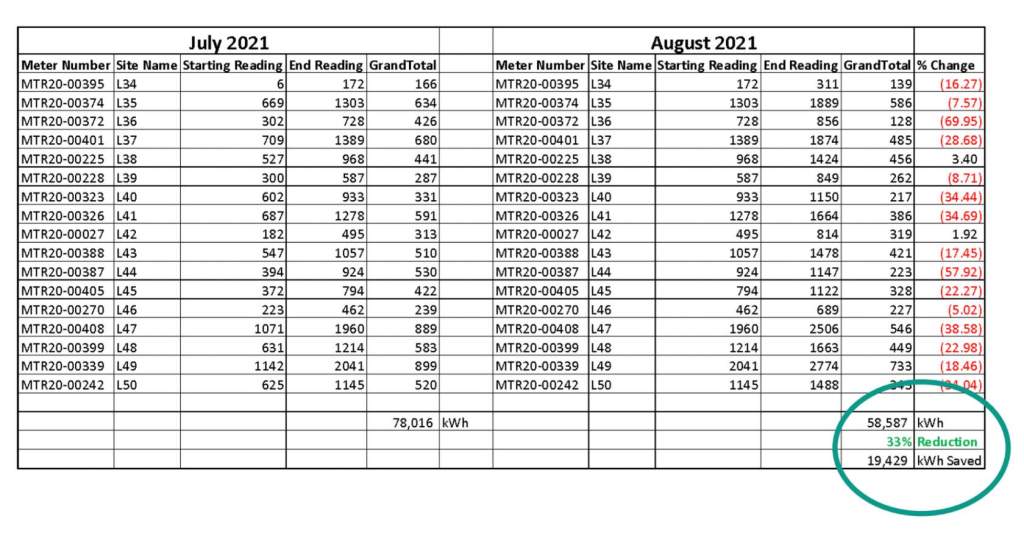
By ARVC’s calculations, electric metering of RV sites can reduce energy consumption by a third.

Indeed, the whole issue of who is going to pay for the extra electricity consumed by EV-RVs, and how, is still being sidestepped at the national level, quite possibly because there is no one answer. That, by itself, may become the biggest impediment to mom-and-pop campgrounds rushing into this brave new world. It’s notable, for example, that while ARVC now has an online “EV Toolkit” to help its members understand how to accommodate the new technology, the only guidance it provides for covering their costs is the vague advice to “consider billing for shorter stays, especially [campers] with unique equipment (large class As, EVs, electric golf carts, etc.), automatically billing those campers for the electricity they use. “

Presumably these and other issues will get resolved, sooner or later—once the industry stops talking around them. The RVing public, meanwhile, should brace itself for still higher costs, as a new electric sensibility starts percolating through the camping universe. Just as computerized reservation systems have introduced demand pricing and all kinds of add-on fees, the electrification push ultimately will result in all RV sites getting electric meters. Or as ARVC’s EV Toolkit asks, in a prominently displayed screen, “You don’t give away ice, candy bars or firewood, why give away electric?”

Most recent posts

At last, numbers to confirm crowding

If you’ve been having a hard time finding a place to park your RV, it’s not your imagination. In what may be the first comprehensive effort to inventory the nation’s supply of campgrounds and camp sites, the RV Industry Association today released a survey in which the number one finding–ta-da!–is that campgrounds during peak season are basically full.

No surprise, right? Yet while the study’s conclusions are unremarkable, what’s interesting are their underlying data and the fact that it’s taken this long to assemble them. KOA, The Dyrt and others have been taking the pulse of campground demand, and ARVC periodically samples the universe of private campgrounds, but an overall understanding of the supply side of the equation has been so primitive that the industry hasn’t been able to agree on even how many privately owned campgrounds there are. (CHM Government Services, the Massachusetts-based consulting firm that did the RVIA’s legwork, cited four sources that had a 40% spread in campground census numbers.)

CHM eventually settled on 12,290 private campgrounds, of which 12,118 have RV sites. Those campgrounds, it further concluded, have 1.4 million RV sites, yielding an average of 116 each. Yet apparently more than a third of the private RV sites can be considered “primitive,” since only 63% have water and electric hookups; roughly half (51%) also have sewer connections.

Public campgrounds, meanwhile–comprising federal, state, county and municipal facilities–outnumber their private counterparts, at 15,119, but because on average they’re significantly smaller, have a total of only 607,014 camp sites. More to the point, fewer than half of the public camp sites–264,861–can accommodate RVs, and of those, only 30% have water hookups and a mere 8% have sewer connections. That latter statistic is especially telling at federal campgrounds, among which just 11.3% have dump stations.

Smushing all those numbers together and contrasting them with camper demand in 2020, the RVIA report concludes that overall campground occupancy during the summer was 76%, and 54% for the year overall. Keeping in mind that these occupancy figures are an aggregate that doesn’t distinguish between weekends and mid-week, summer and winter (for the annual rate) or by region, that suggests that yes, RVers overall would have had a helluva time finding a camping spot–and even more so if they needed utilities, especially sewer hookups.

The space crunch, according to Margaret Bailey, CHM’s project manager for the survey, has been a significant factor behind the recent explosion of boondocking. Dispersed camping, she said, “is partly a choice but partly a default” because of a lack of alternatives. And while some significant amount of funding has recently been devoted to public campgrounds, that money “is going to fix what’s broken” and not to expansion. Any growth in RV sites, she added, “has to come on the private side.”

An RVIA spokesman said he hoped the report will further encourage investors to view campgrounds as more than just a niche market. Campgrounds, he noted, are just another segment of the hospitality industry, comparable to hotels. Indeed, one of the study’s more telling observations is that the national hotel industry had a peak season occupancy of approximately 70% and annual occupancy of 66% in 2019, the most recent year of normal operating conditions.

In other words, you stand a better chance of booking a hotel room this summer than of landing an RV park reservation.

Most recent posts

Cognitive dissonance, part 2

The article in Woodall’s Campground Management that I mentioned in my previous post, regarding efforts by California campgrounds to “stay on top of” the wildfire situation, includes an interesting aside that underscores why we seem incapable of making any headway against extreme weather-driven calamities.

Interviewing Dyana Kelly, president of the CampCalNOW RV Park and Campground Alliance, the article notes that a “recent win” for the trade group was an exemption from a state rule that would have required Class A diesel pushers to participate in an annual emissions inspection and maintenance program. First unveiled this past March, the rule drew an instant and sharp response not only from CampCalNOW, but also from ARVC and RVIA, two national trade groups that declared their mission was to “protect the public” from “overly burdensome” regulations on motorhomes.

The new regs, which remain applicable to commercial truckers, create a smog-check program to ensure that diesel engines in the state have properly functioning emissions controls. Improper control systems, it should go without saying, add to the atmosphere’s greenhouse gases, which further increase global warming and thus exacerbate California’s drought and the wildfires it promotes. In other words, a campground industry that idealizes the environment for recreation is simultaneously doing its damnedest to block efforts to protect that environment from its own depredations.

There’s no question that California’s motorhome owners would have been somewhat inconvenienced by having to trundle off to an emissions inspection station once a year. And there’s also no question that some of those owners would have been hit with the financial costs of repairing or upgrading equipment that failed the smog test. But keeping any equipment in working order is the cost of ownership, and that cost should be borne by the actual owner, not by the broader public–which is what unchecked polluters are imposing. “Protecting the public” should mean all of the public, not just the motorhome-owning portion of it.

Instead of knee-jerk opposition to any regulatory attempt to control the external costs of private actions, the campground industry’s lobbyists and trade groups would do everyone a service by acknowledging reality and working toward alternatives. In Europe, for instance, which is hard at work on eliminating all diesel engines, the RV industry is years ahead of the U.S. in moving to alternative power sources. German-based Erwin Hymer Group, as one example, is developing not just electric motorhomes, but travel trailers–powered in part by roof-top solar panels–with electrified axles that reduce the amount of power needed by tow vehicles. How cool is that? And how not American. . . .

Ironically, Erwin Hymer was acquired by Thor Industries a couple of years ago, which might lead one to think such cutting-edge technology would quickly show up on this side of the Atlantic. Guess again. Apparently, it’s easier simply to lobby for the status quo, regardless of the greater social cost that entails, and celebrate successful obstruction of change as a “win.”