
It’s the little things.
The RV Industry Association regularly cranks out an email blast, called “News and Insights,” in which it promotes various aspects of the RVing business—upcoming lobbying efforts, various new products or services, RVing research of one kind or another. It also provides summaries and links to other sources that have said or written something to its liking, such as today’s suggestion that readers “take a look” at a recent Rolling Stone article, “From Road trips to Staycations, Here’s Why RVshare Is Our Go-To for Festival Camping.”
Wow. So this is why Rolling Stone has tumbled into obscurity.
It’s pretty clear that Tim Chan, who wrote this puff piece, found himself a nifty way to score a posh free stay while attending the Stagecoach music festival, held in April near the Coachella Lakes RV Resort. But you’d think that he’d at least do a little homework before cranking out such a thinly disguised advertorial. Instead, he liberally stroked RVshare, which presumably arranged and paid for his digs; gave a quick shout-out to “Al,” who not only provided the RV but also delivered it from Temecula, set it up, and then packed it up when Chan was done jamming out to Post Malone and Miranda Lambert; and repeatedly assured his readers how swanky RVs have become.
“That image of a run-down trailer with creaking parts and dusty furniture?” he wrote. “Consider that a relic of the past, and RVshare [stroke, stroke] a leader in the future of travel.”
Well, yeah—if what you’re staying in is “a luxe, 43-foot fifth wheel camper,” with electric fireplace, massage chairs and a master bathroom with his-and-her sinks. Or as Chan also raved, “While RVs often (unfairly) have a reputation of being pedestrian and basic, this was glamping at its finest, and we were spoiled with more space and amenities that [sic] we could have imagined.” Which is like staying at the Palms Casino Resort in Las Vegas and concluding that Motel 6-type accommodations are so ‘Fifties.
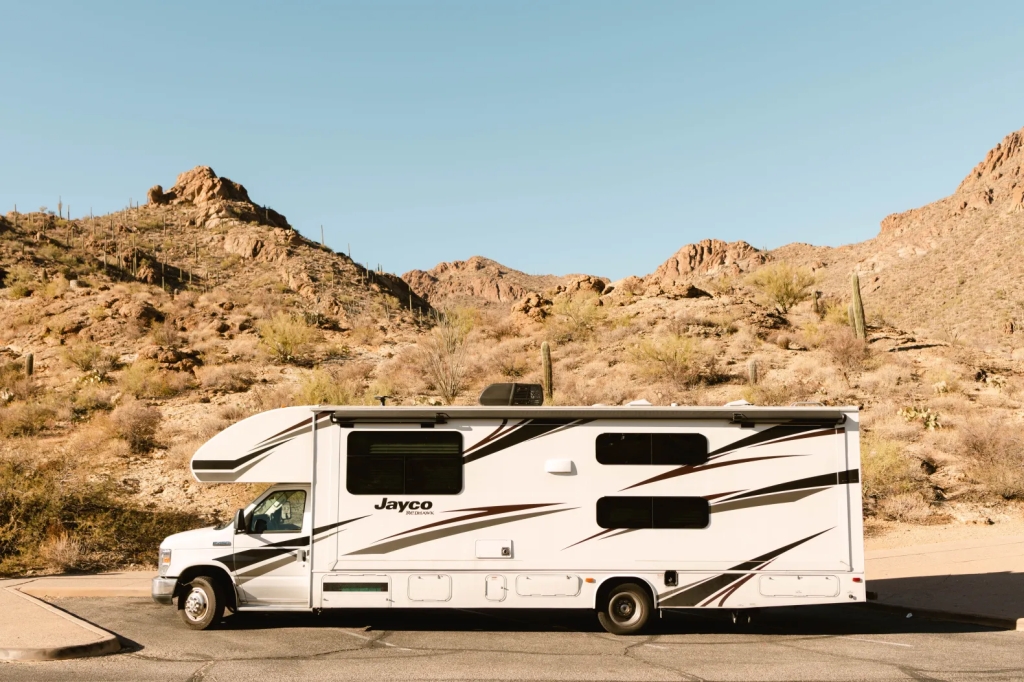
Well, we think Chan stayed in a 43-foot fifth-wheel. His article led off with a photograph of a Jayco Class C (above), which is neither a fifth-wheel nor 43 feet long. He then wrote about having his “motorhome” delivered to the resort, in the next breath describing how Al “was quick to walk us through the trailer settings.” The article wasn’t long enough to throw in truck campers, Class Bs or pop-ups as additional points of confusion, but be forewarned about reading any Chan reviews of automobiles, athletic equipment or electronic gear—it’s all pretty much a blur of undifferentiated products to him.
So why would RVIA highlight this particular piece of froth? Perhaps because Chan’s money graph focused on one of RVIA’s current obsessions, the upcoming travel season and why RVs ostensibly are the most economical way for families to vacation. Indeed, the same RVIA “News and Insights” includes a lengthy nod to the association’s ongoing fiction that “family RV travel to some of the country’s top vacation spots costs an average of 60% less than traditional travel methods.” Although that claim is based on a deeply flawed “study” that I dissected last year, RVIA continues to trumpet its findings as gospel—and is equally ready to repeat even the most sophomoric accounts that seem to bolster its assertion.
In Chan’s money graph, that comes with his observation that “If you’re staying in a hotel, those days and nights can add up, but the average rental price on RVshare.com is only about $150 a night.” Besides the imprecision of that comparison (“add up” to how much?), a “luxe, 43-foot fifth wheel” is going to be on the high end of whatever range produces a $150 average. Apples and oranges. Then there’s the unstated costs of having your RV delivered and set up, as well as site rates that at Coachella Lakes start at $120 a night. That’s not to say it’s not all worth it, but Chan’s lack of transparency about these (and possibly other) costs simply plays into RVIA’s hollow narrative.
RVing can still be a relatively affordable way to travel and vacation, although it’s taking a lot more work than was needed even five years ago. But that’s not going to happen by using 43-foot fifth-wheels (or motorcoaches or whatever) or five-star resorts as points of reference, and any comparisons to other travel options can be highly problematic. RVIA’s readiness to embrace so shallow a piece of reporting as the Rolling Stone story to bolster its claims of affordability, alas, smacks either of carelessness or desperation.
It’s the little things, rubbing you the wrong way, that eventually become a pus-filled blister.
 Renting Dirt