
PMRVs: the tail that wags the RV dog

PMRV, for the uninitiated, means “park model recreational vehicles,” which is a nonsensical word salad. Consider, for example, that the La Plata County, Col. building code defines park model RVs as “a special subset of recreational vehicles that are constructed for the purpose of permanent placement in a park or a residential site.” (Why cite a Colorado county code to make a point? More on that in a moment.) The point here is that “vehicles,” defined as “things that transport goods or people,” ipso facto become non-vehicles as soon as they are in “permanent placement.”

Still, the obvious fiction that park models really are just RVs persists, thanks to vociferous industry lobbying. An interview in the current issue of Woodall’s Campground Magazine with Dick Grymonprez, who’s retiring as the longtime director of park model sales for Skyline Champion, has him triumphantly acknowledging that the RV Industry Association—on whose board he served for a decade—was in the forefront of rebuffing federal efforts to regulate park model designs and construction. “A few years ago, the Department of Housing and Urban Development was trying to say that park model RV manufacturers were advertising and selling the units as housing,” he recalled dismissively, without disputing the claim.

Park models were a cash-cow not easily relinquished, so it’s not surprising that the industry pushed back vigorously. But after defeating HUD’s efforts, it also did nothing to dispel the notion that park models are so much more than an RV. “I think a lot of people that buy park models are buying them for a second home or vacation home”—or more, Grymonprez added, with a “what are ya’ gonna do?” shrug of his metaphorical shoulders. “If you think about it, a person’s going to live wherever they want to live. The RV business doesn’t want to admit this, but there are people that live in RVs year-round, full-time. There are people that live in park models year-round.”

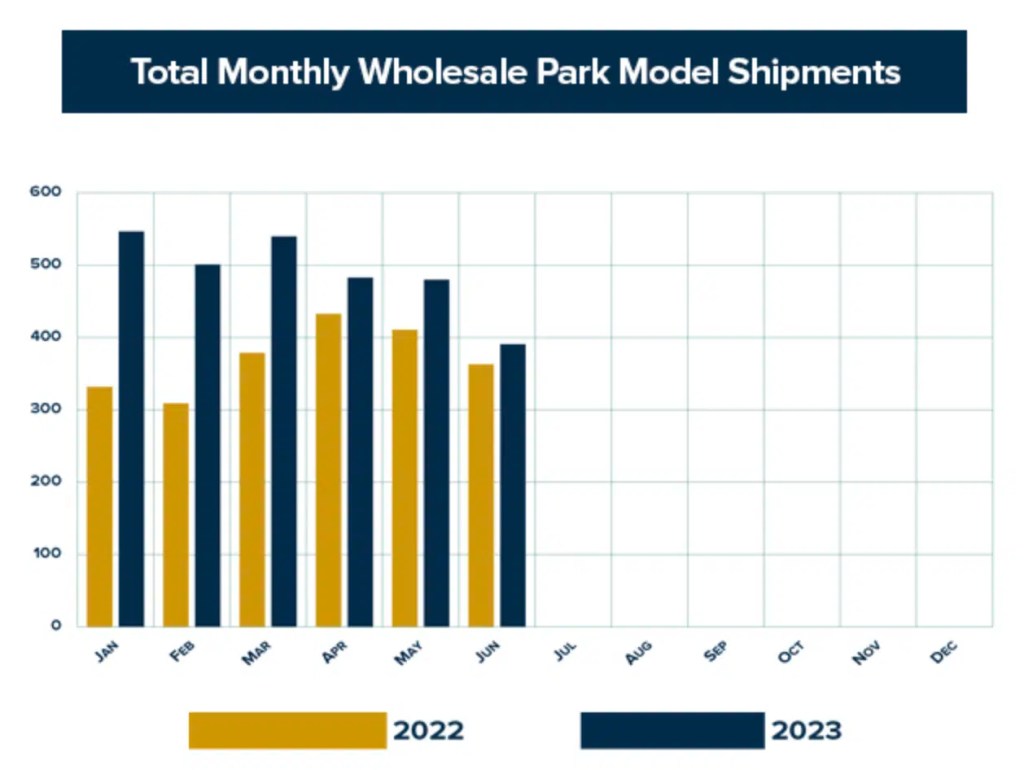
In some ways, this is old news; what’s more recent is the blasé attitude by industry leaders toward the possibility of serious challenges to the housing hybrid they’ve created. And why not? At a time when RV shipments across the board are plunging by 40% to 50% over year-earlier numbers, RV park models—as seen in the bar chart above—are the stunning exception. Month after month, park model shipments have strengthened over last year and are up 32.1% for the year through the end of June. And while total park model numbers are a fraction of overall RV shipments, they’re also significantly pricier pound-for-pound than their rolling counterparts and have seen the greatest price appreciation over the past few years.

(They’re also increasingly boxier. While limited to no more than 400 square feet [500 in Florida] by HUD standards, all but a handful of this year’s shipments have been more than 8.5 feet wide—the maximum width permitted for real RVs and tiny homes on wheeled chassis. Of the 2,942 park models shipped the first six months of this year, 2,921 were too wide to be wheeled down a highway without a special permit.)

Just how costly these putative “RVs” can become is suggested by an email I received last week from a reader who wants to build his own winter ski chalet at a resort in Colorado. In 2017 he purchased a 20′ by 102′ lot in a private gated campground for $19,000, with the thought of eventually putting a park model on the site. After grading and leveling, installing retaining walls, upgrading to 100-amp electrical service and installing a heated hydrant 12 feet deep, he figures his property value is now $135,000. But in the interim, park model prices increased so much that “what was 50k for a custom model is now in excess of 100k for a cookie-cutter standard model,” making him wonder whether it’s all worth it.

Spending upwards of $200,000 for 400 square feet on a sliver of land no wider than can fit a standard automobile cross-wise isn’t how I would spend that kind of money, assuming I had it to spend. Then again, I’m not a skier. On the other hand, this kind of housing development, disguised as a resort community, is becoming ever more common, and it makes its inroads by maintaining the fiction that 12- and 14-foot-wide park models are just RVs and therefore should be admitted wherever the rolling variety is allowed.

In La Plata County, as referenced at the top of this post and as I’ve written before, Scott Roberts, an Arizona-based developer, has advanced his plans to build the so-called Durango Village Camp on the banks of the Animas River. When first presented to local residents and planners last December, the proposal foresaw creation of a 306-site RV park that would include an initial 42 or maybe 49 park models, with more to be added in some indefinite future. According to Roberts’s business model, the park models would eventually be sold—perhaps for as much as $450,000, as they currently are at some of his other properties. Still, regardless of how much that may look like a housing development, Roberts argues that Durango Village Camp “most closely resembles an RV park,” and that’s one of the allowed uses on the property as currently zoned.

But that was then, and this is now. Earlier this month, the final Village Camp paperwork was filed with La Plata County—and in the intervening eight months the proposal’s make-up has changed considerably. Instead of the 306 sites Roberts initially proposed, Village Camp would have only 277—but of those, fewer than half would be RV sites. The balance would include 54 undefined “RV cabin sites” as well as 86 park models, or roughly double the initial number. The narrative laying all this out helpfully observes that the park models “are technically RVs, but their fit and finish is similar to an upscale hotel room with beds, a kitchenette, a bathroom and living room.”

Whether this would be an appropriate use for the property in question is best resolved by the people of Durango. But their job would be much simpler if the whole process were more honest and the evidence of our senses was accepted over industry word-play and obfuscation: a park model is no more a recreational vehicle than a mobile home is mobile. They’re both fixed dwellings, separated by an arbitrary dividing line based on square footage. Nor does it help that zoning regulations all over the country—not just in La Plata County—are years behind the times in recognizing changes in the definitions of camping, campgrounds, RV parks and, now, glamping.

Most recent posts

The park-model scam gains steam

Spring arrives next week—and as surely as the swallows returning to San Juan Capistrano (this year’s festival will be March 25), land developers armed with exquisitely rendered site plans and pulse-pounding economic projections will be descending on planning commissions and zoning boards coast-to-coast. Environmental disruption will be minimal, they’ll promise. Construction will be to the highest standards. Local shopkeepers will see an influx of new customers, tax coffers will be filled, and the people lucky enough to already be in the neighborhood will fatten and prosper.

And some of that may actually happen. Just don’t count on it, and especially not when the dream-spinners use sleight-of-hand to promote one thing while intending something else.

In southern Colorado, the dreams are being spun by Scottsdale, Az.-based Scott Roberts, owner of 11 RV resorts in five states. More recently he’s jumped on the glamping bandwagon, under the “Village Camp” label, which he describes as “an upscale outdoor resort company that combines oversized RV sites with luxury adventure cabins that can be rented or purchased as private getaway cabins.” Two such Village Camps have already opened, near Lake Tahoe in California and in Flagstaff, Arizona, and two more are in the works in Utah. Standard amenities include a steam room, fitness room, outdoor spa, swimming pool, amphitheater, playground, dog parks, outdoor fire pits, bistro with local microbrews, and a general store.

Now Roberts has his sights set on Colorado’s Animas Valley, where he’s purchased an option on a former 36-acre gravel pit that he would like to transform into a fifth, 306-site Village Camp. As with the other four properties, initial plans call for a mix of RV sites and “adventure cabins,” but the long-term goal is to convert a growing number of the RV pads to rental cabins, and eventually to sell as many of the cabins—currently offered at the Lake Tahoe property for just under $450,000—as possible. Which means, in essence, that Roberts is angling to create a series of high-dollar park-model communities without going through all the usual bureaucratic fuss that comes with building actual subdivisions.

But, of course, all that lies in a problematic future. What’s in the present is a proposal first floated at a La Plata County planning department meeting in early December, at which Roberts told area residents that only 49 cabins would be installed initially, but with plans eventually to have more cabins than RV sites. But these aren’t just “cabins,” he explained. They’re essentially tiny homes that meet the definition of an RV—thereby satisfying the less stringent zoning requirements for campgrounds—but are, he averred, the most expensive models ever produced by the factories from which Village Camps has been buying.

“This modular construction would be similar to having your own luxury hotel room,” helpfully added a planner working with Roberts, as reported in the Durango Herald. “The construction would look like some of our more high-end mountain homes here in Durango; it just happens to be smaller.” And just to drive the point home, Roberts chimed in with the claim that his resorts attract a more affluent class than one would expect to find at an RV park, mentioning several times the prevalence of six-figure Sprinter vans and Teslas on his properties.

That initial December meeting, in which the Herald reported that Roberts was greeted with a mixture of wariness and enthusiasm, was followed by a more divided planning commission hearing Jan. 12. A barrage of public comments, lasting well over an hour, included only a handful of Roberts supporters, with the rest objecting to the lack of more details, to the undefined increase in local highway traffic and to the impact of the park on the rural feel of the neighborhood. The planning board nevertheless voted, 3-2, to approve the next stage of the permitting process, clearing the way for Roberts to submit a preliminary plan that would respond to many of the concerns raised. Such a plan and permit application, Roberts said, will be forthcoming later this spring.

But in the interim, local opposition has gathered steam. The newly formed Animas Valley Action Coalition announced its existence this week and is seeking more support, contending that the planning commission is ignoring the county’s land-use plan. As argued by Dorothy Wehrly, one of the coalition’s founders, in a letter to the Herald editor, Roberts’ application should be for a “tiny home community” or a “manufactured home park,” both of which have more extensive permitting procedures, rather than for an “RV park.” Moreover, she added, Roberts is trying to have his cake and eat it, too, by proposing a 120- or 180-day occupancy limit for his cabins, whereas maximum length-of-stay under the county’s RV park rules is 60 days.

Whether the Animas coalition will generate the kind of local opposition that has greeted other recent glamping proposals is questionable: the environmental issues are not as stark in this instance as they have been elsewhere (how much more damage than a gravel pit can an RV park do?) and local opinion still seems more divided. As always, the devil will be in the details. But if nothing else, the Animas Valley case underscores yet again the Trojan-horse nature of park models, by which long-term housing can be introduced into a community in the guise of recreational vehicles. Need to meet the looser requirements of a commercial campground? No problem: park models are RVs. Want to sell “small luxury homes” for hundreds of thousands of dollars? No problem: park models can be decked out to look precisely so, and without having to conform to pesky HUD construction rules.

Finally, the sharp-eyed reader will have noticed that—as with most manufactured home parks—the “adventure cabins” that Roberts will be selling don’t come with the land on which they’re sitting. In addition, for the privilege of owning a tricked-out RV they’ll be paying $695 a month in rent, disguised as a “community fee.” And if the new owners want to recoup some of their investment by renting out “their” cabins when they’re not using them, that’s okay—provided the rentals are through the Village Camp management company, “to assure consistent guest experience.” For its troubles, the management company will claim half of the rental proceeds.

Financially incomprehensible as all that is, as evident when the glitz is stripped away, there undoubtedly are people with too much money and not enough horse sense who will snap up Roberts’ sugar plums. The question is whether Animas Valley will enable him to open up yet another confectionary shop—and what price it may pay for doing so.

Most recent posts