Maybe it’s time to rethink s’mores

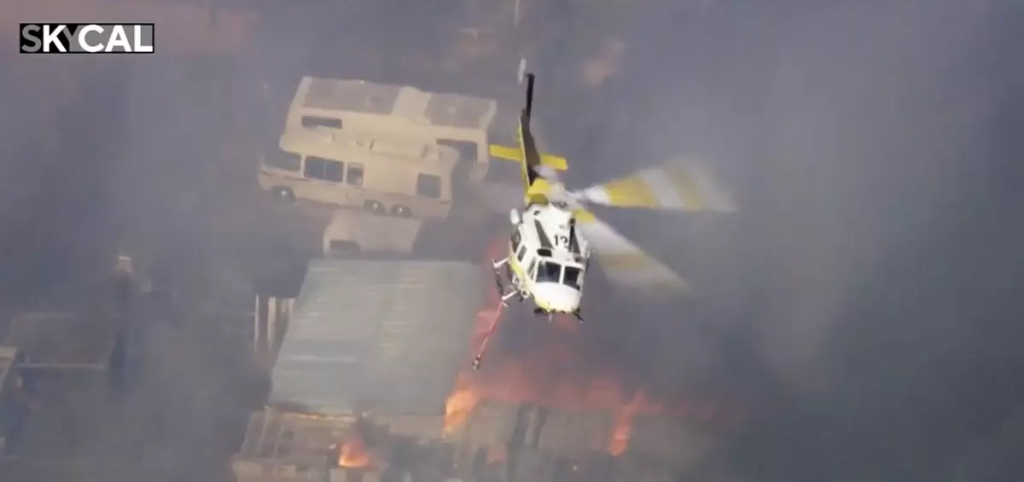
The original Los Angeles Times caption under this photo identified the scene as “a fast-moving brush fire [that] damaged some buildings” this past weekend. But those “buildings” sure do look like RVs, which despite nearby flames are not going anywhere.

If there is any one iconic image of what it means to go camping, it has to be that of a family or group of friends clustered around a campfire under a starry canopy, sparks swirling toward the sky to join their celestial counterparts. Whereas such fires were once the means by which hunters, cowboys and pioneer families cooked their meals, these days it’s rare that anything more than marshmallows on a stick gets thrust into the flames. This is fire as an aesthetic—even mystical—experience, not as a tool for meal prep.

The Dyrt, a mobile app for campers looking for sites, recently underscored that point in its annual survey, in which it quoted several campers on the central importance of campfires. For Adam R. of Colorado, a list of the things that thrill him about camping starts most notably with “campfires and stargazing at night, sunrises and hearty breakfasts in the morning.” Miccal M. of Vermont went deeper, contending that “there is nothing like sitting next to a fire in the woods to help look inwards and see if you need to adjust paths.”

They’re not wrong. I’ve had my share of pensive moments of staring into the embers of a well-banked campfire, watching intense blue flames dance along a charred log cosseted by orange coals. There’s primitive pleasure in feeling a skin-tightening warmth on your face while your back tingles with evening’s chill, of hearing the occasional pop and hiss of damp or sappy wood echoing through the otherwise still air, of letting your thoughts drift upwards with the sparks and wispy smoke. I get it.

Here’s what I also get. According to the National Academy of Sciences, seven of every eight wildfires are caused by humans, and of those, 29% are attributed to unattended or abandoned campfires. Such wildfires are becoming increasingly common and increasingly large and widespread, especially in the West. Indeed, The Dyrt’s annual report also relates—without any acknowledgement of irony—that 33.1% of West Coast campers had their plans last year interrupted by wildfires and natural disasters, more than twice the rate of campers not on the West Coast (13.1%).

As I write this, a series of wildfires is again burning up and down California, with the largest—along I-5 between Los Angeles and Bakersfield—having consumed nearly 16,000 acres and as of early this morning being only 31% contained. More than 61,000 acres have burned in the state this year, making this the fourth biggest fire season to date since 1996—and this is after two years of resumed rain and snow that ended a years-long drought.

In southern New Mexico, meanwhile, where the drought still persists, a pair of forest fires is advancing on the village of Ruidoso “like a pair of pincers,” according to local officials. Residents were urged to flee immediately, without pausing to pack valuables, as the South Fork Fire grew to nearly 14,000 acres with zero containment and the Salt Fire neared 5,000 acres, also with zero containment. Much of the American southwest is under “red flag warnings” because of the increased risk of wildfires, due to very dry air and winds and parched ground cover.

All this is happening in the closing days of spring, which is to say, with the hottest days of summer still ahead of us. No surprise, then, that the Colorado Sun published an opinion piece Monday under the headline, “Six reasons why campfires should be banned year-round in Colorado.” Written by science writer and lecturer Trish Zornio, the piece argues that increased wildfire risks and increased health risks from rising smoke pollution suggest “it’s time for Coloradans to ditch the campfire ring.”

While the causes of the California and New Mexico fires remain under investigation, that’s not the case with Zornio’s leading example, the Interlaken fire near Twin Lakes in Lake County, Colorado. Now more than a week old, the Interlaken fire is being blamed on an improperly extinguished campfire that smoldered for several days before being reported. To date it has burned more than 700 acres, and while it’s reportedly 86% contained, that doesn’t mean it’s almost out; expectations are that it will continue burning within its circumscribed perimeter for weeks to come.

As Zornio points out, there are no fire restrictions in Lake County—no one thought they were needed this early in the season. But growing climate instability “makes predicting weather conditions more difficult,” she writes, which in turn means “our ability to predict and manage wildlife conditions is also impacted.” Meanwhile, a growing population with more of a taste for outdoor activities is further stressing the environment. “Once spacious campgrounds are now packed to the gills, dramatically increasing the concentration of campfires,” Zornio writes, thereby increasing “the chances of human-caused wildfires.”

There will be other Interlaken fires in the weeks ahead, but that won’t deter traditionalists who cling to the idea that a campfire is the very essence of camping. It isn’t, unless you need some way to cook that rabbit you just bagged while living off the land. But until there is a widespread understanding that open fires have become much more of a threat to the environment—not to mention to human health and property—than was true even a decade ago, most campers will stubbornly continue building fires in a flammable landscape because that’s what “camping” is all about. And, no surprise, more of that landscape will burn.

Looking for a mystical experience? Try yoga, or deep breathing and meditation, or even ‘shrooms. Consign campfires to the same historical closet in which we store fur leggings and brush lean-tos.

Campers flying solo and on the cheap

Overworked though it might be, the parable about six blind men describing an elephant—each varying wildly from his companions, depending on what his hands encountered—couldn’t be more appropriate for the coverage of The Dyrt’s recently released 2024 Camping Report.

Compiled from an annual survey of 7,000 of its members, a representative sample of 1,ooo U.S. residents and of camping property managers across all 50 states, The Dyrt’s report is as comprehensive as any in the industry. For all that, however, published analyses of the report’s findings have been surprisingly superficial and repetitive, hitting the same high notes while missing other potentially significant but less obvious findings, or how they might interact. Yes, the elephant has a snake-like trunk, and yes, its legs are like tree trunks, but. . . .

This year, the most hyped finding was that more people than ever went camping in 2023, at a whopping 84.8 million—but good news! Campgrounds had met the increased demand by adding sites, presenting campers with “more options than ever before.” As a result, “only” 45.5% of campers reported difficulty booking a site because a campground was sold out, or four times more than in 2019—but down from a peak of 58.4% in 2022.

But that’s only part of the story. Because as the report also found, nearly two-thirds of campers said they sought out free camping in 2023, up from just one-third in 2019. Whether it’s boondocking or Walmart parking lots or a friend’s back 40, campers have been looking for and finding—thanks in no small part to The Dyrt’s listings—cheaper or more scenic alternatives to commercial campgrounds, and even to state or federal facilities. All of which explains, for example, why KOA has reported elsewhere that camper nights stagnated or even declined last year, even as revenues rose, thanks to higher rates.

If that’s not a wake-up call for campground owners, here are a couple of other statistics teased out of The Dyrt’s report that should give them pause. Number one, while there were 5.5 million first-time campers in 2023, that’s barely more than half of the pandemic-driven freshman class of 2020. And while that’s still more than double the average annual increase prior to the pandemic, the downward trend is unmistakable and a clear sign that the high-rollin’ years are over. The low-hanging fruit has been picked.

Number two, contrary to all the industry euphoria about how camping is no longer dominated by old people, industry growth is occurring at the two ends of the age spectrum but has dropped in the middle. According to the report, those 65 and older comprised 29.1% of all campers in 2023—the single biggest cohort—increasing their share by 4.9% over the previous year. Yes, grandparents are still spending their kids’ inheritances. From there, meanwhile, it’s all downhill through the generations, with those 55-64 comprising 25.4% of the total camping public in 2023, down 3.1%; those 45-54 comprising 16.9% of the total, down 13.7%; and those 35-44 at 13.9% of the total, down 8%. It’s not until we get to campers who are 25-34 that we see another uptick, by 10.8%, to 10.7% of the total. And while campers 18-24 exploded in numbers, by 65%, that’s only to be expected when you start with a low base, since they still made up only 3.9% of the whole.

What’s it all mean? Just that the working-age population, having tried camping at a time of social distancing and greater acceptance of remote work, is reverting to more established behaviors. Been there, done that—and other responsibilities and opportunities are calling.

At least two other findings in The Dyrt’s report deserve to be highlighted. One provides an illuminating insight into the problem of booking sites: fewer than half of campers (42.7%) used all the camping reservations they made in 2023. Most eventually cancelled the reservations they couldn’t keep, potentially freeing those sites for someone else—but 14.9% couldn’t be bothered to cancel at least once. Moreover, the older the camper the less likely he or she will be a no-show, with millennials and Gen-Zers 52.6% more likely than Gen-Xers and baby boomers to be no-shows.

And oh, yeah: having a lot of money apparently results in cavalier behavior (who knew?), with campers having annual incomes of more than $250,000 twice as likely to be no-shows as those making less than $50,000.

The other curious fact to emerge from the report is that 29.8% of campers in 2023 went camping alone. That’s up from 18.8% in 2021, when social distancing might have been a large part of the reason for going solo, but the report has no explanation for the sharp increase.

Finally, all of the above should be taken with a grain of salt. Comprehensive as The Dyrt’s report may be, it includes some numbers that beggar belief, such as its finding that the average RVer camped 54 nights in 2023. That number makes sense only if a significant number of respondents were full-timers, but The Dyrt makes no effort to parse such distinctions, potentially skewing many results in one unhelpful direction or another. That’s not to say the report is useless, but as with so many data sets generated by vested interests, it’s best approached with a skeptical eye.

Dyrt-y facts about camping in 2022

The Dyrt, a rapidly growing web site and mobile app, is possibly the country’s most comprehensive platform for the camping public–which means, in turn, that The Dyrt’s users may comprise the country’s broadest demographic profile of the camping public. So when The Dyrt’s users have their temperature taken, it pays for other industry participants to take notice.

But first, some context. The Dyrt has listings of 44,000 public and private campgrounds and “other properties” that accept RVers and tenters. Last year the site pulled in more than 27 million visitors, more than doubling its 11.8 million visitors in 2020. More than a million of those visitors have been sharing tips and reviews on the site, and this past December, 3,000 of them–selected at random–responded to a far-ranging questionnaire about themselves and their experiences. An additional 2,000 respondents, chosen to be census-representative by age, race, gender and region, also were questioned, by two third-party organizations.

The result, released earlier this month, is the statistically most meaningful picture of what it’s like to go camping in America that the industry has produced to date. Some of its findings are by nature unsurprising–it’s their size or extent that may catch your breath. Other conclusions are disconcerting, to say the least. Among the highlights:

The camping “season” isn’t–camping is on the rise every month of the year, but no more so than in winter, up 40.7% since 2019. Camping is also less and less of just a weekend event, with 70% of campers now taking trips that include weekdays. Some of that growth is fueled by the rise in remote working, with the number of campers toting their laptops with them nearly tripling since 2018–in fact, The Dyrt notes, 23.8% of campers worked from a campsite last year.

The inevitable result, as most campers already know: it really has become a lot harder to book a campground. Nearly half of all campers reported difficulty finding available campsites in 2021, including 47% on the West Coast and 48% in the Mountain West and southwest; at the opposite end of the spectrum, of those trying to book a New England campground, only 37% reported difficulty. Overall, three times as many campers said they had trouble booking a site in 2021 as in 2019.

What or how you camp had a lot to do with how much trouble you had. Tenters had only twice as much difficulty in 2021, at 37%, compared with 18% in 2019. Motorhome and Class C campers, meanwhile, saw their comparable numbers soar to 51% from 14%, while those towing trailers weighed in at 55% and 16%, respectively.

Here’s the disconcerting part: frustrated by the overcrowding at conventional campgrounds, that unprecedented flood of campers is now washing over the backcountry. The number of boondockers looking for “dispersed camping” doubled in just one year, The Dyrt reported, adding that the four most-saved “campgrounds” on its app in 2021 were all dispersed-camping areas: Blue Lakes in Colorado, Edge of the World in Arizona, Shadow Mountain in Wyoming and Alabama Hills, California.

All four, it needs to be noted, have become severely degraded. Alabama Hills, on the eastern slope of the High Sierra and a much sought-after Hollywood shooting location, had to be closed down late last year because it was trashed so badly. The damage came despite an “Eastern Sierra Dispersed Camping Summit” held the previous February, in which half-a-dozen local groups managing public land in the area brainstormed strategies to prevent a repeat of the “carnage” from 2020, to little avail.

At Shadow Mountain, as another example, as many as 400 people can be camped in an area that has only one bathroom–back at the road entrance. Forest managers say the area’s occupancy has tripled in four years, from about 30% in 2016 to 91% last year. Human waste is the most obvious resulting problem, but officials also worry about poor food storage habits leading to increased wildlife-human conflicts.

That’s not the kind of information that will turn up in a search of The Dyrt. Nor will The Dyrt’s data base account for the growing number of “non-recreational campers,” which is land manager-speak for transient retirees, displaced families and homeless individuals. The western states with the most available land for boondocking also have some of the country’s highest housing costs–and among the highest rates of homelessness. People have to live somewhere. . . .

There’s no reason, alas, to think that any of these trends will soften in 2022.

Most recent posts