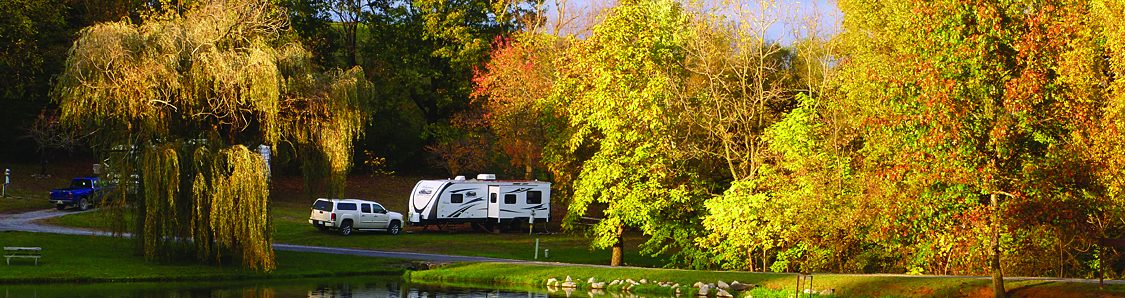

Bluegrass: now there’s a multi-layered word. It can refer to a musical style popularized by Kentuckian Bill Monroe, not unlike country music but consisting entirely of stringed instruments. It can refer to the lush grass covering much of Kentucky’s rolling hills, giving that state its nickname. But these days it also can mean a battleground pitting real estate developers against that other Kentucky icon, its thoroughbreds.
A proposed mega RV park calling itself the Kentucky Bluegrass Experience Resort (KBER) is now entering its fifth year of laying siege to the town of Midway (midway between Frankfort and Lexington) and the surrounding county of Woodford. First floated to Midway officials in June of 2020, the massive $40 million project thereafter slid rapidly from ready acceptance to growing horror at its scope and environmental impact, to permit denials and a lawsuit, and now to greater secrecy by the developers about just what it is they’re contemplating. Adding to the intrigue: while KBER’s access road and a chunk of its acreage are in Woodford County, an even larger piece of the property is on the other side of a creek, in adjacent Scott County—and the two jurisdictions could scarcely be more dissimilar in their views on economic development.
Now things are coming to a head, as KBER’s developers look to surmount a final regulatory barrier by seeking a zoning change in Scott County that would allowing recreational development of 96.9 acres currently reserved for agriculture. The county planning commission originally scheduled a July 11 vote on the application, but that’s been moved to August 8. And in the interim, local resistance has steadily mounted, this time spearheaded by the area’s thoroughbred farm owners, some of whom have property adjoining to KBER’s parcel but who despite that proximity only now are recognizing they face an existential threat.
“Horses need a place that’s quiet. There’s just no way we can survive if that RV park goes in,” Foxbrook Farm owner Jason Tackitt told T.D. Thornton, of the Thoroughbred Daily News. “Anybody who raises thoroughbreds knows that you can’t have noise and disruptions. Noise changes horses’ sleeping patterns and it affects pregnant mares. We can’t have that.” Should the KBER project actually go through, he added, he won’t have any recourse but to move his 20 thoroughbreds, probably to Florida—as will many of his neighbors, a prospect he simply can’t fathom. “If something like this happens to you, it’s like a slap in the face. It’s like people saying, ‘We don’t value horse-raising in this area.'”
That KBER would have a major game-changing impact on the area is undeniable. As originally proposed, it would have placed 818 RV sites, 155 cottages, 15 spots for employee accommodations and 37 rustic tent sites across 240 acres split by the ox-bowed Elkhorn Creek, creating one of the ten largest RV parks in the eastern U.S. But that’s not all. In addition to the usual campground amenities, like an aquatic park, sports courts and game room, KBER’s developers planned to lean into its “resort” aspirations with a business center, a fitness and yoga center, spa services, food services with seating for 400, a 525-person capacity amphitheater and an educational center with a 100-person capacity. The “bluegrass experience” theme was to be served with a farmer’s market of local produce, equestrian trails and a bourbon-tasting room. There would be golf car rentals, mini-golf and mini-bowling, kayaking, perhaps a lazy river . . . .
That was the original plan. What it is now is anyone’s guess, although some permutations can be traced. When Midway’s town elders finally understood the immensity of what was being proposed, they threw up the only roadblock available to them by denying the project’s application to hook into the town’s sewage treatment plant. KBER responded by applying for a state permit to build its own treatment plant, assuring county officials that it had severely reduced the project’s footprint—“in response to criticism that that proposal was ‘too big'”—by withdrawing plans for developing its 142 acres in Scott County. The downsized, more modest KBER would have only 390 RV sites and 82 cottages, all on Woodford County’s side of Elkhorn Creek.
But KBER’s application for the Scott County portion of the property was only “postponed,” according to that county’s planning commission. So, bogus claim. And when Woodford County wouldn’t relent, KBER simply shifted the site for its proposed sewage treatment plant across the creek, to Scott County—a jurisdiction that’s home to the world’s largest Toyota Motors’ manufacturing plant, and one with clearly more receptive views of large economic projects than its agriculturally-fixated neighbor. And while Elkhorn Creek had been severely polluted decades earlier by raw sewage from a trailer park treatment plant, resulting in a Scott County ban on private treatment plants in the area—well, times change. Memories fade. Economic imperatives demand the benefit of the doubt.
“There are RV parks all across the United States that are generating opportunities, and I have concerns about cutting that opportunity out because of negative issues in the past,” asserted a Scott County regulator last fall in a lead-up to that county’s eventual approval of KBER’s application, summarizing the new attitude.
That would have seemed to be that, had not that pesky rezoning matter started edging into local awareness. And as it did, KBER’s neighbors who had been oblivious to what was going on belatedly woke up, and nowhere more so than in the thoroughbred farming community—which, yes, recognizes that it’s been asleep at the switch. As Thornton wrote in his extensive article in Thoroughbred Daily News: “Although Tackitt said opposition to the RV park is now at a can’t-miss level within the community because of roadside signage, mass mailings, and online social media groups devoted to stopping the development, he acknowledged that some abutters [those whose property abuts the KBER parcel]—including himself—didn’t immediately pick up on the threat.”
Now, as Tackitt and the other breeders interviewed by Thornton scramble to defend their way of life, KBER’s promoters have gone dark. In sharp contrast to early days, when project owner Andrew Hopewell and local real estate broker Joey Svec were glad-handing local officials and mounting a full-court publicity blitz about the economic benefits of their idea, these days . . . nothing. Hopewell ghosted Thornton’s efforts to get a response to community concerns. A wealth of online information about the project has disappeared. The number of proposed RV and other sites now varies from one public account to another, and an initial project cost estimate of $40 million—after a four-year delay—almost certainly is too low, raising questions of how the bottom line will pencil out.
But perhaps the most disturbing void in all the publicly available information is the disappearance of the Kentucky Bluegrass Experience Resort from the NadiGroup website. The Nadi-designed site plan at the top of this column was just one of the many documents once available from the Canadian design firm, as it unabashedly showed off the most ambitious of its many RV park projects—gone. Nowhere to be found. And with no public explanation of such a disappearing act, leaving open to conjecture just what changes KBER’s plans are undergoing, and what further effect those plans will have on Kentucky’s horse country.
The Aug. 8 meeting in Scott County promises to be one helluva bluegrass experience, all right (cue the strings)!
 Renting Dirt