Why does KOA play a numbers game?

As it’s prone to do, KOA—“the world leader in outdoor hospitality”—tooted its own horn this past week by announcing yet another “year of significant expansion.” Claiming to have notched a dozen independent park conversions in 2023, as well as eight new construction contracts, the RV park franchiser trumpeted that its increased inventory “underscores the organization’s resilience and adaptive strength in the evolving travel, camping and outdoor hospitality industry.”

Really?

Although the campground industry’s sycophantic press was quick to regurgitate the “news,” apparently no one paused long enough to let the numbers sink in—or to notice how awfully familiar they sound. Because while the same press release noted that the year’s developments increased KOA’s “elevated number of branded locations to 511 across North America,” the company had claimed 525 locations in mid-2021, up from 520 in 2020—so where’s the “significant expansion”?

A generous person might argue that the apparent two-year decline—unfounded claims of KOA’s “resilience” notwithstanding—shouldn’t be taken too seriously, a one-off because of the pandemic and its aftershocks. But the truth is that KOA’s crowing about growth in locations has been a recurring event for at least a decade, a marshaling of incomplete numbers wrapped in hyperbole aimed at convincing the public—and especially campground owners— that this is one helluva dynamic, growing company. The truth is somewhat less than that.

Consider, for example, the presentation given by KOA’s then-president Toby O’Rourke at the company’s 2018 annual convention. “This year we brought in 12 new conversions, four more are to be signed and that means we should have 515 KOAs in the 2019 directory,” she explained. “People are investing in camping and they’re investing specifically in KOA.” Which sounds good only until you notice that O’Rourke, as was true of KOA this past week, referred to only one side of the ledger. And as the numbers above indicate, departing KOA franchisees have more or less cancelled out all those incoming conversions and new builds. When it comes to campground numbers, KOA is only treading water.

It’s actually worse than that. In 2012, for example, there were 484 campgrounds across the U.S. claiming the familiar yellow logo, so at first blush one might think that at least the system has expanded by two-dozen or so properties over the past decade. But of that 484, 26 KOAs were company-owned and 458 were franchisees. By this past summer, the number of KOA-owned parks had nearly doubled, to 51, while the number of franchised properties had increased by just two. To the extent that KOA has been growing, it has done so as an owner of RV parks and not as a franchiser

Does it matter? Maybe not, but for KOA’s persistence in making its unfounded statements of franchisee growth, which begs the question: why? Why keep repeating the same cockamamie claims? KOA is privately owned, so it doesn’t have stockholders to impress. Its campers don’t much care if the chain has 450 or 500 or 600 RV parks. The only other significant audience for its overblown representations is independent park owners, whom KOA needs in its ranks to offset the deserters—and who presumably need assurances that KOA is one bitchin’ star to which they can hitch their wagons. And, indeed, that’s pretty much the case made by O’Rourke, now KOA’s CEO, as she asserted that “the healthy influx of new franchisees and new campgrounds is a clear indication that KOA is meeting the needs of our customers—both campers and franchisees alike.”

Beneath all this bluster is the unremarked fact that KOA is rapidly morphing from a company in service to its franchisees to one serviced by those franchisees: all those company-owned properties were purchased thanks to the 10% of revenues that KOA collects in franchise fees. Moreover, the RV parks that KOA buys are on the upper end of its tripartite breakdown of properties into Journey, Holiday and Resort categories, which means that corporate resources have been getting funneled into developing high-end amenities and standards, not into raising the laggards. The KOA Journeys, meanwhile, are left to fend for themselves against growing competition from the likes of Love’s Travel Stops, which coincidentally announced this week it will expand its chain of full-hookup RV parks from 54 to 98 by year’s end. Give Love’s a couple more years like that and it will be eating KOA’s lunch at all but the high end of the campground spectrum.

One other development buried within KOA’s unreleased numbers is the extent to which its individually owned campgrounds have been consolidating under group ownerships. A KOA today is as likely to be one of several owned by a corporation or an investment group as it is to be a traditional mom-and-pop operation, from some entirely native to KOA—Recreational Adventures Co., the Bell family out of San Diego—to others sprawling across various outdoor properties in and out of KOA, such as Team Outsider, Encore RV Resorts or BlueWater, to name just a few. The number of individual franchise owners, in other words, is rapidly diminishing, and with it the overall KOA culture, which is becoming flatter, more corporate and less interesting with each passing year.

KOA, as KOA likes to remind us, was founded by an aw-shucks Montana entrepreneur who wanted to provide Americans traveling to the Seattle world’s fair with a clean, safe place to spend the night. No telling what Dave Drum would have thought of what his creation has become, but I suspect the one thing that might have rubbed him the wrong way is its penchant for puffing out its chest and telling tall tales and half-truths. Sounds like something you’d expect from a city slicker.
As ’23 winds down, so does the party

Easing into various seasonal celebrations, and from there into year’s end, various RV industry representatives have been spewing predictions for 2024 that are short on context and long on wishful thinking and data cherry-picking. Call it the holiday effect, an irresistible compulsion to make things merry by spiking the statistical punch, morning-after hangover be damned.

Consider, for example, the glowing news announced at KOA’s recent annual convention by CEO Toby O’Rourke that the franchise behemoth had crossed the $500 million mark in annual revenues, up 36% since 2019. Receiving considerably less emphasis was the news that camper nights in 2023 were actually down 4.8%, and up only 5% over 2019, an increase initially notched by a pandemic-driven camping explosion that now seems to be waning. Revenues going up even as camper nights decline can be explained only by higher rates—and, indeed, escalating fees may explain in part why camper nights are down. Camping is getting just too damn expensive.

Indeed, the annual Generational Camping Report, released by RMS North America last week, found that “price is still a driving factor in campground destination decisions,” with a third of respondents “selecting the cost of reservation as their top concern.” Contrasted with O’Rourke’s ambition to increase camper nights by 2% next year, even as she projects a further 5% annual growth in revenue, that concern appears to be a circle that can’t be squared.

Or consider the persistently upbeat outlook propagated by the folks who build RVs. In one trade show after another this fall, dealers and manufacturers conceded that yes, traffic was down—“attendance might not have broken any records,” “traffic was clearly off somewhat”—but that they were optimistic about 2024 and beyond. Precisely why was never made clear, but it might have something to do with an industry penchant for pulling numbers out of the air. On Sept. 1 of last year, for example, the RV Industry Association was forecasting wholesale shipments in 2023 of 419,000; as of Dec. 6, that had slipped only a bit, to 391,499. Today it looks unlikely that even 290,000 RVs will roll out the door in 2023—but that hasn’t prevented RVIA’s statistical geniuses from calling for a rebound to 369,700 units in 2024. Why? Well, why not?

There are a few—a very few—voices calling out this forecasting malpractice. Industry consultant John Spader, for example, has observed that as of June 30, the average North American RV dealer’s debt to equity ratio had ballooned from .97:1 in 2021 to 1.73:1 in 2022 to 3.64:1 in 2023. As he notes, the debt-to-equity ratio is “arguably the most important measure of a dealer’s financial health” and its ability to manage debt. Most lenders want to see a ratio of 4.0:1 or less, so as this trend continues in the wrong direction, expect to see a growing number of RV dealerships going belly-up as they fall afoul of financing covenants. Disappearing dealerships don’t do much to increase sales

A more extensive—and bleak—analysis of this trend by Gregg Fore, whose industry-friendly credentials include induction into the RV/MH Hall of Fame, was published by RVBusiness a week ago. “Margins on sales have dropped, costs of nearly everything has risen, and maintaining safety in cash flow is more critical than ever,” he wrote. “Some dealers will see the handwriting on the wall and close voluntarily rather than lose their entire personal asset base. Others will be forced to do the same as cash flow reaches critical levels.”

RV park promoters and investors tend to be cavalier about such developments, claiming that with so many millions of RVs already cluttering the landscape, a constriction in the supply pipeline will be immaterial to campground owners. But RV parks are part of a larger ecosystem; when any part of it is diminished, the greater whole will feel the effects. Or as Fore also points out, fewer RV outlets will result in a higher percentage of larger dealers, “meaning the consumer will be forced to work harder to make a purchase and to get service (emphasis added).” In other words, owning an RV is going to become more expensive and more of a headache than it already has been.

The same economic forces that are crippling the RV industry are battering the camping public as well, with predictable results. Persistently high interest rates, two overseas wars, the ongoing threat of a federal government shutdown and a polarized, fractious political climate have soured consumer sentiment, which now has fallen for four consecutive months. Consumer spending has followed suit, dipping 0.1% in October, just ahead of the holiday season and the first decline since March. With two-thirds of Americans saying their household expenses have risen over the last year but only one in four saying their income has increased in the same period, it’s perhaps predictable that credit card debt is shooting up and retirement accounts are being ravaged through hardship withdrawals.

None of that adds up to a rosy outlook for next year—at the very least, it’s going to challenge the airy notion, advanced by some (I’m looking at you, Frank Rolfe), that the RV park industry is somehow immune to the economic forces that affect everyone else. Yes, people who already own RVs will want to use them—but not if they can’t afford ever-higher site fees, or if they can’t get their RVs serviced at a reasonable price within a reasonable time frame. Not if they can’t keep up with the outsized payments on their over-leveraged RV loans and have to unload their white elephants. Not if a tightening job market slowly makes that “work from anywhere except the office” lifestyle ever more fanciful.

The party was fun while it lasted, but they’re taking away the punchbowl and tomorrow you’ll wish they’d done so sooner.

Whistling past the RV sales graveyard

Heading into the Memorial Day weekend, camping industry cheerleaders were cranking out comparisons and forecasts to support their contention that the industry’s best days still lie ahead. But coming on the heels of some truly astonishing declines in factory shipments of new RVs, the chorus had a distinctly plaintive tone.

RV shipments for the first four months of the year were notably grim, down 52.1% compared to the same period last year—and down even more sharply for towables (which include travel trailers, fifth-wheels, pop-ups and truck campers), down 55.8%. Motorhomes (types A, B and C), meanwhile, were down a mere 14.9%, but the motorhome segment is less than one-fifth that of towables. Forecasts for the rest of the year have been revised steadily downward each month, with expectations now that 2023 will be the worst year for RV production in more than a decade.

Industry leaders have attempted to brush away this news with the assertion that 2023 was bound to show a decline after the pandemic-driven bumper-crop years of 2021 and 2022, and there’s certainly some truth to that. It’s the magnitude of the plunge that accounts for the barely concealed jitters, however—how many businesses can withstand half of their business evaporating in a year?—with no reasonable way to discern whether we’re in the throes of a minor correction or whether this is a deeper secular trend. But industry attempts at reassuring investors and customers have produced some near-comical contortions.

For example, Winnebago Industries, one of the biggest RV manufacturers, issued a cheery consumer survey this week that was long on insinuation but short on details to make a tenuous case that RV interest remains healthy. “Winnebago Survey Shows Growing Outdoor Activity,” its press release proclaimed, fudging the distinction between RVing and “outdoor activities,” such as hiking, cycling and boating. By the time the release got around to its ostensible subject, in a section subtitled “The Summer of RV Travel,” it was to present such carefully worded observations as “almost two-thirds of respondents have considered [emphasis added] using an RV for a vacation rather than traveling by plane,” and “over two-thirds of respondents have considered [emphasis added] using an RV for travel instead of a flight, hotel and rental car.”

Well, that’s reassuring—but what did those respondents actually do? Your guess is as good as any, but it’s clear that the airlines are not feeling any heat from RVs or other modes of transportation. As just reported by the Transportation Security Administration, its agents nationally screened 9.8 million passengers over the Memorial Day weekend, or 300,000 more than in the pre-pandemic year of 2019.

The idea that RVing is a cheap alternative to flying or driving on vacation nevertheless has captivated the industry, resulting in some highly questionable cost comparisons. The RV Industry Association, for example, reported May 18 that “an outside, independent firm has found that RV vacations cost much less than other types of vacation travel, even when factoring in fuel prices and the cost of RV ownership.” Aside from the problematic issues that come with any apples-to-oranges comparisons (what kind of RV compared to what kind of air fare or car rental plus what types of hotel accommodations? etc.), the lack of a publicly defined “cost of RV ownership” makes the analysis meaningless. For instance, is that the cost of an RV purchased outright, or one with a 10- or 15-year loan? With how much down and at what interest rate?

(One detailed example, from the several that were included in the RVIA-backed study: the costs for a family of four traveling from Dallas, TX to the Grand Canyon for a 14-day vacation would be $8,801 if the family took a plane, rented a car and stayed in hotels, according to the study, contrasted with an equivalent Class C motorhome vacation expense of just $5,627. But Go RV Rentals apparently occupies a different reality. Its unrelated press release this month (touting the economics of RV rentals) calculated that using a Class C motorhome for 20 days costs $911 per day “when you factor in the total cost of ownership”—or $12,754 for 14 days, more than double RVIA’s rosier assessment. As with the RVIA study, no explanation here of what comprises the costs of RV ownership.

(Meanwhile, want to rent rather than own? Go RV Rentals says that same Class C goes for an average base rate of $217 per day, plus as much as an additional 50% for insurance, service charges, optional equipment and sales tax. That’s $4,557 for the Dallas-Grand Canyon trip—before gas, any excess mileage charges and campground fees. Throw those in and you’ll certainly exceed the RVIA’s estimated $5,627.)

The argument that RVing is an economical way to vacation works only if such a vehicle gets deposited in your driveway for free and it never suffers any mechanical issues. And with the pandemic essentially a non-issue for most Americans, the ability to travel and cocoon in a personal bubble is no longer the enticement it was the past three years. Add to that the shrinking number of American workers who remain able to work remotely, and all of a sudden the main reason to go RVing reverts to what it was before all the craziness started: to go camping!

But is that enough?

Interestingly enough, that very question—with a perhaps predictable answer, after an initial tease— was posed by Toby O’Rourke, president and CEO of KOA, at the 2023 RV Industry Power Breakfast in Elkhart on May 11. “For the past couple of years, when I’ve been asked about all these new people camping, I have always said there is going to be a natural drop-off,” she told an industry audience of more than a thousand. “Camping is not going to be for everybody.” Indeed, she noted, 32% of people who went on an RV trip for the first time said the experience was good or great—raising the question, what was less than okay for the other 68%?

But while O’Rourke used to think that camping isn’t for everyone, now “I really don’t accept that anymore and I don’t think you should, either.” Although she didn’t explain what led her to change her mind, O’Rourke said she now believes those unimpressed campers are simply in need of special attention. They’re a marketing and education challenge, blocked from a full-throated embrace of the joys of camping by a number of “pain points” that the industry must address if it wants to keep growing. “Here’s the problem as I see it: the reality is that camping is an easy choice, but it’s not always easy,” O’Rourke told her audience. “If we don’t smooth over these pain points, we are at risk of losing those 70% of people that are lukewarm about continuing to camp.”

Or maybe O’Rourke had it right the first time: camping isn’t for everyone, not because of “pain points” but because nothing is for everyone. That’s not what the industry wants to hear, of course. Much better to believe that it’s just a matter of better messaging, of becoming more customer obsessed. Desperate times call for desperation.

Most recent posts

More electrifying news for RVers

A pair of webinars this past week, one hosted by the RV Industry Association and one by the National Association of RV Parks and Campgrounds, underscored how seriously the campground world views the oncoming onslaught of electric vehicles. While campground and RV owners remain mostly skeptical, questioning the costs, range, recharging availability and environmental impact of a lithium-based technology, industry leaders are unwavering in their belief that the EV-RV revolution is already here and that the problems others see are either overblown or will be resolved in timely fashion.

“We are really at an inflection point which is amazing,” Ashis Bhattacharya, senior vice president for development and advanced technology at Winnebago Industries, told his RVIA audience. A “wave of electric adoption” is already washing over rental car agencies, delivery services such as Prime, UPS and FedEx, as well as school buses and other municipal vehicle fleets, all of which is normalizing the technology. The paradigmatic shift already underway, Bhattacharya added, is as significant as any ever experienced in the transportation sector.

Meanwhile, said Jay Landers, RVIA’s vice president of government affairs, state initiatives to outlaw internal combustion engines are giving the entire EV sector a kick in the pants. Five states, including California, already have voted to ban sales of new internal combustion vehicles by 2035, and others are looking to possibly follow suit. The state of Washington, which had the country’s sixth highest rate of RV shipments this year, is even more aggressive, adopting a 2030 cutoff deadline. Furthermore, expansion of the EV charging network nationwide is being super-charged by $5 billion in federal funding approved earlier this year.

None of which, all speakers agreed, is to minimize the problems confronting EV in general, and EV-RVs in particular. “The (EV) technology is still more expensive than what it’s replacing,” conceded MacKay Featherstone, Thor Industries’ senior vice president of global innovation. Moreover, he added, “the charging experience is utterly critical” and still inadequate for RVers in particular, both because most RVs need pull-through charging stations to be practical and because they have larger power needs than EV cars.

To their credit, RV manufacturers, frequently criticized for shoveling out hundreds of thousands of RVs without giving a thought to where their buyers might use them, are at least trying to get out in front of this development. And there is little reason to doubt that a society-wide change is coming, and coming hard. EV-RV costs inevitably will come down as sales take off, as they do with any emerging technology. Alternatives to lithium batteries, using less exotic minerals, are being developed, and advances in recycling technologies will further ease environmental concerns. Similarly, ongoing improvements in battery density will continue to expand vehicle range, relieving one of the biggest consumer anxieties about EVs.

The weak link, however, appears to be the RV park and campground end of the product chain. The RVIA webinar inadvertently made that point when its campground representative on the panel—Toby O’Rourke, president and CEO of KOA—was so unintelligible that she had to be dropped from the screen, apparently because she was trying to link in from an airport. (And why O’Rourke, again? Is there no other campground industry representative who can speak to the industry’s issues? Maybe someone from the Yogi franchise, or ARVC, or one of the other large state RV park associations, like Texas or California?)

Subbing in for O’Rourke was Brandi Simpson, her chief of staff, whose faltering contribution was to assert that campground owners are dealing with “a ton of misinformation” about EVs and need a lot of education and guidance. Which, presumably, KOA is scrambling to provide. . .

. . . as is ARVC, which lustily beat the drum on behalf of EV-RVs at its national conference in early November, and again at an hour-long webinar a couple of days after RVIA’s face-to-face. Pitched as “a recap of the best” of the conference for those who might have been unable to attend, the session inexplicably ignored the most contentious convention issue—a proposal to adopt industry-wide “standards”—while devoting the majority of its time to further promoting the idea that campgrounds need to get on the EV bandwagon, starting with the installation of EV chargers.

All of which is undeniably true, but far more nuanced and with many more questions than have been answered to date. For example: both webinars referenced possible tax breaks and federal grants to defray campground costs for installing chargers, while glossing over the reality that such inducements will require making the chargers accessible to the general public, and not just campground guests. Getting equally short shrift were any explanations of the occasionally mentioned “partnerships” that campgrounds might have to accept, whether with public utilities or third-party providers, to deal with licensing and infrastructure issues, since electric sales are typically a utility monopoly and EV chargers require robust additional power supplies.

(On a related note: one of the biggest frustrations for many KOA franchisees has been the parent company’s insistence on taking a 10% cut of all site fees—including any electric charges, even though campgrounds are legally prohibited from making a profit from reselling electricity. To the extent that EVs will increase electricity consumption at RV sites, that means even more unearned money transferred from franchisees to corporate headquarters.)

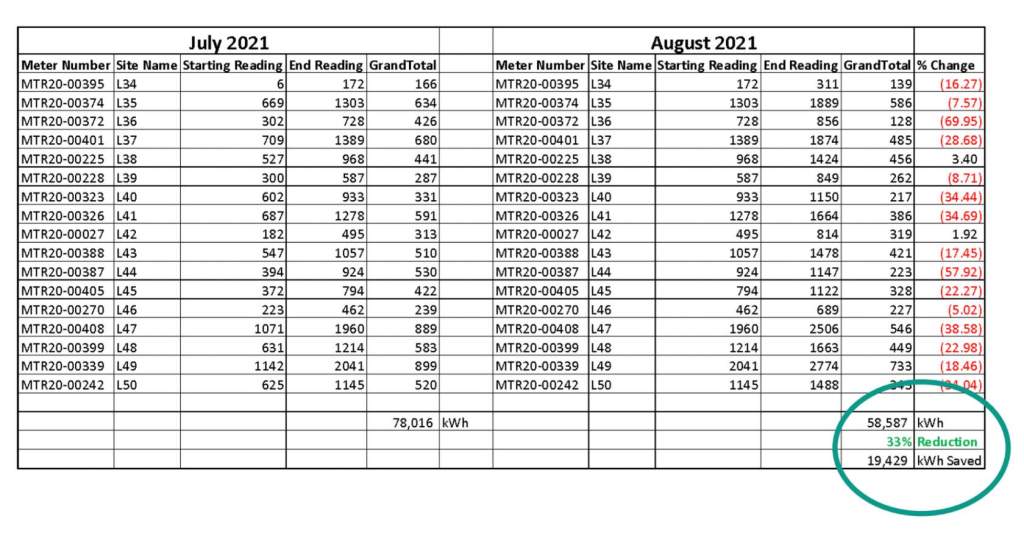
By ARVC’s calculations, electric metering of RV sites can reduce energy consumption by a third.

Indeed, the whole issue of who is going to pay for the extra electricity consumed by EV-RVs, and how, is still being sidestepped at the national level, quite possibly because there is no one answer. That, by itself, may become the biggest impediment to mom-and-pop campgrounds rushing into this brave new world. It’s notable, for example, that while ARVC now has an online “EV Toolkit” to help its members understand how to accommodate the new technology, the only guidance it provides for covering their costs is the vague advice to “consider billing for shorter stays, especially [campers] with unique equipment (large class As, EVs, electric golf carts, etc.), automatically billing those campers for the electricity they use. “

Presumably these and other issues will get resolved, sooner or later—once the industry stops talking around them. The RVing public, meanwhile, should brace itself for still higher costs, as a new electric sensibility starts percolating through the camping universe. Just as computerized reservation systems have introduced demand pricing and all kinds of add-on fees, the electrification push ultimately will result in all RV sites getting electric meters. Or as ARVC’s EV Toolkit asks, in a prominently displayed screen, “You don’t give away ice, candy bars or firewood, why give away electric?”

Most recent posts

‘Luxury and rustic camping’–really?

KOA is marking its 60th anniversary this summer, long enough to become the camping industry’s big dog. Over those six decades it has grown from a string of mom-and-pop campgrounds in the country’s northern tier into a web of 540 RV parks, campgrounds and glamping parks across the United States and Canada, 40 of which are company-owned and the rest owned by franchisees. KOA is big enough and has been around long enough, in other words, that when it speaks about the state of the industry, others lean in to listen.

All of which has made Toby O’Rourke, the company’s president and CEO, a much sought-after speaker within RVing circles. Sometimes she appears at events with a ream of statistics gleaned from KOA’s ongoing market research–statistics compiled in response to the questions KOA feels are important. Sometimes she simply talks about the industry’s future, telling reporters how she sees the industry evolving and how she envisions KOA responding. Because of her position, and because she’s smart and articulate, O’Rourke’s analysis and pronouncements carry extra heft. And because KOA is such a dominant presence in the industry, when it banks either left or right, the industry overall tends to do likewise.

There is a self-fulfilling quality to all of this, making it doubly important for anyone reading the industry to understand O’Rourke’s inherent biases and assumptions. It helps to know, for example, that O’Rourke’s initial position with KOA was as its digital marketing director–a position promoting the brand via the internet and other forms of digital communication. If the world can be divided into the concrete and the abstract, camping–at least as we have known it until now– can be filed in the “concrete” category; digital marketing falls squarely within the abstract world.

Maybe that’s why, in an interview with CEO Magazine this past December, O”Rourke could declare that she’s “very passionate about the intersection between luxury and rustic camping, and where we can go with that as a company.” The statement is dissonant on its face, as if someone were to say they were passionate about the beauty found in squalor–possible, perhaps, but only in the most abstract sense. If there is an intersection between luxury and rustic camping, it involves completely nullifying the meaning of “rustic.” It means pivoting away from the concrete world to a conceptual one.

Is that too abstract? How’s this for a concrete spin on things: a couple of months ago, speaking at an “RV Park Industry Power Breakfast” in Indiana, O’Rourke acknowledged there aren’t enough campsites to meet demand, but explained that it would be hugely expensive to do so–$17,000 to $18,000 per site to expand an existing campground, $45,000 to $55,000 per site when building a new park.

No one, apparently, questioned those numbers. No one, it seems, wondered why a new RV site was being priced at the same level as a new RV. No one asked O’Rourke what all that money would be buying, and if there wasn’t a “value menu” or “economy option” as an alternative to the blue-ribbon specials KOA has been funding. And those dollar amounts, let’s be clear, undoubtedly are what KOA–and Blue Water, and Northgate, and LSI and all the other industry behemoths–are spending, creating O’Rourke’s intersection between luxury and ersatz rustic: paved RV patios and path lighting, water parks and jacuzzis, glamping tents with en suite bathrooms. Under their influence, the whole industry is moving in the same direction.

Well, almost all. Every now and then a smaller voice emerges amid the cacophony, such as the announcement last week by the Newman family–Tom and Marilyn, as well as son Jayson and daughter-in-law Rachel–that they are building a 49-site RV park in La Prairie, Wisconsin. Scheduled to open next May, each site will have a picnic table, fire ring and 50-amp service, but drinking water will be available only from “scattered hydrants,” while black and grey water will have to be hauled to a dump station (although there will be “dry privies spaced out around the park”). For recreation, there are nature trails and shore fishing, not to mention bird watching and “beautiful views.”

Using O’Rourke’s figures, this would be a $2.45 million facility. With more emphasis on the “rustic” and less on the “luxury” end of the scale, I’m betting the Two Rivers RV Park and Campground will come in considerably under less than half that amount–perhaps as little as a fourth–but it will be an outlier. Dave Drum, KOA’s founder, would have found himself entirely at home in such a modest setting (check out this photo for an early KOA, with campers saddled up in front of a pickup camper; that’s rustic), but six decades later his company has moved the needle past anything he would have recognized.

It’s all part of what O’Rourke told CEO Magazine reflects her efforts at “bringing a lot of camping into the modern age.”

Most recent posts