Oregon a hellish RV epicenter

A perfect storm of bad ideas with potentially catastrophic consequences is shaping up in central Oregon, where the already struggling Family Motor Coach Association plans to have a four-day international convention and RV expo. The association, which has been hemorrhaging members for years but still advertises itself as “the world’s largest nonprofit association for recreational vehicle owners,” said it expects more than 700 RVs to converge on the Deschutes County fairgrounds in Redmond on Aug. 14.

Well, maybe.

Such events are planned months and even years ahead of time, so FMCA’s leadership might be excused for not knowing it would be hosting a party in a pizza oven. Then again, this is hardly unexpected. California is getting the most wildfire press at the moment, principally because its Park Fire has grown to more than 400,000 acres and is now the fourth largest in that state’s history. But Oregon is even more of a wildfire hotspot, with twice as many large active fires as its southern neighbor (25 versus 13), and this year already has had more than 973,000 acres scorched. Only two of those wildfires have been contained. The convention’s theme, “Adventure Peaks,” may have more of a dark meaning than originally intended.

You might argue that a million acres is only a small fraction of Oregon’s total land mass of roughly 61 million acres, so what are the odds that your campground will be next to go up in flames? But of course it’s not just a question of whether RVers will have a direct encounter with a fire, but whether they’ll also have to breathe its exhaust. Wildfire smoke has become an annual scourge across all of the western U.S. and Canada, and as it becomes more common, its effects on human health are getting closer scrutiny—with dismaying early findings. One recent study, for example, attributed more than 50,000 premature deaths to wildfire smoke exposure; the risk of cardiac arrests for people who have cardiovascular issues increases 70% during days with heavy smoke.

And here’s a truly sobering warning for the RVing demographic most prone to attend FMCA get-togethers: according to a decade-long study involving more than one million southern California residents, released just a few days ago, exposure to wildfire smoke poses a 21% increase in the risk of being diagnosed with dementia compared with other types of air pollution. The dangers, in other words, aren’t just respiratory or cardiac. Wildfires that tear through manmade structures, vehicles and other non-wild fuel emit smoke that contains a toxic brew of chemical compounds; its aerosolized particles, meanwhile, enable those poisons to infiltrate every part of a human body.

Nor is this sort of hazard something unusual—just the opposite. A much-publicized report this past week from The Dyrt, an online camping reservation platform, disclosed that 18% of campers reported that wildfires or other natural disasters disrupted their camping plans last year, or triple the rate of 2019. Such disruptions are even more common on the West Coast, where fully one-third of campers had their plans interrupted in 2023—as did an even larger 42% in Oregon and Washington. Ironically, The Dyrt is headquartered in Oregon, “so we’ve seen firsthand the toll wildfires have taken on the Pacific Northwest,” The Dyrt’s chief executive, Kevin Long, wrote in releasing the study. “It’s scary and tragic for so many reasons.”

For all that, however, Oregon in general and Deschutes County in particular have been grappling with proposals for several new RV parks as well as rules to allow RVs to be used as permanent rental housing. Those efforts have been given additional impetus by the U.S. Supreme Court’s decision in June upholding an Oregon town’s ban on homeless residents sleeping outdoors, which among its unintended consequences has increased the pressure on elected officials to find housing alternatives—and what’s cheaper (and more flammable) than an RV? The unresolved problem, of course, is finding a home for those RVs that’s not a city street or highway underpass.

None of this is going down well with Deschutes County residents, many of whom turned out this past week for a county commissioners’ meeting to excoriate a proposed 300-site RV campground that the county wants to build just north of Bend, at least in part as a low-cost housing solution. In addition to the standard worries about water, sewage and roads, objections also centered on growing concerns about an influx of the homeless and of an increasingly volatile natural landscape. “We need to start controlling sources of combustion out there, whether it be the homeless, people in campgrounds or fireworks,” one attendee told the board, summing up the powder-keg nature of the RVing phenomenon.

Meanwhile, a luxury RV resort being built on the other side of town, southwest of Bend, was originally scheduled to open this past spring but has been delayed repeatedly. A soft-opening of the 176-site property, the Bend RV Resort, is now projected for later this month, just in time for Labor Day—and well into the fire season. At $120 a night, this clearly is not an RV park that’s targeting the homeless as its customer base. Given current events, however, it’s also an RV park with an uncertain future—as, indeed, is true of summer camping overall.

Most recent posts

Fiddling while California burns

California is burning once again, after a two-year hiatus, with something like 200,000 acres already turned to charcoal—and here it is only mid-July, with three to four months of fire season still ahead of us. The state’s property insurance premiums are getting hiked by 30% or more a year. Wildfire smoke, according to a National Bureau of Economic Research (NBER) analysis released in April, is contributing to nearly 16,000 deaths annually across the U.S. as a consequence of large wildfires in the western U.S. and Canada.

Alarming, right? The kind of apocalyptic onslaught that would have any thoughtful outdoor industry leadership publicly fretting about a proper response—but hey, this is California, long renowned for living in an alternative reality. So when Dyana Kelly, president and chief executive of the California Outdoor Hospitality Association, recently took figurative pen to paper to address the burning (sorry) issue of the day, it was to go after . . . the organization formerly known as the National Association of RV Parks and Campgrounds (ARVC). And not for anything having to do with weather, wildfires, insurance rates or other existential threats to the RVing lifestyle, either.

No, what ruffled Kelly’s feathers was ARVC’s temerity in rebranding itself as OHI, or Outdoor Industry Hospitality, which aside from being an awkward three-legged stool of a name is strikingly similar to CalOHA, which is how Kelly’s organization usually styles itself. The rebranding is not news—it happened early this year—but Kelly greeted it as though it were, sarcastically congratulating ARVC for moving “away from the standard membership of RV parks and campgrounds by partnering with Hipcamp and allowing non-permitted parks, dispersed campgrounds and possibly even backpacking locations (as indicated by their release video) into membership.” Ouch.

This kind of frontal assault in an industry of glad-handers and back-slappers was notable enough for RV Business to seek Kelly’s permission to reprint her broadside, originally written for CalOHA’s members. But to be fair, Kelly was only playing tit for tat: it wasn’t all that long ago that ARVC took legal action against the California association after it dropped its affiliation with the national group but retained the CalARVC name. The similarity, ARVC contended, was causing “confusion” for park members. So rather than get embroiled in a trademark tussle, the Californians switched to CalOHA—only to now find their roles reversed.

“Is there confusion,” Kelly wrote, reprising ARVC’s earlier complaint. “YES. A number of parks have called to inquire about an invoice they received recently from ‘CalOHA’ when it was actually a well-disguised invoice from OHI.”

Yes, of course this is a problem—but not, I’ll submit, as big as the problem that both CalOHA and OHI are resolutely ignoring. Bookkeeping confusion pales beside the fundamental climate threat to RVing’s business model, which if nothing changes will make the current contretemps seem more than just a bit precious. And quite irrelevant. But both organizations are carrying on as though it’s business as usual—nothing to see here!

If Kelly wanted a truly righteous fight to pick on a national stage, she’d take ARVC/OHI to task for its history of climate change denial. This is an organization whose official policy maintains that there is still “considerable uncertainty surrounding the theories on climate change,” so much so that the only responsible thing to do is “more research, data collection and scientific analysis” before changing emission standards—or, indeed, doing anything at all that might have an economic impact on the industry. Of course, that economic impact is felt more severely with each passing year precisely because of such a don’t-rock-the-boat approach.

Yes, that would be a righteous rumble, but also a hard slog. And not nearly as satisfying as a quick and dirty couple of jabs over something as relatively meaningless as what we choose to call ourselves.

Maybe it’s time to rethink s’mores

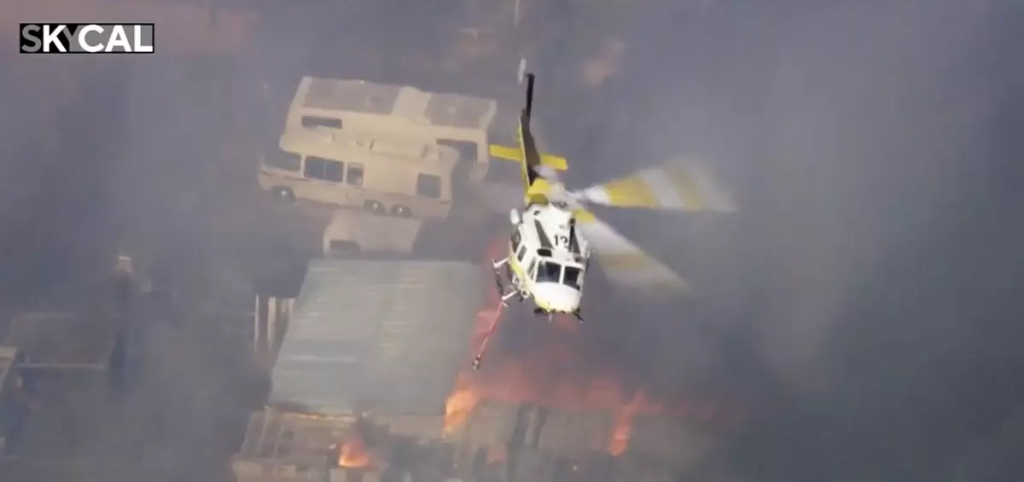
The original Los Angeles Times caption under this photo identified the scene as “a fast-moving brush fire [that] damaged some buildings” this past weekend. But those “buildings” sure do look like RVs, which despite nearby flames are not going anywhere.

If there is any one iconic image of what it means to go camping, it has to be that of a family or group of friends clustered around a campfire under a starry canopy, sparks swirling toward the sky to join their celestial counterparts. Whereas such fires were once the means by which hunters, cowboys and pioneer families cooked their meals, these days it’s rare that anything more than marshmallows on a stick gets thrust into the flames. This is fire as an aesthetic—even mystical—experience, not as a tool for meal prep.

The Dyrt, a mobile app for campers looking for sites, recently underscored that point in its annual survey, in which it quoted several campers on the central importance of campfires. For Adam R. of Colorado, a list of the things that thrill him about camping starts most notably with “campfires and stargazing at night, sunrises and hearty breakfasts in the morning.” Miccal M. of Vermont went deeper, contending that “there is nothing like sitting next to a fire in the woods to help look inwards and see if you need to adjust paths.”

They’re not wrong. I’ve had my share of pensive moments of staring into the embers of a well-banked campfire, watching intense blue flames dance along a charred log cosseted by orange coals. There’s primitive pleasure in feeling a skin-tightening warmth on your face while your back tingles with evening’s chill, of hearing the occasional pop and hiss of damp or sappy wood echoing through the otherwise still air, of letting your thoughts drift upwards with the sparks and wispy smoke. I get it.

Here’s what I also get. According to the National Academy of Sciences, seven of every eight wildfires are caused by humans, and of those, 29% are attributed to unattended or abandoned campfires. Such wildfires are becoming increasingly common and increasingly large and widespread, especially in the West. Indeed, The Dyrt’s annual report also relates—without any acknowledgement of irony—that 33.1% of West Coast campers had their plans last year interrupted by wildfires and natural disasters, more than twice the rate of campers not on the West Coast (13.1%).

As I write this, a series of wildfires is again burning up and down California, with the largest—along I-5 between Los Angeles and Bakersfield—having consumed nearly 16,000 acres and as of early this morning being only 31% contained. More than 61,000 acres have burned in the state this year, making this the fourth biggest fire season to date since 1996—and this is after two years of resumed rain and snow that ended a years-long drought.

In southern New Mexico, meanwhile, where the drought still persists, a pair of forest fires is advancing on the village of Ruidoso “like a pair of pincers,” according to local officials. Residents were urged to flee immediately, without pausing to pack valuables, as the South Fork Fire grew to nearly 14,000 acres with zero containment and the Salt Fire neared 5,000 acres, also with zero containment. Much of the American southwest is under “red flag warnings” because of the increased risk of wildfires, due to very dry air and winds and parched ground cover.

All this is happening in the closing days of spring, which is to say, with the hottest days of summer still ahead of us. No surprise, then, that the Colorado Sun published an opinion piece Monday under the headline, “Six reasons why campfires should be banned year-round in Colorado.” Written by science writer and lecturer Trish Zornio, the piece argues that increased wildfire risks and increased health risks from rising smoke pollution suggest “it’s time for Coloradans to ditch the campfire ring.”

While the causes of the California and New Mexico fires remain under investigation, that’s not the case with Zornio’s leading example, the Interlaken fire near Twin Lakes in Lake County, Colorado. Now more than a week old, the Interlaken fire is being blamed on an improperly extinguished campfire that smoldered for several days before being reported. To date it has burned more than 700 acres, and while it’s reportedly 86% contained, that doesn’t mean it’s almost out; expectations are that it will continue burning within its circumscribed perimeter for weeks to come.

As Zornio points out, there are no fire restrictions in Lake County—no one thought they were needed this early in the season. But growing climate instability “makes predicting weather conditions more difficult,” she writes, which in turn means “our ability to predict and manage wildlife conditions is also impacted.” Meanwhile, a growing population with more of a taste for outdoor activities is further stressing the environment. “Once spacious campgrounds are now packed to the gills, dramatically increasing the concentration of campfires,” Zornio writes, thereby increasing “the chances of human-caused wildfires.”

There will be other Interlaken fires in the weeks ahead, but that won’t deter traditionalists who cling to the idea that a campfire is the very essence of camping. It isn’t, unless you need some way to cook that rabbit you just bagged while living off the land. But until there is a widespread understanding that open fires have become much more of a threat to the environment—not to mention to human health and property—than was true even a decade ago, most campers will stubbornly continue building fires in a flammable landscape because that’s what “camping” is all about. And, no surprise, more of that landscape will burn.

Looking for a mystical experience? Try yoga, or deep breathing and meditation, or even ‘shrooms. Consign campfires to the same historical closet in which we store fur leggings and brush lean-tos.

Too much tinder, not enough water

As 2022 lurches toward an uncertain finish, with blizzard-battered western New York still counting its dead and California bracing for yet another round of torrential rains, two recent Colorado-centric events deserve the attention of anyone concerned with the outdoors. Unfortunately, any meaningful response seems unlikely. Worse yet, Colorado is only a bellwether for much of the nation.

The first of these events is the one-year anniversary of the Marshall fire in Colorado, a conflagration that on Dec. 30 forced the evacuation of more than 35,000 people–killing two—as it incinerated more than a thousand homes and seven businesses. Although an anniversary may not fit the dictionary definition of an “event,” in this case the event merely started on Dec. 30 and is still unspooling: 12 months later, just one of the 1,084 missing homes has been rebuilt and fewer than 170 building permits have been issued to reclaim what was lost in just a few hours.

To date, no one knows why the fire started, although some possible causes—such as downed power lines—have been ruled out. That in itself is remarkable. Nor has there been a conclusive accounting of the financial losses sustained—a process made more complicated by the surge in interest rates over the past year—but the total is expected to exceed $2 billion. In short, this continues to be an unfolding story for those who once lived in the devastated area.

But there’s more. As documented in an extensive ProPublica story published two days ago, the Marshall fire underscored in the most dramatic way possible the growing danger of developing the so-called wildland-urban interface, or WUI. Once understood as a zone of transition between unoccupied land and human development, WUIs are now recognized as having encroached on urban areas that formerly were considered “non-burnable.” It’s not just that development has pushed ever more steadily into wildland areas; it’s that “wildland” increasingly penetrates urban areas, with trees, shrubs, grasses and even wooden fences mixed in with homes, power lines and businesses.

As ProPublica reports, fire experts who recently thought that fire threats were confined to the WUI now believe that the entire state of Colorado may be at risk of conflagration. Even without that more expansive view, however, the fact is that the number of new homes built in Colorado’s classically defined WUI more than doubled between 1990 and 2020. Nationwide, meanwhile, the WUI is growing by 2 million acres a year, with more than 46 million homes in 70,000 communities now within the path of a firestorm, according to a June report from the U.S. Fire Administration. One of the most generally unrecognized danger zones: the southeastern states, where the Fire Administration says the potential for larger fires will increase by 300%-400% by midcentury.

So that’s one alarm bell sounded at the end of 2022. The second is being rung by the Colorado River Water Users Association, which concluded its annual convention a couple of weeks ago pretty much as always: looking helplessly at the impossibility of squeezing a 10-pound ball of crap into a five-pound sack. Unlike recently recognized firestorm dangers, the inevitable collapse of a seven-state compact dividing the Colorado River’s waters was foreseen decades ago. The drawing down of the river’s two largest reservoirs, lakes Mead and Powell, has been many years in the making; that they are now nearing dreaded “dead-pool” status cannot be a surprise to anyone.

And yet. With drinking water for 40 million people at stake, not to mention irrigation for farmers tilling millions of acres of former desert, the various vested interests remained unable to agree on how to reduce water allocations by 15%—in 2023. More cuts undoubtedly will be needed in the years ahead, as decades of drought continue the aridification of most land west of the 100th meridian, affecting not just the Colorado basin but also the upper Missouri, the Platte, the Arkansas and the Rio Grande rivers. But with the Colorado River convention ending without a plan, the seven states now have until the end of January to somehow reach an agreement before the federal government, via the Bureau of Reclamation, imposes its own “solution.”

Why the scare marks around “solution”? Because anything the Bureau of Reclamation—or anyone else—concocts is only a rear-guard action. There is no long-term way to water an area that 150 years ago was more accurately described as the great American desert, any more than there is any hope of transforming the Sahara into a garden. John Wesley Powell tried to tell that to a disbelieving Congress in 1876. Texas historian Walter Prescott Webb was equally ignored in 1957, when he wrote in Harper’s that the West is “a semidesert with a desert heart.” What happens when the rivers run dry? When the aquifers finally collapse from over-pumping? When the cost of such fantastical dreams as diverting the Yukon or tapping into the Great Lakes is finally, fully comprehended?

But even today, as the alarm bells ring ever more loudly, we go blithely about our business as though there’s nothing to worry about. A concluding anecdote in an excellent Dec. 23 report in The New Yorker says it all. According to reporter Rachel Monroe, a boat captain who has spent decades on Lake Mead—where six of seven boat launches had to shut down last year because the water level is so low—isn’t worried because his neighbor, a retired intelligence operative, “told him that water shortages were created by the government ‘to promote the climate change.’ If the region ran out of water, he assured me, they would step in and fix it.”

Magical thinking isn’t unusual during the Christmas holidays, but it won’t be helpful in the harsher time that awaits us. Too much fire and not enough water: they’re opposite sides of the same coin, elemental forces that we can resist only so long. And there is no “they” to fix it.

Most recent posts

Attention, RVers: it’s brutal out there

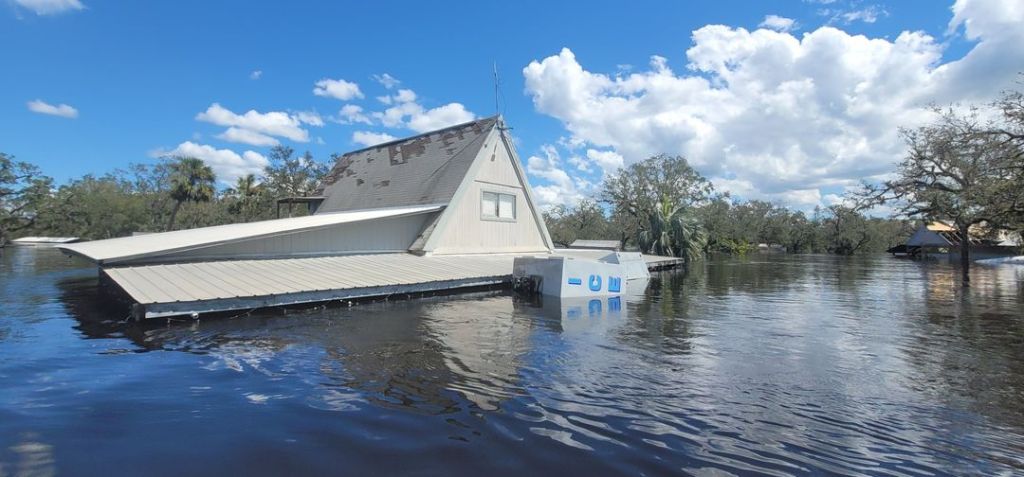
Peace River Campground, Arcadia, FL, two days after Ian struck.

“Depend upon it, Sir, when a man knows he is to be hanged in a fortnight, it concentrates his mind wonderfully.”

Those words were written by Samuel Johnson about the sentencing of an American clergyman, William Dodd. Exactly 245 years later (as of Sept. 19), they could–or should!–apply to anyone witnessing the twin ravages of Fiona and Ian, which between them tore up tens of billions of dollars in real estate, immiserated countless thousands and claimed an as-yet unmeasured loss of life. If contemplating such destruction doesn’t concentrate the collective mind, we are indeed doomed.

At this writing, the full extent of the devastation in Florida is still unknown, and the swamping of huge swaths of the southeast is just beginning. But the forlorn reports have started trickling in: “The Peace River is still rising!” announced a Facebook post from the Peace River Campground this morning. “If you had ANYTHING on the property, it’s UNDER WATER and not accessible. . . .The water is to the ceiling in the office. . . . We tried pulling campers to higher ground but the river was just too high. It’s catastrophic devastation.”

The Frog Creek RV Resort reported that it has no electricity and no certainty of when it will. “We have power lines down. Our staff is working hard to clean up the debris. Currently park is closed.” The San Carlos RV Park, meanwhile, said it had “sustained massive damage,” adding: “Our computers and records are inaccessible at this time. If you had reservations obviously that won’t happen. We will be working to refund deposits as soon as humanly possible, but please understand the immense task in front of us.”

Those and similar stories will be repeated dozens of times in the next few days, which is tragic enough. But the bigger tragedy is that they’ll be repeated next year, and the year after that–just as they were last year, and the year before that. And it’s not just hurricanes and subsequent flooding that will be the cause, or just RV parks and campgrounds along the Gulf Coast or the eastern seaboard that will be affected. Tragedy can be caused by too much water, but also by too little.

So it is that the National Interagency Fire Center announced today that 12 new large fires were reported yesterday alone, eight in Idaho and one each in Oklahoma, Oregon, Texas and Washington. Idaho and Montana currently have the most large fires, 59, out of 88 total across the West. To date, 6.9 million acres of U.S. land have burned in 2022, forcing thousands of evacuations and causing more than $11.2 billion in damage, according to Bankrate, an insurance website–and fire season isn’t nearly over.

Hurricanes become stronger and more frequent as ocean water gets warmer, while warmer air holds more moisture, resulting in heavier rainfall. But the same warming climate that pumps too much moisture into one part of the country is baking it out of another, causing widespread–and growing–aridification of all the states from the Central Plains west to the Pacific. The resulting tinderbox makes “enjoying the outdoors” ever more of a gamble, threatening the viability not just of camping but of fishing, as streams dry out and lakes shrink; wine making, as wildfire smoke contaminates grapes and bark beetles start killing off drought-stressed conifers and now oak trees in wine country; and farming and ranching. (As just one example of the latter, 39% of respondents to an August survey by the American Farm Bureau Federation said that wildfires have contributed to crop losses and herd sell-offs in their area in 2022.)

All of the above suggests a screaming need to reevaluate our relationship to the Great Outdoors–to “concentrate the mind wonderfully” on the hard questions reality is demanding we confront. Instead, the reflexive response, as already articulated by the Florida RV Park and Campground Association, is to pull together and rebuild and show some grit. “Our park owners and operators are some of the best people in the world,” association president Bobby Cornwell assured his members in an email today. “I have no doubt the industry will rally together and support all those in need.” Southwest Florida “will, without a doubt, be rebuilt and will be paradise once again.”

But doing more of the same, if spunky and admirable in a fatalistic sort of way, avoids the even harder work of figuring out how to avoid a repeat. It doesn’t engage the mind at all, much less concentrate it. Doing more of the same only assures an endless Groundhog Day-cycle of rebuilding and devastation and rebuilding again, until there’s no energy or money or hope left.

Poetically, both KOA and the National Association of RV Parks and Campgrounds will be holding their annual conventions in Orlando in November–long enough from now for a lot of the clean-up to be done, soon enough that the scars left by Ian will be inescapable. Both meetings would be ideal opportunities to examine what just happened, what is happening elsewhere in the country because of climate change, and how the campground industry could better respond to this existential threat. Ideal–but don’t count on it. That would require too much concentration.

William Dodd, it’s also worth remembering, was hanged.

Most recent posts

We’re all fiddling while Rome burns

Here it is, another three weeks before we get to Memorial Day, and already fire sirens are wailing all across the west. Blazes in Arizona and New Mexico have started pushing smoke into Colorado and Utah, reminiscent of last year’s West Coast fires that cast a pall over the eastern seaboard. Fire restrictions and bans are being ramped up throughout the Mountain West, affecting not only campfires but cigarette smoking and the discharging of firearms. The country’s largest reservoirs have been drawn down so far that decades-old corpses are emerging from the depths.

The causes of all this are well known. In the Sierra Nevada, the first three months of this year have been the driest in California’s recorded history, resulting in a snowpack that currently stands at only 35% of the average. One consequence: the state’s wildfires this year to date already have burned 35% more acreage than they did last year. In Colorado, meanwhile, the below-average snowfall of this past winter is raising fears among state officials that they’re heading into the worst wildfire year in state history. As reported by the Denver Post, for example, the snowpack in the San Juan Mountains is less than 25% of what it should be and is melting at a “ridiculous” rate.

The “facts” are unmistakable, but as the Covid pandemic demonstrated (and unfortunately continues to underscore), there are people for whom facts can be terribly inconvenient. Calls to change behavior for the greater good–to do something that will protect the lives and well-being of others, such as wearing a face mask or refraining from watering a lawn–are resisted at best, attacked as government oppression at worst. All sorts of spurious arguments and fantastical rationalizations get spun out, but rarely is there any acknowledgment that something must be done, much less what that something might be.

What brings this to mind most vividly is yesterday’s decision by Colorado’s Democratic legislators to abandon their attempt to address the vulnerability of homes built in wildfire-prone areas, such as the thousand homes in Boulder County that were torched last December. The forsaken proposal would have created a 17-member state board charged with adopting strict statewide building standards for the wildlife-urban interface by 2024, but was immediately attacked for its top-down approach. With more than 200 other bills pending and the legislative session supposedly ending today, Senate Republicans threatened to stall the entire process if the bill didn’t get yanked, forcing the Democrats to capitulate.

The Republicans, it should be mentioned, did not have a substitute proposal. That would have required acknowledging that a problem exists, and that the role of government is to deal with problems that threaten public welfare.

Colorado thus remains one of only eight states in the country without a minimum wildfire mitigation building code, even though its four largest and most destructive fires all occurred within the past two years. Moreover, the state’s lack of such a building code costs it big points when bidding for FEMA grant money, which flows more readily to states with a more pro-active approach to fire prevention. But, hey, how you can put a price tag on independence from the yoke of big government?

In southern California, meanwhile, an estimated 70% to 80% of urban water use is devoted to landscaping–in a state where agricultural fields are being left fallow because there isn’t enough water. But when water district officials impose restrictions, such as a demand that water use be reduced to 80 gallons per day per capita, public pushback has been immediate and vehement. Despite water bills of more than a thousand dollars a month, affluent homeowners who have spent as much as half-a-million dollars on landscaping are defying both regulatory pressures and common sense.

“A lot of people out here, they just feel kind of entitled,” Thomas Anderson, a security guard for entertainers, told The Washington Post earlier this week. “So they be like, ‘We got the money we’ll just pay whatever it is. Whatever the penalties is, so what? We’ll just write it off.’ They’re just going to suck up all the water anyway.”

Maybe all the numbers and statistics are too abstract for some people to absorb, so here’s one final sobering fact to drive reality home: as the fires in northern New Mexico continue to rage, various news sources are reporting that the moisture content of some of the timber they’re consuming is less than is found in kiln-dried lumber.

And yes, these are all things to think about if you’re camping, and especially if you’re boondocking.

Most recent posts