Let’s face it: we’re all tourons

There’s an undeniably smug pleasure many of us take in observing others’ failings or stupid behavior, and indeed, it’s hard not to feel superior when reading about the latest winners of the Darwin Awards. Or when gaping at the pictures posted on the People of Walmart site. Who goes out in public like that? How do some people come up with such incredibly dumb ideas?

And aren’t we special/smart/superior not to be like that?

And yet . . . and yet, perhaps the line between smart and stupid is a lot fuzzier than we think. Consider, for example, the gleeful fascination that self-styled outdoorsy types have with “tourons,” that mashup of tourist and moron used to describe people who think it’s a good idea to take selfies with a bison or elk, or who try to pet bear cubs. These encounters, which frequently end badly for the touron, are grounded in a Disney-fied view of nature and its creatures as essentially benign and placed on this world for our enjoyment. For a touron, the thought that we might be perceived as a threat—or even as a food source— is inconceivable. And it’s that lack of awareness that causes so much self-satisfaction for observers who pat themselves on the back for knowing so much better.

But what if we’re all tourons, to one degree or another, distinguished only by the clarity of our perceptions and the sophistication of our understanding? How much difference is there between the tourist who ambles up to a wild animal and the tourist who thrashes heedlessly through a tick-infested meadow, or who kicks up leaf mold and breathes in fungal spores, or who ignores a mosquito bite even after the headaches it caused progress to vomiting, high fever and aching joint pain?

That last set of symptoms describes the progression of dengue fever, which can leave a lucky person debilitated for weeks on end. The unlucky ones develop severe dengue, which causes plasma to leak out of blood vessels and results in organ failure. If untreated, with blood transfusions and intravenous fluids, the mortality rate is 15%. That’s probably higher than the mortality rate inflicted by bison goring stupid tourists, but thus far, at least, no one is calling dengue victims “tourons.” Not yet.

Although many Americans have never heard of dengue fever, or if they have, think of it as something exotic, it is in fact establishing a foothold in the United States, as are a growing number of other tropical diseases. Not seen in the U.S. until a few years ago, dengue is already found in the warmer, wetter parts of the country—Florida in particular, but also Texas, Arizona and southern California—and is expected to get a boost this year as a current explosion of the virus in Brazil moves north with the seasons. Depending on the weather, Georgia, Arkansas, Alabama and Mississippi could be next. The few hundred cases reported to date could quickly swell into the thousands.

This spread of mosquito-borne diseases—not just dengue, but yellow fever, West Nile and Zika viruses, malaria and others—is just one result of a warming climate that gets more attention because of the extreme weather it produces. But the “natural” world of flora and fauna is just as strongly affected by climate change as the physical world of wind and ocean currents and the increasingly violent storms they kick up. Warming waters produce algae blooms that poison once-pristine rivers and lakes. Shorter winters enable the spread of tick-borne lyme disease far beyond its New England origins. “Valley fever,” once confined to the desert southwest, is becoming endemic throughout the country.

All of which is to say that the romanticized view of Mother Nature promoted by the campground industry, and now its glampground imitators, is just as superficial and ignorant as that of the tourons who view wild animals as cuddly photo-ops. There are numerous threats to our well-being when we venture out of our domestic bubbles, some not even visible to the naked eye, and that number is growing at an alarming rate. Ignoring those less obvious perils doesn’t make us superior to tourons—indeed, failing to recognize our responsibility for creating a more dangerous environment, through our contributions to climate change, arguably makes us dumber.

Nature is not inherently hostile to humans: it just doesn’t give a damn, any more than a lightning bolt concerns itself with the tree it cleaves. In the final analysis, then, we have only ourselves to blame when we put ourselves in danger’s way, whether that danger comes in the form of a 1,200-pound bison that can run 35 miles per hour, or a 2.5-miligram mosquito.
Need RV repairs? Be prepared to wait!

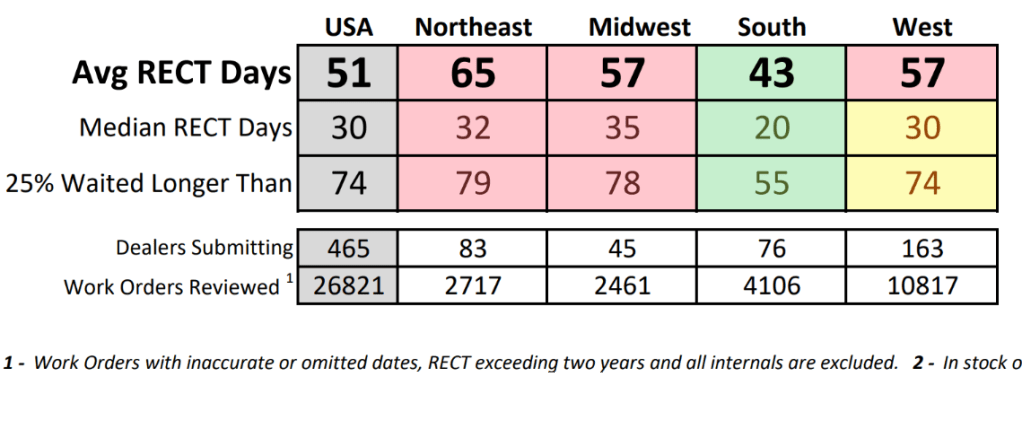
RECT is an acronym for Repair Event Cycle Time—the time from the start date of an RV repair order to its completion. Note that RECTs that took longer than two years (!) are not included.

Last summer I reported on a possible silver lining to the grey cloud of plunging RV sales: the decline in high-margin sales meant dealers had more incentive to beef up their servicing efforts. Complaints about months-long waits to get even basic repairs had been exploding, thanks in part to shoddy workmanship and substandard parts as manufacturers rushed product out the door—then dragged their heels on approving warranty repairs. Add a resulting shortage of replacement parts, and the completely predictable result was an average wait time last May of 34 days for non-warranty work—but 50 days for warranty repairs.

And if even one part was out of stock? That national average jumped to 73 days for non-warranty work, 89 days for warranty repairs.

Crazy, right? But that was actually an improvement over December 2022, when the national repair time had averaged 53 days, and the wait time for both warranty and out-of-stock repairs had nudged down a bit. Not a huge change overall, true, but moving in the right direction and with every reasonable expectation that the improvement would continue.

But that was then, and this is now. The average national repair time this past December shot back up, to 51 days—and if you’re unlucky enough to be in the northeast, that average was 65 days. In May, 25% of all customers had to wait longer than 33 days for their repairs to be completed; in December, that wait time for the unlucky 25% had more than doubled, to 74 days. The national average wait of 50 days for warranty repairs in May had jumped to 67 days in December, and to a whopping 90 days in the northeast. Meanwhile, the percentage of repairs that languished because parts were out of stock jumped to 33% in December from 21% in May, extending those repairs by another week.

It wasn’t supposed to be like this. The number of RVs cranked out by manufacturers last year was roughly half that of 2022, which one might think would mean more time for quality control on production lines. Lower production and the repair of pandemic-disrupted supply lines should have replenished parts stocks, not squeezed them further. And after several years of pumping money into its technical institute, the RV Industry Association was boasting in December of having the largest number of certified techs in the RV industry’s history.

So where’s the bottleneck?

A good question, and one the industry hasn’t yet acknowledged, much less answered. To be sure, some of the numbers above may be attributable to seasonal variations, if inexplicably so: repair times seem to peak in December and January, then gradually decline through the spring and summer before bottoming out around October. Still, the latest peaks are significantly higher than those of a year ago, so progress this ain’t. The only thing certain is that RV owners who need repairs are still twisting in the wind, their expensive and frequently highly leveraged adult toys sitting on a dealer’s lot somewhere for months on end.


The data above, utilized by the RV Dealers Association for the benefit of its members, is extracted from much more extensive research conducted by a systems software company called Integrated Dealer Systems. Number nerds who would like to explore that information more thoroughly can go deeper here. 

ARVC/OHI: adrift without a rudder

The organization formerly known as the National Association of RV Parks and Campgrounds, or ARVC, is having one heck of an identity crisis.

Last November, supposedly after a year of vaguely referenced “surveys and interviews,” the association’s leadership announced that it was “rebranding” itself and henceforth would be known as Outdoor Hospitality Industry, or OHI. That awkward word jumble without a subject noun was explained away by ARVC/OHI’s executive director, Paul Bambei, as marking the association’s transition toward becoming “the trusted voice of all outdoor hospitality.”

Delusions of grandeur, anyone?

While Bambei and his enablers thus laid claim to global aspirations for their modest little industry association, ARVC’s dues-paying members couldn’t help but notice that they had been disappeared. An organization originally founded “for the purpose of promoting camping through the private sector and protecting the camping industry from unfair legislation and unfair competition” apparently had decided that “camping” was—what? Too old-school? Too limiting? Just not as focus-group attractive as “outdoor hospitality”? Whatever the case, “campgrounds” and “RV parks” seemed to have ceased as an integral part of the organization’s identity.

Predictably, the grumbling soon started. Critics pointed out that the outdoor hospitality industry’s “trusted voice” presumably would be speaking on behalf of not just campgrounds, RV parks and glampgrounds but also bed-and-breakfasts, inns, ski lodges, marinas, resorts and even hotels and motels if they were in any way connected to the “outdoors.” Worse yet, the new “outdoor hospitality” umbrella would cover Harvest Hosts, Boondockers Welcome and Hipcamp, long seen by many campground owners as unfair competitors who don’t have to comply with RV park licensing requirements. How would all these disparate businesses have their conflicting interests represented by a single voice except in the most abstract sense?

Less than a month later, the grumbling became more serious when the Pennsylvania Campground Owners Association voted to quit its partnership with OHI. The national organization’s “mission and vision” no longer aligned with its own, PCOA leadership explained, adding that its members had grown increasingly concerned about OHI’s lack of communications and transparency about various changes it was implementing.

Decisive though it was, however, PCOA actually was slow on the uptake: ARVC/OHI had been signaling its intentions at least a year earlier, with little apparent pushback—and, indeed, may have been emboldened by the muted response. Early last year, for example, I wrote a three-part post making the case that ARVC had lost its way. (Indeed, in an ironic foreshadowing, I suggested at the end of the second installment that “perhaps it should rebrand as the National Association of the Outdoor Hospitality Industry.”) I observed at the time that ARVC had adopted a “mission statement” that was couched “in soulless corporate-speak,” to wit: “We empower outdoor hospitality businesses by providing industry-tailored resources, organic connections, consumer exposure, professional development, and proactive legislative action.” 

This past week, apparently in belated response to PCOA’s secession, ARVC/OHI backpedaled furiously. According to its press release, because the new mission statement neglected to explicitly identify its “core membership,” the wording would be changed to the following: “To empower RV parks, campgrounds and glamping businesses with the community, resources, professional development, and legislative advocacy needed to ensure successful futures for all Outdoor Hospitality Industry businesses.” (The new wording, it added, is to be approved at ARVC/OHI’s board meeting this spring—raising the question of just who decided this is a good idea that should be announced before board approval.)

No mention of the name change to OHI and its silence on the subject of camping. No mention of OHI’s “vision” statement—“an empowered outdoor hospitality industry”—also cited by PCOA as a point of contention.

The proposed new mission statement is known as trying to have your cake and eat it, too. As with most such efforts, however, it fails as a semantic construct, since there is no logical connection between empowering RV parks, campgrounds and glamping businesses on the one hand, and ensuring the successful futures of all outdoor hospitality businesses on the other. The “empowering” of a part does not ensure the success of the whole. On the other hand, the way this sentence is constructed, its unmistakable meaning is that RV parks and campgrounds need to up their game so that the outdoor hospitality industry as a whole can thrive.

Bambei, meanwhile, proved himself just as fuzzy-minded as the organization he leads by insisting in the press release that the core constituency he serves really hasn’t changed, “it’s simply expanded.” Which is not unlike saying our little town of New Amsterdam really hasn’t changed, it’s simply expanded—into New York City. 

But logical thinking and precise language aren’t the point: muddying the waters is. Whatever he may say after the fact about his primary concern for ARVC/OHI’s “core,” Bambei just can’t keep his grandiose ambitions from spilling into the open—and so, in that same press release, he goes on to to declare that “we know it is important that the hospitality industry has a national organization positioned to represent it well into the future.” And so, by golly, the RV park and campground industry might as well shoulder that burden on behalf of all those other unrepresented businesses. With Bambei at its helm, of course.

PCOA’s secession apparently had another, more salutary effect: almost simultaneously with its announced mission restatement, OHI’s board voted to allow direct RV park and campground membership across the United States. In doing so, it ended a much-criticized requirement that campgrounds in partnering states—like Pennsylvania—could belong to ARVC only if they first joined the state organization. (On the flip side, campgrounds that belonged to a partnering state association were in most cases required to pay national dues even if they didn’t want to be ARVC members.) That compulsory package deal was so unpopular that the country’s biggest state associations had been seceding from ARVC, one by one, with Pennsylvania’s departure the final straw.

But while long overdue, this change means that OHI will relinquish having captive dues-payers delivered by compliant state associations and will have to actually earn those members by convincing them it has their best interests at heart—a daunting prospect for an organization increasingly criticized for being out of touch with its grassroots and given to top-down decision-making. That, as much as any dreams of representing a vaguely defined but overarching “hospitality industry,” explains why ARVC/OHI seems so unmoored these days.

A warning shot about RV price fixing

The use of algorithms to set prices of common goods and services, enabled by widespread computerization and data scraping, has seeped into various parts of the economy. Proponents claim such “advances” simply promote greater market efficiency, but that increased “efficiency” benefits just the price-setting side of each transaction—buyers don’t have similar access to data that would enable them to get a more efficient price.

RVers and campers have experienced this problem first-hand. It wasn’t so long ago that RV parks provided rate sheets spelling out how much a particular site would cost on a particular night, but these days that kind of transparent pricing has been supplanted by “dynamic pricing.” How much you’ll be charged for an RV site will depend not just on the day you want to reserve, but on the day—and even time of day—when you make the reservation. Of course, which day will get you the best price is not something a consumer can learn, not least because the “dynamic” piece of that pricing system makes this a moving target. But this system wasn’t designed to benefit customers, anyway.

The industry rationalizes this two-step as simply a response to supply and demand, neglecting to acknowledge a third piece of today’s pricing puzzle: what is the competition charging? Back in pre-algorithmic days that wasn’t a question to be answered easily, since it required obtaining and looking at numerous published rates or contacting other campground operators directly, which not only was a lot of work but also raised all kinds of messy price-fixing and antitrust concerns. But then the campground industry embraced online reservation systems, and as the saying goes, That. Changed. Everything.

Or not. Digitally-driven sales and marketing have made price collusion a lot easier to implement, but the legal (and ethical) considerations have not gone away, making push-back inevitable.

This coming Tuesday, a group of U.S. senators will be introducing legislation, dubbed the Preventing the Algorithmic Facilitation of Rental Housing Cartels Act, to make it illegal for landlords to use algorithms to artificially inflate rents or reduce the supply of housing. The proposed law apparently was catalyzed by an extensive ProPublica investigation, on which I reported in the fall of 2022, that found software used by competing landlords was collecting their proprietary data and feeding it into an algorithm that would “suggest” what rents they should charge. As price setting goes, according to bill sponsor Sen. Ron Wyden of Oregon, that’s “no different from doing it over cigars and whiskey in a private club.”

Although Wyden said he believes existing antitrust laws already apply to what data-compiling companies like RealPage and Yardi are doing, “I want the law to be painfully clear that algorithmic price-fixing of rents is a crime.” Next week’s proposal, therefore, brushes aside industry protestations that it’s only providing information—in its words, making price-fixing collusion “implausible”—by make it illegal for property owners to contract with companies that coordinate rent prices. It also would bar two or more rental owners from coordinating on such information.

The parallels between rental housing algorithms and those now available to RV park owners are stunning, as manifested most widely by Campspot, easily the big dog among campground reservation software providers. The Grand Rapids-based booking agent last year made 3.1 million reservations across more than 2,100 campgrounds, processing in excess of $1.9 billion. But as reported last July, Campspot also introduced a reporting dashboard for its RV park clients that leverages all the reservation data it is constantly accumulating, enabling “individual campground owners to compare their metrics, such as average daily rates, occupancy rates and revenue per available site, with what everyone else is doing—and to make adjustments as desired.”

Campspot’s helpful guidance to campground operators seems to fall a step short of the problem next week’s Senate bill will address among landlords, in that it apparently doesn’t suggest a specific site rate; it just provides all the information for campground owners to reach their own conclusions. Or as Campspot puts it, “With these tools at their fingertips, campgrounds are able to stay ahead of the competition, make confident pricing decisions, and unlock their park’s full potential.” Collusion? Nah—that’s so implausible.

Compared with the massive rental housing industry, RV parks and campgrounds are just an economic blip, and so may readily slip under the radar of antitrust regulators and lawmakers. But to the extent that RV parks increasingly serve as part of the nation’s housing stock, it wouldn’t be surprising to see the introduction of a Preventing the Algorithmic Facilitation of RV Park Cartels Act, enabling the public to make confident pricing decisions when reserving campground sites.

Why does KOA play a numbers game?

As it’s prone to do, KOA—“the world leader in outdoor hospitality”—tooted its own horn this past week by announcing yet another “year of significant expansion.” Claiming to have notched a dozen independent park conversions in 2023, as well as eight new construction contracts, the RV park franchiser trumpeted that its increased inventory “underscores the organization’s resilience and adaptive strength in the evolving travel, camping and outdoor hospitality industry.”

Really?

Although the campground industry’s sycophantic press was quick to regurgitate the “news,” apparently no one paused long enough to let the numbers sink in—or to notice how awfully familiar they sound. Because while the same press release noted that the year’s developments increased KOA’s “elevated number of branded locations to 511 across North America,” the company had claimed 525 locations in mid-2021, up from 520 in 2020—so where’s the “significant expansion”?

A generous person might argue that the apparent two-year decline—unfounded claims of KOA’s “resilience” notwithstanding—shouldn’t be taken too seriously, a one-off because of the pandemic and its aftershocks. But the truth is that KOA’s crowing about growth in locations has been a recurring event for at least a decade, a marshaling of incomplete numbers wrapped in hyperbole aimed at convincing the public—and especially campground owners— that this is one helluva dynamic, growing company. The truth is somewhat less than that.

Consider, for example, the presentation given by KOA’s then-president Toby O’Rourke at the company’s 2018 annual convention. “This year we brought in 12 new conversions, four more are to be signed and that means we should have 515 KOAs in the 2019 directory,” she explained. “People are investing in camping and they’re investing specifically in KOA.” Which sounds good only until you notice that O’Rourke, as was true of KOA this past week, referred to only one side of the ledger. And as the numbers above indicate, departing KOA franchisees have more or less cancelled out all those incoming conversions and new builds. When it comes to campground numbers, KOA is only treading water.

It’s actually worse than that. In 2012, for example, there were 484 campgrounds across the U.S. claiming the familiar yellow logo, so at first blush one might think that at least the system has expanded by two-dozen or so properties over the past decade. But of that 484, 26 KOAs were company-owned and 458 were franchisees. By this past summer, the number of KOA-owned parks had nearly doubled, to 51, while the number of franchised properties had increased by just two. To the extent that KOA has been growing, it has done so as an owner of RV parks and not as a franchiser

Does it matter? Maybe not, but for KOA’s persistence in making its unfounded statements of franchisee growth, which begs the question: why? Why keep repeating the same cockamamie claims? KOA is privately owned, so it doesn’t have stockholders to impress. Its campers don’t much care if the chain has 450 or 500 or 600 RV parks. The only other significant audience for its overblown representations is independent park owners, whom KOA needs in its ranks to offset the deserters—and who presumably need assurances that KOA is one bitchin’ star to which they can hitch their wagons. And, indeed, that’s pretty much the case made by O’Rourke, now KOA’s CEO, as she asserted that “the healthy influx of new franchisees and new campgrounds is a clear indication that KOA is meeting the needs of our customers—both campers and franchisees alike.”

Beneath all this bluster is the unremarked fact that KOA is rapidly morphing from a company in service to its franchisees to one serviced by those franchisees: all those company-owned properties were purchased thanks to the 10% of revenues that KOA collects in franchise fees. Moreover, the RV parks that KOA buys are on the upper end of its tripartite breakdown of properties into Journey, Holiday and Resort categories, which means that corporate resources have been getting funneled into developing high-end amenities and standards, not into raising the laggards. The KOA Journeys, meanwhile, are left to fend for themselves against growing competition from the likes of Love’s Travel Stops, which coincidentally announced this week it will expand its chain of full-hookup RV parks from 54 to 98 by year’s end. Give Love’s a couple more years like that and it will be eating KOA’s lunch at all but the high end of the campground spectrum.

One other development buried within KOA’s unreleased numbers is the extent to which its individually owned campgrounds have been consolidating under group ownerships. A KOA today is as likely to be one of several owned by a corporation or an investment group as it is to be a traditional mom-and-pop operation, from some entirely native to KOA—Recreational Adventures Co., the Bell family out of San Diego—to others sprawling across various outdoor properties in and out of KOA, such as Team Outsider, Encore RV Resorts or BlueWater, to name just a few. The number of individual franchise owners, in other words, is rapidly diminishing, and with it the overall KOA culture, which is becoming flatter, more corporate and less interesting with each passing year.

KOA, as KOA likes to remind us, was founded by an aw-shucks Montana entrepreneur who wanted to provide Americans traveling to the Seattle world’s fair with a clean, safe place to spend the night. No telling what Dave Drum would have thought of what his creation has become, but I suspect the one thing that might have rubbed him the wrong way is its penchant for puffing out its chest and telling tall tales and half-truths. Sounds like something you’d expect from a city slicker.

More RV sites don’t mean more room

If you’re a recreational RVer—someone who bought a travel trailer or class C motorhome thinking you’d like to take the kids camping—a pair of reports this past week by two long-time campground observers could make your head spin.

The first, by industry reporter Jeff Crider writing in RVBusiness News, tells readers they can “expect more than 18,000 new campsites through 2027,” thanks to 90 new campgrounds being built across the country, as well as new sites being added at 66 existing parks. For RVers who had been complaining since the pandemic about the increased difficulty of finding a place to camp, that sounds like incredibly good news—or it could be an instance of being a day late and a dollar short, given more recent reports of reservations loosening up. But hey—either way, it can’t hurt that more RV sites are coming, right?

Well, maybe not. Because as the second report suggests, much of that new RV site inventory is already spoken for, and even then there’s not going to be enough inventory to meet growing demand from residential RVers. Or as Frank Rolfe asks rhetorically, in yet another post promoting the investment rewards of RV park ownership, “What’s up with customers moving into RV parks full-time?” The answer, he quickly responds, is that “millions of Americans are starting to realize that they can live in their RVs fulltime and save a fortune on housing costs, with the additional benefits of pleasant surroundings and camaraderie of the RV park.”

Against that backdrop of “millions of Americans” looking for a home, even 18,000 new campsites becomes a negligible expansion. Indeed, if Rolfe is to be believed, the entire RV park segment is rapidly becoming a tricked-out version of the trailer courts that long ago became a depository of America’s most impoverished class.

Now, Frank Rolfe is not someone to be trusted if you don’t have a firm grip on your wallet, so take whatever he says with a grain of salt. He’s not a reporter but a promoter, one who years ago made a name for himself by recognizing that the residents of mobile home parks are a captive customer base, sitting ducks for ever higher lot rents and add-on fees for even the most basic services. But as affordable sticks-and-bricks homes remain in short supply (thanks in part to speculators at the other end of the vulture spectrum, with hedge funds snapping up single-family homes by the thousands), resulting in a 30-year low in home sales in 2023, the resulting demand for mobile homes has made that an increasingly pricey option as well: indeed, the growth in mobile home prices has outpaced that of single-family homes since 2017, soaring 77% to an average nationally of $127,300.

With the average mobile home in 2022 costing more than $100,000 in every state in the country, and as high as $168,500 in Idaho, house trailers have yielded their lowest-cost housing status to travel trailers—which, it should be noted, are explicitly not designed or built for full-time residency, but which are a damn sight better than living in a tent full-time. And if that carries a whiff of desperation, well, that’s exactly the kind of odor that appeals to a bottom-feeder like Rolfe.

So it is that Rolfe has taken to pounding the drum on behalf of RV parks as the next great real-estate cash machine, extolling their role in solving America’s “worst affordable housing crisis since 1776.” (Really?) Sure, RVs are smaller than mobile homes, built to less durable standards and rarely designed for four seasons, but they’re . . . cozy. And they’ve got those “pleasant surroundings and camaraderie” of an RV park to distract their occupants from their narrowed horizons. To make such privation sound more attractive, Rolfe links to a story about a 38-year-old woman living in a 20-foot travel trailer in Austin who simply loves “tiny living.” It helps, of course, that she’s single, has no kids and is healthy enough to bike to work each day, and whose primary motivation—as detailed in a different, more extensive story— is to save a million dollars by the time she’s 45.

That this is not your typical full-time RV dweller should be obvious, but Rolfe is in any case more interested in convincing RV park owners to convert their properties into something that looks more like a mobile home park. “The average RV park customer stays for 14 days per year” (Again—really?), while a full-timer stays for 365 days, “so one full-time customer is as important for your business as 180 normal customers.” The math doesn’t add up (Rolfe divided 365 by 2 instead of 14, mixing up weeks and days), nor do the dollars, since full-timers get a significant pro-rated discount from nightly rates. But as Rolfe goes on to point out, there are other benefits to having year-round residents, including fewer marketing requirements, more consistent cash flow and more stable management.

Indeed, if the Austin “tiny living” enthusiast is an example of what Rolfe is seeking, there are wads of cash to be made by pushing full-time occupancy in RV parks: in this example, lot rent of $750 a month, plus $42 for utilities, or $9,504 a year. Given that a large RV park may cost as little as $10,000 a site to build, those are the kinds of numbers that will have institutional investors falling all over each other to get into the business, and even more so if they’re shown how to run an RV park with minimal fuss—which is to say, with year-round residents rather than transients. So what’s not to like?—unless, of course, you’re the unfortunate RVer looking for a long weekend where your kids can get some fresh air and wood smoke.

Turning a deaf ear to Mother Nature

Sorting through the crushed remains of a camping trailer at the Florida Caverns RV Resort.

It’s been a helluva week on the weather front, and nowhere more so than in Marianna, Florida, where a likely tornado smashed through the Florida Caverns RV Resort. The Tuesday twister “obliterated the laundromat at the campground, peeled the roof off the gas station and restaurant and damaged or destroyed a number of one-bedroom park models and mini-cottages,” according to reporting by the Tallahassee Democrat. It also wasn’t kind to RVs, an unspecified number of which were totaled.

All that is bad enough, but such misfortune becomes farce when one learns that the relatively new owner of the campground, Tallahassee businessman Erwin Jackson, had just paid the final bill for $2.5 million in damages caused by Hurricane Michael. Michael, a Category 5 tropical cyclone, plowed through Florida and Georgia in late 2018—so just a bit more than five years ago, and only days after Jackson had bought the property. Now Jackson, despite declaring that “we actually had more damage with this than with Hurricane Michael,” says he will rebuild yet again.

Call him plucky—or maybe just foolishly stubborn, like those oceanside homeowners who insist on rebuilding despite rising seas and ever more violent storms. Einstein’s aphorism about the definition of insanity jumps to mind, but perhaps King Canute’s vain exhortation of the tide is more on point, a delusional belief in one’s god-given power to do as one pleases, elemental forces be damned. Or maybe there’s a different calculus at work, a bet that surely lightning won’t strike in the same place a third time?

Yet as suggested by several new reports and studies, also released this past week, the odds of a third strike are both dismally high and rising with each passing year. Not only was there confirmation that 2023 was the planet’s hottest year on record, a statistic that measures ambient air temperature, but there was the fresh news that the world’s oceans have gotten hotter with each passing year since World War II—and are heating faster than at any time in the past 2,000 years. That’s according to a study published in the journal Advances in Atmospheric Sciences, which found that ocean surface temperatures were “off the charts” last year, contributing to ever more extreme weather events.

No surprise, then, that the National Oceanic and Atmospheric Administration separately reported that the U.S. endured 28 billion-dollar weather disasters in 2023, readily eclipsing the previous record of 22, set in 2020. The average time between billion-dollar disasters was less than two weeks, a fraction of the average interval of 82 days in the 1980s, according to an analysis by a nonprofit group of scientists called Climate Central. The 2023 toll included $92.9 billion in damages, although that almost assuredly will increase as the bills keep coming in, as well as nearly 500 deaths.

For the RV industry, it’s worth noting that two-thirds of the billion-dollar disasters occurred during peak camping season, May through September, not to mention numerous “smaller” disasters sprinkled throughout. In other words, the kind of trauma experienced by campers at the Florida Caverns RV Resort this past week will become increasingly more commonplace, whether from extreme hailstorms, flooding, tornados, hurricanes or forest fires. Those affected will include not just campground owners and vacationing RVers, but a growing number of people who now live in campgrounds as their housing of last resort.

Still, despite all these clanging alarm bells, there is no discussion within the RVing “community” of what this all means. No discussion of the unsuitability of untethered RVs for long-term housing—unlike trailer parks, for example, which are required in hurricane country to have their mobile homes strapped down. No discussion of the idiocy of building RV parks and campgrounds in flood zones, as continues to be a widespread practice. No discussion of the long-term precarity of the whole RV park business model, which entices people to spend beyond their means to buy ever more blinged out homes on wheels to be pulled or propelled by internal combustion engines that burn ever greater quantities of fossil fuels, thereby perpetuating a vicious cycle.

That’s in marked contrast to less myopic business and financial leaders, who are taking environmental concerns very seriously, indeed. Among the many relevant reports out this past week was The Global Risks Report 2024, the 19th edition of an annual risk assessment prepared by the World Economic Forum, in partnership with Marsh McLennan and Zurich Insurance Group. Drawing on “the collective intelligence of nearly 1,500 global leaders across academia, business, government, the international community and civil society,” the study found that environmental concerns “dominate the risks landscape” both short- and long-term, with extreme weather as the leading risk. (Other environmental concerns include biodiversity loss and ecosystem collapse.)

That ranking puts extreme weather ahead of AI technology, social polarization, inflation or other economic concerns as threats to business as usual, but as Erwin Jackson’s resolve indicates, when it comes to RVs and campgrounds, business-as-usual is the rallying cry. His peers will sympathize with his plight—as is to be expected—and most will cheer him on and possibly extend a helping hand; that’s understandable and even commendable, if shortsighted. But if history is any guide, no one in the industry will question whether rebuilding is actually a smart thing to do, or if there’s an alternative, or whether enabling self-defeating behavior is more unkind than demanding a reality check.

Mother Nature is talking, but is anyone in RV-land listening?

Holes down which to throw money

Years ago, when I was reporting from a coastal city in South Carolina, I learned the classic definition of a boat: a hole in the water down which you throw a lot of money.

RVs are like that. Like boats, they hold out a promise of freedom, of self-sufficient travel and of being unshackled. For most, they’re a way to vacation; for a comparative few, they’re an alternative lifestyle. But the overall reality is that mostly they sit in a driveway or storage yard, their insides vulnerable to mold and invading rodents, their outsides bleached by rain and sun. The romance of the road is much like the siren call of the sea, a hazy aspiration that quickly founders on the shoals of high fuel prices, constant maintenance and the realization that you’ll never spend enough time on the thing to justify its price tag.

Turns out others are coming to the same realization. My AOL newsfeed (yes, I realize I’m dating myself) just ran a story from Cheapism headlined “19 Reasons Why You Really Don’t Want to Buy an RV” which a) is surprising because AOL isn’t where I turn to read news about RVs, and b) nineteen reasons? Really??

But yeah: 19 reasons, which is an odd number for an industry that usually likes round figures. It’s also odd because the list could readily have grown to 20 if not for an inexplicable omission, but more on that later. What’s worth noting about this litany, however, is that roughly a third of its red flags have to do with the daunting economics of owning RVs, from their “insanely expensive” sales tags to the “minefield” of rampant up-selling and scare tactics at dealerships to pricey insurance premiums. Throw in “RVs are gas guzzlers,” “RVs depreciate like crazy” and “upkeep is expensive, too,” and it’s clear that boats aren’t the only money pits awaiting the unwary.

Other Cheapism reasons not to buy an RV are critiques of RVs themselves, rather than of a decision to purchase one, familiar to any RVer: they can be “terrifying to drive,” can leave their users feeling cramped, suffer from shoddy workmanship and can be exhausting to set up and break down between long days of driving. And, let’s not forget, “One word: sewage.”

What’s surprising, in a cost-weighted analysis, is the article’s failure to look at the steadily rising cost of campgrounds and RV parks. Although one of its 19 reasons is the observation that “you can’t just park an RV anywhere for the night,” the brief explanatory text warns only of the limitations for penny-pinchers of overnighting at Walmart. That’s like writing about the cost-saving benefits of tossing an anchor into open waters for the night, ignoring the price of harbormaster and docking fees that inevitably will become part of the overall calculus.

On that score, then, it’s worth noting that campground fees have roughly doubled over the past three years. And, as with the upselling and scare tactics Cheapism cites at RV dealerships, RV parks increasingly are layering on additional charges, including reservation fees (!), site lock fees, nonrefundable deposits and cancellation fees—and all that’s on top of the industry’s widespread adoption of dynamic pricing.

Nor is that the top of the pricing escalator. As recently reported by RV Business, RVers seem surprisingly open to the idea of having their electricity consumption metered and paid for separately, with a full 50% of respondents to a survey averring that such a charge would be “only fair for everyone”—presumably the sentiment of pop-up owners looking at motor coaches with two air conditioners. But while metering is commonplace for long-term sites, charging overnighters for their electricity use would be groundbreaking. It also would result in minimal if any change in baseline site rates, amounting to an overall increase for pop-up and class A owners alike.

Back in the day, outsized cars used to be called “land yachts,” so that moniker can’t be hung on today’s even larger recreational vehicles. Which is a shame, because those RVs indeed have become land yachts in every sense of the word: holes down which a lot of money can be thrown. It’s unfortunate that campgrounds are making that hole deeper.

RVing shenanigans of the past year

No, this is not a glamping tent, no matter how much it looks like one. It’s an Airbnb rental, which means it sits not in a campground but on a residential site—along with 12 others in Minnesota.

The end of one year and the start of another frequently prompts retrospectives by those seeking closure or looking to demonstrate their cleverness. Sometimes it would be better if they didn’t.

This week, for example, the RV Industry Association breathlessly announced its “top 10 highlights from 2023!” and led off with its 2023 Vacation Cost Comparison Study. Released last April, this 125-page analysis “found” that “RV vacations cost much less than other types of vacation travel, even when factoring in fuel prices and the cost of RV ownership.” “Found”— rather than “established” or “determined”—was an apt choice of verbs, given its overtone of accidental discovery.

Indeed, as I wrote here and here, the “comparison study” suffered from several analytical errors and oversights, leading me to conclude that “the argument that RVing is an economical way to vacation works only if such a vehicle gets deposited in your driveway for free and it never suffers any mechanical issues.” But at least RVIA was touting its cost-benefit analysis in an understandable if flawed attempt to bolster sagging RV sales, which despite such efforts continued their plunge right through the end of the year. There’s less excuse, however, for RVIA to continue promoting such questionable claims today, even if in the guise of a top-ten list of the past year. That’s like the White Star Line citing the April 2 completion of RMS Titanic as one of its highlights of 1912.

Perhaps RVIA leadership is just too lazy or too innumerate to engage in a bit of critical thinking about its output. As much can’t be said for the outright grifters that the campground industry has attracted the past couple of years, few of whom can claim ignorance of the scams they’re peddling. Take Travis John, for example. As I wrote last January, John was looking to raise $8 million from 10,000 or so investors so he—and they—could buy a campground. The sales pitch included a lot of trendy jargon about non-fungible tokens and how John’s company, Campers DAO, would use “latest blockchain technology and an innovative business model to turn a membership into an NFT asset.”

Apparently that innovative business model didn’t find a lot of buyers. And, of course, the whole airy-fairy world of cryptocurrencies and non-fungible anything began wavering, culminating in the November conviction of Sam Bankman-Fried. But by then John had already retreated to a hidey hole somewhere, announcing in April an indefinite delay of the Campers DAO launch while it went about “building more value.” Not a peep out of him since.

Meanwhile, the unbelievable promise of a full year of luxury RV camping for just $3,100 a year has proven to be just that, as two of the four partners in the Whispering Oaks Luxury RV Park in Arkansas filed suit in December against the other two. The aggrieved partners averred that it is “no longer reasonably practical to carry on” the business, not least because, they allege, Brian and Stacy Sides misappropriated business assets for personal gain, bounced checks and otherwise acted in ways that “damage and destroy the business.”

How shocking was that? It shouldn’t have been. As I wrote in April (what’s with this April thing?), Sides already had a record that included defrauding three Joplin, Missouri women out of a combined $29,000 for work he never performed. But when a local reporter earlier this year asked him about the incident, he responded with the classically moronic “there is another guy that done that” riposte. It goes without saying that not a shovelful of dirt has been turned at the luxury RV park site, its website has vanished, and so has the entrance billboard.

Other fantastical campground deals announced last year remain to be played out, including a luxury (aren’t they all, these days?) RV park in Danville, VA proposed by developer Joe Cubas, whose other bright idea is to make that town a Virginia version of Sturgis, SD. And, of course, there’s the grand design by failed Florida real estate developer Ricky Trinidad to build a “white glove” RV resort in Pennsylvania covered by a massive, transparent air dome. Local politicians in both municipalities have been tripping over each other in their eagerness to welcome these so-called revitalization projects, so one can only hope a brisk winter will shock some sense into them.

The seductive—if empty— promise of a financial bonanza for the locals is often enough to mute the critics when someone proposes a multimillion tourist development, but several notable exceptions were notched in 2023. Among them was the victorious campaign in Saugerties, NY against a proposed KOA glampground under the Terramor name plate, and the less heralded deep-sixing of a $30 million luxury (yes, again) campground proposed for New Hope, Tennessee. While the Saugerties battle featured a relatively media-savvy grassroots movement in a relatively economically resilient area, New Hope is “a wide spot on two-lane Route 156 that has one Dollar General, two beauty shops and a meat processing business,” as I wrote in, yes, April. But in July, after a bit of local agitation and a petition drive, the developer backed out.

Local resistance isn’t always effective, though, if an RV resort developer has exceptionally deep pockets and the locals are slow to cotton on to what’s happening. That’s been the story in Midway, Kentucky, where town fathers initially welcomed and then belatedly backpedaled from a monster project known as the Kentucky Bluegrass Experience Resort, projected to become one of the ten largest RV resorts in the eastern U.S. When the full scope of the proposal—and how it would impact the local community—finally sank in, Midway’s city council tried to block the project by refusing to extend municipal water and sewer to the site.

That was more than two years ago, but despite the lack of subsequent headlines, the developers didn’t just go away. Instead they played the long game, culminating in October in approval of an ordinance allowing RV parks to operate private sewer plants. Such private plants had been banned a couple of decades ago, after several local mobile home parks had private systems that failed, spilling raw sewage into local waterways. But history doesn’t repeat—does it?

Finally, one more example of perseverance against local opposition deserves spotlighting. Christine Wyrobek, told by her local planning commission in May (not April!) that she could not build a glampground on her 45 acres abutting Lake Vermilion, Minnesota, went ahead and did so, anyway. She’s just not describing it as a campground. As she explained to a Star Tribune reporter in September, her 13 campsites “fall securely within the county ordinance allowing short-term rentals for fewer than 180 days on residential property—which also allows for VRBO and Airbnb rentals.” And so glampground out, Airbnb rentals in.

Just when you thought all possible blurring of the lines about “camping” had been achieved. . . .

RVer dilemma: death by fire or cold

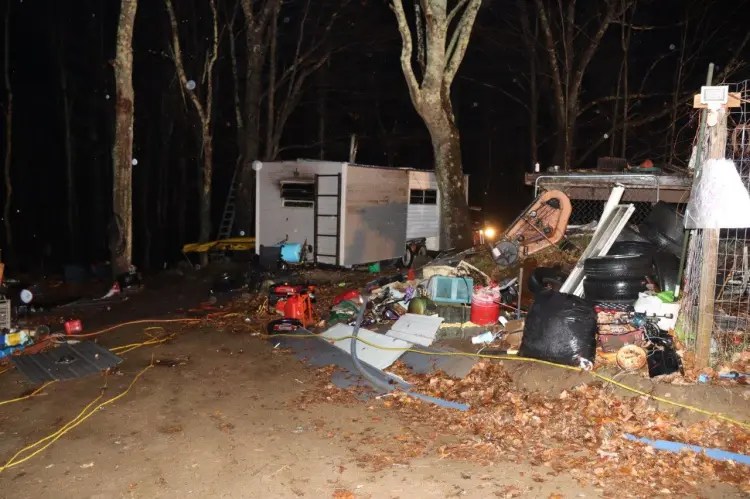
The site of a fatal RV fire in Windsor, Maine, in early November. Note the multiple extension cords criss-crossing the area, indicative of the jury-rigged nature of this encampment.

Now that we’re well into meteorological winter, one sure-fire prediction is that we’re going to see a rising crescendo of reported RV fires. A Google search for “RV fires,” for example, turned up the following news reports over just the past 24 hours:

  • “Putnam County Fire Rescue responded to a 30-foot RV fire off Mackey Avenue,” but were unable to save two family dogs.
  • “Firefighters are investigating what caused an RV to go up in flames in northwest Fresno.”
  • “An investigation is underway after a RV fire briefly threatened a home in Sparks Tuesday night. “

Expand the time frame and you’ll encounter some truly chilling headlines, such as the following from a week ago: “Mom listens to baby scream in burning RV until he falls silent, Arkansas cops say.”

It’s hard to ascertain, in the first three examples, how many of the immolated RVs were being used as full-time housing, but it’s a pretty good guess that such was the case in the older story. Such incidents have become commonplace, and will become more so as time goes by: more than 650,000 people nationwide are sleeping outside or in shelters, according to the latest snapshot census (another will be conducted next month), thanks in no small part to a critical shortage of affordable housing. The real estate group Redfin reported last week that just 15.5% of homes for sale are affordable for the typical U.S. household, the lowest share in at least a decade.

For those unable to afford a home, the opportunity to live in an RV must seem immeasurably better than joining the army of pavement dwellers. A roof and four walls, a door that can be locked, possibly functioning electrical outlets—even the shabbiest travel trailer can be a refuge against rain, prying eyes and human predators. Indeed, if first occupied during summer months, such an RV can seem like a godsend, allowing fantasies of outdoor vacationing and only temporary inconvenience, a pitstop on the road back to “normal.” And then harsh winter intrudes.

Last month the Waldoboro, Maine, Select Board heard about people living in RVs without appropriate hookups. Sewage was being dumped on the ground. In at least one instance, an RV dweller had cut a hole through the roof for a chimney pipe so he could heat the interior with a wood stove. Referring to an RV fire in nearby Windsor the previous week, in which a 25-year-old man had been killed, Waldoboro’s code enforcement officer, Mark Stults, observed that existing ordinances were insufficient to deal with such conditions. “I would rather be the bad guy in town, forcing people to find safe places to reside,” he said, urging adoption of more stringent regulations.

A month later he got his wish, as the Select Board proposed an ordinance that for the first time will set “limitations on the use of RVs and other non-permanent structures for permanent habitation,” including a maximum stay of 120 days and required installation of smoke detectors and fire extinguishers. More action is expected. Yet even as the Waldoboro town fathers attempt to limit the deaths and health hazards resulting from full-time RV residency, they remain flummoxed by the economic factors that contribute to the problem.

As recently as last August, for example, the Waldoboro Economic Development Committee conceded that the town had been “remarkably bad at having affordable housing for people to work and live here.” The area’s affordability index had gone from 75% to 51% in just two years—considerably better than the 15% national figure cited by Redfin, but still leaving half of the area’s workers with less than the $48 hourly wage they would need to afford a home. All of which makes Mark Stults’s preferred option of “forcing people to find safe places to reside” a non-starter.

Or as Waldoboro Select Board Member Bob Butler said, “there’s a lot of homeless people now. What are we going to do with them? They could die from the cold or they could die from the fire, but they’re still dead.”

Waldoboro is just a microcosm of a far larger problem that will become an ever more in-your-face national crisis, but give it credit for at least wrestling with the issues. Not so elsewhere, where it’s less common to connect the dots between low pay, astronomical rents, an inadequate housing stock and an explosion of beat-up, rattletrap RVs parked virtually anywhere. There are lots of reasons for that willful blindness, in a world that can seem irredeemably broken, from a feeling of being overwhelmed to the silent hope that someone else will fix things to a reflexive turning inward. Most can be addressed, by people of good will.

But the most difficult reaction to overcome, alas, is a hardening of the heart that objectifies and dehumanizes the unfortunate. Consider, for example, the reaction of an “I’ve got mine” RVtravel subscriber who, on reading its account of the proposed Waldoboro ordinance—an account that not once described those who were living in the town’s RVs—wrote: “I’m all for the regulations. It’s lazy, filthy people like this that screw it up for hard working RV’rs.”

That’s the Christmas spirit, Bub.