Fiddling while California burns

California is burning once again, after a two-year hiatus, with something like 200,000 acres already turned to charcoal—and here it is only mid-July, with three to four months of fire season still ahead of us. The state’s property insurance premiums are getting hiked by 30% or more a year. Wildfire smoke, according to a National Bureau of Economic Research (NBER) analysis released in April, is contributing to nearly 16,000 deaths annually across the U.S. as a consequence of large wildfires in the western U.S. and Canada.

Alarming, right? The kind of apocalyptic onslaught that would have any thoughtful outdoor industry leadership publicly fretting about a proper response—but hey, this is California, long renowned for living in an alternative reality. So when Dyana Kelly, president and chief executive of the California Outdoor Hospitality Association, recently took figurative pen to paper to address the burning (sorry) issue of the day, it was to go after . . . the organization formerly known as the National Association of RV Parks and Campgrounds (ARVC). And not for anything having to do with weather, wildfires, insurance rates or other existential threats to the RVing lifestyle, either.

No, what ruffled Kelly’s feathers was ARVC’s temerity in rebranding itself as OHI, or Outdoor Industry Hospitality, which aside from being an awkward three-legged stool of a name is strikingly similar to CalOHA, which is how Kelly’s organization usually styles itself. The rebranding is not news—it happened early this year—but Kelly greeted it as though it were, sarcastically congratulating ARVC for moving “away from the standard membership of RV parks and campgrounds by partnering with Hipcamp and allowing non-permitted parks, dispersed campgrounds and possibly even backpacking locations (as indicated by their release video) into membership.” Ouch.

This kind of frontal assault in an industry of glad-handers and back-slappers was notable enough for RV Business to seek Kelly’s permission to reprint her broadside, originally written for CalOHA’s members. But to be fair, Kelly was only playing tit for tat: it wasn’t all that long ago that ARVC took legal action against the California association after it dropped its affiliation with the national group but retained the CalARVC name. The similarity, ARVC contended, was causing “confusion” for park members. So rather than get embroiled in a trademark tussle, the Californians switched to CalOHA—only to now find their roles reversed.

“Is there confusion,” Kelly wrote, reprising ARVC’s earlier complaint. “YES. A number of parks have called to inquire about an invoice they received recently from ‘CalOHA’ when it was actually a well-disguised invoice from OHI.”

Yes, of course this is a problem—but not, I’ll submit, as big as the problem that both CalOHA and OHI are resolutely ignoring. Bookkeeping confusion pales beside the fundamental climate threat to RVing’s business model, which if nothing changes will make the current contretemps seem more than just a bit precious. And quite irrelevant. But both organizations are carrying on as though it’s business as usual—nothing to see here!

If Kelly wanted a truly righteous fight to pick on a national stage, she’d take ARVC/OHI to task for its history of climate change denial. This is an organization whose official policy maintains that there is still “considerable uncertainty surrounding the theories on climate change,” so much so that the only responsible thing to do is “more research, data collection and scientific analysis” before changing emission standards—or, indeed, doing anything at all that might have an economic impact on the industry. Of course, that economic impact is felt more severely with each passing year precisely because of such a don’t-rock-the-boat approach.

Yes, that would be a righteous rumble, but also a hard slog. And not nearly as satisfying as a quick and dirty couple of jabs over something as relatively meaningless as what we choose to call ourselves.
ARVC/OHI: adrift without a rudder

The organization formerly known as the National Association of RV Parks and Campgrounds, or ARVC, is having one heck of an identity crisis.

Last November, supposedly after a year of vaguely referenced “surveys and interviews,” the association’s leadership announced that it was “rebranding” itself and henceforth would be known as Outdoor Hospitality Industry, or OHI. That awkward word jumble without a subject noun was explained away by ARVC/OHI’s executive director, Paul Bambei, as marking the association’s transition toward becoming “the trusted voice of all outdoor hospitality.”

Delusions of grandeur, anyone?

While Bambei and his enablers thus laid claim to global aspirations for their modest little industry association, ARVC’s dues-paying members couldn’t help but notice that they had been disappeared. An organization originally founded “for the purpose of promoting camping through the private sector and protecting the camping industry from unfair legislation and unfair competition” apparently had decided that “camping” was—what? Too old-school? Too limiting? Just not as focus-group attractive as “outdoor hospitality”? Whatever the case, “campgrounds” and “RV parks” seemed to have ceased as an integral part of the organization’s identity.

Predictably, the grumbling soon started. Critics pointed out that the outdoor hospitality industry’s “trusted voice” presumably would be speaking on behalf of not just campgrounds, RV parks and glampgrounds but also bed-and-breakfasts, inns, ski lodges, marinas, resorts and even hotels and motels if they were in any way connected to the “outdoors.” Worse yet, the new “outdoor hospitality” umbrella would cover Harvest Hosts, Boondockers Welcome and Hipcamp, long seen by many campground owners as unfair competitors who don’t have to comply with RV park licensing requirements. How would all these disparate businesses have their conflicting interests represented by a single voice except in the most abstract sense?

Less than a month later, the grumbling became more serious when the Pennsylvania Campground Owners Association voted to quit its partnership with OHI. The national organization’s “mission and vision” no longer aligned with its own, PCOA leadership explained, adding that its members had grown increasingly concerned about OHI’s lack of communications and transparency about various changes it was implementing.

Decisive though it was, however, PCOA actually was slow on the uptake: ARVC/OHI had been signaling its intentions at least a year earlier, with little apparent pushback—and, indeed, may have been emboldened by the muted response. Early last year, for example, I wrote a three-part post making the case that ARVC had lost its way. (Indeed, in an ironic foreshadowing, I suggested at the end of the second installment that “perhaps it should rebrand as the National Association of the Outdoor Hospitality Industry.”) I observed at the time that ARVC had adopted a “mission statement” that was couched “in soulless corporate-speak,” to wit: “We empower outdoor hospitality businesses by providing industry-tailored resources, organic connections, consumer exposure, professional development, and proactive legislative action.” 

This past week, apparently in belated response to PCOA’s secession, ARVC/OHI backpedaled furiously. According to its press release, because the new mission statement neglected to explicitly identify its “core membership,” the wording would be changed to the following: “To empower RV parks, campgrounds and glamping businesses with the community, resources, professional development, and legislative advocacy needed to ensure successful futures for all Outdoor Hospitality Industry businesses.” (The new wording, it added, is to be approved at ARVC/OHI’s board meeting this spring—raising the question of just who decided this is a good idea that should be announced before board approval.)

No mention of the name change to OHI and its silence on the subject of camping. No mention of OHI’s “vision” statement—“an empowered outdoor hospitality industry”—also cited by PCOA as a point of contention.

The proposed new mission statement is known as trying to have your cake and eat it, too. As with most such efforts, however, it fails as a semantic construct, since there is no logical connection between empowering RV parks, campgrounds and glamping businesses on the one hand, and ensuring the successful futures of all outdoor hospitality businesses on the other. The “empowering” of a part does not ensure the success of the whole. On the other hand, the way this sentence is constructed, its unmistakable meaning is that RV parks and campgrounds need to up their game so that the outdoor hospitality industry as a whole can thrive.

Bambei, meanwhile, proved himself just as fuzzy-minded as the organization he leads by insisting in the press release that the core constituency he serves really hasn’t changed, “it’s simply expanded.” Which is not unlike saying our little town of New Amsterdam really hasn’t changed, it’s simply expanded—into New York City. 

But logical thinking and precise language aren’t the point: muddying the waters is. Whatever he may say after the fact about his primary concern for ARVC/OHI’s “core,” Bambei just can’t keep his grandiose ambitions from spilling into the open—and so, in that same press release, he goes on to to declare that “we know it is important that the hospitality industry has a national organization positioned to represent it well into the future.” And so, by golly, the RV park and campground industry might as well shoulder that burden on behalf of all those other unrepresented businesses. With Bambei at its helm, of course.

PCOA’s secession apparently had another, more salutary effect: almost simultaneously with its announced mission restatement, OHI’s board voted to allow direct RV park and campground membership across the United States. In doing so, it ended a much-criticized requirement that campgrounds in partnering states—like Pennsylvania—could belong to ARVC only if they first joined the state organization. (On the flip side, campgrounds that belonged to a partnering state association were in most cases required to pay national dues even if they didn’t want to be ARVC members.) That compulsory package deal was so unpopular that the country’s biggest state associations had been seceding from ARVC, one by one, with Pennsylvania’s departure the final straw.

But while long overdue, this change means that OHI will relinquish having captive dues-payers delivered by compliant state associations and will have to actually earn those members by convincing them it has their best interests at heart—a daunting prospect for an organization increasingly criticized for being out of touch with its grassroots and given to top-down decision-making. That, as much as any dreams of representing a vaguely defined but overarching “hospitality industry,” explains why ARVC/OHI seems so unmoored these days.

Tossing a pebble into the OHI pond

The National Association of RV Parks and Campgrounds earlier this month held its annual convention in Kansas City, at which its most prominently headlined action was to rebrand itself as the Outdoor Hospitality Industry, or OHI. Quite overshadowed by that announcement, and lost in the typically tepid shuffle of self-promoting panels and lectures, was a ground-breaking presentation by Michael Scheinman, CEO of Campspot—underscoring, yet again, that this is not an industry given to self-examination.

“Navigating the Camping-Hotel Crossover: Lessons for Success in Outdoor Hospitality,” if Campspot’s subsequent press release is to be believed, played to a standing-room only crowd. But the industry’s primary “news” outlet, Woodall’s Campground Magazine, couldn’t be bothered to provide more than a sketchy three-paragraph summary—although, to be fair, it did link to Scheinman’s white paper, so at least it can be read online [registration with Campspot required]. Other campground-oriented media, however, pretty much gave the presentation a pass.

That’s what happens when you swim against the current, even obliquely.

Scheinman’s apostasy was to challenge industry group-think by asking an obvious question, “Why are campgrounds increasingly considering hotel best practices?” As he summarized in an opening statement, the industry’s uncritical embrace of hotel industry tactics and tools “can lead to poor guest experience, sub-optimal revenue optimization and costly and unnecessary investments”—not exactly what a convention full of vested interests devoted to selling hotel industry tactics and tools wants to hear. Little wonder, then, that Scheinman’s tossed pebble sank beneath the pond’s surface with scarcely a ripple.

Long-time campers and RVers are well aware of this trend, which began in earnest with the pandemic but can trace its roots to the turn of the century, when a hotel and casino executive was tapped to become president and chief executive of the industry’s largest campground chain. As Jim Rogers told Forbes magazine a decade after assuming KOA’s leadership mantle, “the casino business is so cutting edge and the camping industry is so ‘back of the woods’ ” that he was having a lot of fun making the latter look a lot more like the former. Among his many transformative initiatives, for instance, was a full-court press to add cabins—many, many cabins—to RV parks, which Rogers explained “are just like a suite in a hotel except the interior is all wood.”

That myopic outlook has become even more prevalent today, Scheinman observed, thanks to the pandemic-driven flood of institutionally-backed investors looking for a more stable alternative to the volatile hotel-asset class. As those investors applied their hotel experience to their campground acquisitions, a similarly pandemic-driven class of new customers flocking to this alternative form of lodging brought expectations based on their experiences with hotel and vacation rentals. Meanwhile, hotel-focused managers, consultants and software vendors also piled into this “new” business opportunity, but in doing so “often needed to convince campground operators that they were ‘missing out’ when neglecting key tactics and tools used in hotels”—as good a description as any of most OHI convention content.

This perfect three-way storm of hotel-oriented pressure to change traditional campground culture and practices has been augmented by technology, which provides campground owners with labor savings while creating opportunities for new revenue streams. But as Scheinman wrote, “given the relative dearth of campground-specific software related to point of sale, loyalty, customer relationship management, accounting, and others, they were led to hotel-centric solutions.” In short, there now exists a hotel-based feedback loop that has pushed the campground industry out of Jim Rogers’ “back of the woods” to the front of the line, although that line may not be one you want to be in.

For campers, the application of hotel-centric solutions to campgrounds has meant significantly higher rates and add-on costs, less face-time with a shrinking number of campground employees and an ongoing shift in the ratio of RV sites to various forms of lodging. It also, arguably, has resulted in a shifting ratio between “nature” and physical comfort as fundamental aspects of the camping experience, requiring that nature’s less comfortable aspects be minimized, if not eradicated: more outdoor lighting, more paved surfaces, more hard-sided shelters, and so on. And as nature gets pushed to the periphery, a compensatory emphasis on “amenities” takes its place, from wifi to golf car rentals to organized programs such as movie nights or kids’ activities.

These developments, although widely discussed in campers’ forums, are largely unexamined by the campground industry itself, which continues lurching in a direction largely defined by the newcomers. Indeed, it’s notable that to the extent a spotlight has been trained on the subject, it’s being shined by a graduate of the Cornell School of Hotel Administration, alma mater of a significant number of the new campground investors. Nor is Scheinman a disinterested observer, as much of his white paper’s conclusions lead to an explanation of why Campspot is ideally positioned to provide campground-specific—rather than hotel-centric—services that meet the industry’s unique needs. In that respect, Scheinman’s presentation was only a more sophisticated version of the usual self-serving OHI fare.

But self-serving or not, Scheinman dared raise questions that the RV park industry would benefit from considering. A little bit of critical thinking and discussion would go a long way in disrupting the relentless promotion of campground “modernization” —which, of course, explains why Scheinman’s white paper has received so little attention. And while his “solution” may be to Campspot’s advantage, that doesn’t make his observations less trenchant or the problems he highlights any less urgent.

O, hi! Did you know ARVC is no more?

The RV park and campground industry, increasingly dominated by investors with a background in hotel management, has for some time put on airs by claiming to be in the “hospitality” business. Today, it went one step farther: the National Association of RV Parks and Campgrounds has renounced its name and rebranded itself as Outdoor Hospitality Industry, or OHI.

Announced at a plenary session of ARVC’s annual convention, the name change was justified in a letter to members from executive director Paul Bambei as being more representative of “the breadth of the industry, where it is today, and—especially—where it will be in the future.” OHI, he added, “will continue to grow as the trusted voice of all outdoor hospitality businesses and will continue to be the organization that is at the forefront of a growing and dynamic lifestyle for the Outdoor Hospitality Industry and camping consumers.”

Although Bambei claimed that the rebranding is responsive to “surveys and interviews conducted this past year” that found 80% of “participants” felt a name change was warranted, he did not offer any particulars about who was surveyed or interviewed, nor exactly what they were asked. Nor is there any indication that ARVC’s current campground and RV park membership had pushed for a name change, or that it wanted its organization to represent a more generalized “outdoor hospitality” industry that presumably now includes many hotels and motels as well as bed-and-breakfasts, Harvest Host sites, inns, ski lodges, marinas, resorts, glampgrounds, and so on. This clearly was a top-down initiative, driven by ARVC’s leadership wanting to play in a bigger sandbox.

I’ve written before about this loss of focus and why it’s detrimental to ARVC’s core constituency. But grasping after a broader mandate isn’t just a disservice to existing members; it’s out of step with current events, coming at a time when “hospitality” at campgrounds and RV parks is becoming ever more elusive. These days, with institutional money piling into the industry, it’s really all about efficiency and return on investment, goals inherently at odds with a labor-intensive aspiration.

Hospitality, after all, requires interaction with one’s customers. It means face-to-face encounters. As one industry website summarizes it, it means “making your customers feel special and even spoiled,” which “is an art that only dedicated, trained staff can achieve.” Yet staff, dedication and training are in woefully short supply at all except the very largest and the very smallest campgrounds and RV parks, the former because of economies of scale and the latter because mom and pop are not being overwhelmed by a flood of customers.

Just how dire the situation has become can be seen in ARVC’s annual industry survey, released this week in ironic juxtaposition to the name-change announcement. As flawed as the survey is, as detailed in my last post, its less granular, more reliable findings reveal that many campgrounds are hard-pressed even to take the trash out, with the typical (median) campground of 90 sites employing just three full-time and two part-time workers during its main season—and that’s actually one full-time employee less than in 2022.

To call such staffing skeletal is generous. Consider, for example, that a campground with an office-store open 10 hours a day—or 70 hours a week—will require a minimum of two employees just to put one person behind the counter. Additional staffing during the busiest hours—say, 2 p.m. to 7 p.m.—will require at least one more full-timer or two part-timers. For the average campground that also wants its bathrooms cleaned at least once a day, its cabins and “glamping” accommodations cleaned at check-out, its swimming pool maintained and its lawns mowed and edged, the choice comes down to shorter office hours or not getting some things done—and don’t even think about hosting activities of various kinds.

Why not just hire more employees? Aside from the question of whether some campgrounds choose not to because they prefer a fatter net income, one very likely reason is because most people don’t want jobs that pay at or barely above the $15 minimum wage in effect in some of the biggest camping states, including all three West Coast states and Colorado. As the ARVC survey reports, the typical park pays general staff a median rate of $15.01 an hour, which in much of the country—issues of minimum wage aside—is barely competitive with fast-food restaurants and big box stores that also provide year-round employment. “Dedication” won’t be bought that cheaply. By comparison, hotel front-office managers get paid on average $42,740 a year, according to Glassdoor, while directors of housekeeping receive $55,266.

The National Association of RV Parks and Campgrounds was always a mouthful, and the ARVC acronym didn’t even track, but at least the name conveyed whose interests the organization represented. Outdoor Hospitality Industry isn’t just awkward because of its lack of a subject noun (is it an association? a coalition? a cooperative, federation or guild?), but it borders on false advertising at a time when “hospitality” is found more in its rhetoric than in reality.

RV chickens coming home to roost

This may sound harsh, but the campground industry has an enormously uncomfortable relationship with Mother Nature: like the victim of an abusive spouse, it prefers not to acknowledge that there is a dark and sometimes violent side to its partner.

Two days after passing around a tin cup for donations to help campgrounds getting swamped on the West Coast, the National Association of RV Parks and Campgrounds (ARVC) was at it once more, this time on behalf of campgrounds at the opposite end of the country. Proclaiming yet again that “When natural disasters strike, it’s in our nature to help,” the solicitation summarized the situation as follows:

At least eight people were killed on Thursday as severe storms and tornadoes left a trail of damage across the South. Ferocious winds sent residents running for cover, blew roofs off homes and knocked out power to thousands. The storms damaged power lines, severed tree limbs and sent debris flying into streets in Alabama, Georgia and Kentucky, where at least 35 preliminary tornado reports were recorded as of Thursday evening, according to the Storm Prediction Center.

All of which undoubtedly was true, as was a similarly generic recitation about the West Coast disaster—but in neither description was there any mention of an actual RV park or campground. The reader is left to assume that campgrounds were damaged, which is quite likely, but how many campgrounds or to what extent is left to the imagination. There are no human faces put on the tragedies for which ARVC is seeking a compassionate response, for the simple reason that ARVC doesn’t know them—nor does it really want to know them. Much better to leave this all on an abstract level.

That may sound harsh, but it speaks to the enormously uncomfortable relationship ARVC, and perhaps a majority of its members, have with Mother Nature. Like the victim of an abusive spouse, the campground industry prefers not to acknowledge that there is a dark and sometimes violent side to the relationship. Yes, there are problems, but we’ll keep those to ourselves—regardless of how unsustainable that may be—while presenting only a sunny face to the public. Anything else might be bad for business.

What throws this dynamic into sharp relief is the ironically concurrent news in the journal Science, published yesterday, that scientists at ExxonMobil “predicted global warming correctly and skillfully” more than 40 years ago. The peer-reviewed study found that Exxon’s scientists made remarkably accurate projections of just how much global warming would be increased by burning fossil fuels—“as accurate, and sometimes even more so, as those of independent academic and government models,” reported the New York Times this past Thursday.

Exxon’s corporate suite, no surprise, quickly put the kibbosh those several decades ago on its own research, casting doubt on its scientists’ work and cautioning against any move away from carbon-based fuels. Global warming projections “are based on completely unproven climate models or, more often, on sheer speculation,” the oil company’s chief executive assured a company annual meeting in 1999. “We do not now have a sufficient scientific understanding of climate change to make reasonable predictions and/or justify drastic measures,” he wrote in a company brochure the following year

ARVC, whose members rely on customers who drive vehicles of unenviable gas consumption, was only too happy to fan the embers of skepticism. Calls to reduce greenhouse emissions were premature, it declared in a 1998 policy, because of the “considerable uncertainty surrounding the theories on climate change.” What was needed, ARVC contended, was “more research, data collection and scientific analysis”—although presumably not by scientists employed by ExxonMobil. And guess what? Nearly a quarter of a century later, ARVC’s policy remains unchanged, as mired as ever in “considerable uncertainty,” even as its members watch helplessly as their campgrounds get inundated, leveled and swept away by pounding seas, tornadoes, mud slides and thousand-year storms.

And the tin cup gets passed around yet again.

To be clear, asking help for those unfortunate enough to be home when the chickens come to roost is both admirable and necessary. It’s just not enough. Aside from the disproportionate ratio of need to available resources, it doesn’t deal with the underlying problem. It doesn’t answer such fundamental questions as: who’s at risk? can that risk be managed? if not, what’s the alternative? is the current campground business model sustainable? if not, what changes—if any—can make it so? It essentially ensures that without such questions being asked, the pleas for help will only grow more bigger and more frequent.

One place to start changing this vicious spiral would be for ARVC to create a reporting system so it can quickly identify which campgrounds and RV parks may be affected by the latest extreme weather disaster—to put a face on the victims. Another would be to revisit its 1998 policy, in light of the past 24 years of “research, data collection and scientific analysis,” and figure out what a meaningful revision might look like. Yet another would be for ARVC to promote discussion among its members of a common threat, so it’s no longer seen as a taboo subject, the bogeyman whose name must not be uttered.

Most of all, it would help if ARVC and its members simply acknowledged that the love of their lives is sometimes abusive. The first step on the road to recovery, as any 12-step program participant will tell you, is to acknowledge that your life has become unmanageable.

Most recent posts

We’re not ready for the new normal

As California reels from a two-week series of storms that have claimed at least 18 lives, forced tens of thousands to evacuate and permanently altered the landscape, the National Association of RV Parks and Campgrounds (ARVC) finally took notice yesterday with an email blast from its disaster relief foundation, requesting donations to help battered campgrounds. The solicitation was heralded with the bold statement, “When natural disasters strike, it’s in our nature to help.”

Well, maybe sorta.

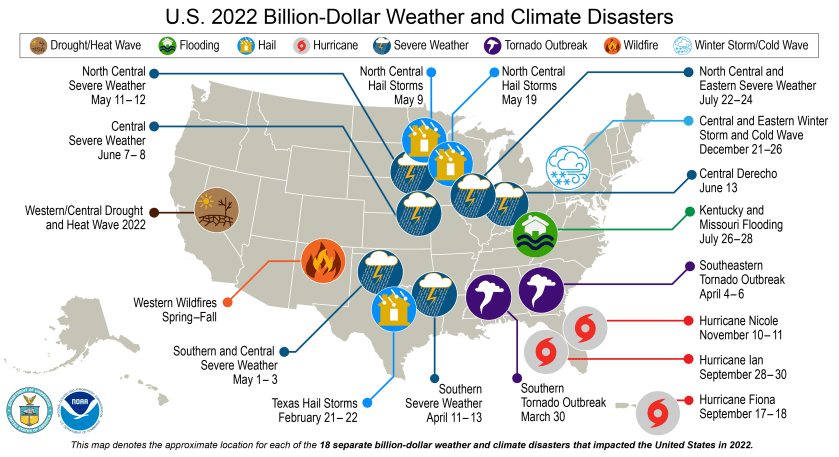
While the jury is still out on the helpful nature of the industry’s recent wave of institutional investors, ARVC members’ recent track record of helpfulness is not reassuring. As I reported in a November post, mere weeks after dozens of Florida campgrounds were devastated—some terminally—by Hurricane Ian, the ARVC Foundation had dispensed slightly more than $20,000 in disaster relief for all of 2022. And Hurricane Ian was far from the only weather disaster to ravage the U.S. last year, as witness the following graphic (a larger version can be seen here):

Indeed, it’s ironic that ARVC jumped on the assistance bandwagon just one day after the National Oceanic and Atmospheric Administration (NOAA) released that map as part of a larger report on 18 U.S. weather disasters in 2022, each causing at least $1 billion in damage. That’s the third costliest such tally on record, trailing only 2017 and 2005, both those years also marked by severe hurricanes. Ian led the charge this time, with a $112.9 billion price tag contributing the lion’s share of a tentative $165 billion in total damages—tentative because the final total is still awaiting cost estimates from a year-end winter storm that could add as much as $5 billion. Oh, and lest we forget: those 18 supercharged weather events also caused 474 deaths. The price tag for those is incalculable.

Now we’re off to the races again, jump-starting the casualty and damage steeplechase with torrential downpours that are predicted to start tapering off over the next week or so. The destruction no doubt will exceed NOAA’s billion-dollar threshold for inclusion in the 2023 map, continuing a pattern that since 2016 accounts for more than $1 trillion in damage and more than 5,000 deaths. While the campground industry obviously is no more than a footnote on that balance sheet, it’s just as obvious that $20,000 in damage relief doesn’t begin to address the need. Yes, every bit helps for those lucky enough to get a donation. But let’s also acknowledge that such help ultimately is as futile as bailing out a lake with a tin cup, amounting to little more than feel-good virtue signaling.

What’s to be done? For starters, ARVC and the rest of the industry must step out of their glamping bubble, look around at the natural landscape, and recognize that the natural order of things really is undergoing a fundamental change. You can’t deal with a problem without first acknowledging that it exists. The blissfully mild and predictable weather patterns of 40 and 50 years ago are growing steadily more anarchic, and more recently have become downright nihilistic—not everywhere, and not all the time, but often enough to demand attention. Unfortunately, that means talking about a phenomenon that most campground owners resolutely deny is even a thing, much less something that requires a response from them.

Meanwhile, although ARVC might be expected to provide leadership on the matter, this is an organization that operates with a transactional business model: the things that get talked about must either a) strengthen the executive suite; or b) enable someone to sell something, be it a product or a service. EV charging stations currently are a hot topic not because of ARVC’s commitment to a carbon-free future, but because RV manufacturers are developing electric RVs that they won’t be able to sell if their customers won’t have any place to plug them in. Nothing wrong with that, any more than there was anything wrong with promoting on-line reservation systems or enhanced campground wi-fi capabilities—just don’t confuse all that with a policy-driven agenda.

So until either someone figures out a way to make money off natural disasters or ARVC has a come-to-Jesus moment about climate change, the tin cup response will be the default position—again and again. “Groundhog Day” comes to mind. So does that quotation attributed to Einstein about the definition of insanity.

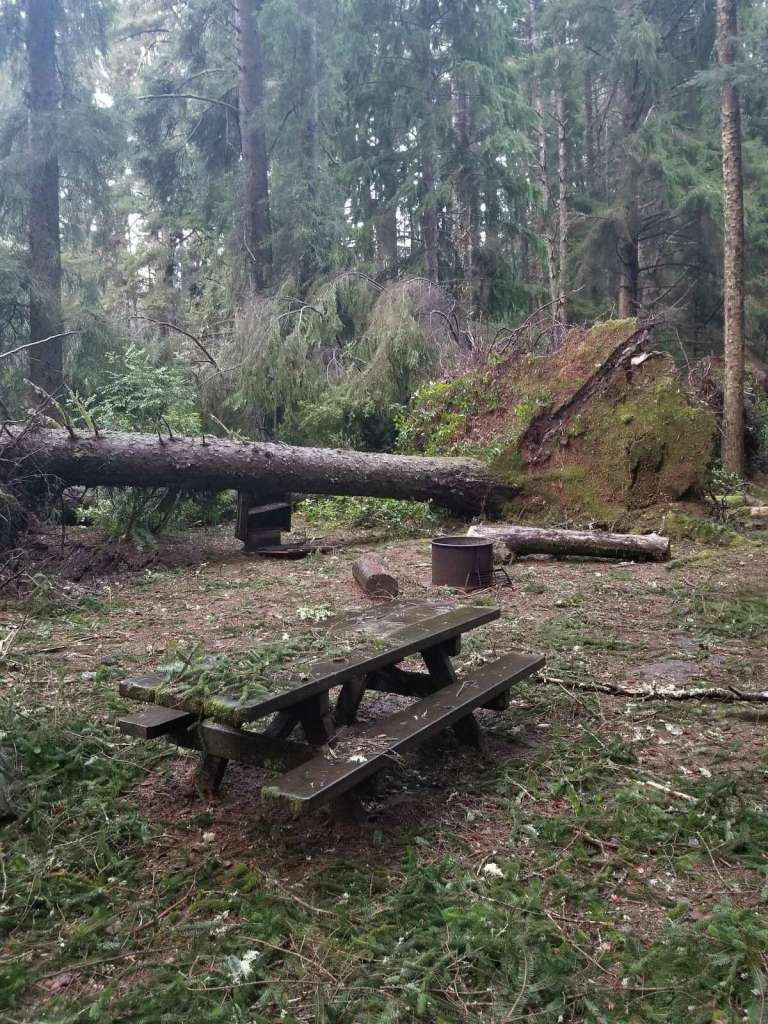
Even redwood trees like this one, at Sue-meg State Park in Humboldt County, CA, are succumbing to the relentless wind and rain buffeting the Pacific Coast. Be glad you weren’t camping here.

Most recent posts

Part III: RV parks and campgrounds are NOT part of a ‘hospitality industry’

The first two installments of this series examined how the National Association of RV Parks and Campgrounds (ARVC) fails to live up to its promise of being either “national” or an “association.” That was a relatively straightforward case to make. The more abstract yet more fundamental argument, however, is to demonstrate how ARVC’s leadership has been so seduced by the idea of being part of the “hospitality industry” that it has lost its way—and in doing so has lost sight of the many existential threats now confronting its core constituency. Which, if anyone needs reminding, is RV parks and campgrounds.

The “hospitality industry” identity, which ARVC claims overtly in its “vision” and “mission” statements and which it embraces in practice, is a seductive one. It sounds high-toned and professional, even scientific, as though there were a single overarching set of principles that could be applied to all those many ways of hosting people away from home: hotels, motels, campgrounds, bed-and-breakfasts, inns, RV parks, ski lodges, marinas, resorts, glampgrounds, and so on. And, indeed, there are commonalities—including some common problems, the most obvious being the extraordinary shortage of workers willing to be hospitable. But the differences are far greater than the similarities, and overlooking them in order to lump all those disparate businesses together makes as little sense as combining trees and horses in one category because they both have limbs.

Three years after the pandemic decimated the labor force, for example, the hospitality industry still has nearly a million fewer employees than it had in early 2020. But that burden is not distributed evenly. Hotel and motel employment has rebounded almost to full strength, while campgrounds and RV parks are still struggling to flesh out their payrolls, and especially among seasonal operations. One inevitable result: campers increasingly are pushed toward making reservations online (some campgrounds, if they answer the phone at all, now charge an extra fee for the “service” of accepting your money), are encouraged to check-in remotely and may never interact with a campground employee before checking out. That might be a preferred way of doing business for some, but it makes a mockery of any pretense at campground “hospitality,” just as the “hospitality” of an automat is nothing like that of a full-service restaurant.

But that’s only part of the problem. RV parks and campgrounds are significantly more labor intensive than their bricks-and-sticks counterparts even in the best of times, with campground owners having to deal with grounds-keeping, sewage disposal, and water and electric utilities on a scale that would make hotel managers blanch. But these are not the best of times. An increasingly unstable climate has added to this burden, with more frequent and destructive weather creating disproportionate damage to open-air facilities through flooding, wildfires, ice storms or wind damage. Their labor forces depleted, campgrounds and RV parks are accumulating a significant backlog of deferred maintenance projects, while routine housekeeping is increasingly sparse—and the claim to “hospitality” becomes even more illusory.

It therefore may seem paradoxical that campgrounds and RV parks have become sought-after acquisition targets for various investment groups, which over the past couple of years have been snatching them up at a fantastic rate, for reasons I’ve discussed elsewhere. But while that may be an attractive development for campground owners wanting to get out of the business, it also creates enormous stresses and strains for the survivors—in the same way that gentrification puts the squeeze on long-term residents of a neighborhood—as site rates get pushed to unprecedented heights and campgrounds increasingly remake themselves as amusement parks.

This trend also means that an industry that once was largely diversified across thousands of small one-off operators, typically small family holdings, increasingly is dominated by companies that own dozens of properties. Being big has a remarkable effect on one’s perspective: problems that can fill a small operator’s horizon may be negligible from an absentee investor’s broader overview, with its deeper pockets, backfield of talent and abundant outside resources. But guess who’s more likely to get the ear of industry leaders?

Taken together, those three dynamics—an insufficient workforce, a more hostile natural environment and a gentrifying business model—are fundamentally transforming the campground industry right under ARVC’s nose, yet without a flicker of recognition of what that means for association members. To take just one set of examples: how should campgrounds respond to the growing recognition of wildlife-urban interface problems? What best practices can they adopt to mitigate threats of wildfire or flooding? How many campgrounds may soon find themselves unable to to obtain property insurance in environmentally threatened areas, and how should ARVC respond to that need? What are the possibilities of the industry as a whole becoming self-insuring? Alternatively, what can the industry do to promote non-private insurers of last resort?

Similar kinds of questions can be asked about a depleted workforce and gentrification, but not by an organization that doesn’t recognize them as issues in the first place. And if that organization has isolated itself from its membership base, and if it identifies itself as being a segment of a more refined “hospitality industry” than as representing a bunch of hard-scrabble dirt renters for whom this is their entire fortune, it’s every man for himself and the devil take the hindmost. The most critical questions won’t be asked until ARVC remembers why it was created in the first place: to serve the needs of privately owned RV parks and campgrounds, just like its name says.

Everything else is a distraction.

Most recent posts

Part II: ARVC’s name is misleading, because it’s hardly an ‘association’

There are lots of nouns a group of people can adopt when creating an entity of common interests. “Grange” has a certain folksy appeal, despite its admittedly short-lived history as a farmers’ group to advance agricultural methods and to promote its members’ social and economic needs. “Society” is another possibility, as is “alliance,” as are “union,” “brotherhood” and “confederation.” But when a group of campground owners got together in 1967 to form a national group that would meet their needs, the noun they chose was “association.”

That’s “association” as in the National Campground Owners Association, decades later changed to the National Association of RV Parks and Campgrounds (ARVC). “Association” as in “a group of people or organizations who work together for a particular purpose.” “Association” as a collective noun whose commonly understood synonyms include partnership, companionship, fellowship—words, alas, that hardly describe ARVC as it is today.

This is an organization, after all, whose current stated “vision” is a mystifying five words—“an empowered outdoor hospitality industry”—and whose “mission” is couched in soulless corporate-speak: “We empower outdoor hospitality businesses by providing industry-tailored resources, organic connections, consumer exposure, professional development, and proactive legislative action.”  That’s a long way from the association’s founding principle, which was “for the purpose of promoting camping through the private sector and protecting the camping industry from unfair legislation and unfair competition.”

Just as ARVC has replaced the earthiness of “camping” with corporate jargon about “outdoor hospitality,” so too has it jettisoned the fraternal trappings of an association in favor of a service organization’s efficiencies. Members are asked for little more than their annual dues, in exchange for which they get a strongly hyped menu of vendor discounts, various educational opportunities and a steadily more expensive annual convention. True, ARVC has a notably energetic legislative watchdog and lobbyist in the person of Jeff Sims, whose efforts readily fulfill at least that part of the original mandate. But efforts to promote “association”? To harness the energies of people to “work together for a particular purpose”? Not so much.

Instead, under the 12-year leadership of chief executive Paul Bambei, ARVC has become increasingly transactional and more distant from its individual members. Nominees for the board of directors, for example, must have received a certificate from—or be actively enrolled in—the organization’s Outdoor Hospitality Education Program, regardless of how much campground operating experience they already have. While the full program leads to certification as an Outdoor Hospitality Professional, it’s questionable how “professional” one can become after just eight days of face-to-face instruction. What’s unquestionable is that the $3,790 tuition cost, plus the expense of hotel, travel and time lost from work, can be a steep deterrent to potential ARVC leaders and a surprising hurdle for an association to place before any civic-minded members.

Once elected to the board, however, ARVC directors conduct their duties in a bubble. Although their names and pictures can be found on the ARVC website, no contact information is provided for any of their constituents who might want to reach them. The membership is not notified of upcoming board meetings before which it might to tempted to bring up matters of interest, and the minutes of board meetings are not published for membership review. Meanwhile, the flow of membership publications has been steadily choked off, its last magazine being quietly dispatched last year without so much as a farewell notice. As a result, ARVC members have little to no idea of their organization’s internal workings, and ARVC’s leaders hear extraordinarily little of their members’ concerns. Small wonder, then, that membership ranks have been eroding.

Thus insulated from their supposed following, ARVC’s “professional” leaders are free to develop solutions for non-existent problems while remaining oblivious to actual industry threats. Among the current distractions, for example, is a renewed push—more than a decade after it was first rebuffed—to create an industry-wide set of “standards.” Regardless of whether this is a good idea or not, the lack of prior membership involvement and education—and how could that have happened, given the leadership’s near-total isolation?—has resulted in a massive backlash and still more alienation between the leaders and the led.

Just how poorly those leaders appreciate the chasm that lies before them was suggested by a letter one of the board’s past presidents wrote a few weeks ago to the various state affiliates, seeking to explain why the standards had been proposed. None of his reasons indicated that the proposal was a response to membership demands. Instead, his chief rationale seemed to be that because the “hospitality industry has emerged as a leading travel and vacation style in recent years,” “regulators” are paying more attention. And since the regulators “don’t know our industry, wouldn’t it be better if the industry itself provided the definition rather than ceding that inevitable chore to others?”

Although no evidence is presented that this is in fact a problem (what “regulators”? making what “attempts to define us”?) the argument has a certain logic—until, that is, one realizes it turns the whole association dynamic on its head. Instead of an association of campground owners “protecting the camping industry from unfair legislation,” as was originally conceived, an increasingly “professional” ARVC has reached the point at which it will attempt to institute its own regulations, its own legislation. That’s a whole lot easier than pushing back against ignorant meddling by outsiders.

And, not incidentally, it also cements the transformation of a society of equals into a corporate-style command structure. There’s the top of the pyramid, which controls all internal communication and sets the agenda for everyone else; and there’s everyone else—until they aren’t. Until they bail, out of resentment or disgust or simply because their real needs aren’t being met.

Next post: Part III of why the National Association of RV Parks and Campgrounds should reconsider its name. Perhaps it should rebrand as the National Association of the Outdoor Hospitality Industry?

Most recent posts

Part I: ARVC’s misleading name, to whit, it’s not really a ‘national’ org

There’s only one national organization that non-franchised campground owners can turn to when they need help with their business, and that’s the National Association of RV Parks and Campgrounds (ARVC). It’s unfortunate, therefore, that ARVC is “national” more in name than fact, and is scarcely an “association” in any meaningful sense of the word.

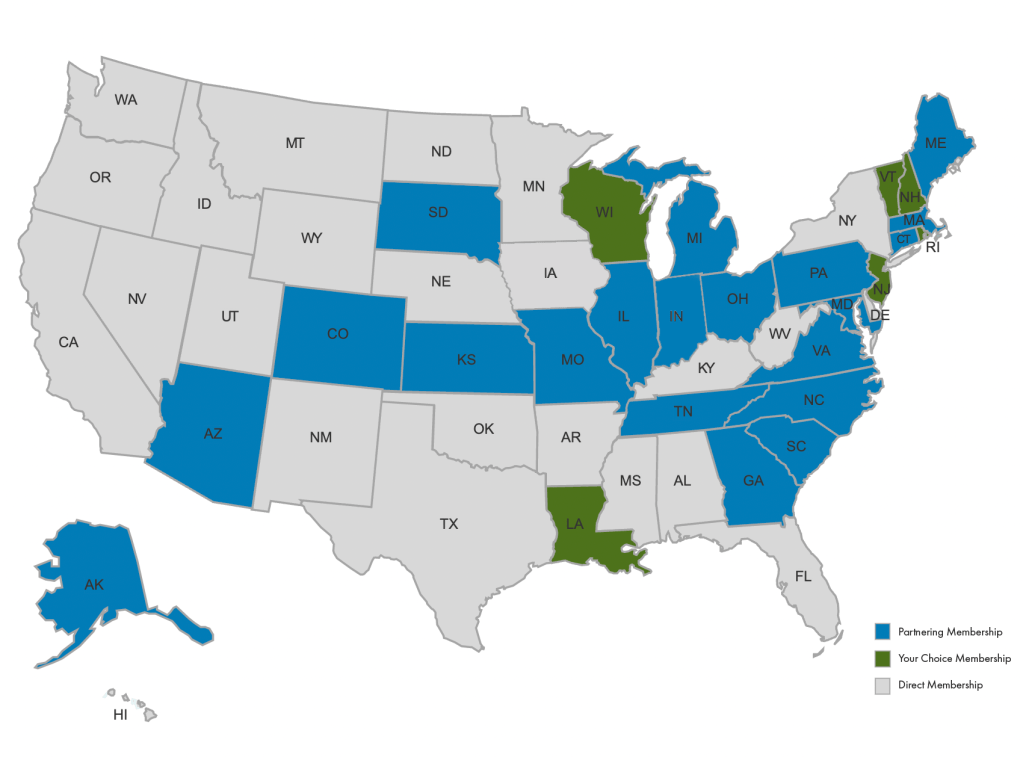
For a better understanding of that first point, take a look at the map above. The blue states are ones that have state associations affiliated with ARVC: if you own a campground in one of those states, you can’t belong to ARVC unless you first belong to that state’s ARVC affiliate. Indeed, so entwined are these relationships that the blue states are charged with collecting dues on behalf of the national association as well as themselves—there is no option for paying dues directly to ARVC. Want to benefit from national membership but don’t see any value in belonging to the state organization? Too bad. This is an all or nothing proposition, not dissimilar from other bundled “services” we’ve grown to resent.

Own a campground in one of the six green states? You’re comparatively lucky there, because in those states you can belong to either ARVC or the state ARVC-affiliate—or both. Your choice, courtesy not of ARVC but of those state affiliates, which apparently feel confident enough in their offerings to believe they can attract members without having to ride ARVC’s coattails.

Then there are the grey states, of which there are 24, or roughly half the total but more than half by any other measure, such as land area or population. Those are the 24 states that don’t have an ARVC affiliate in the first place, so prior state association membership isn’t a consideration—for ARVC. Take a closer look, however, and you might realize that the country’s four most populous states—California, Texas, Florida and New York, accounting for fully a third of the U.S. total—are all grey, and while they don’t have ARVC-affiliated associations, they most definitely have their own campground membership organizations. They are, in other words, competitors.

How many campground owners in those states do you think might belong to both ARVC and to their own, unaffiliated state associations? To both ARVC and TACO (Texas Association of Campground Owners), or to ARVC and CONY (Campground Owners of New York)? Some, to be sure, but far fewer than would be the case if those independent associations weren’t around. Indeed, as illustrated by the California Outdoor Hospitality Association, former ARVC state affiliates have a distressing tendency to jump the ARVC ship when it seems financially feasible to do so: COHA did so in 2019, and hasn’t looked back since. Other non-ARVC associations, meanwhile, are reaching across state lines to create larger industry groupings, as Florida has with Alabama.

The result is an anemic “national” organization from which its potentially strongest affiliates have seceded altogether, while its main membership base is sustained by a mutually dependent relationship with state affiliates that might not otherwise stand alone—not unlike two drunks leaning against each other for support. That mixed allegiance led Greg Gerber, the now-retired editor of a daily RV industry watchdog publication, to observe that ARVC has a muddled public mission. “Does it represent campgrounds, or is it an association of state associations that represent campgrounds?” he wondered in 2016, in his seminal report, “RV Industry Death Spiral.”

Good question, and one that ARVC has never answered, even as it continues to trumpet its standing as “the only national association dedicated to representing the interests and needs of private RV parks and campgrounds in the U.S. and Canada.” Which is true as far as it goes, but that seems to be progressively less each passing year: even as its overall income increased by 50% over the five years since Gerber wrote his report, overall membership has declined and now sits below 3,000 campgrounds—or less than a quarter of the industry overall.

Next post: Part II of why the National Association of RV Parks and Campgrounds should rethink what it calls itself, in this case focusing on what it means to be an “association.”

Most recent posts